
How I'd Learn Automation From Scratch in 2026: Workflows First, AI Later
A practical roadmap for learning automation the right way, starting with predictable workflows and the fundamentals of data, then layering in AI only once the foundation is solid.

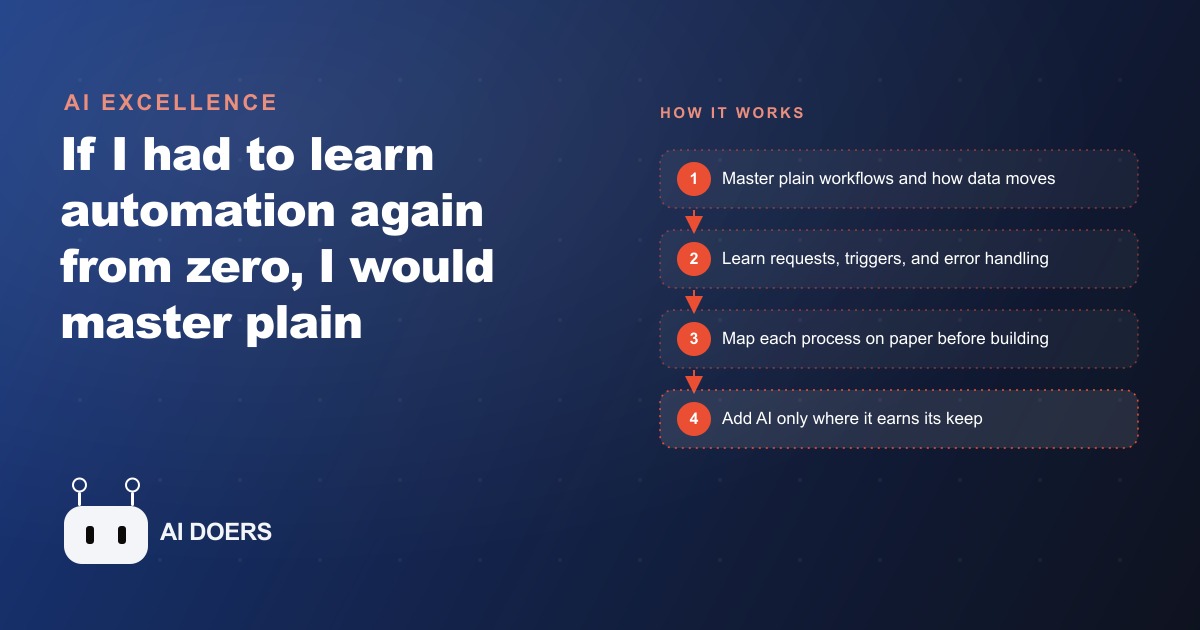
The most useful automation advice in 2026 sounds boring
I am Madhuranjan Kumar, and I want to start with the advice that no one leading with a demo reel wants to give you: the most valuable automation skill you can build in 2026 is not building AI agents. It is understanding how data moves through a plain, rule-based workflow. That sounds like a step backward from the conversation happening around agentic AI, and I think that is exactly why it keeps being skipped, and exactly why the people who skip it spend months watching their agents break in ways they cannot diagnose.
The news driving this article is a shift in how the automation teaching community is approaching the learning sequence for tools like n8n. The dominant advice until recently was to start with whatever is most exciting, which in practice meant AI agents, because they demo well and they feel like the destination. That advice is now being revised publicly by experienced practitioners who have watched the same failure mode play out repeatedly: beginners build agents on top of shaky pipes, the agents behave unpredictably, the beginners blame the AI, and the actual problem, which is that the underlying workflow was unreliable from the start, goes unfound.
The revised advice is explicit: workflows first, AI later. Not as a moral position about taking the long way. As a practical observation that the sequence matters because everything you build in AI automation depends on the data infrastructure underneath it. An agent is only as reliable as the workflow feeding it. A shaky workflow produces a shaky agent, and shaky agents are far harder to debug than shaky workflows.
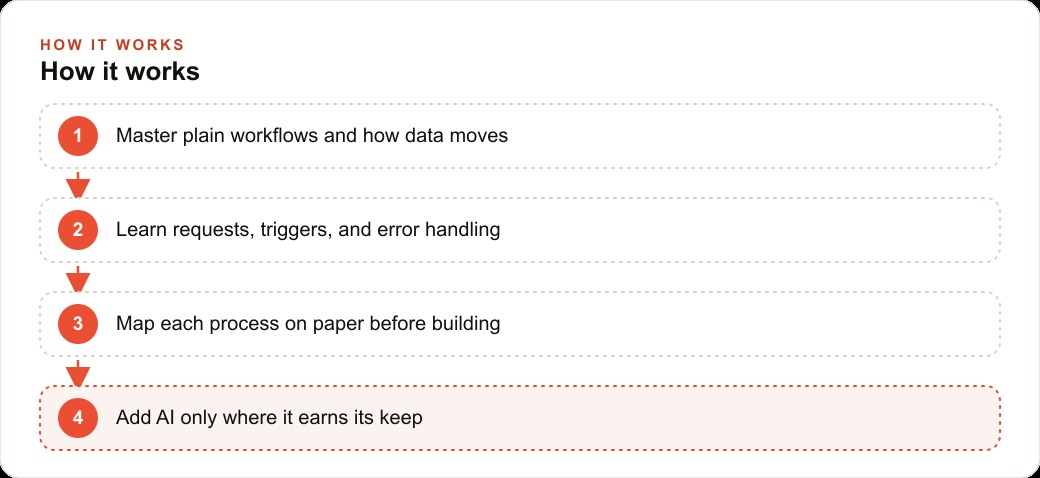
Here is what the three-layer model gets right about AI agents
The experience-based practitioners now recommending this sequence describe automation in three layers, and the model is worth understanding explicitly because it explains why the sequence is not arbitrary.
The first layer is plain workflows: predictable, rule-based automation where given the same inputs you get the same outputs every time. A form submission triggers an email. A new row in a spreadsheet sends a notification. A calendar event creates a task in a project tool. These workflows are boring in the best sense. They run the same way every single time. When they break, the failure is almost always traceable to a specific node in the sequence: the trigger did not fire, the field was empty, the API returned an error. Debugging a broken plain workflow is a process of elimination through a visible chain of events.
The second layer adds AI assistance to that plain backbone. The workflow still triggers reliably, the data still flows through structured pipes, but at one or more points in the chain an AI component makes a judgment call. It classifies an incoming inquiry as urgent or routine. It personalizes a follow-up email with the customer's specific context. It extracts a relevant field from a free-text form submission. The AI layer sits on top of reliable infrastructure. If the classification is wrong, you know exactly where the wrong classification came from and can adjust the prompt. If the personalization is off, you know what data was fed into it and can correct the source.
The third layer is full agents: AI that makes decisions, uses tools, maintains memory, and takes autonomous actions across multiple steps. This is the layer everyone wants to start at, and it is the layer that fails least gracefully when the infrastructure under it is unreliable. A full agent operating on bad data produces actions that are wrong in complex, difficult-to-trace ways. Finding the root cause of an agent failure requires understanding every layer it depends on. An agent that breaks because a data field upstream is occasionally empty is much harder to debug than a plain workflow that breaks for the same reason, because the plain workflow fails at a visible node and the agent fails at an opaque downstream action that might not surface until a customer complains.
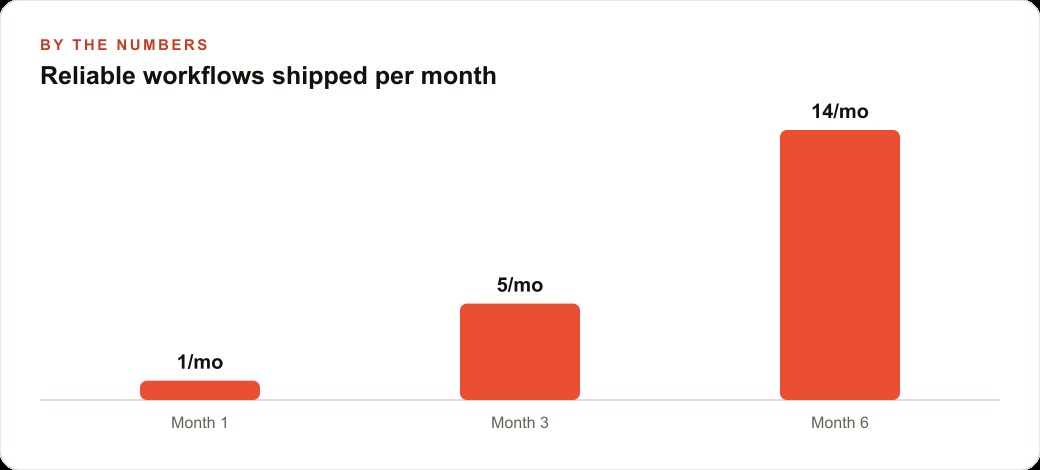
Plain workflows are already delivering strong returns before AI enters the picture
One of the most important market realities worth naming explicitly is that plain workflows, the boring first layer, deliver genuinely significant returns all by themselves. The commonly cited estimate is that a large share of everyday business activities can be automated without any AI component at all. Appointment confirmations, review requests, follow-up sequences, file routing, lead notifications, invoice reminders: all of these can be handled by simple rule-based triggers that run the same way every time and require no AI judgment.
For the majority of small businesses, the most valuable automation projects available to them right now are not the ones involving AI. They are the ones involving consistent execution of the tasks that are always intended but often forgotten. The appointment reminder that was supposed to go out the night before but did not because the coordinator was pulled into something else. The follow-up email that was supposed to go three days after a completed job but sat in a draft folder. The review request that should have gone to every satisfied customer but only went to the ones the owner remembered to email manually. Each of those is a plain workflow, and each of them produces measurable improvement in customer retention, review volume, and repeat bookings without any AI involved.
This matters as a starting point because it means the first automation project for almost any small business is achievable quickly and produces a clear return. That early success builds the understanding of how data flows through a system, which is the exact skill needed to build more complex automation later. The practitioner who has shipped a working appointment reminder workflow understands triggers, data mapping, error handling, and external API calls at a practical level. That understanding transfers directly to the second and third layers. The one who jumped to building an AI agent without that foundation has no reference model for what reliable automation looks like, which makes evaluating whether the agent is actually reliable very difficult.
The business consequence of skipping the foundation and rushing to agents
The failure mode that experienced practitioners are now documenting publicly is specific and consistent enough to be worth naming. A beginner builds an AI agent that handles a business task. The agent works on most inputs but fails silently on edge cases, occasionally taking wrong actions that go unnoticed until they produce a customer complaint or a data inconsistency. The beginner assumes the problem is the AI model and tries different prompts or different models. The real problem is a structural one: the data flowing into the agent is sometimes malformed, the trigger fires incorrectly in certain conditions, or an error in one node is silently swallowed rather than surfaced.
Because the beginner does not have a working model of how the underlying workflow functions, debugging is difficult. They know what the agent is supposed to do and can see what it is doing wrong, but they cannot trace the wrong behavior to a root cause in the infrastructure because they have never built and debugged that infrastructure separately. The agent's behavior is the only thing visible to them, and the agent's behavior is opaque: a black box that sometimes works and sometimes does not, with no clear indication of why.
The cost of this failure mode is not just the broken automation. It is the broken trust in the whole category. The beginner concludes that AI automation is unreliable and moves back to manual processes, having invested weeks in a project that did not produce a stable result. The lesson they take from the experience is about AI rather than about workflow architecture, which means the same mistake waits for them on the next project.
The sequence correction, workflows first, is the circuit breaker for this pattern. A beginner who spends the first month building and debugging plain workflows develops a mental model of what correct data flow looks like and what failure looks like at each layer. When they add AI to a working workflow in month two, they can isolate AI-specific problems because everything else is already known to work. When an agent breaks in month three, they can tell the difference between a prompt problem and an infrastructure problem because they have seen both in isolation.
What the data-and-requests foundation enables that clever prompting cannot
The deepest insight from the experienced practitioner community moving to this sequence is that clever prompting cannot substitute for solid data infrastructure. This is a counterintuitive claim in a world where prompt engineering gets most of the attention, so it is worth being specific about what it means.
A model can only reason about what it is given. If the data flowing into an AI node is inconsistently structured, sometimes a field is present and sometimes it is missing, the model cannot reason correctly about that field regardless of how cleverly the prompt is written. The prompt can include instructions for handling the missing case, which helps, but the solution to a data consistency problem is a data consistency fix, not a prompt instruction. Adding more instructions to handle more edge cases produces an increasingly brittle prompt that fails on the edge cases not anticipated. Fixing the data source so the field is always present or always absent produces a reliable workflow that the model can reason about consistently.
This is why understanding how data moves, specifically knowing what structured data looks like, what keys and values mean, what an empty or null field looks like and why it happens, is the foundational skill that makes every subsequent layer more reliable. A practitioner who understands data flow can see a prompt failure and quickly determine whether the fix is in the prompt or upstream. One who does not has to try everything, which is slow and often produces a fragile result even when it works.
The same applies to understanding how requests work: what an HTTP request is, what different response codes mean, what happens when an external API rate-limits your workflow or returns an error format you did not expect. Every automation tool eventually makes API calls to external services. Every external service eventually returns something unexpected. The practitioner who understands what is happening at the request level can write error handling that deals with the unexpected response cleanly. The one who does not has a workflow that breaks silently on the API's bad day and produces no clear indication of what went wrong.
The practical path this community is now recommending is to invest the first month in building three or four working plain workflows on real business tasks, completing them to the point of reliable operation including error handling, and only then adding AI components to one of them. That sequence builds the foundation before the structure. And the structure, the AI layer that everyone came to build, is far more reliable when the foundation is solid.
That is exactly what we do at AI DOERS. Book a private 30-minute call with Madhuranjan Kumar and we will map the fastest path to it for your specific business.
Book your call →
Madhuranjan Kumar
Madhuranjan Kumar brings 20 years of performance-marketing experience and has managed over $200 million in Facebook ad spend for brands across the United States and beyond. His expertise spans the full modern marketing stack: Meta, Google Ads, TikTok, email automation, CRM, and the websites that hold it together. At AI DOERS he turns that track record into lead-generation systems for businesses across every industry.