
How I Built a Voice to Content App With AI Coding Tools
A voice first app captures spoken ideas and saved web clips, then turns them into polished, link rich content in minutes instead of hours.

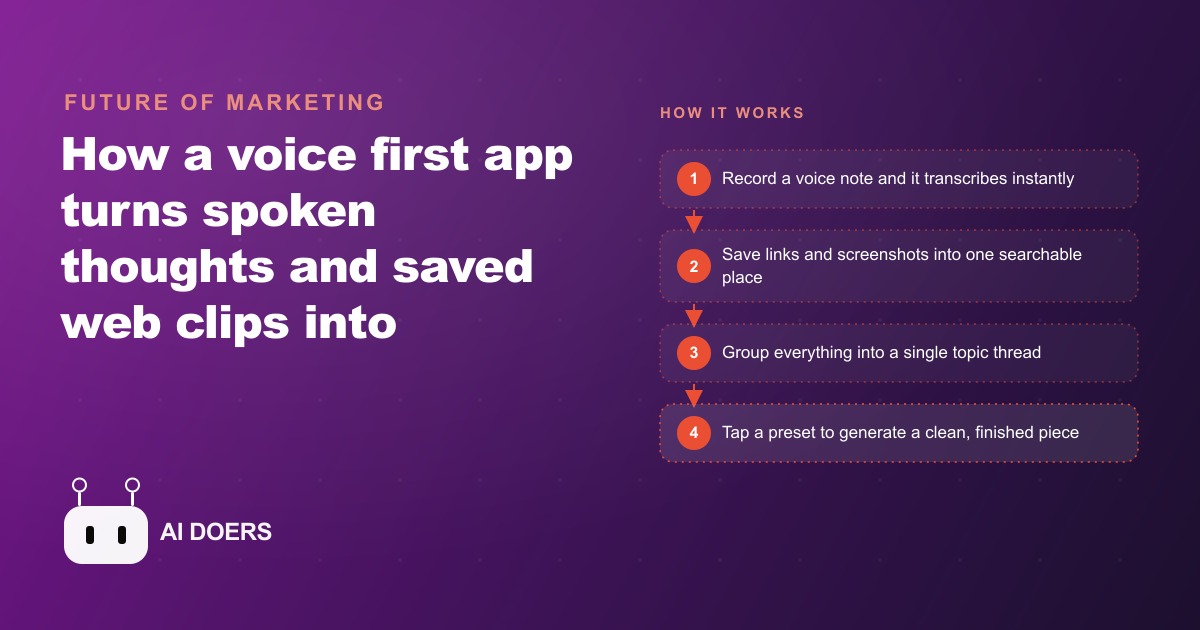
Content creation tools have been solving the wrong problem for years. Most of them make writing faster, which sounds right until you notice that writing was never the hard part. I am Madhuranjan Kumar, and I want to make an argument that the consistent-content problem most businesses face is a workflow problem, not a writing problem, and that fixing the workflow changes everything.
The blank page was never the real obstacle
The standard pitch for AI writing tools is that they beat the blank page. The blank page problem is real, but it is downstream of a more fundamental bottleneck. Most business owners who struggle to publish consistently are not stuck because they cannot write. They are stuck because there is no system connecting the ideas they have throughout the day to the polished content that needs to go out by Friday.
Consider what actually happens with most business content. An owner has a sharp insight while driving between appointments. They tell themselves they will write it up later. Later does not come, or it comes at nine in the evening when they are tired and the insight has lost its edge. A customer says something in a meeting that would make a perfect testimonial hook. The owner thinks about it for a moment and it evaporates. A competitor posts something that triggers a useful counter-perspective. The owner screenshots it, which means it is now buried in their camera roll. By the time the content calendar demands output, the material from the week is gone.
The tool that fixes this fixes the capture problem first, before it fixes the writing problem. A voice-first app that records a spoken thought and transcribes it immediately, organizes notes into threads by topic, and lets you clip web sources into the same place is addressing what actually kills consistent publishing, not the quality of the prose once you sit down to write it.
Speaking is faster than typing for nearly everyone, and always was
The average person speaks at roughly 130 words per minute and types at roughly 40. That gap has always existed, but until voice-to-text accuracy became reliable, closing it required expensive transcription services or accepting an unusable first transcript. Both paths made the speed advantage theoretical rather than practical.
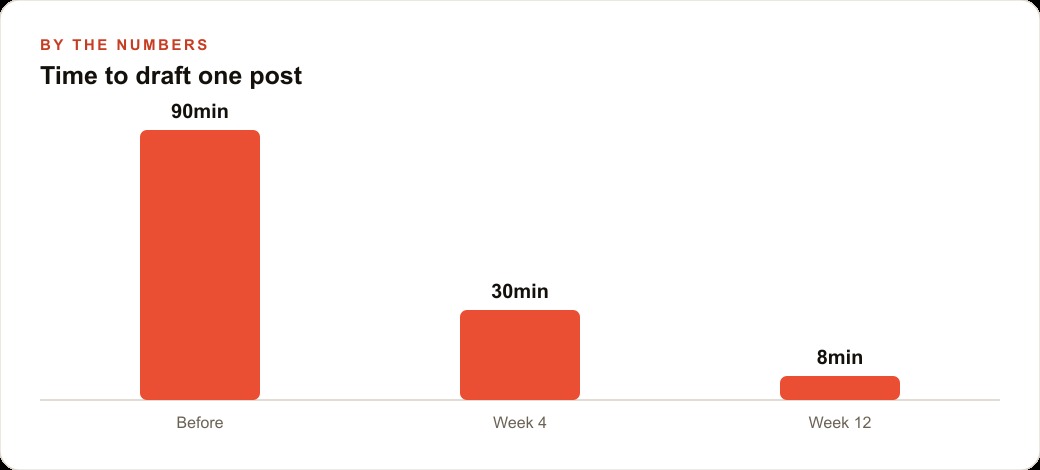
A voice-first content app collapses the gap and makes it operational. You speak a thought, it transcribes immediately, and it asks a follow-up question to draw out more context. Tapping that question lets you answer by voice again, so one thought pulls the next one out of you without you having to force continuity. The result is a thread of material generated in roughly three to four minutes of actual talking that would have taken fifteen to twenty minutes of careful typing to produce.
For any business owner trying to publish content consistently across multiple channels while also running the business, that compression is the difference between a sustainable habit and an aspirational one. Consistency is the actual asset in content marketing. A business that publishes something genuine twice a week for a year will outperform one that publishes something polished four times a year, because the consistent one is building trust and search presence simultaneously. Consistent SEO and organic search rankings are built on steady publishing cadence, and speaking rather than typing is the most underused way to make that cadence achievable.
One app connecting four steps removes the seams where content dies
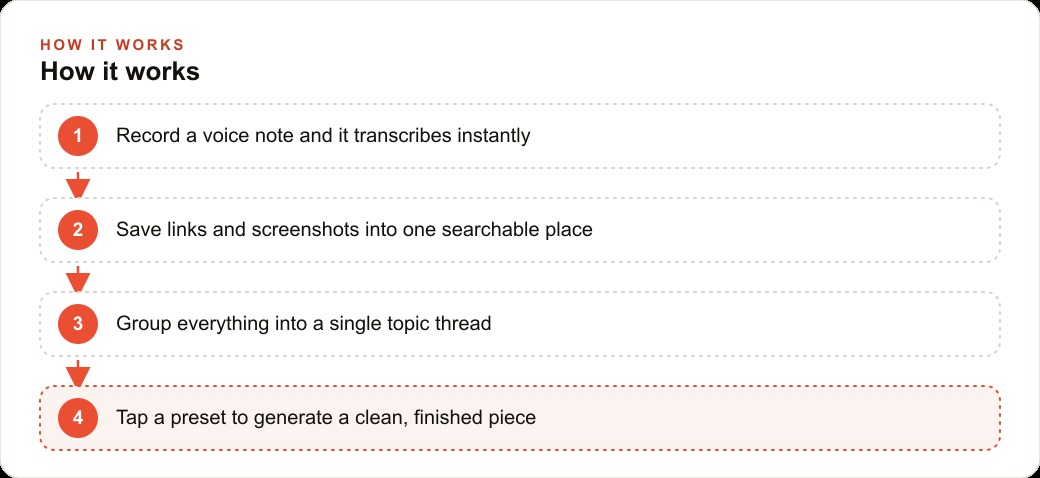
The traditional content workflow forces you across multiple apps and the handoffs between them are where content dies. You capture an idea in a notes app, clip a web source in a bookmarking app, write a draft in a document editor, schedule it in a social tool, and somewhere in the middle you lose the link you wanted to cite or forget which draft was the final version. Four tools means four contexts to maintain and four places where the material can get stuck.
A voice-first app that connects all four steps, capture, source collection, organization, and conversion, removes the seams. The voice note you recorded on Monday morning is already in the same thread as the web article you clipped on Wednesday, both sitting ready when you decide to write the Friday newsletter. You pick a preset, the app generates the piece with every source link intact and clickable, and you request one rewrite to tighten the language and bold the key terms. Total time to a finished draft from raw material: under ten minutes.
The follow-up question feature is worth singling out. After each voice note, the app surfaces a question designed to pull more depth out of what you just said. Tapping it and answering by voice extends the thread naturally, the way a good interview does. You end up with more material than you thought you had, organized around the topic, and the preset converts it into whatever format you need. The output is research-quality and personal simultaneously, which is the combination that connects with an audience.
The businesses that need this most think they need a copywriter
There is a predictable misdiagnosis when business owners recognize they are not publishing consistently. They conclude that they need a copywriter, either a freelancer or an in-house person, whose job is to turn their ideas into content. The diagnosis is wrong. The knowledge is already in the business owner's head. A copywriter who does not have access to that knowledge produces generic content that sounds like it could have been written for any competitor. The owner ends up spending time briefing the copywriter, reviewing drafts, and correcting specifics the copywriter got wrong because they were not there.
A voice-first workflow lets the owner dump the knowledge directly, in their own voice, and the app handles the structural conversion. The content that comes out sounds like the owner because it is the owner's words, reorganized and tightened. That specificity and authenticity is exactly what makes Facebook and Instagram ad campaigns built around organic content more effective than campaigns built around copy that could have come from anywhere. The audience recognizes a real perspective, and recognition builds the kind of trust that turns a cold audience into one that responds when you promote something.
How this looks for a bakery owner over one week
Consider a small bakery where the owner is up at four in the morning and has no time to sit at a laptop writing captions. Through the week, the owner records short voice notes between batches. One morning, three sentences about why they switched to a local mill for the sourdough flour. Another day, a brief description of a custom wedding cake order and what made it challenging. When a customer leaves a strong review, they hit share and clip it into the app. When a seasonal ingredient trend appears in the food news, they clip that too.
By Friday, a thread full of voice notes and saved sources exists. The owner picks a newsletter preset, and the app generates a warm weekly email covering the new sourdough, the flour story, and the customer review, with every link working. A single rewrite instruction shortens the piece and bolds the product names. The same thread generates an Instagram caption and a short blog post with two different presets, each one in a slightly different format but pulling from the same material. Five minutes of talking throughout the week becomes a full distribution of content before the weekend.
Every source link survives the whole process. The customer review they clipped stays clickable in the finished email. The trend article they saved still points back to its source. The content reads researched and specific rather than thrown together, because the raw material was gathered by someone who actually knows the business and the craft. That specificity is precisely what builds an audience over time and makes SEO and organic search work, because specific, experience-based content earns both reader trust and search visibility in ways that generic AI output does not.
The practical setup and what actually makes it work
Make capture a daily reflex rather than a scheduled task. Whenever an idea, a customer comment, or a market observation crosses your path, save it immediately into one place rather than trusting your memory or your camera roll. Talk in honest bursts rather than scripted takes, because the transcription and follow-up questions are designed to draw more out of natural speech rather than prepared statements. Build two or three presets that match the formats your business actually publishes, one for email, one for short social posts, one for longer blog content, and do not overthink them. The preset is just the structural instruction the app uses to assemble the material you gave it.
The one habit that makes the whole system reliable is consistent capture. The app is only as good as what you feed it throughout the week. A rich thread of voice notes and saved sources produces a rich newsletter. An empty thread at the end of a week of not capturing produces nothing useful, no matter how good the preset is. The discipline is not writing. The discipline is noticing and recording. That is a fundamentally different and much lighter cognitive load than sitting down to write from scratch, which is why this approach actually sticks where traditional content commitments tend to fade.
The deeper point is that content publishing becomes sustainable when the hard part stops being the writing and starts being the noticing. The knowledge worth publishing already exists in every business owner's day. The voice-first workflow gives it a place to land and a fast path to usable output without requiring the time or skill that traditional content production demands.
That is exactly what we do at AI DOERS. Book a private 30-minute call with Madhuranjan Kumar and we will map the fastest path to it for your specific business.
Book your call →
Madhuranjan Kumar
Madhuranjan Kumar brings 20 years of performance-marketing experience and has managed over $200 million in Facebook ad spend for brands across the United States and beyond. His expertise spans the full modern marketing stack: Meta, Google Ads, TikTok, email automation, CRM, and the websites that hold it together. At AI DOERS he turns that track record into lead-generation systems for businesses across every industry.