
How Codex and Remotion Let You Make Motion Graphics by Typing
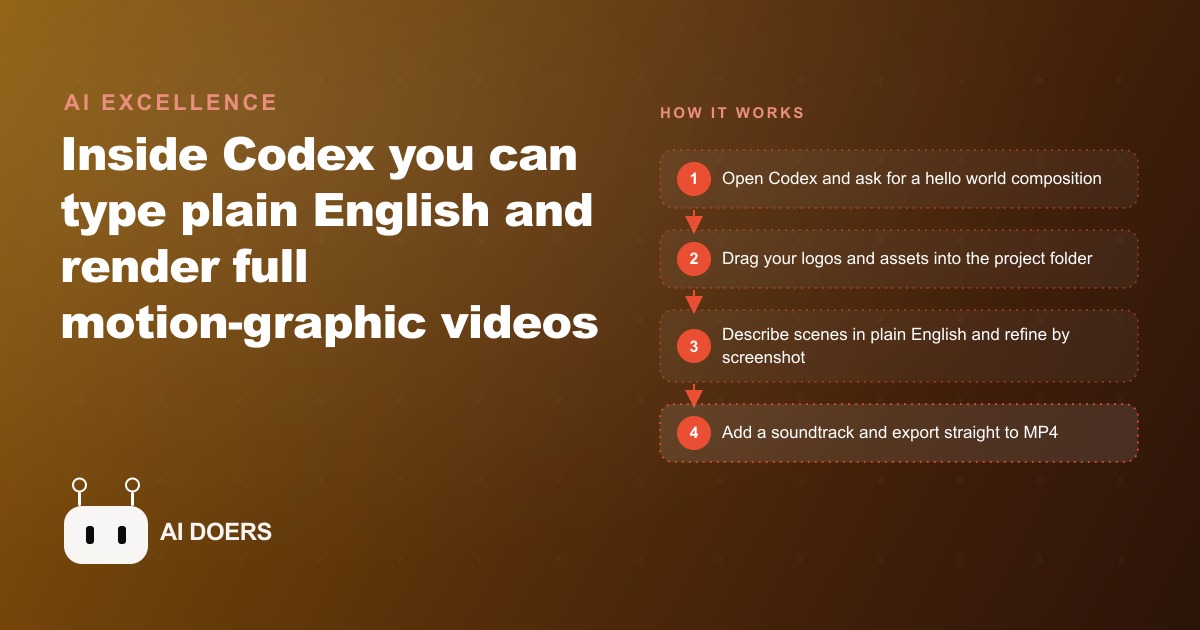
Inside Codex, the Remotion plugin lets you describe a video in plain English and GPT-5.4 writes the code that renders it, so you can ship a branded motion-graphic clip in a handful of prompts without ever opening After Effects.

A real estate brokerage in Toronto spent $1,800 per property on professional video tours before this year. I am Madhuranjan Kumar, and the system their marketing coordinator built using Codex and Remotion reduced that cost to the time it takes to type a description and review an output.
The problem with professional video production at listing volume
The economics of professional real estate video only work at low listing volume. One or two new properties per month at $1,800 each is a manageable marketing expense that most brokerages can absorb and justify with conversion data. Eight to twelve new listings per month is a $14,000 to $21,600 monthly line item for video production alone, before any other marketing costs.
The brokerages that list at high volume face a choice between producing video for every listing and accepting the cost, producing video selectively and accepting that some listings are under-marketed relative to others, or finding an alternative that produces acceptable quality at a cost the volume can sustain.
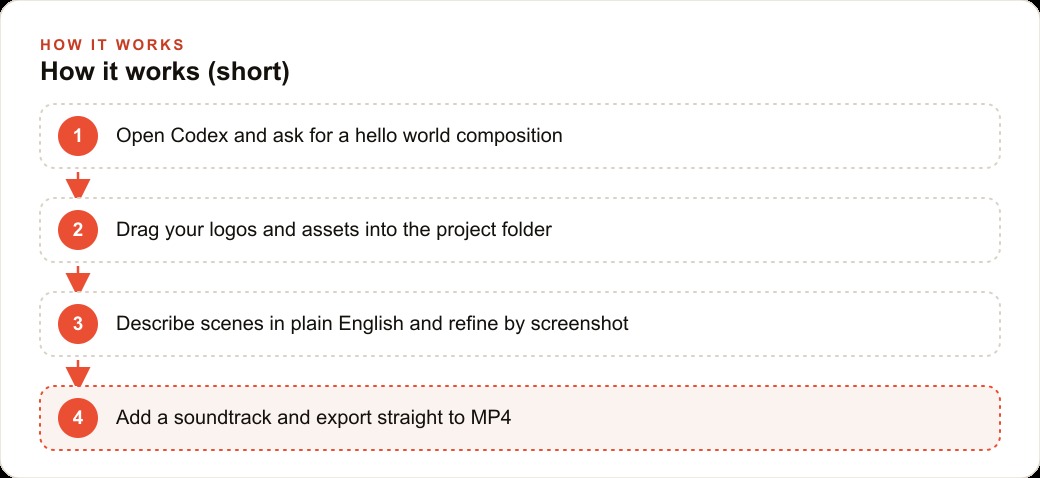
The alternative this brokerage built was a programmatic video pipeline. Each listing goes through a sequence: property description input, AI generation of scene scripts from the description, Remotion rendering of a video from the scripts, review and approval by the marketing coordinator, and upload. The output is not a professional tour with a videographer and camera movement. It is a composed video that communicates the property's key attributes through text, imagery, and narration in a format that works as a social ad and as a property page supplement.
The comparison is not professional video versus this output. The comparison is no video versus this output. At the volume the brokerage lists, professional video was not a realistic option for every property. The pipeline made video production realistic at full volume for the first time.
Codex as the first step in the pipeline
The Codex integration in this pipeline is not generating the final video. It is generating the intermediate asset: the scene specification that Remotion renders. This distinction matters for understanding what Codex is actually being asked to do and what quality of output to expect from it.
The input to Codex is the property listing description: square footage, number of bedrooms, key features, neighborhood, any specific attributes that differentiate the listing. The output from Codex is a structured scene specification: a sequence of scenes, each with a description of what should be displayed visually, the text overlay for that scene, and the narration script for that scene.
This is a well-defined transformation from text to structured text, which is a task that Codex handles reliably. The scene specifications it produces follow a consistent structure because the prompt that generates them includes clear examples of the desired output format. The marketing coordinator reviews the scene specification before the rendering step, which means any Codex output that mischaracterizes the property can be corrected before it becomes a video.
The review step is worth keeping even as the pipeline matures and the typical output quality improves. A video that misrepresents a property's features is worse than no video. The thirty seconds it takes to scan a scene specification before rendering is the cheapest quality control step in the pipeline.
How Remotion translates specifications into video
Remotion is a framework for building videos with React code. The brokerage's Remotion template is a set of React components that render scenes: title cards, feature callouts, neighborhood highlights, contact slides. Each component accepts the scene specification that Codex generated and renders it into a composed frame.
The template was built once and is reused for every listing. The components that handle property-specific content accept the data from the scene specification. The components that handle brand-consistent elements, the logo, the color palette, the typography, the animated transitions between scenes, are fixed in the template and do not change between listings.
This architecture means that each new listing requires a scene specification input and a render. The template development cost, which was the significant upfront investment, is amortized across every listing that runs through it. At twelve listings per month, the per-listing cost of the template falls rapidly. At a hundred listings, it is negligible.
The marketing coordinator who built the Codex integration and the Remotion template is not a professional video editor. She understood React well enough to set up Remotion and modify component parameters. She used Codex to generate the integration code that connected the listing description input to the Remotion render process. The skills she needed were: understanding what she wanted the pipeline to produce, the ability to describe it clearly to Codex, and the judgment to review the outputs and identify what needed to change.
The spec format that produces consistent output
The scene specification format the brokerage settled on after the first ten listings is worth describing because it reflects lessons learned from specification formats that produced inconsistent output.
The initial format was free-form: a text description of each scene's intended content. Codex produced specifications in this format, but the specifications varied in structure between runs. Some scenes had more detail than others. The narration length varied significantly between scenes, which caused some scenes to have narration that extended past the scene's display duration and others to have narration that ended with several seconds of silence.
The revised format is structured: each scene has a fixed set of fields including a headline (maximum eight words), three feature callouts (maximum five words each), a narration line (maximum twenty words, designed to read naturally in three to four seconds of speech), and an image context description that tells the template which type of visual to use.
This format produces consistent scene specifications because it constrains the output dimensions. The narration timing is reliable because the word count ceiling maps to a predictable read duration. The headline and callout constraints prevent scenes from being overloaded with text. Codex fills in the values for each field accurately when the format specifies the constraints clearly.
Moving from proof of concept to production pipeline
The first version of this pipeline produced one video for one listing in a half-day of setup and iteration. The production version, after two months of refinement, produces a video for a new listing in under twenty minutes of marketing coordinator time, most of which is the review step.
The refinements that moved it from proof of concept to production pipeline were not primarily technical. They were procedural. A checklist for what information needs to be in the listing description input before the Codex step starts, to prevent scene specifications that omit key property attributes because they were not in the input. A standard for what "approved to render" means during the scene specification review, to prevent specifications with timing problems from making it through. A file naming convention that connects the rendered video to the specific listing and version, to prevent the wrong video from being uploaded.
These procedural refinements are the work that AI coding tools do not do automatically. The pipeline that Codex and Remotion made possible still required a human to design the workflow around the tools and establish the practices that make it reliable at scale.
For a brokerage also running Meta advertising campaigns to promote listings, this breakdown output from this pipeline has a direct commercial application: short-form video ads for Facebook and Instagram that use the same composition and narration as the organic listing video. The incremental cost of the ad version is the time to trim the rendered video to the appropriate duration for the ad placement, which is a post-production step that requires no additional AI generation. The Google Ads investment in search-visible listings also benefits from the existence of video content on listing pages, which improves time-on-page metrics that factor into quality score calculations for search campaigns targeting property-seeker queries.
The template evolution that happened over the first twenty listings
A Remotion template is not a finished product at the first deployment. It is a starting point that improves with each listing that runs through it. The brokerage's template looked significantly different at the twentieth listing than it did at the first, and most of the changes were driven by specific observations from reviewing rendered outputs.
The first version of the template used a single animation style for all scene transitions: a cross-dissolve. By the fifth listing, the marketing coordinator had noticed that cross-dissolves made certain scene sequences feel slow, particularly the transitions from text-heavy scenes to photo-heavy scenes. She added a second transition style, a cut with a brief motion blur effect, and configured the scene specification format to include a transition type field. Codex began specifying transition types based on scene content, and the rendered videos felt more dynamically paced.
The second major evolution was in how property features were presented. The initial format presented features as a simple bulleted list. A test where the same property was rendered with the list format and with a feature-callout format that highlighted one feature per scene and paired it with a photo showed a clear preference for the callout format in viewer testing with a small group of actual recent buyers. The template was updated to default to the callout format, and the specification format was updated to organize features by which photos they should accompany rather than as a standalone list.
These evolutions did not require rebuilding the pipeline. They required updating the template components and the specification format, then re-running Codex on the existing briefs to regenerate specifications in the updated format. The twenty listings that had already been produced could be updated to the new format without manual rework of the property briefs.
The long-term cost of professional video versus the pipeline
The three-year cost comparison between professional video and the Remotion pipeline answers the question that every business owner considering this kind of tooling investment asks: does the upfront development cost justify the ongoing savings?
At twelve listings per month, the professional video model at $1,800 per listing generates $21,600 per month in video production costs. Over thirty-six months, that is $777,600. The Remotion pipeline has a development cost (the initial build and the template refinements over the first several months) and ongoing costs (the Codex API calls for each specification generation and the cloud storage for rendered videos). At twelve listings per month, the ongoing operational costs are a small fraction of the per-listing professional video cost.
The development investment pays back within the first two to three months of operation at full listing volume. After that, the brokerage is operating with video content at a cost that would not be economically viable with professional production. The broader implication for businesses in cost-sensitive operational contexts is that once-expensive production processes, when they are repetitive and follow a consistent format, are candidates for pipeline development that can dramatically change the economics of the output.
For a brokerage also running Google Ads or Meta advertising campaigns that use video content as the primary creative format, the ability to produce video for every listing rather than for selected listings removes the inventory mismatch between what is advertised and what the full listing portfolio contains. Every listing has a video that can be promoted as an ad, which changes the flexibility and coverage of the advertising program.
The distribution that changed when every listing had video
The brokerage's social media distribution strategy before the pipeline was selective: video content was produced for high-value listings and text-and-photo posts were used for the rest. After the pipeline, every listing had video. The distribution strategy changed because the content format changed.
Video posts on LinkedIn and Facebook generate higher organic reach for the same audience size than static posts. A brokerage that posts video for every new listing is distributing its listing inventory with higher organic visibility than a comparable brokerage posting a mix of video and static content. The pipeline did not change the advertising budget or the posting schedule. It changed the content format for every listing, which changed the default reach per post.
For agencies managing social media advertising alongside organic distribution for real estate clients, the existence of a video asset for every listing removes a significant production bottleneck from the paid promotion workflow. A $50 video promotion of a listing that has a Remotion-produced video is available for every listing, not just the ones with professional video.
That is exactly what we do at AI DOERS. Book a private 30-minute call with Madhuranjan Kumar and we will map the fastest path to it for your specific business.
Book your call →
Madhuranjan Kumar
Madhuranjan Kumar brings 20 years of performance-marketing experience and has managed over $200 million in Facebook ad spend for brands across the United States and beyond. His expertise spans the full modern marketing stack: Meta, Google Ads, TikTok, email automation, CRM, and the websites that hold it together. At AI DOERS he turns that track record into lead-generation systems for businesses across every industry.