
How Beginners Are Building Profitable AI Tools With a Single API Key
A marketplace of plug and play AI models lets anyone add image, video, and voice generation to an app without managing servers. Here is how it works and how I would use it to fill an HVAC company's calendar.

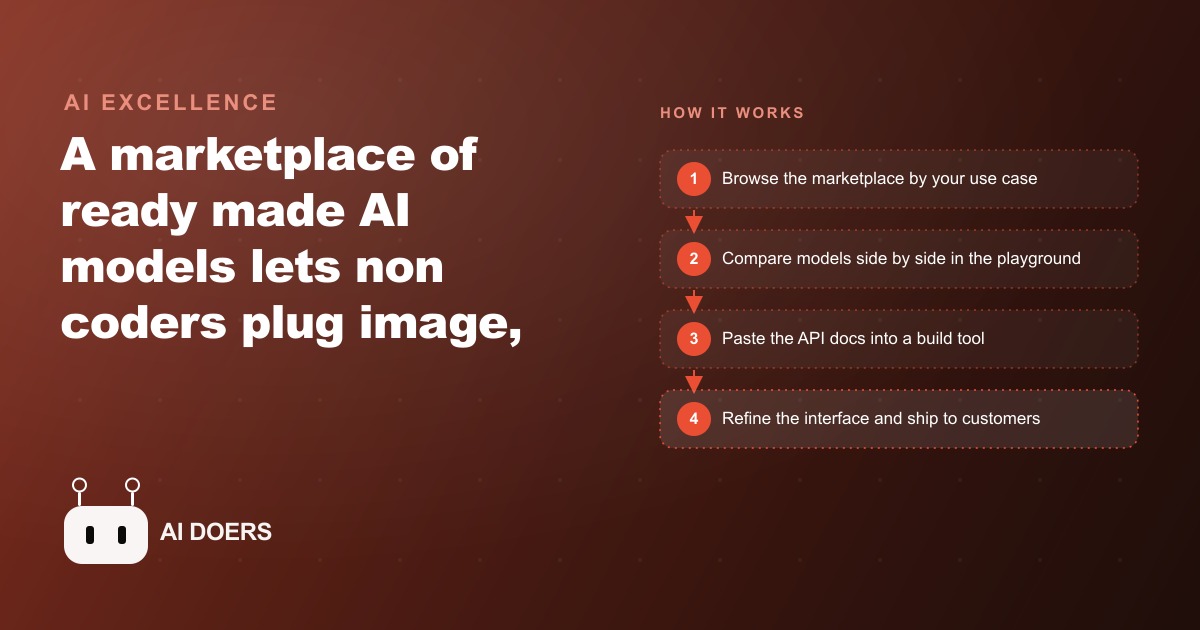
Something changed in AI model marketplaces this year that did not make the front page of any technology publication. The underlying models did not dramatically improve. The APIs did not get cheaper by a meaningful order of magnitude. What changed was the interface layer: a playground that lets a non-technical business owner open a browser, pick two models from a list of hundreds, run a real input through each one side by side, and see the output in under a minute. That single addition moved AI model marketplaces from developer infrastructure into a category that a contractor, a gym owner, or an HVAC dispatcher can actually use today.
Madhuranjan Kumar has been tracking this shift across the businesses he works with and has watched the adoption curve change significantly in the past six months. The barrier was never compute access or API availability. The barrier was knowing which model to use, how to test it, and what it would cost before you committed to building anything around it. The playground interface and per-output pricing answered all three questions without requiring a developer.
The marketplace playground turned model selection from a research project into a ten-minute test
Before the playground interface arrived, choosing a model for a specific task required reading technical benchmarks that were written for researchers, running test scripts in a terminal, and comparing outputs across multiple API calls that required account setup and billing configuration. That process took hours and required a minimum level of technical comfort that excluded most small-business operators.
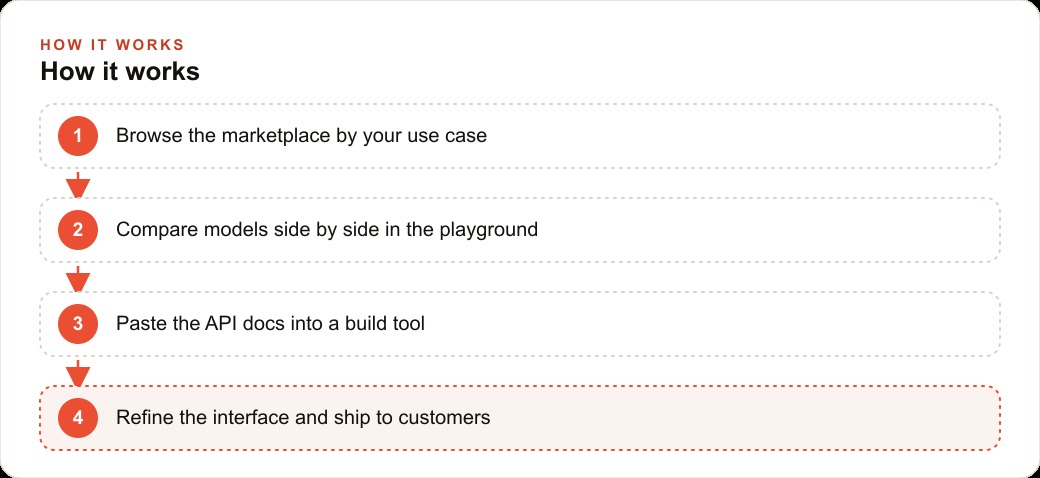
The playground compressed that process. You type a prompt. You pick a model from a categorized list that includes brief plain-language descriptions of what each model does well. The output appears in seconds. You change the model and run the same prompt again. The comparison is visible in front of you. If the output from one model is clearly better for your specific use case, you use that model. If neither is right, you try the next one down the list.
The key word in that description is "specific." The playground works because it tests against your actual input, not a benchmark designed by researchers. A generic benchmark tells you how a model performs on average across a test set. The playground tells you how it performs on the exact type of content you need to process. Those two things frequently diverge. A model that ranks highly on general benchmarks can underperform for a specific industry's vocabulary or a specific output format.
For a small-business owner who needs to generate product descriptions in a consistent voice, the relevant test is whether the model produces descriptions that sound right for their products. For a contractor who needs to parse inspection reports and extract action items, the relevant test is whether the model handles the language in those reports correctly. The playground answers those specific questions in minutes, not hours. It also answers the question that comes second in every evaluation: is the output good enough for my purpose, or do I need to move up to a more expensive model? That trade-off between quality and cost becomes visible immediately when you can run both options side by side on your own input.
Per-output pricing means you can prototype a content engine for under five dollars before committing
The per-output pricing structure changed the economics of experimentation. Earlier pricing models for AI API access required a minimum monthly commitment or charged by the token in ways that were difficult to calculate in advance for variable workloads. Per-output pricing, where you pay a fraction of a cent for each image generated, each transcript processed, or each piece of text produced, means that running 50 test outputs to evaluate a model's performance costs under one dollar.
That cost structure removes the risk from prototyping. If you want to know whether a voice transcription model handles your industry's technical vocabulary correctly, you can run 30 audio clips through it for two or three dollars and have a clear answer. If the answer is no, you have lost three dollars and gained information. If the answer is yes, you can build a workflow around it knowing exactly what each output will cost to produce at scale.
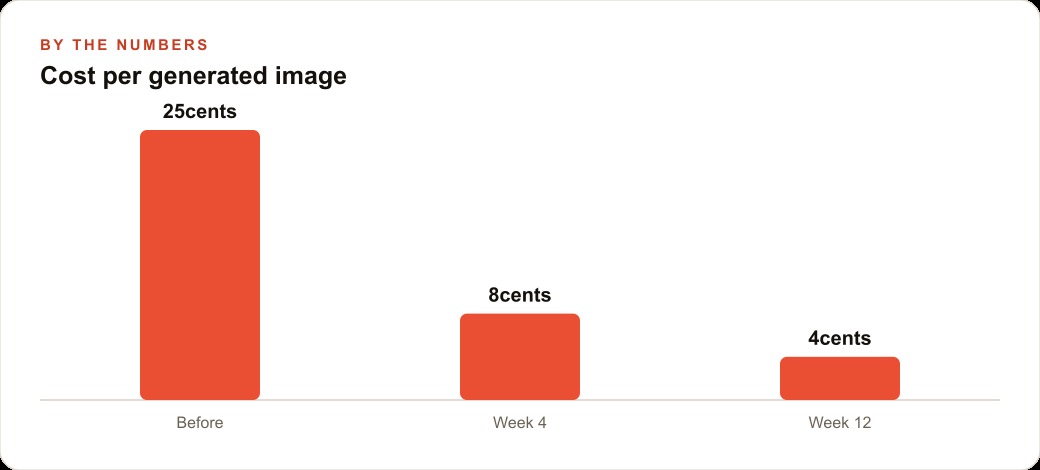
The arithmetic is accessible to anyone who can run a small experiment. A model that produces one image per output at $0.04 per image costs $4 to run 100 test outputs. If 80 of those outputs are usable for your social content calendar, you have just established that you can produce 80 pieces of visual content for $4 in generation costs. That number is the foundation of a business case. It does not require a developer to calculate. It requires running the test.
The per-output structure also makes cost predictable at scale. If each output costs $0.04 and you need 400 outputs per month, the cost is $16. That is a number a business owner can evaluate against the time it would take to produce those outputs manually. The decision becomes arithmetic, not a leap of faith about whether the technology will work at production volume.
The builders earning serious money are chaining two or three models, not using one
The business models that are generating meaningful revenue in this space share a structural characteristic: they use more than one model. A single model can improve a workflow. A chain of models can replace it.
The pattern that appears consistently in the builders earning significant monthly revenue looks like this: a first model handles generation or transformation of raw input into a base output. A second model handles refinement, enhancement, or extraction from that base output. A third model, where it is used at all, handles a quality check, a formatting step, or an adaptation for a specific channel or audience.
The advantage of chaining is that each model in the sequence is only asked to do the task it is best at. The first model does not need to produce a perfect final output. It needs to produce something that the second model can improve. The second model does not need to understand the original input. It only needs to refine what the first model produced. The instructions at each step are simpler and more specific, which is precisely the condition under which these models perform best.
The recent-runs logs that most marketplaces now provide are important for chaining specifically because they make debugging transparent. When a chain produces an unexpected output, you can examine what each model received and what it produced, then identify exactly which step introduced the problem. Without that visibility, debugging a three-model chain would require running each step separately to isolate the failure. The logs make that unnecessary and turn debugging from a frustrating mystery into a straightforward comparison of input and output at each stage.
The builders who are struggling are, in most cases, trying to do too much with one model. They are asking a single model to take raw business data as input and produce a polished, formatted, audience-ready output in one step. That is a hard task for one model to do consistently well. Breaking it into two or three steps, each with a narrower and clearer instruction, produces consistently better results with fewer failed outputs to discard.
Distribution is now the bottleneck, not the technology
Madhuranjan Kumar has watched multiple builders go through the same sequence: they build something genuinely useful using a model chain, they confirm it works, and then they find that their revenue is not proportional to how useful the tool is. The reason, consistently, is that building access to good models and knowing how to chain them is no longer rare. Distribution is.
The access problem was solved by the marketplace. A year ago, building a functional AI content tool required knowing which models existed, how to access them, and how to integrate multiple APIs. Today that knowledge is available to anyone who spends an afternoon in a marketplace playground. The technical barrier has dropped to near zero.
What has not dropped is the difficulty of finding an audience, communicating clearly what the tool does, and converting interested users into paying customers. Those are marketing and sales problems. They have been the hard part of software for decades and they remain the hard part now.
The implication is that a business owner who already has an audience, a distribution channel, or a category of clients who trust their recommendations is better positioned to build a profitable AI tool than a developer who can code but has to build audience from scratch. The developer who can build the chain but cannot market it will be outperformed by the business owner who can market it but needs help building the chain. The scarce resource shifted, and it shifted to the side of the equation that most technology builders traditionally undervalue.
The pricing structure compounds this. B2B pricing, where you serve a small number of clients at high monthly fees, requires a much smaller distribution reach to produce meaningful revenue than B2C pricing, where you need thousands of subscribers. A B2C tool at $20 per month needs 500 customers to reach $10,000 in monthly revenue. A B2B tool at $1,500 per month needs 7 customers. Finding 7 clients in a specific industry you already serve is a distribution problem most business owners can solve. Finding 500 strangers online is a different problem entirely.
What this means for an HVAC company's content calendar starting this week
Consider an HVAC company that needs to maintain a consistent social media presence across its service area. The owner knows that educational content about seasonal system maintenance performs well with the local audience. The problem is time: producing 20 pieces of quality visual content per month takes hours the owner does not have, and hiring a designer or a social media agency costs more than the content's measurable return.
A three-model chain solves this problem for under $20 in API fees per month.
The first model is an image generation model that takes a seasonal maintenance prompt as input and produces a base graphic: a visual of an HVAC unit, a thermostat, a duct system, or a seasonal element relevant to the month. The prompt specifies the general scene and lighting. The output is a base image without text or branding. At $0.04 per image, generating 25 base images costs $1.00.
The second model is an image editing model that takes the base graphic and a branding prompt as input. The prompt specifies the company's primary color, adds the company name in a consistent position, and overlays a brief headline in legible text. The model applies these elements to each base image. At $0.04 per edit, processing 25 images costs another $1.00.
The third model is a text generation model that takes the image description and a target platform as input and produces the caption: 150 words for Facebook, 30 words for Instagram, a thread structure for X. At fractions of a cent per caption, generating captions for 25 images on three platforms costs under $1.00.
Total generation cost for a month of content across three platforms: approximately $3.00 in API fees. If the owner's time is worth $75 per hour and producing this content manually would take 8 hours per month, the monthly value of the chain is approximately $600 in recovered time, minus $3 in model costs.
The additional step that comes before building the chain is testing before committing. Running 10 images through the full sequence before writing a month of content around it costs $0.40 and takes twenty minutes. If the output quality is not right for the HVAC context, you adjust the prompts at the failing step and run 10 more. The per-output pricing means that iteration is cheap enough to treat as standard practice rather than a cost that requires justification.
The businesses starting this week have an advantage over the ones that started a year ago: the playground makes model selection fast, the per-output pricing makes testing cheap, and the logging makes debugging transparent. The technology access problem is solved. The remaining problems are being specific enough about the task and the audience to write prompts that produce consistent results, and building the distribution reach to sell access to the chain you build. Both of those problems have always existed in business. Only the tools around them changed.
That is exactly what we do at AI DOERS. Book a private 30-minute call with Madhuranjan Kumar and we will map the fastest path to it for your specific business.
Book your call →
Madhuranjan Kumar
Madhuranjan Kumar brings 20 years of performance-marketing experience and has managed over $200 million in Facebook ad spend for brands across the United States and beyond. His expertise spans the full modern marketing stack: Meta, Google Ads, TikTok, email automation, CRM, and the websites that hold it together. At AI DOERS he turns that track record into lead-generation systems for businesses across every industry.