
How AI Coding Agents Turn One Lucky Trade Into a Testable Strategy
Paste a confusing result into an AI coding agent like Codex or Claude Code, ask it to explain exactly why it happened, then let it brainstorm repeatable plays you can test with small stakes. The lesson is the workflow, and it works on any business data.

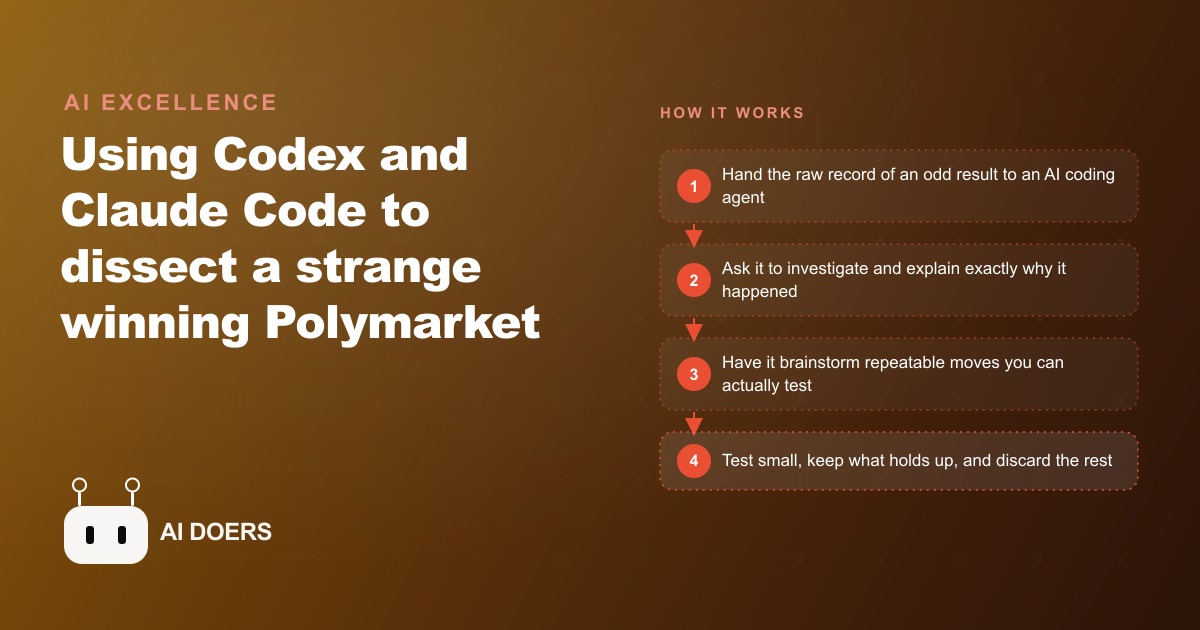
One dollar turned into one hundred on Polymarket last month, and the trader who made it did not fully understand why until he handed the raw transaction data to an AI coding agent. The return was interesting. The method was the point. I am Madhuranjan Kumar, and I want to be clear upfront: nothing in this article is financial advice, and the Polymarket example is not a recommendation to trade prediction markets. The reason the story matters for any business owner is the workflow, and that workflow applies to every set of numbers that surprises you.
Here are six lessons about using AI coding agents to analyze anomalous results in your own business data. The trade is the context. The habit is the takeaway.
Hand the raw data to the agent, not your interpretation of it
The first instinct when something surprising happens is to construct an explanation. Sales spiked on a Tuesday with no promotion running, so it must have been the email from two days prior. A trade settled for 100 times the stake, so it must have been luck. A client cancellation rate jumped for three days, so there must have been a service quality issue somewhere.
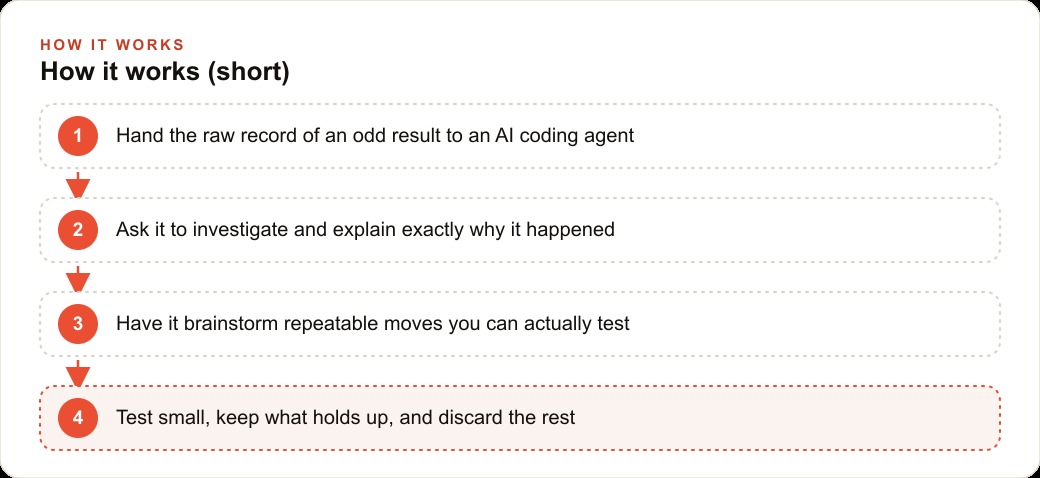
These interpretations feel reasonable. They are often wrong. When you hand the agent your interpretation and ask it to confirm, it confirms. That is the yes-man problem embedded in the question format. The correct move is to hand the agent the raw record with no framing at all and ask it to explain what happened. In the Polymarket case, the trader pasted the transaction hashes, pointed the agent at the blockchain data, and asked one plain question: I made a strange trade I do not fully understand, can you investigate and explain exactly what happened. No pre-loaded answer to confirm. The question produces a real investigation rather than a confirmation of a guess.
This discipline applies directly to business data. Instead of asking "did our email cause the Tuesday spike," export the raw order data, the traffic sources, the discount codes used, the timestamps, and the session data, and ask the agent to explain what drove the spike. Let it build the explanation from the evidence rather than confirming yours. The conclusion it reaches from clean data is more reliable than the one you handed it as a starting premise.
Ask for the mechanism, not just the outcome
The agent reading the Polymarket data did not just confirm that the trade was profitable. It reconstructed the exact sequence. Both legs had filled at one dollar each, 50 shares on the up side and 50 shares on the down side. It then answered the harder question of how that fill was possible when the outcome was nearly certain. The cause was a settlement delay combined with resting low bids that stayed on the book past the point when informed participants had moved on. A taker swept those stale prices right at the close window.
That is a mechanism, not just an outcome. The mechanism tells you whether the result is reproducible. A random lucky fill is not reproducible. A market structure feature, stale bids during a settlement window, is a condition you can watch for and position around. This distinction matters just as much in business data. A one-day sales spike caused by random traffic noise is not reproducible. A spike caused by a specific referral link combined with an active discount code during a specific time window is something you can try to engineer again.
Always follow up the agent's initial explanation with one more question: what is the specific mechanism that produced this result, and is it a condition that recurs. The mechanism is what you actually need for the result to become useful.
Both-sides fills reveal guaranteed-positive structures: look for them in your own operations
The specific edge in the Polymarket trade was structural. Holding both sides of a binary market at a low enough combined cost guarantees a positive outcome regardless of which side wins, because the winning side always redeems for more than the combined cost of both positions. The structure, not a prediction, created the edge. You did not need to know which side would win. You needed both sides to fill cheaply enough.
Every business has structural equivalents of this: arrangements where the outcome is positive regardless of which direction a key variable moves. A retainer structure where you bill the same amount whether the client uses your full capacity or not. A subscription product where margin improves as usage increases without proportional cost increase. A media budget split across two channels where the total return is positive even when one channel underperforms, because the other more than compensates.
Asking an AI agent to look at your business model with the explicit question of where guaranteed-positive structures exist, or where they could be created, is a different kind of analysis from the usual performance review. It finds the mechanics that work regardless of noise rather than the single best result that might not repeat. This is the kind of structural insight that is hard to see when you are inside the business looking at weekly numbers. The agent reads the patterns faster and more dispassionately.
Stale orders at settlement time are just slow information: every market has them
The specific inefficiency the Polymarket trade exploited was information asymmetry during a narrow window. The settlement delay meant that informed participants had already moved on while stale bids sat accessible on the book. The agent identified this as the edge and described how to position for it in future windows: pre-loading both-sided bids early when fill queues are short, and timing entries exactly at the window transition when stale prices from the closing window are briefly available.
Both strategies cancel their resting positions after about 120 seconds. You only pay when a position fills. Canceling early limits exposure to being picked off on a position that no longer makes sense at the later price.
This structure, slow-moving information creating a brief window of advantage, appears in most markets and most business categories. A competitor who raises prices but has not yet updated their ad copy. A supplier who has inventory at the old cost but is days away from repricing. A customer segment that responds well to a specific offer that the broader market has not yet seen at scale. The agent's job is to identify where the slow information sits in your specific context. Your job is to decide whether acting on it is worth the effort.
Ask the agent to brainstorm repeatable variations, not just confirm the one-off
After the agent explained the settlement delay mechanism, the trader asked the obvious follow-up: how could this be done again. That question produced a list of testable approaches, not just one. Several variations on the same underlying structure, positioned at different points in the market cycle. The first pre-loaded both sides of future windows early when bids cost almost nothing to place. The second timed entries at the exact window switch moment, placing eight bids across multiple markets simultaneously. Each was a distinct test of the same underlying thesis.
This brainstorming step is where most people stop short. They understand what happened, feel satisfied with the explanation, and move on. Asking the agent for five variations of a repeatable test takes about 30 seconds and surfaces approaches you would not have generated yourself.
For business data, after the agent explains a surprising result, the follow-up prompt is always: give me five ways to test whether this is repeatable, and what is the smallest possible version of each test. You run the smallest version of the most plausible test first. If it shows a signal, you expand. If it does not hold within the test window, you move to the next item on the list. That discipline, treating your data like a trader treats a market signal, is the compounding skill.
The 120-second cancel rule: test small and cut losses fast
Both strategies in the Polymarket workflow canceled resting positions after 120 seconds. The logic was explicit: you only pay when a position fills, so canceling early limits exposure without costing anything. You wait for the rare paired fill. When it does not arrive within the window, you cancel and set up the next opportunity.
The business equivalent is setting a hard stopping point on every test before the test runs. Not "we will see how it goes" but "if this does not show a specific signal within these parameters by this specific date, we stop and redirect the budget to the next test." Most business tests run too long because no one defined the stopping point before the test started. Tests that should be cut at week two run for two months, consuming resources that could have funded three better tests in the same period.
The AI agent can help set these parameters. After it brainstorms the repeatable variations, ask it: for each of these tests, what is the minimum signal that would tell me it is working, and what is the maximum time I should run it before canceling. It will give you concrete, specific stopping criteria. The discipline of using them is the human contribution. The agent provides the framework. You provide the judgment about when the evidence is strong enough to commit more resources.
The worked example: an e-commerce sales spike
Here is how I would run this full workflow for an online store that sells home goods. Suppose sales run at three times normal volume on one particular Thursday with no promotion scheduled. The owner is pleased but has no explanation. The usual response is to hope it happens again.
Instead, I export the raw order data for that day: timestamps, SKUs, quantities, discount codes used, traffic source UTM parameters, and session data showing where customers came from. I hand the entire export to an AI coding agent and ask it to investigate and explain what drove the spike. No suggested explanation. Just the investigation.
The agent works through the data and finds that a specific UTM source, a niche blog that linked to one product without the store knowing, drove a burst of high-intent traffic during a two-hour window in the afternoon. That traffic arrived while an existing sitewide discount code was active. The combination produced a conversion rate roughly four times the store's baseline for that product.
That is the mechanism. The blog is a real channel. The discount created urgency. The product matched that audience's specific interest. Now I ask the agent to brainstorm five repeatable variations. It suggests reaching out to the blog for a formal content partnership, testing a similar limited discount with three related products in the same category, identifying five other niche blogs in the same topic cluster, and setting a 72-hour flash sale timed to coincide with the next time that traffic source appears in the UTM data. For the products that spiked, I can also build lookalike audiences through Facebook and Instagram ads using the buyers from that Thursday as the seed, and run Google Ads campaigns targeting the same keyword cluster the blog was covering.
I run the smallest test first: an email to the blog author and a 48-hour flash sale on the original product. If the flash sale shows a signal above baseline, I expand the product set. If the blog responds and confirms interest in a partnership, I build a longer-term arrangement. If neither holds within the test window, I look at the next item on the agent's list.
The Thursday spike was a lucky result. The investigation, the mechanism identification, and the test plan that follows are a system. The agent did the heavy reading. The decisions, and the discipline to cancel tests that do not hold, remain yours. That division of labor, machine reading plus human judgment, is the one that actually compounds over time. The agent reads faster than you can. The judgment about what to do next is still yours to make, and it gets sharper every time you run the loop.
That is exactly what we do at AI DOERS. Book a private 30-minute call with Madhuranjan Kumar and we will map the fastest path to it for your specific business.
Book your call →
Madhuranjan Kumar
Madhuranjan Kumar brings 20 years of performance-marketing experience and has managed over $200 million in Facebook ad spend for brands across the United States and beyond. His expertise spans the full modern marketing stack: Meta, Google Ads, TikTok, email automation, CRM, and the websites that hold it together. At AI DOERS he turns that track record into lead-generation systems for businesses across every industry.