
How a Senior Dev Ships 100x Faster: The Agentic Engineering Playbook
Shipping far faster is not about better prompts, it is agentic engineering: you do the thinking while a strong harness and a best-in-class model execute. Here is the full playbook, and how the same discipline pays off for a small business like a hair salon.

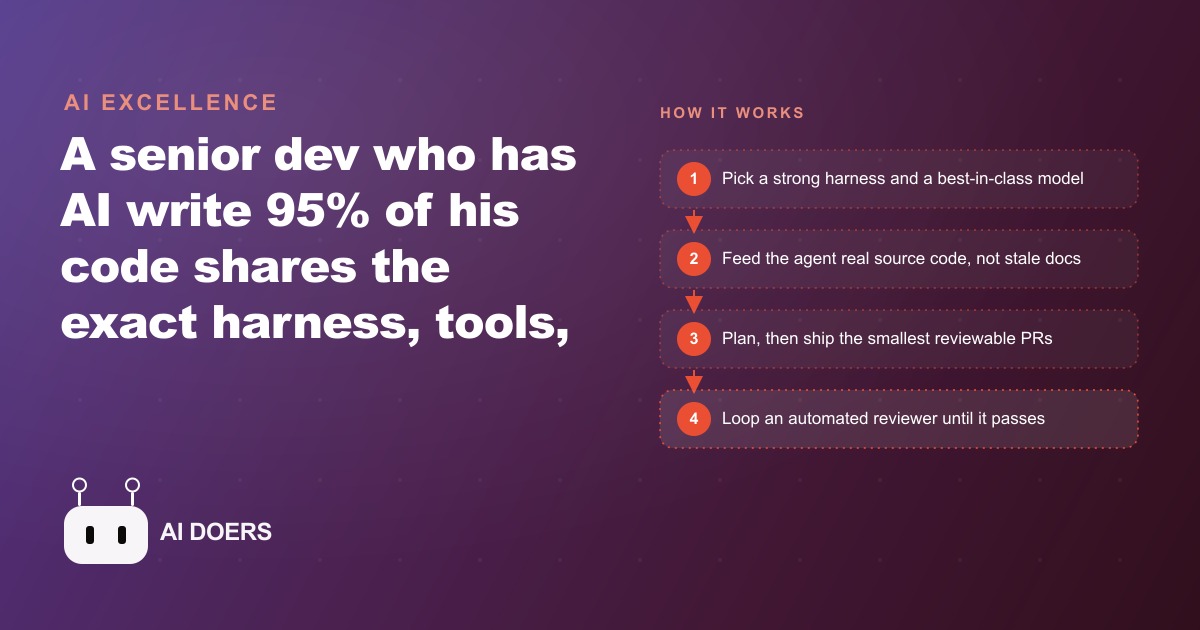
The fastest way to misunderstand what makes some developers dramatically more productive than others is to assume it is about better prompts. I am Madhuranjan Kumar, and the distinction that actually explains the gap is not a technique. It is a discipline, and it has a name that most people who practice it use consistently: agentic engineering.
Agentic engineering means you do the thinking and let the agent execute. You decide what the architecture should be. You decide what the edge cases are. You decide what the correct abstraction is for the problem you are solving. Then you hand the execution of that thinking to a model that can translate it into code, or a contract analysis, or a reconciliation summary, faster than any human can type. The contrast is with vibe coding, where you hand the thinking over too and hope the agent infers the right decisions. The results from vibe coding look impressive for an afternoon. They start falling apart when the first real constraint appears, because the agent made assumptions during the thinking phase that the domain expert would never have made.
The productivity multiplier that comes from agentic engineering is not primarily about the agent. It is about the quality of direction the agent receives. A precise, context-rich direction produces a precise, useful result. A vague, context-poor direction produces plausible-looking output that requires significant correction. Since the correcting is done by the same person who could have written the direction more carefully in the first place, the time savings from the agent are often partially or wholly erased by the time spent on review and repair. The discipline is about keeping that correction loop small.
The Discipline No One Names
The reason agentic engineering produces consistently better results than vibe coding comes down to a specific category of error. Models make mistakes that look correct. A model that does not fully understand the architecture of a system will write code that compiles, runs without errors, and introduces a structural problem that creates a painful refactor six weeks later. The problem is invisible until it is expensive. An engineer who understands the architecture and uses the model for execution catches that kind of mistake before it exists, because the plan is reviewed before the first line of code is written.
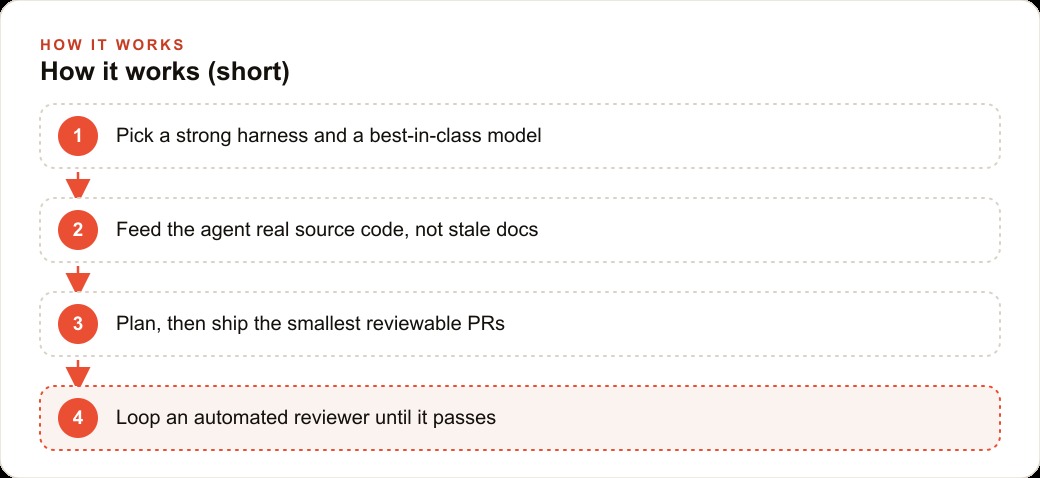
The mechanics of doing this well are specific. You use the best available model for serious work. The quality difference between a top-tier model and a cost-optimized one is small in cost terms and large in output terms on complex tasks. Shortcuts on the model tier compound in the wrong direction: small savings on compute produce large costs in review time and rework. You feed the model real source code rather than documentation, because documentation is always incomplete and often wrong. When you need the model to work with a specific library or framework, you pull the library's actual source into the working context and have the model reference that. Code is the only source of truth that is provably current.
Context engineering is the practice that most separates rigorous agentic work from careless use. Every additional piece of context you push into the session dilutes the model's attention across more material. A model asked to fix one function while holding an entire codebase in context is a worse version of itself than a model given the fifty relevant lines and the same question. The discipline is to give the agent exactly what it needs for the current task, no more. When the session accumulates too much context from prior exchanges, you open a fresh session rather than compounding the dilution. Practitioners who do this for a living start a new session when the context indicator reaches roughly 75 to 80% full. Compacting, which is the alternative of summarizing prior context and continuing in the same session, consistently produces degraded output compared to starting clean.
The rhythm for keeping work units small is the same principle applied at the task level. Before any code is written, the agent generates a plan. The plan is reviewed by the person who understands the domain. Adjustments happen at the plan stage, when they are cheap. Then execution proceeds in the smallest chunk that can be independently reviewed: not the whole feature, but the smallest slice that could stand on its own. Small work units keep the session context tight, produce results that are easy to evaluate, and build a history of decisions that is readable rather than buried under accumulated drafts.
What the Harness Actually Does
Most people who use AI for knowledge work are using the model. The people who get dramatically better results are using the harness, which is the system wrapped around the model that allows it to act rather than only respond.
A model on its own predicts the next token in a sequence. It cannot read a file, run a command, search the web, or send a message. A harness adds those capabilities by connecting the model to tools, and the combination is what allows an agent to perform multi-step tasks that span real systems. Two people working with the same underlying model through different harnesses will produce results that are not meaningfully comparable. One person sees suggestions appear in a chat window. The other has an agent that can read every relevant file in a repository, run the tests, read the test output, identify the failing assertion, trace it back to the source, and propose a targeted fix, all in one uninterrupted loop.
The automated review loop is the component of the harness that keeps quality from decaying across a large volume of output. A code reviewer scores each unit of work numerically and explains the specific issues it found. The agent reads that feedback, applies the corrections, and the reviewer runs again. This loop continues until the score meets the threshold you set. The person directing the work reviews the final result and the final score rather than every intermediate draft. The mechanical review work, the checking of formatting, naming conventions, error handling, test coverage, is automated. The judgment work, evaluating whether the architecture is right and whether the output actually solves the problem, stays with the human.
The habit of keeping a clean service layer addresses a failure mode specific to AI-generated code. Models default to writing new implementations of things that already exist rather than finding and reusing existing ones. If a function that formats a currency value already exists in a shared utilities module, the model will often write a new version of it in the new file rather than importing and calling the existing one. Over time, a codebase built this way accumulates duplicate logic that is expensive to maintain because the same behavior has multiple implementations that can diverge. The discipline of refactoring code into reusable units at the end of each work session, and directing the model to reference existing utilities explicitly, keeps the codebase clean enough that the next session can build on it rather than around it.
Knowledge Work, Same Rules, Different Domain
The most underused implication of agentic engineering is that it extends to any knowledge work involving documents, analysis, or structured research. The discipline is identical: keep the thinking, hand off the execution, provide real source material, work in small reviewed chunks. The harness is different (a document interface rather than a code editor), but the underlying pattern is the same.
Consider, illustratively, an accounting practice handling year-end reconciliation for a mid-size client. The standard process requires reading several months of bank statements, matching transactions to recorded entries in the general ledger, identifying discrepancies, and producing a summary report of findings. Done manually by a trained accountant working through transaction records sequentially, a complex client can take a full day or more. Done with agentic discipline applied to the same material, the time compresses significantly.
The key is keeping the thinking with the accountant. The accountant does not hand the agent a stack of bank statements and say "reconcile this." That is vibe coding applied to accounting, and it produces output that looks thorough but contains enough embedded assumptions that the accountant cannot fully trust it without line-by-line review, which erases most of the time saving. Instead, the accountant defines the specific transaction categories to examine, the matching rules, the threshold for what constitutes a discrepancy worth flagging, and the format the summary report should take. That thinking stays with the accountant. The work of reading thousands of transaction rows and comparing them against those rules is handed to the agent.
The result in that illustrative scenario compresses a full-day task to a few hours: one hour defining the task precisely and identifying the sections of the statements most likely to contain issues, two to three hours of agent processing with the accountant reviewing flagged items in batches rather than checking every line, and a final pass to verify the summary before it goes to the client. The accountant applies judgment where judgment is genuinely required. The mechanical matching and comparison runs in the background.
Contract analysis follows the same pattern. A commercial agreement of twenty-five to thirty pages that a business owner needs to understand fully can be systematically analyzed in under two hours when the approach is disciplined. The owner reads the document at a high level first, identifies the sections most consequential to their business, and directs the agent to analyze those sections specifically, comparing the language against what standard market terms look like. The owner retains judgment about what constitutes acceptable risk for their specific situation. The agent handles the parallel reading, the comparison against standard language, and the drafting of plain-language summaries for each significant clause.
For businesses that invest in organic growth through SEO content, the same agentic discipline applies at the content level: define the specific search intent before writing anything, provide real competitor content as reference material rather than describing it, review draft sections rather than accepting full articles wholesale, and apply editorial judgment to claims and structure. The agent handles the volume. The editorial judgment stays with the person who understands the brand and the audience. The same is true when the work is analyzing the performance of Facebook and Instagram ad campaigns: the operator decides which metrics define success and which segments to investigate, and the agent does the reading and the comparison across the raw numbers.
The Safety Habit That Costs Nothing
The package age rule used by serious developers deserves to be generalized beyond software. Never direct an agent to install or integrate any package, plugin, or third-party service less than fourteen days old. The reason is specific: most supply-chain attacks against software come through packages released in the hours or days before the attack is discovered. The two-week observation window catches the majority of them without requiring manual security review of every dependency.
For non-software applications, the principle generalizes cleanly. Be skeptical of tools, integrations, and services that are too new to have an observable track record. For any system with wide permissions, whether it is a code agent with write access to a repository or a document agent with access to client files, define the minimum necessary permissions at setup rather than granting broad access and narrowing it later. For any automated output that goes to clients or customers, a human review step between the agent's draft and the actual delivery is the correct default until the agent's reliability on that specific task is well established.
The deeper principle behind both rules is that agentic engineering is a discipline of control. The person directing the agent decides what the agent touches, what it references, what it produces, and what it sends. Allowing the agent to operate with broad permissions and unchecked outputs is a gap in that control that creates risk proportional to the breadth of the agent's access. The two rules above are specific applications of the same underlying commitment: keep the agent's authority well-defined, keep its outputs reviewed, and keep the judgment in human hands.
The central argument of this piece is that speed at scale comes from discipline, not from shortcuts. The productivity multiplier associated with the best agentic practitioners is built on habits that resist the temptation to hand everything over and hope: feed real source material, keep context tight, plan before executing, work in small reviewed chunks, retain judgment over the output. Those habits transfer to accounting, to contract review, to research, to any work that involves processing large amounts of information and producing structured results. The unlock is recognizing that the discipline is the same regardless of the domain, and choosing to apply it rather than hoping the agent fills the gap where careful direction should have been.
That is exactly what we do at AI DOERS. Book a private 30-minute call with Madhuranjan Kumar and we will map the fastest path to it for your specific business.
Book your call →
Madhuranjan Kumar
Madhuranjan Kumar brings 20 years of performance-marketing experience and has managed over $200 million in Facebook ad spend for brands across the United States and beyond. His expertise spans the full modern marketing stack: Meta, Google Ads, TikTok, email automation, CRM, and the websites that hold it together. At AI DOERS he turns that track record into lead-generation systems for businesses across every industry.