
How a Nontechnical Founder Made $400K Teaching Companies AI
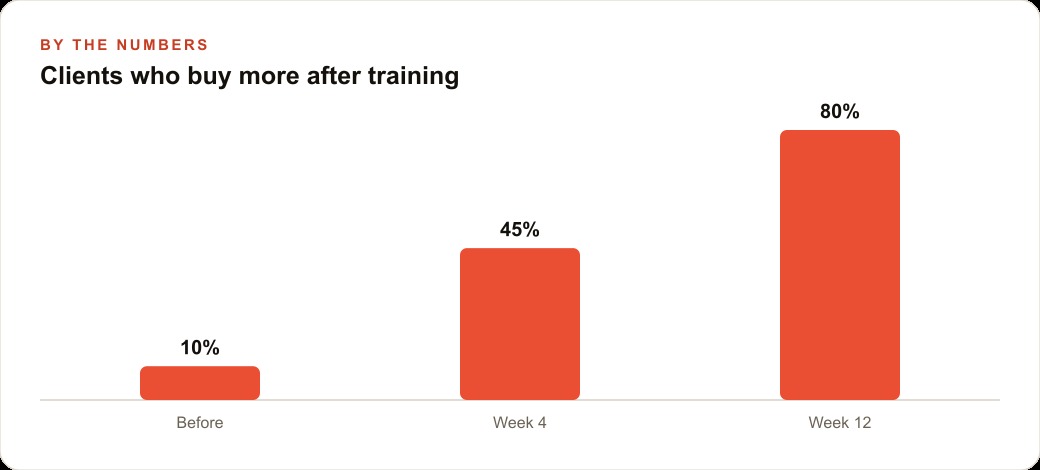
He led with AI training instead of automation, because adoption fails on culture and process, not technology. Train a few internal champions and roughly 80% of clients buy the bigger work next.

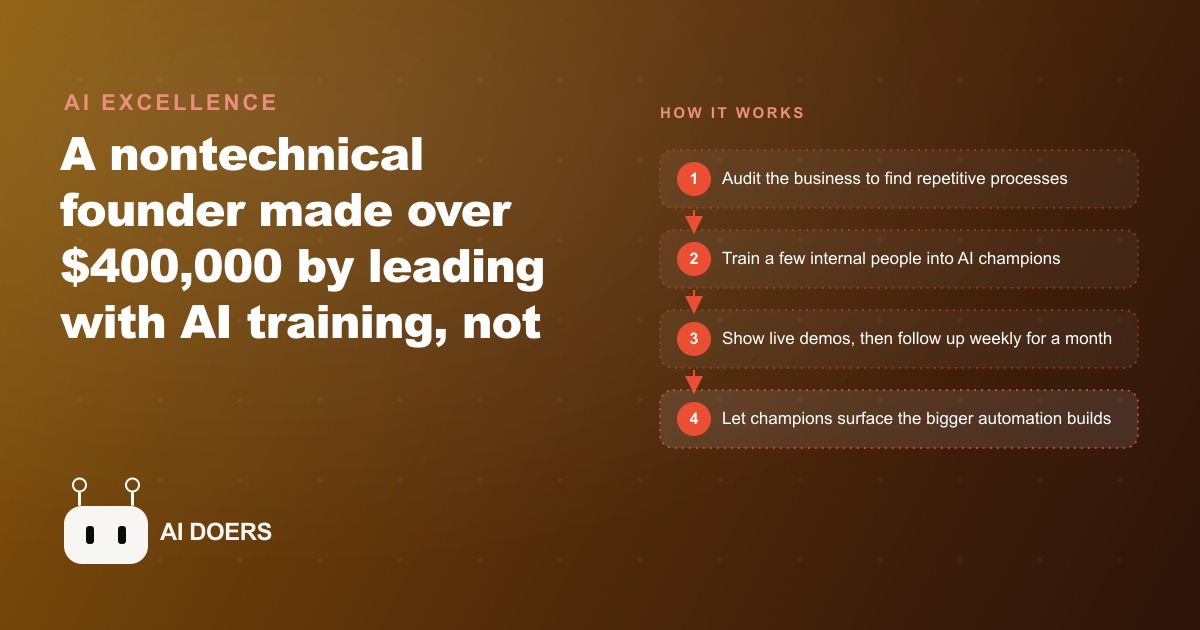
A nontechnical founder built over $400,000 in revenue by teaching companies to use AI tools they already had access to. No custom software, no elaborate automations, no development team. The model is repeatable and the lessons are concrete. I am Madhuranjan Kumar, and here are the eight that changed how I think about AI services as a business.
The foot-in-the-door offer is training, not automation
The single most important positioning insight in this model is the sequence: sell understanding before you sell software. Walking into a company cold and pitching a custom automation system asks the client to trust a technology they do not yet understand and a vendor they have just met. That is a high-risk sale with a high drop rate. Walking in and offering a workshop that teaches their people to use AI tools they already have is a low-risk entry that produces genuine value and demonstrates competence before any larger commitment is made.
The commercial logic is also compelling. Roughly 80 percent of companies that went through at least one training session and developed an internal champion went on to buy automation and development work afterward. The training offer is not the main revenue source. It is the filter that identifies the clients ready for the larger work, and it pays for itself while doing so.
Automation fails on culture, not technology
The original model this founder tried was the more obvious one: pitch and sell automation systems directly. It underperformed. The failure was not technical. The automations worked. The failure was human. Staff did not understand the benefits, processes were not clean enough to automate efficiently, and the company culture had no mechanism for helping people adopt new ways of working. The automation sat unused or underused because the ground was not prepared. This is a pattern repeated across the industry. Selling a complex system before the audience understands the category produces weak results and skeptical clients who do not refer new business.
The fix is not a better automation. It is a different starting point. Training creates the understanding that makes adoption possible. Once a few people inside a company can actually use AI tools well and can see the time they are saving on their own work, the culture starts to shift without external pressure. The training created the condition for everything that followed.
The AI champion inside each company is the lever that makes adoption stick
The core method is identifying two or three people inside each client company who are curious, credible with their colleagues, and positioned to influence the team around them. These are the AI champions. Training is designed to build those specific people into genuine internal experts rather than giving a generic overview to the whole room. Once a champion exists, adoption accelerates from within. The champion answers questions, shares results, and creates the social proof that brings skeptical colleagues along. Adoption driven by an internal peer is more durable than adoption driven by an external consultant, because the peer is present every day and the consultant is not.
The audit before the workshop is what makes the demo land
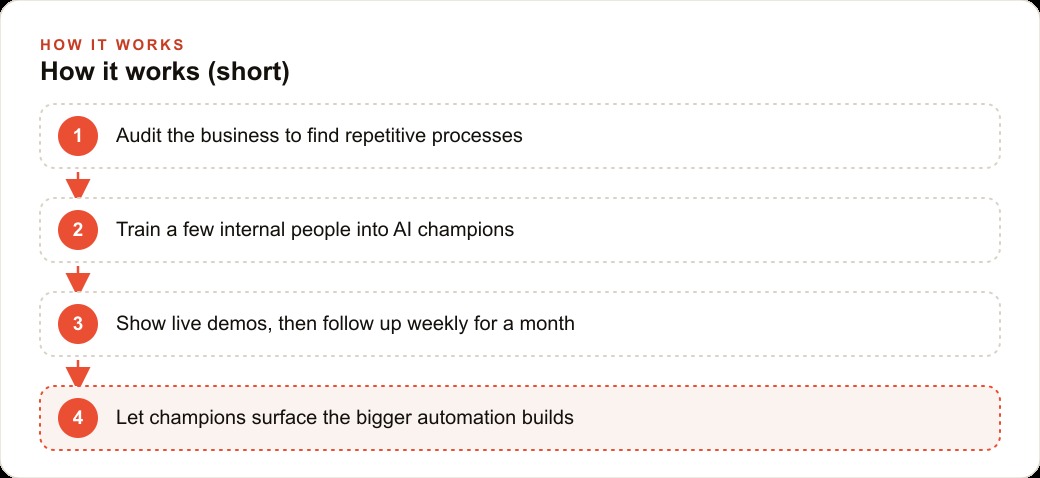
Before any workshop, the process starts with a quick assessment of the client's current work. The practical version is a short survey sent to the leadership team that asks about repetitive tasks and current time costs on specific processes. The goal is to identify two or three workflows that are easy to map, quick to optimize, and will show clear before-and-after results. Those become the foundation of the live demo. Showing a team their own actual process, optimized in front of them, produces a completely different reaction than a generic demonstration using a hypothetical example. Generic examples get polite attention. A demonstration of their own accounts payable process running three times faster than their best person can run it manually creates immediate conversion.
Live demos over slide presentations, always
Generic slide-based training gets forgotten within 24 hours. The cognitive distance between a slide about what AI can theoretically do and a team member's daily experience of their own work is too large to close through a presentation. The demo format that actually converts is sitting in front of the most experienced person in the room on the most tedious task in their specific workflow, and completing it faster than they can while they watch. That experience is impossible to intellectually dismiss. They just saw it happen to the task they do every day. Resistance breaks at that moment in a way that no slide deck can replicate, and the follow-up questions that come from genuine curiosity rather than polite engagement are where the relationship with the future champion actually starts.
Simple tools first, complex builds later
For a recruitment client, the highest-impact early result came from simple off-the-shelf tools used in a structured way rather than from custom-built systems. Configured AI tools applied to manual research tasks cut the time spent on them by roughly half with no bespoke development required. The lesson is that the first goal is not to build the most technically impressive thing. It is to show the fastest meaningful improvement to the most painful daily process. Simple tools applied correctly to real workflows produce that result faster than custom builds that need weeks of scoping and development. The complex builds come later, after the client has seen real results, developed internal confidence in the technology, and identified the workflow gaps that genuinely require custom solutions.
Four weeks of follow-up is not optional
The time from training to real adoption is not the one or two days of the workshop. It is the four weeks that follow. A structured follow-up of one hour per week for the month after any training session is what converts an attendee who found the workshop interesting into a champion who is actively changing how they work. The follow-up sessions surface the questions that only arise when people try to apply what they learned to their real work. They also reveal who the actual champions are. Not everyone who seemed enthusiastic in the workshop will sustain that engagement. The ones who show up to the follow-up sessions with specific questions about their own workflows are the ones worth investing in, and identifying them early is what makes the transition from training to larger project work happen naturally rather than through a separate sales effort.
The champion surfaces the large development work on their own
Trained champions who have gotten real results with small optimizations will start identifying the larger gaps that require custom development. They come back asking for the $20,000 to $80,000 project because they have already proven to themselves and their leadership that AI delivers results in their specific environment. They also provide the business case internally because they have built credibility by delivering visible results from the training engagement. That internal advocacy closes projects faster and at higher conversion rates than any external sales pitch could, because the champion is a trusted insider and the sale is based on demonstrated results rather than projected ones. This dynamic is why the training model scales so well: each satisfied champion becomes a source of high-margin follow-on work without requiring a separate outbound sales effort to generate it.
The businesses that this model reaches most effectively are the ones where repetitive knowledge work is the daily reality, which covers an enormous range. A CRM and website stack that handles client relationship management at a law firm, a medical practice, or a consulting firm is exactly the environment where trained AI champions quickly identify the ten routine tasks they spend their mornings on and want to automate. The training model works because the bottleneck is human understanding, not tool availability, and it turns out that most organizations are full of people who will enthusiastically adopt tools that make their own work faster once someone shows them how.
That is exactly what we do at AI DOERS. Book a private 30-minute call with Madhuranjan Kumar and we will map the fastest path to it for your specific business.
Book your call →
Madhuranjan Kumar
Madhuranjan Kumar brings 20 years of performance-marketing experience and has managed over $200 million in Facebook ad spend for brands across the United States and beyond. His expertise spans the full modern marketing stack: Meta, Google Ads, TikTok, email automation, CRM, and the websites that hold it together. At AI DOERS he turns that track record into lead-generation systems for businesses across every industry.