
How A 100% Local AI Pipeline Generates Videos With No APIs
By chaining four local tools, a scripting model, a local image model, a tiny voice model, and a renderer, all driven by one agent harness, you can auto-generate polished short videos offline with zero API cost.

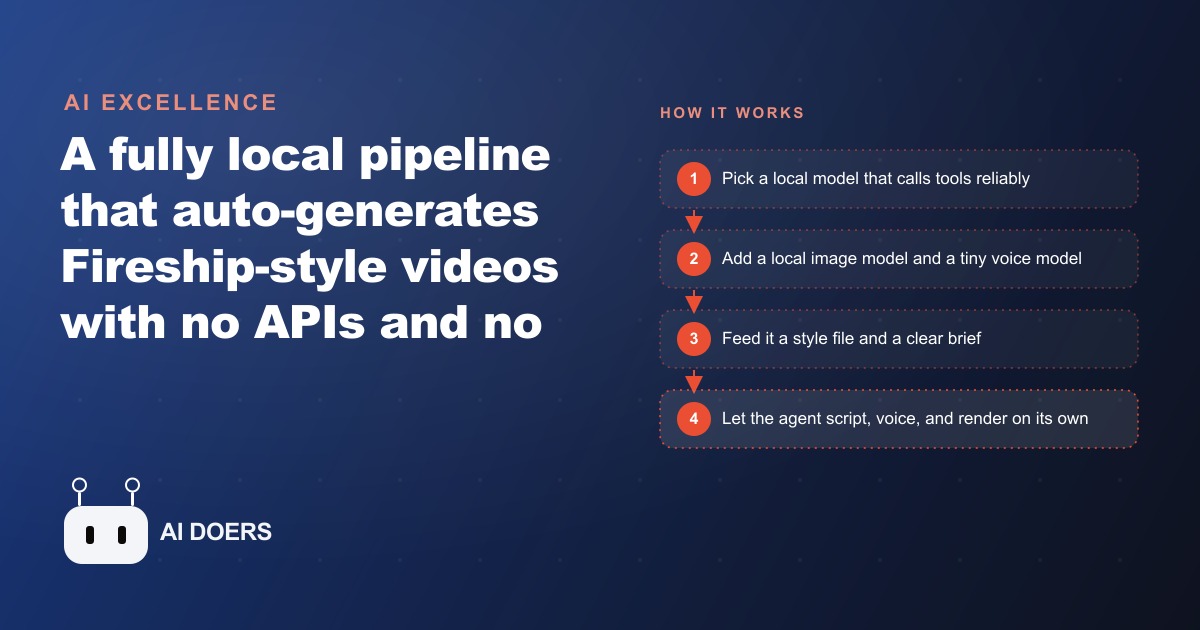
A polished video just came out of a machine that never touched the cloud
Someone recreated the punchy, meme heavy style of a popular tech channel using nothing but open models running on their own hardware, and the first version genuinely looked good. No cloud API was called at any point. The finished piece was a short comparing AI coding agents to slot machines, written, voiced, and rendered entirely offline, at a cost per run of essentially zero. That last detail is the newsworthy part. I am Madhuranjan Kumar, and what caught my attention was not the clip, it was the architecture, because the whole thing is copyable by any business that publishes video.
For the last two years the default assumption was that serious AI content meant a stack of metered APIs billing you for every word, every image, and every second of narration. That assumption just got a lot weaker. A capable creative pipeline now fits on ordinary hardware, and the running cost drops to whatever the electricity bill is.
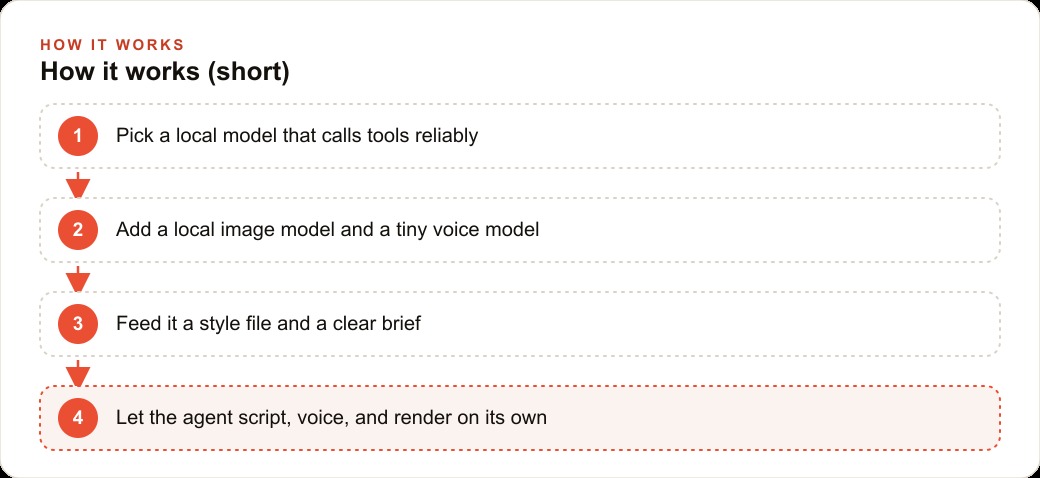
Four local pieces standing on one agent harness
The build rests on four local components tied together by a single agent runner. A local language model writes the script. A local image model generates the visuals. A local text to speech model narrates. A rendering tool stitches it all into the final video. The agent runner drives them in sequence, working through its to do list largely on its own while nobody watches.
The most instructive part of the whole experiment was the model selection, because it flips a common assumption on its head. The first attempt reached for a larger model, and it kept failing at tool calling and running into loops, so it got dropped. A different model in the same size class handled tool calling cleanly, wasted fewer thinking tokens, and ran noticeably faster. For an agent that has to drive a real pipeline, that reliability matters far more than raw parameter count. Bigger is not better when the model's job is to call tools in order without getting confused.
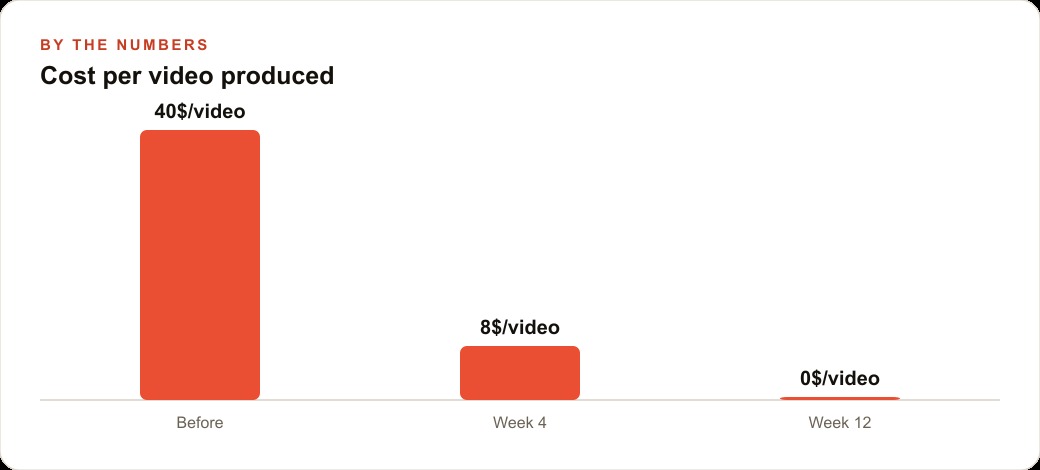
How the cost actually reaches zero
Two design choices keep the price at nothing per run. The image model runs locally after a single one time download, so every image card generates offline with no metered spend. The voice model is tiny, only around eighty two million parameters, which is exactly why it runs so fast on unremarkable hardware. Small and fast beats large and slow when you are producing a batch of clips rather than a single showpiece.
Style was handled without copying anything. A few reference transcripts were studied for their humor and structure, then compiled into one markdown file and handed to the agent. The point was never to lift scripts word for word, it was to transfer the format so the output carried the same rhythm. Then a single prompt set the brief: the topic, the tone, the target length of a few minutes, and the share of image cards to aim for. From there the agent took over and worked the full pipeline itself. On this run the job climbed past a hundred and seventy thousand tokens of context and simply ran in the background while the operator was away, even at the gym. Because nothing calls out to a paid service, there is no meter running and no reason not to leave it going.
Who should be watching this closely
Any business that publishes a steady stream of short video should at least consider this, and the ones paying per clip should be paying attention. If you are handing money to an editor for every piece, or burning credits on cloud generation tools, a local pipeline converts that recurring cost into a fixed one time hardware and setup cost. A real estate team can spin up listing explainers. An e-commerce store can mass produce product clips. A coaching brand can turn one long video into a dozen shorts. A local service business can keep a social feed alive without hiring a creator.
The machinery stays identical every time. You pick a reliable local model, add a local image model and a small voice model, hand it a style file and a clear brief, and let it run. Only the topic and the visual look change from one business to the next. That is what separates this from a one off stunt. It is a repeatable system, and a repeatable system is something you can build a content operation around.
A worked example: the gym that needs a clip a day
Take a gym, which lives or dies on a constant feed of content: exercise tips, member transformations, class promos, and motivation clips. Paying an editor for each one gets expensive fast, and the volume never lets up. Here is how I would stand up the offline pipeline for that owner.
First I would compile a short style file from the gym's best performing posts, so the agent learns the way the coaches talk, the energy they bring, and the kind of hook that lands with members. Then I would wire the local stack: a reliable local model to write each script from a one line brief like a thirty second form check tip for deadlifts, the local image model to generate the visuals and the text cards, and the tiny voice model to narrate it in a consistent voice.
Once that runs, the owner fires a batch overnight. Because nothing calls an API, the job simply runs in the background while the gym is closed, and a week of daily clips is waiting in the morning at no per video cost. One prompt produces a class schedule promo, the next a tip on protein timing, the next a quick win of the week shoutout, all in the gym's style. The owner stays the creative director, choosing the topics and approving the output, while the pipeline handles the grind of scripting, voicing, and rendering.
Those finished clips do more than fill a feed. A steady stream of native video is the raw material that feeds Facebook and Instagram ad campaigns without a separate production cost, and the same clips can be repurposed into blog posts and short pages that help with SEO and organic search over time. One offline pipeline quietly becomes the top of the whole marketing funnel, which is a lot of leverage for a system that runs on hardware the gym probably already owns.
Reliability over horsepower is the real lesson
If you take one thing from this, take the model choice. The instinct is to grab the biggest model you can fit, but in an agent pipeline the biggest model is often the wrong one. The job is not to write the most eloquent single sentence, it is to call the right tool at the right moment, in order, without looping or stalling. A smaller model that does that faithfully will finish the run while a larger, cleverer one is still tripping over its own tool calls.
This is a general truth about building with agents, not a quirk of one experiment. When you are chaining several steps together, the failure mode that kills you is not a slightly weaker sentence, it is a step that never completes. Optimize the pipeline for reliability and speed at each hop, and the quality of the whole is far higher than optimizing any single component for raw intelligence.
It also changes how you shop for models. Instead of chasing the top of a leaderboard, you test candidates on the specific job they will do in your pipeline, which is calling tools in order without getting lost. A model that scores lower on a general benchmark but never fumbles a tool call is the better choice for this work, and you only learn that by running it against your actual sequence rather than trusting a headline ranking. That habit of testing on the real task is worth more than any single model recommendation.
The move to make this week
You do not need to assemble the entire stack on day one. Start with one piece. Pick a local model known for reliable tool calling rather than the largest one available, and get it writing scripts from a simple brief. Once that feels solid, add a local image model and a small voice model so your visuals and narration also run offline, then bolt on a renderer to assemble the parts. Compile a style file from a few examples of the look you want and hand it to the agent so it carries the format over. Only after that does background batching matter, because now there is something worth leaving to run all night.
The broader signal here is worth sitting with. The building blocks for a real content pipeline are now free, local, and fast enough to run unattended, which means the cost floor for producing video has quietly fallen through the floor for anyone willing to set it up. The businesses that notice early get a durable cost advantage over the ones still paying per clip.
Where a local pipeline still asks for a human
Honesty matters here, because the offline pipeline is powerful but it is not magic, and setting it up well means knowing where it needs a person. The output of the first few runs will not be perfect. The script model can misjudge a joke, the image model can produce an odd card, and the voice model can stumble on an unusual word. None of that is a dealbreaker, but it means the early batches are drafts you review and tune rather than finished pieces you post blind.
The style file is where most of the quality lives, and it rewards attention. A thin, careless style file produces generic clips that could belong to anyone. A rich one, built from the brand's genuinely best performing content, produces output that sounds like the brand. Spend the time there, because it is the single highest leverage input in the whole system. The brief matters too: a vague one line prompt gives vague video, while a specific brief with a clear angle and a target length gives something usable on the first try.
The hardware is the last honest caveat. The tiny voice model runs on ordinary machines, but the image model and the language model want a capable graphics card to run at comfortable speed. This is exactly why the person behind the original experiment planned a version that runs through a hosted coding agent, so people without the hardware can still use the same pattern. The architecture does not change, only where the heavy compute sits.
Why the cost curve is the real story
Step back from the individual clips and the important part is the shape of the cost over time. In the old model, every video carried a marginal cost: another payment to an editor, another slice of cloud credits. Your content bill scaled directly with your output, which meant publishing more always cost more. That is a brake on any business that wants to grow its presence.
A local pipeline flips that curve. You pay once for the hardware and the setup, and after that the marginal cost of the next clip is essentially electricity. Publishing your tenth video a week costs almost the same as publishing your first. For a business that treats content as a growth channel rather than an occasional expense, that changed curve is the entire point, because it removes the penalty for producing more of the thing that actually drives attention.
You can absolutely build this yourself, and I would encourage any content heavy business to start by getting one local model writing scripts this week. If you would rather have someone assemble the full offline pipeline, tune it to your brand voice, and set it to batch on its own so the clips just appear, that is exactly the kind of build I do, and you can bring me in to handle it.
That is exactly what we do at AI DOERS. Book a private 30-minute call with Madhuranjan Kumar and we will map the fastest path to it for your specific business.
Book your call →
Madhuranjan Kumar
Madhuranjan Kumar brings 20 years of performance-marketing experience and has managed over $200 million in Facebook ad spend for brands across the United States and beyond. His expertise spans the full modern marketing stack: Meta, Google Ads, TikTok, email automation, CRM, and the websites that hold it together. At AI DOERS he turns that track record into lead-generation systems for businesses across every industry.