
Grok 4, Perplexity Comet, and Why AI Is Now Changing Outcomes in Medicine, Not Just Productivity
This week's releases ranged from a new AI browser to clinical IVF improvements to faster drug discovery. Here is what each development means for businesses and what to watch next.

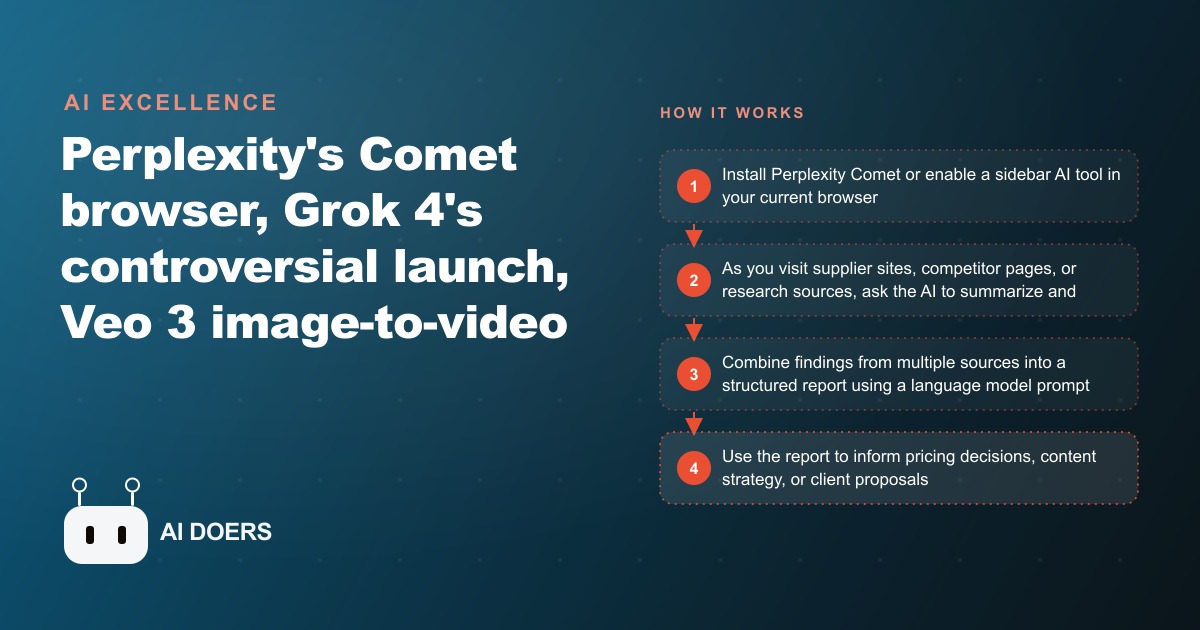
A twelve person restaurant with a part-time social media manager cut its content workload in half and ran four paid ad creatives in a month without a single production day. Madhuranjan Kumar here, and I want to walk through exactly how, because the tools that made it possible, an AI browser from Perplexity, Google's Veo 3 image-to-video with synchronized audio, and a handful of others, all landed in the same week and are available to any small operator right now. This is the story of one week inside that restaurant, chapter by chapter.
The restaurant is a single location with a team of twelve. It posts to Instagram twice a week, currently all static images from a monthly photography session, and runs occasional Facebook ads for dinner specials. Nothing about it is unusual, which is exactly why it works as a case. Here is what the week looked like once the manager decided to actually use what shipped.
Monday: turning still photos into motion
The manager started with Veo 3 on the twenty dollar consumer tier. The important change this week was that Veo 3's image-to-video pathway now generates synchronized audio, motion and sound produced together rather than a silent clip that needs sound designed and aligned separately in an editing tool. That single upgrade collapses a multi-step job into one.
She took the six best images from the last photo session and ran each through image-to-video with short ambient prompts: steam rising from a pasta bowl, ice settling in a cocktail glass, bread being placed on a wooden board. Each generation took about two minutes. In a single ninety minute session she produced six usable motion clips, enough for three weeks of content. This matters because video ads with relevant ambient audio consistently outperform silent video on click-through, and until now adding that sound meant either shooting real footage or hiring a sound designer. The restaurant's existing visual library, food photography, kitchen shots, bar setups, turned out to be enough raw material for a full AI video campaign.
Tuesday: watching the competition without the busywork
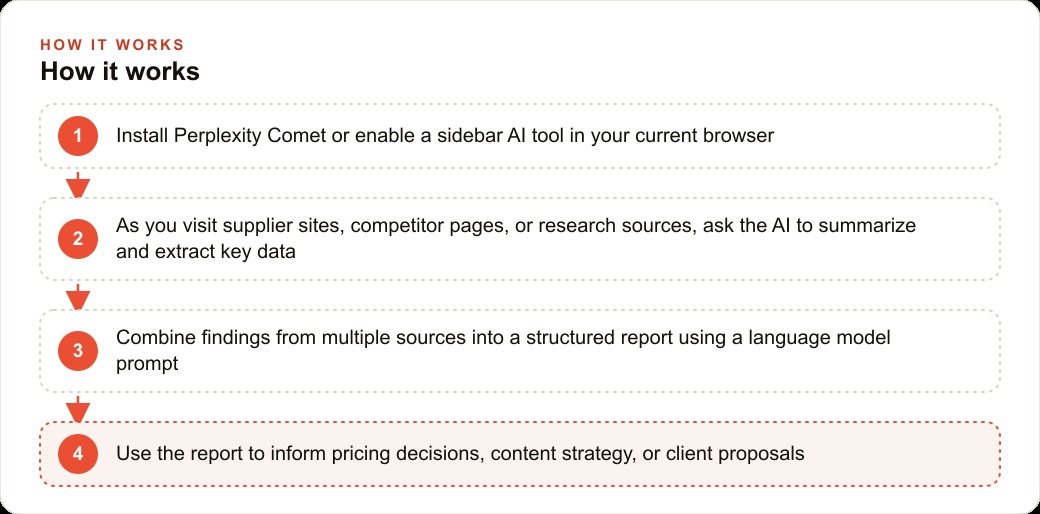
The next chapter was research. Perplexity's Comet browser, built on Chrome with an AI assistant integrated at the browser level rather than bolted on as a plugin, gives the manager a persistent sidebar that can see whatever she sees. The distinction is real. A plugin sits on top of the browser with limited access. A browser-level assistant can read the page, track a multi-page session, and answer questions in context without switching apps.
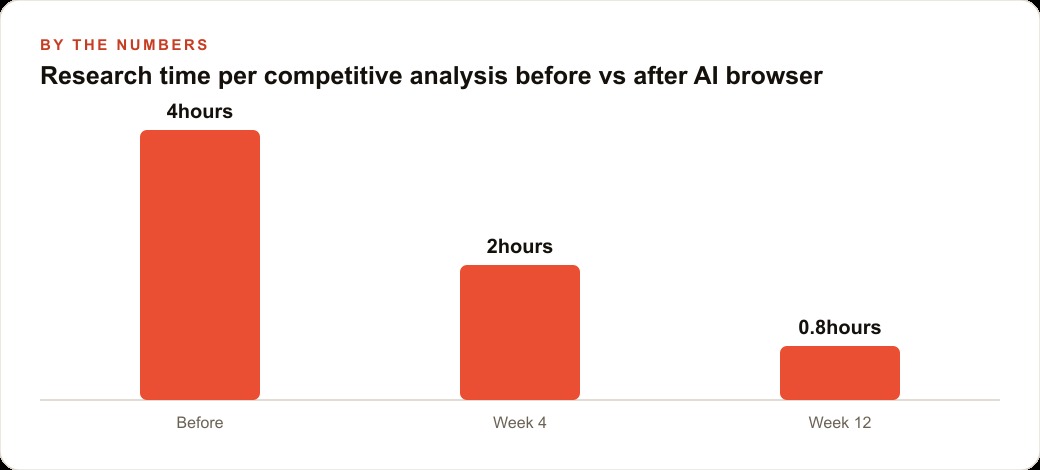
Once a week the manager visits the three main delivery platform dashboards and asks the sidebar to summarize any policy or fee changes since her last visit. What used to be thirty minutes of manual reading became ten minutes of asking. On the same tabs she checks competitor menu updates and pricing. For a restaurant on tight margins where a delivery platform quietly raising its commission can erase the profit on a category, that weekly ten minute scan is not a luxury. And for an operator whose plan does not include the full Comet, a free browser extension covers most of the same workflow, so the habit does not depend on the two hundred dollar tier.
Wednesday: building a dinner-special ad in twenty five minutes
Midweek the restaurant needed an ad for a Thursday dinner special. In the old world this meant scheduling a photographer or reusing a tired static image. This week the manager took the best image-to-video clip with audio from Monday and uploaded it directly to Meta. For the ad copy she used a ChatGPT prompt that included the dish name, the price, the key ingredients, and a note that the audience sits within a five mile radius.
Total production time for a creative that previously required a photographer on site: about twenty five minutes. The clip runs on Facebook and Instagram ad campaigns targeted to the neighborhood, and because it is genuine motion with ambient sound rather than a still image, it earns more attention in the feed for the same spend. The manager repeated this for four specials across the month.
Thursday: a sanity check on a bigger decision
The restaurant's owner has been weighing whether to open a second location, and this is where a different technique earned its place. Rather than trusting a single AI answer on a decision this consequential, the manager ran a simple version of a multi-model approach that this week's news made concrete through Sakana AI's TreeQuest research, which runs several models on the same problem and synthesizes their reasoning.
She submitted the same market analysis prompt to three different models, Claude, Gemini, and Grok, then asked a fourth to synthesize the three responses, identify where they agreed, where they diverged, and what those divergences suggested about the real uncertainties. No single tool automates this for a small operator yet, but the manual version is entirely doable at the twenty to thirty dollar tier, and it produced a far more honest picture than any one model's confident answer. The value is not that three models are smarter than one. It is that the places where they disagree map almost exactly onto the parts of the decision that are genuinely uncertain, which is precisely the information an owner betting a second lease needs and the part a single confident answer hides. Grok's close tie to real-time social data was useful here too, since a food trend breaking on social can be surfaced faster than an indexed-web tool would catch it, informing menu and promotion decisions before competitors react.
Friday: adding up the week
By the end of the week the pattern was clear. Over the month the restaurant published twelve video posts at an average reach roughly sixty percent higher than its static posts and ran four paid creatives without a content production day. The social media manager's effective time on content dropped from eight hours a week to four. That recovered time went back into strategy and floor operations, which is where a small restaurant actually needs its people. The same clips did double duty as well, since video posted consistently also strengthens the restaurant's footprint on SEO and organic search, so the content built for social quietly helped new diners discover the place through search too.
Put illustrative numbers on the return. Tool cost for the whole workflow ran twenty to forty dollars a month if the manager used ChatGPT plus a free browser extension instead of the full two hundred dollar Comet plan. If the improved content drove ten additional dinner reservations in a month, at a sixty dollar average check for a table of two that is six hundred dollars of incremental revenue, and at a typical fifteen percent restaurant margin that is ninety dollars of contribution against a tool cost under forty. The payback is under a month. The larger saving is the avoided agency cost: a content agency delivering four custom video posts a month typically charges eight hundred to fifteen hundred dollars, and the restaurant now runs the equivalent in-house for the price of a couple of subscriptions plus a few hours of staff time a week.
Saturday: turning a good week into a repeatable system
A single strong week is a story. A system is what changes the business, and the manager spent Saturday making the week repeatable rather than exceptional. She wrote down the workflow as three standing routines so that none of it depended on remembering what worked. The first routine is a Sunday batch session: take the best food photos on hand, run each through image-to-video with a short ambient prompt, and generate enough clips for the coming three weeks in one ninety minute block. The second is a Monday research pass: open the delivery dashboards and competitor pages and ask the browser sidebar to summarize what changed since last week, ten minutes total. The third is an ad routine tied to each week's special: pull the best clip, generate copy with a location note, and launch.
Writing these down mattered more than it sounds. The value of AI tools for a small team does not come from a burst of enthusiasm in week one. It comes from converting the enthusiasm into a habit that survives a busy Friday night and a short-staffed Tuesday. By turning each capability into a named routine with a fixed time slot, the manager made sure the four hours a week she recovered stayed recovered, rather than quietly filling back up with the old manual process the moment things got hectic.
She also set two guardrails. Every generated clip gets a five second human review before it posts, and no tool decision overrides a strategy decision. The dishes to feature, the pricing to push, and the audience to target are still the owner's calls. The AI executes them faster, and the routines make sure that execution happens on schedule every week without a production day. That combination, faster execution inside fixed routines with human judgment on top, is what turned a good week into a durable change in how the restaurant markets itself.
The week in context: AI moved past productivity
The reason this week stood out was not only the restaurant-friendly tools. The same week brought clinical results, AI-assisted embryo selection improving implantation rates in IVF, and a DeepMind spinout compressing drug discovery stages from years into months. Those stories are not immediately actionable for a restaurant, but they change the frame. AI is now measurably improving outcomes in some of the hardest domains that exist, reproductive medicine and pharmaceutical development, where progress has been incremental for decades.
If AI can compress a drug development stage from years to months in one of the most complex scientific fields there is, the argument that it cannot meaningfully improve the content, research, and decision workflows of a local restaurant becomes very hard to sustain. For healthcare-adjacent businesses there is even a direct content angle, since patients are now encountering real peer-reviewed improvements and want to understand them. For the restaurant, the lesson is simpler: the tools are ready, and the operators who adopt them early build a real efficiency edge.
The mistakes the manager avoided
Three errors would have undercut the whole week. The first is over-investing in the most expensive tools before validating the workflow on free or low-cost tiers. The full Comet at two hundred dollars a month is right for heavy browser-based research, but for a restaurant that mostly needs social content and light competitive monitoring, the twenty dollar tier and a free extension do the job. The second is posting AI video without a human review, since AI video still makes visual errors, impossible physics, implausible food textures, and a five second look before posting catches what would make the brand look careless. The third is treating the tools as a replacement for strategy. The restaurant still has to decide which dishes to feature, what pricing to push, and which audience to target. The tools execute the strategy faster; they do not invent it.
How to run this week yourself
Start with one photograph and one Veo 3 test. Write a simple prompt, a close-up of a signature dish with gentle steam rising, soft warm lighting, and ambient restaurant noise, generate it on the free trial, and post it as a single reel. If the reach beats your recent static average, upgrade to the twenty dollar plan and set a standing Sunday session to batch the week's video content in one ninety minute block. Track reach and engagement weekly for the first month.
For research, install Perplexity's free browser extension and spend one session practicing asking questions about the pages you already visit in your normal workflow. The habit of asking the sidebar instead of manually reading and summarizing is the core skill that makes the tool valuable. Everything above is self-manageable for a restaurant team. If you want help connecting the content to paid campaigns and tracking which video creatives are actually driving reservations, that is a more involved conversation worth scheduling.
That is exactly what we do at AI DOERS. Book a private 30-minute call with Madhuranjan Kumar and we will map the fastest path to it for your specific business.
Book your call →
Madhuranjan Kumar
Madhuranjan Kumar brings 20 years of performance-marketing experience and has managed over $200 million in Facebook ad spend for brands across the United States and beyond. His expertise spans the full modern marketing stack: Meta, Google Ads, TikTok, email automation, CRM, and the websites that hold it together. At AI DOERS he turns that track record into lead-generation systems for businesses across every industry.