
Grok 4 Is the Most Powerful AI Available Right Now. Here Is What That Means for Your Business.
xAI's Grok 4 tops every hard AI benchmark and was built specifically for tool use and strategic reasoning. Here is a practical guide for business owners who want to use it for real planning work.

Benchmark leaderboards for AI models have a credibility problem. They are updated so frequently, and the margin between positions is often so small, that most business owners have learned to treat them as marketing noise. Grok 4 landing at the top of Humanity's Last Exam and ARC-AGI is different, and I want to explain why before getting into what it actually means for a business. I am Madhuranjan Kumar, and this is the kind of release that matters precisely because the benchmarks in question were designed to be nearly impossible to top.
Grok 4 is the first model to top every hard benchmark at once, and that matters for a specific reason
Humanity's Last Exam is not a standard reasoning test. It was assembled by gathering the hardest questions that PhD-level researchers across dozens of academic disciplines could construct, covering advanced mathematics, specialist medicine, materials science, formal logic, and fields where even experts within the discipline would struggle with the questions. ARC-AGI is specifically designed to measure whether an AI can reason through genuinely novel problems, meaning problems that cannot be solved by pattern-matching against training examples. Both benchmarks were built with the explicit goal of being hard enough that passing them would mean something.
Grok 4 tops both. That result matters for businesses not because it implies the model can answer PhD-level chemistry questions you are likely to need answered, but because the underlying capability those benchmarks measure is the same one that drives performance on complex real-world planning tasks. A model that can sustain reasoning across many steps, hold many constraints simultaneously, update its position when it encounters conflicting information, and produce a conclusion that accounts for all of it, is exactly the model you want when the task is building a technician schedule, analyzing service area profitability, or designing a pricing structure for a new service tier.
The difference between Grok 4 and models that score lower on these benchmarks is not primarily a writing quality difference or a creativity difference. It is a reasoning depth difference. Complex business planning tasks are precisely the category where reasoning depth translates directly into output quality.
10x more reinforcement learning compute is the mechanism behind its planning strength
The benchmark scores are the result, but the mechanism behind them is worth understanding because it tells you what category of tasks Grok 4 is strongest at. xAI used roughly ten times more computing power in the reinforcement learning phase compared to previous Grok versions. Reinforcement learning is the training stage where the model learns by attempting tasks, evaluating whether each attempt produced a good outcome, and adjusting its behavior accordingly. More compute at this stage does not just make the model faster. It makes it better at the specific things reinforcement learning teaches, which are iterative problem-solving, self-correction, and sustained reasoning across many steps.
This is the direct explanation for why Grok 4's outputs on strategic planning tasks feel more thorough and complete than what earlier models produced. The model learned to check its own work more rigorously, to pursue a line of reasoning further before concluding, and to produce answers that account for more of the relevant variables. For a business planning task that involves real constraints, such as a staffing model that needs to balance coverage requirements, travel time, overtime limits, and seasonal demand swings simultaneously, the extra reasoning depth is what produces a useful output rather than a surface-level answer that misses the constraints that matter most.
Grok 4 also runs multiple internal reasoning agents in parallel and selects the strongest answer before responding. This internal parallel reasoning is the mechanism behind its planning outputs feeling unusually complete. Before the answer reaches you, the model has effectively generated and evaluated several approaches to your question and chosen the one that holds up best. For complex planning prompts, this produces outputs that are notably more thorough than single-pass generation.
Tool use by design means it searches the web and pulls live data into its analysis
Grok 4 was trained explicitly on tool usage, not as an afterthought but as a core design objective. It learned how to search the web, call external APIs, run code, and interact with live data sources as part of completing tasks. This distinguishes it from models designed primarily for conversation or creative writing. Grok 4 is designed to reason through a problem and then act on that reasoning using real tools to gather real information.
The practical implication for business planning work is significant. When you ask Grok 4 to help decide whether to expand into a new service area, it can look up current population data for that area, check competitor presence and pricing in the market, review relevant demand trends from recent public data, and factor all of that into a structured recommendation. This is closer to what a junior analyst with web access does than what a language model that answers from training memory does. The analysis is grounded in current information rather than the model's memory of how things were at some point in its training period.
For Facebook and Instagram ad campaigns where competitive intelligence matters, enabling Grok 4's web search lets it pull current information about what other businesses in your category are running rather than answering from training data that may be a year or more out of date. For SEO and organic search keyword planning, the same web access lets it research what terms are currently gaining traction rather than what was trending historically. For any planning task where the accuracy of the input data determines the quality of the output decision, the tool-use capability is the feature that makes the analysis reliable.
The voice mode makes strategic planning sessions possible during commutes and field visits
The new voice mode on Grok 4's mobile app enables a genuinely different use case for field-service business owners. Most planning work with AI tools happens at a desk, because typing a structured prompt with real constraints requires a keyboard and a focused few minutes. Voice mode removes both of those requirements.
An HVAC owner who spends three to four hours per day in a truck driving between service calls now has access to structured planning sessions during that time. The owner can speak through a problem, "I need to figure out which ZIP codes in my service area are actually profitable after accounting for drive time, because I suspect I'm losing money on the outer ring," and have a back-and-forth conversation that works toward a framework for that analysis. The model can ask clarifying questions, the owner can answer them in natural speech, and twenty minutes later the owner arrives at the next appointment with a clearer framework for the profitability analysis than they had when they left the previous one.
The hands-free capability also matters for the specific way field-service business decisions get made. Many of the most important operational decisions happen during the day, in the truck, between jobs, when the problem is fresh. The voice mode is the first AI interaction pattern that fits naturally into that context without requiring the owner to stop, find a quiet moment, and type a structured prompt.
The competitive window for first movers is narrow and worth taking seriously
Right now, the large majority of small business owners use AI primarily as a writing assistant. They generate emails, social media posts, and occasional blog drafts. A much smaller number use it for analysis tasks. A still smaller number use it for structured strategic planning sessions where the output directly informs operational decisions. The businesses in that last category are building an advantage that is compounding every week.
The gap between using AI to write better emails and using AI to build a technician scheduling model that reduces overtime by twelve percent is not a technology gap. The technology is available to everyone. It is a workflow gap, a habit gap, and a prompt-quality gap. The business owners who invest the time to build structured planning sessions into their weekly routine now will have done a year's worth of iteration on those sessions before competitors who have not started yet begin. By the time the practice becomes common enough that every competitor is doing it, the early movers will have planning workflows that are refined, tested, and producing consistent outputs while everyone else is still figuring out how to write a useful planning prompt.
The HVAC example makes the window concrete. The owner sat down with Grok 4 and built three planning outputs in a single structured session. The first was a technician scheduling model for peak summer demand. The owner provided technician count, their service area ZIP codes, historical call volume by week for the previous two summers, and the target of keeping overtime under ten percent while maintaining a four-hour response time during peak weeks. The output was a week-by-week staffing model through the season, with the three highest-volume weeks flagged so a contract technician could be arranged in advance rather than scrambled at the last minute.
The second was a service area profitability analysis. The owner provided revenue, call volume, average ticket size, and approximate drive time by ZIP code. The model ranked each area by estimated net margin after travel time and fuel costs. Two ZIP codes that looked acceptable on gross revenue were losing money after those costs were factored in. The recommended move for each: raise the minimum ticket price to cover the travel overhead, or stop serving that area and redeploy that capacity into higher-margin zones closer to the company's base.
The third was a maintenance plan structure. An annual membership where customers pay monthly for two scheduled tune-ups and priority scheduling is one of the highest-margin revenue streams an HVAC company can add. The model designed the membership tiers, wrote the pricing rationale, created talking points for technicians to use during service calls, and drafted a three-email sequence to offer the plan to the existing customer list. The full package came out of one session. The owner estimated the maintenance plan, if it converts fifteen percent of the existing customer base at a monthly fee, adds roughly forty thousand dollars per year in predictable recurring revenue.
That session took ninety minutes. The planning work it produced would have taken a consultant several billable hours to deliver and several weeks to schedule. The owner did not need technical expertise to run it. They needed real numbers, a structured approach, and a clear question for each of the three tasks.
The CRM and website stack that the company uses to follow up after service calls can be updated to reflect the new maintenance plan offer based on the language the session produced. The scheduling model can be revisited each spring as the new season's data comes in. The profitability analysis can be refreshed when service area coverage expands. Each session builds on the last, and the model gets better outputs when you provide it prior outputs as context for the next round.
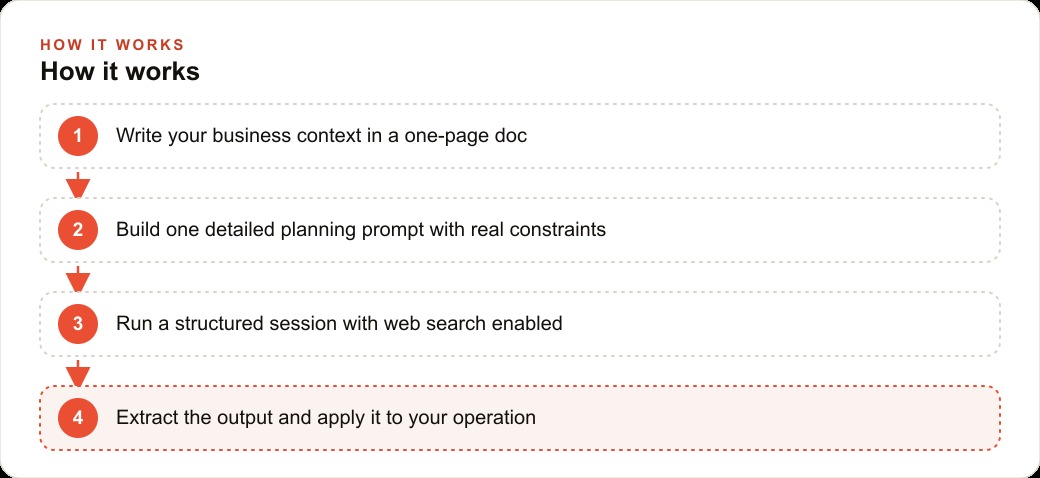
The Heavy plan at $300 per month is the tier that unlocks the full multi-agent reasoning cycle. For complex planning work where the output quality directly affects a real business decision, the cost difference compared to the standard tier is justified by the output depth difference. For simpler tasks, the standard tier is sufficient. The practical starting point is a month-long test: pick one operational decision that currently consumes three to four hours of your time each week, spend a focused ninety-minute session building a structured prompt for it, run the session with web search enabled, and evaluate the output against what you would have arrived at manually. For most owners running service businesses, one strong planning session covers the monthly cost of the subscription many times over in recovered time.
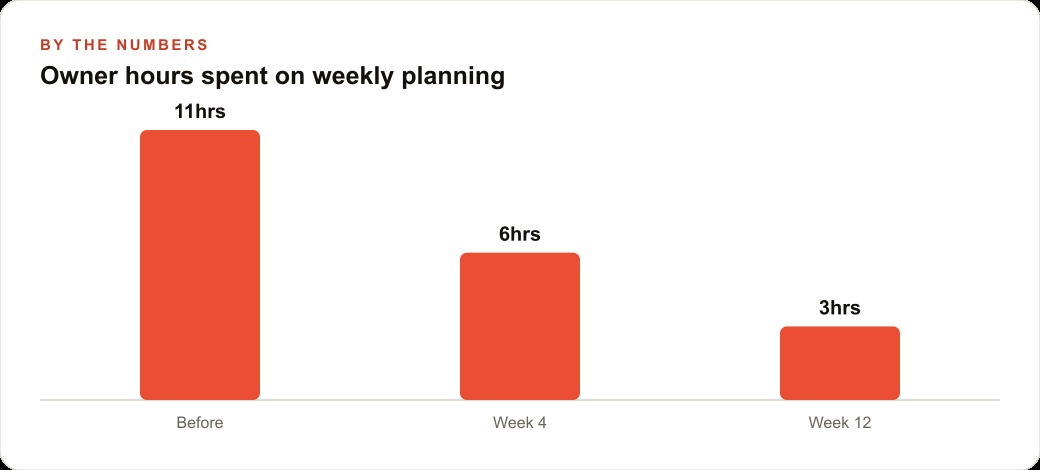
The benchmark numbers for Grok 4 are impressive. The more important number is how many hours of strategic planning time you spend each week that a well-structured Grok 4 session could compress into a fraction of that time, starting this week.
That is exactly what we do at AI DOERS. Book a private 30-minute call with Madhuranjan Kumar and we will map the fastest path to it for your specific business.
Book your call →
Madhuranjan Kumar
Madhuranjan Kumar brings 20 years of performance-marketing experience and has managed over $200 million in Facebook ad spend for brands across the United States and beyond. His expertise spans the full modern marketing stack: Meta, Google Ads, TikTok, email automation, CRM, and the websites that hold it together. At AI DOERS he turns that track record into lead-generation systems for businesses across every industry.