
Grok 4.1 and the Road to Grok 5: Why Multimodal AI Is About to Change Online Stores
Grok 4.1 is live and Grok 5 promises a much larger model that reads images, video, and audio together, which hands online store owners a way to turn product media into listings, answers, and sales.

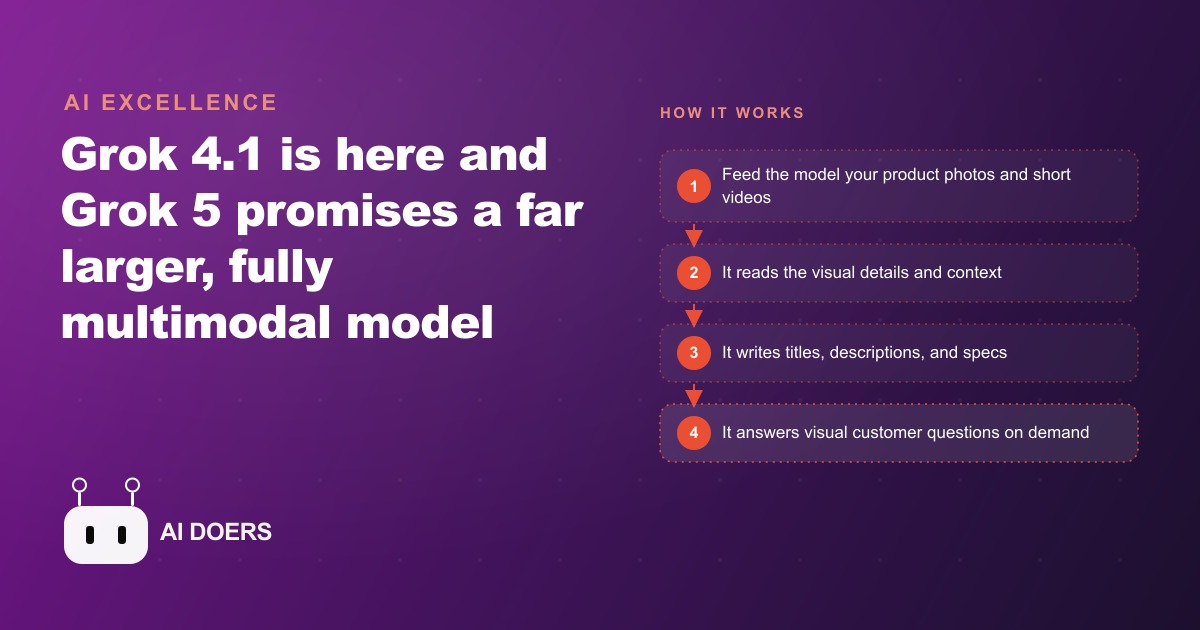
There is a quiet gap running down the middle of almost every online store, and Grok 4.1 landing this week, with Grok 5 already promised behind it, is the clearest sign yet that the gap is about to close. The gap is this. Stores are built out of pictures and video, beautiful, detailed, expensive to produce, and the software that runs them can barely read any of it. A product photo that a human understands in half a second is, to most systems, an opaque file with a price tag stapled on. For years we have papered over that blindness with hand typed descriptions, manual tagging, and support agents squinting at the same image the customer is looking at. That workaround is what multimodal AI is coming for.
I want to make an argument rather than list features, so let me state it up front. The most important thing about the Grok 5 roadmap is not the horsepower, it is that visual understanding is finally becoming native, and native visual understanding rewrites how a store turns its media into money. Grok 4.1 is out now, and the team is openly setting expectations for Grok 5 as the biggest leap yet, describing it as a six trillion parameter model, double the three trillion behind Grok 3 and Grok 4, with much higher intelligence packed into every gigabyte. They put a small but real chance on it being a genuine step toward general intelligence. Those numbers are impressive, but they are not the point. The point is the design choice underneath them.
The shift from bolted on to born multimodal
For most of the last few years, models handled images the way a monolingual traveler handles a foreign menu, by translating everything back into the one language they actually think in, which was text. Vision was a bolt on. You could show a model a picture, but it was really being handed a caption someone else had generated, and a lot got lost in that handoff. What the Grok 5 description signals is a model built to be multimodal from the ground up, where text, images, video, and audio all flow through the same reasoning rather than being converted and stapled together after the fact.
That distinction sounds academic until you remember what real business content actually looks like. It is not clean paragraphs. It is a messy mix of pictures, short clips, captions, and voice notes. A model that treats all of that as one shared stream of understanding can look at a product photo, read the caption, watch a short demo, and listen to a voice memo, then reason across the whole thing at once. The standout claim on top of this is real time video understanding, the ability to watch a live feed and grasp what is happening as it unfolds, something the team argues other models still cannot do well even though humans lean on it every waking moment. Pair that with much stronger tool use, where the model can go fetch a price or update a record rather than just describing what should happen, and you have a system that does not merely see your content, it acts on it.
Why the pace is the real story
The other thread worth pulling is speed. The gap between Grok 4.1 and the promised Grok 5 is short, and it keeps getting shorter with each release across the industry. There is also Grokipedia, planned to be renamed Encyclopedia Galactica, an open knowledge base anyone can access, use, or train on, which tells you how quickly the raw material for these systems is being assembled in the open. The lesson a store owner should take from that pace is not to wait for the perfect model. It is to get comfortable working with images and video now, so that the moment the next jump lands, you are ready to use it rather than starting from zero.
I find this reassuring rather than intimidating, because it means the skill you build today does not expire. If you learn to hand your product media to a capable multimodal model and get consistent listings back, that habit gets more valuable with every release, not less. The stores that win the next two years will not be the ones that guessed which model would be best. They will be the ones that already had a pipeline for turning visual content into words and answers when the capability matured.
Where the blindness costs a store the most
Think about where a store actually bleeds time and sales because software cannot see. The first place is the catalog. Most stores have genuinely good photos and thin, inconsistent descriptions, because writing them by hand is slow and boring, and it shows. Two products photographed on the same day end up with wildly different levels of detail depending on who typed the copy and how tired they were. A multimodal model reads the actual pixels, so it catches the texture, the clasp, the pattern, the small details a rushed team misses, and it keeps the wording uniform across hundreds of products in the store's own voice.
The second place is support. Shoppers constantly ask questions a text bot simply cannot handle, like whether a bag will fit a laptop or how a jacket looks from the back. A model that can look at the product photos answers those directly, and as real time video matures it could even watch a short clip a customer sends and tell them whether a part matches. Every one of those answered questions is a sale that did not stall and a return that did not happen. The blindness was never free. It just hid its cost inside abandoned carts and support tickets that never got a good reply.
It is not only stores that sit on visual gold
I keep coming back to online stores because the payoff is so obvious there, but the argument is bigger than retail, and it is worth widening the lens for a moment. Any business that lives on visual content is sitting on the same untapped asset, and that is far more businesses than people assume. If your work involves photos, video, or audio that someone currently has to describe by hand, a multimodal model can do that describing for you. Real estate listings, restaurants with food photos, trades that document jobs with pictures, and creators with sprawling video libraries all sit on piles of visual material that is hard to search and slow to turn into words. The blindness tax is not a retail problem, it is a content problem, and content is everywhere.
The reason retail is the cleanest example is that the connection between a described product and a sale is short and measurable. But the same mechanic applies wherever visual content is trapped. A tradesperson who photographs every job has, without realizing it, been building a library that a multimodal model can turn into case studies, service pages, and answers to customer questions. A real estate agent's listing photos can become rich descriptions and instant replies to buyer questions about a room they are looking at. The pattern is identical to the store's catalog problem: valuable visual material, generated as a byproduct of normal work, sitting unused because until now nothing could read it. What changes with a genuinely multimodal model is that the reading finally happens, and the byproduct becomes an asset.
There is a second reason this matters for these businesses specifically. Visual content is not just hard to describe, it is hard to search and hard to reuse, so it tends to be created once and then lost. A tradesperson has thousands of job photos scattered across a phone that no one will ever look at again. A restaurant has a folder of dish shots that get posted once and forgotten. A multimodal model changes the economics of that content by making it readable, which means searchable, which means reusable. Suddenly the pile of photos is a queryable library you can pull descriptions, answers, and marketing material out of on demand. The content did not get more valuable because you made more of it. It got more valuable because something can finally read what you already had.
This is why the design choice underneath Grok 5 matters so much more than the parameter count. A model that treats images and video as first class understanding rather than an afterthought unlocks value that was always there but never accessible. The businesses that win are not the ones with the most advanced model. They are the ones that noticed they were already sitting on a pile of visual content and got a capable model to read it before their competitors did.
A concrete run through one store
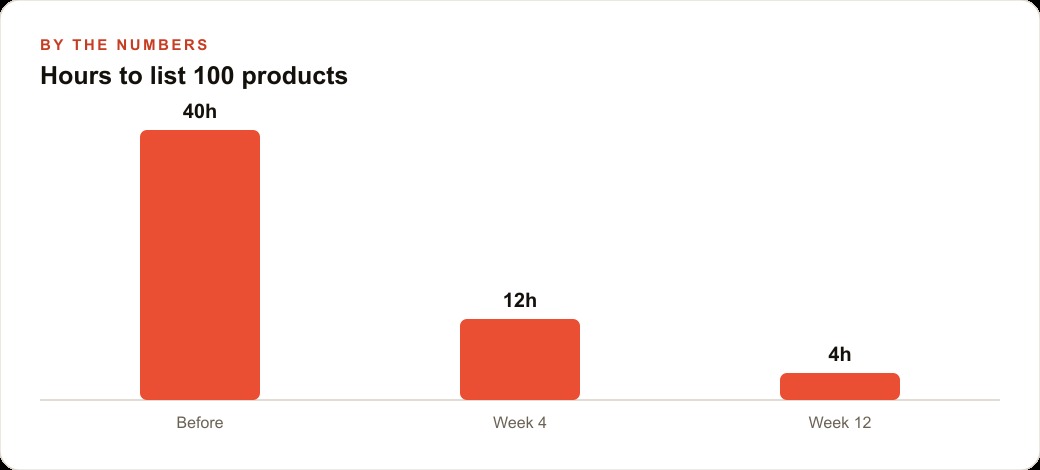
Let me put numbers to it with an illustrative example, because the argument only matters if it pays. Picture a store with one thousand products and a small team. Cataloging by hand runs at roughly the pace this kind of work always has, and getting a hundred products fully and consistently described might take around forty hours of someone's week. Hand the same batch to a capable multimodal model with a clear instruction about title format, description length, tone, and the exact specs to pull out, and that forty hour slog collapses toward an afternoon of review, call it four hours once the model is dialed in. Across a thousand products, that is the difference between a project that never quite gets finished and one that wraps in a couple of weeks.
The payoff does not stop at time. Consistent, detailed, keyword rich descriptions are exactly what SEO and organic search rewards, so the same pass that fixes the catalog quietly lifts the store's visibility without any extra work. The alt text the model generates for accessibility does the same job for image search. Then the visual support layer goes live, cutting the questions that used to stall checkout, and the leads and conversations it captures flow into the CRM and website stack where follow up automation handles the next few touches. If the store drives traffic through Facebook and Instagram ad campaigns, the product media the model has already read becomes ready made ad creative, described and tagged and on brand. One capability, letting the model see what you sell, pays off in four directions at once.
Start with your images, not a grand plan
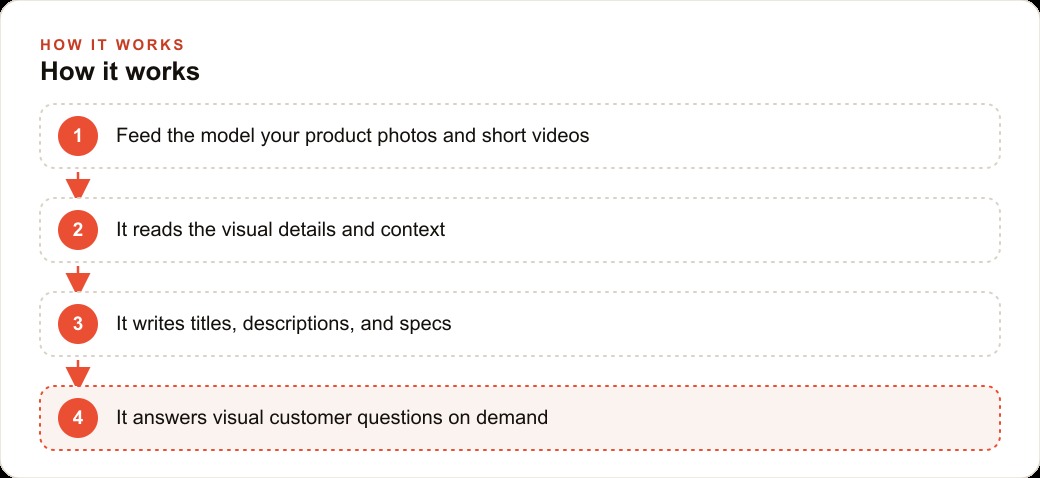
If the essay has a single instruction, it is this. Start with your images, not a strategy deck. Take a small batch of products, maybe twenty, and hand the photos to a capable multimodal model with a clear brief about format, length, tone, and specs. Review what it writes, correct the wording and the details it gets wrong, and fold those corrections back into your instruction so the next batch comes back better. Once the listings read the way you want, scale to the full catalog, then layer visual support and content generation on top of the same setup. Keep a human checking accuracy, because a confident wrong spec costs you returns and trust, and that is the one failure a store cannot absorb quietly.
The deeper features, the real time video and the self created tools, are coming fast, but they are step two, and the roadmap all but guarantees they will arrive whether you prepare or not. The hard part today is writing the instruction so the output matches your brand and your catalog rules exactly, and building a quick review habit so quality holds at scale. That is unglamorous work, and it is precisely where the advantage lives, because most stores will keep typing descriptions by hand until the gap between them and the ones that adapted becomes impossible to close. You can do all of this yourself with the steps above, or you can have your catalog pipeline built, tuned to your product types, and handed over already working. The tools are about to be able to see everything you sell. The only question is whether your store is ready to let them.
That is exactly what we do at AI DOERS. Book a private 30-minute call with Madhuranjan Kumar and we will map the fastest path to it for your specific business.
Book your call →
Madhuranjan Kumar
Madhuranjan Kumar brings 20 years of performance-marketing experience and has managed over $200 million in Facebook ad spend for brands across the United States and beyond. His expertise spans the full modern marketing stack: Meta, Google Ads, TikTok, email automation, CRM, and the websites that hold it together. At AI DOERS he turns that track record into lead-generation systems for businesses across every industry.