
GPT-5 vs GPT-4o: I Tested Both on 10 Real Tasks. Here Are the Results and What They Mean for Your Business
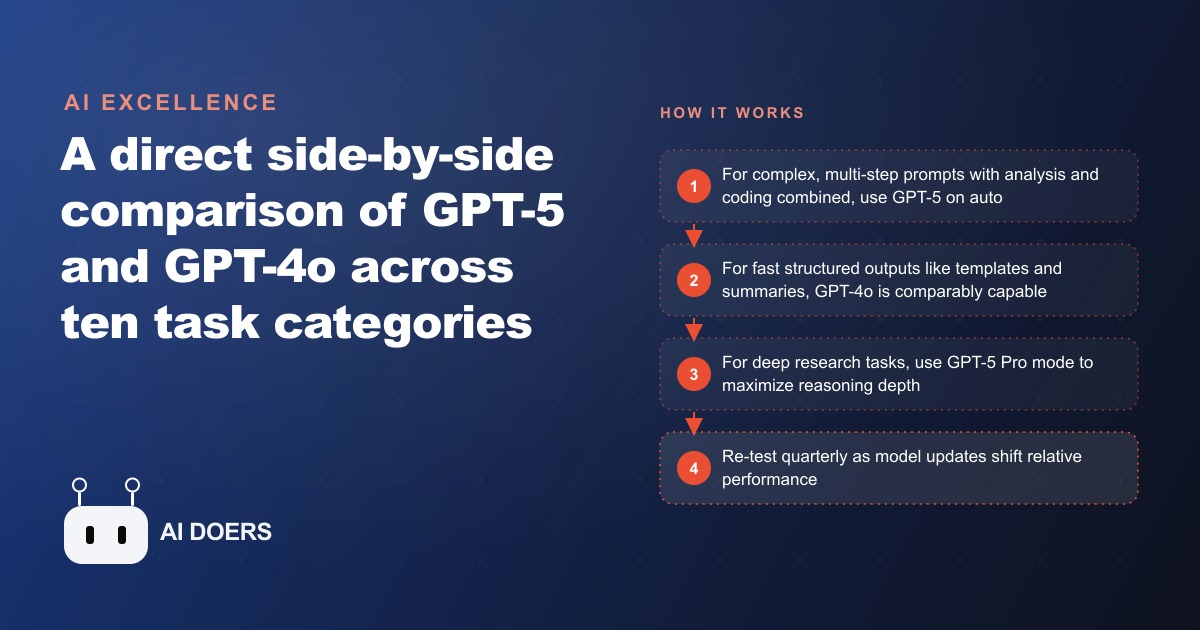
OpenAI brought back GPT-4o after user pushback against GPT-5, creating a rare opportunity to compare both models directly. The results show clear differences in how they handle complex, multi-step business prompts, and knowing which to use for which task saves meaningful time.

Eight things the GPT-5 versus GPT-4o test actually revealed
For a brief window, both of OpenAI's flagship models are available side by side, which almost never happens, and it makes for an unusually clean comparison. I am Madhuranjan Kumar, and I ran both models through the same real-work prompts across ten categories to find where the difference is material and where it is noise. Broad claims about which model is "better" are useless. What you actually need is a task-by-task map. Here are eight specific findings, each one something you can act on.
1. GPT-5 decides how long to think on its own
The single biggest architectural change is that GPT-5 is a hybrid reasoning model. It internally decides how much thinking to apply to each prompt. Ask something simple and it answers fast. Give it a complex, multi-step prompt and it spends more time before responding. GPT-4o does none of this. It is a single-mode model that applies a consistent level of processing to every prompt. This matters because it means GPT-5's advantage shows up specifically on hard prompts, and barely at all on easy ones. The model is allocating effort where the difficulty is, which is exactly why a fair test has to include genuinely complex tasks, not just short ones.
2. GPT-4o only came back because users revolted
When GPT-5 launched, OpenAI deprecated GPT-4o and the other older models across all plans. A significant chunk of users disliked the change, particularly around tone and output style, and pushed back hard enough that OpenAI reintroduced GPT-4o as a legacy option in the model dropdown. That is why this comparison is even possible. The lesson buried in this finding is about switching costs and preference: model updates are not universally welcomed, and the "newest" model is not automatically the one your team will prefer for every task. Keep your own judgment, not the version number, as the deciding vote.
3. Auto mode is the only fair way to compare them
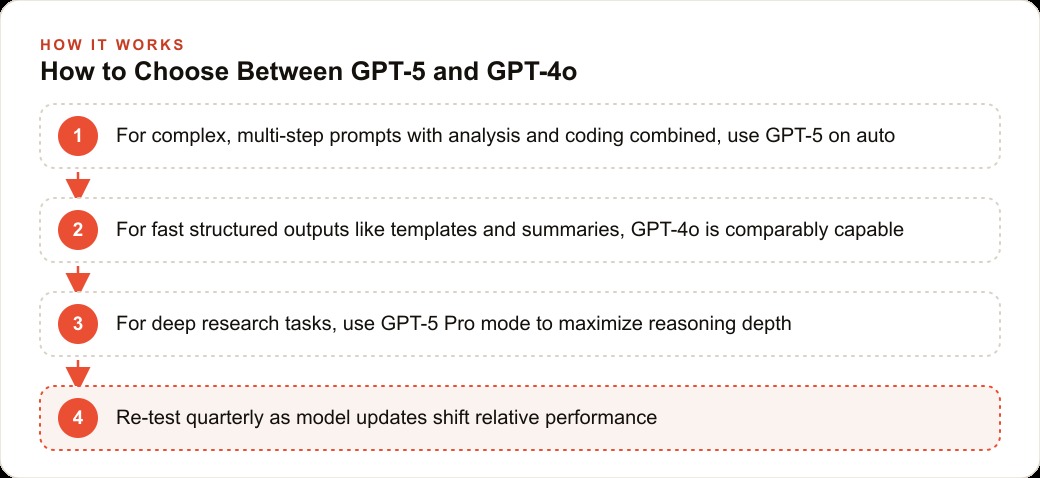
There is a right way to run this test. GPT-5 on auto mode lets the model decide its own reasoning depth, and since GPT-4o also gives you no reasoning toggle, auto is the fairest baseline. Comparing GPT-5's maximum thinking mode against GPT-4o would be rigged, and comparing a hobbled GPT-5 would be too. The methodological point generalizes to any tool test you run: match the settings so you are measuring the thing you actually care about, which is how each model performs on your prompts under normal conditions, not under artificial ones.
4. GPT-5 finishes multi-step prompts that GPT-4o partly drops
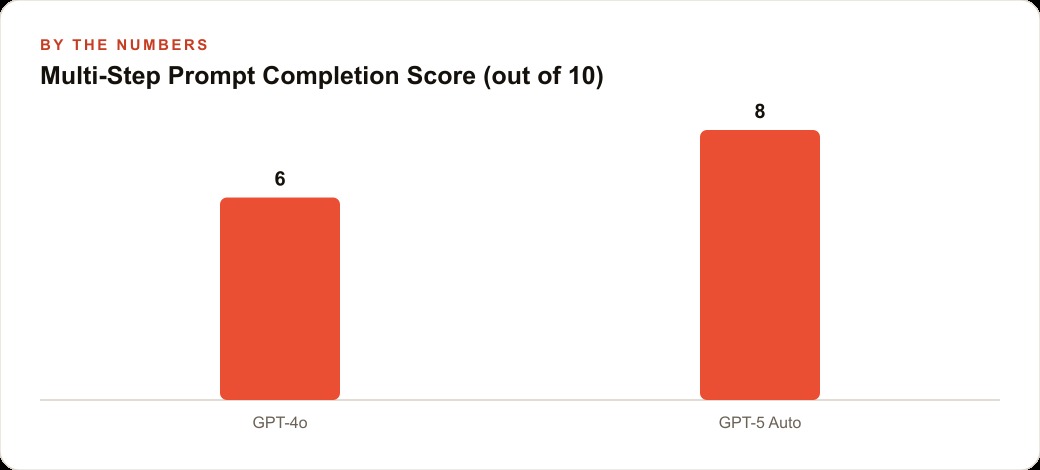
This was the clearest, most repeatable finding. On a multi-input prompt that combined three simultaneous tasks, analyze a screenshot of a webpage, recreate it in canvas, and suggest conversion improvements, GPT-5 addressed all three parts more completely. GPT-4o completed the task but with real gaps: a broken image that needed manual fixing, generic design decisions, and surface-level suggestions. GPT-5 showed better design judgment, gave more specific conversion advice tied to the actual page, and even resolved the broken image by asking for a source link. When a prompt has several parts, GPT-4o tends to answer some and quietly skip others, while GPT-5 covers the whole thing.
5. Canvas and layout quality is where the gap is visible to the eye
Beyond completeness, the design quality of canvas outputs differed noticeably. On web-page generation tasks, GPT-5 made better layout decisions and produced more polished visual results on identical prompts. This is the finding that matters most if any part of your work involves generating pages, mockups, or formatted documents. The difference is not subtle wording, it is something you can see. For simple structured outputs, though, the two are close, which is the recurring theme: the gap widens with complexity and design demand, and narrows to nothing on plain tasks.
6. A hidden personality setting changes every answer
Most users have never touched this. ChatGPT has a personality configuration, tucked into the customize section, that changes how the model communicates. The default is described as cheerful and adaptive, but options like nerd, listener, or a more direct style change the texture of every response. It is not advertised on the main interface, and it can meaningfully change how useful the model feels day to day. For business writing that needs to be more direct, or for anyone who finds the default too casual, this single setting is worth five minutes to explore. It is the cheapest quality upgrade in the whole comparison.
7. Pro mode is for research, not for everything
The Pro option on paid plans forces extended thinking, and it is specifically designed for long research tasks where spending more time produces materially better output, like deep analysis or technical writing. The mistake is assuming Pro is always better. On simple tasks, extended thinking is just slower for no gain. Save Pro mode for genuinely complex analysis, not for drafting a quick email. Matching the mode to the task is the whole discipline: auto for daily work, Pro for the heavy research jobs, and the legacy model when speed on a simple task matters more than depth.
8. The cost math decides where each plan pays off
Here are the practical numbers. GPT-5 in standard form is available to free users with usage limits. The Plus plan runs a modest monthly fee and unlocks higher limits plus thinking mode. The Pro plan is an order of magnitude more expensive and suits users who regularly do deep research or technical writing where extended reasoning earns its keep. GPT-4o lives inside the paid plans as a legacy option, not a separate subscription. For most small businesses, Plus is the right entry point, and Pro is only worth it if your work genuinely leans on heavy analysis.
A worked example: an HVAC office manager writing proposals
Numbers make this concrete, so consider an HVAC company with a handful of technicians and one office manager who handles customer communications and quoting, running about thirty service calls a week and sending replacement proposals to roughly ten customers a month. A detailed replacement proposal used to take the manager forty-five to sixty minutes each, because it had to include the existing system specs, the recommended replacement with model number and efficiency rating, three pricing tiers, a financing option, and a plain-language explanation of why the replacement made sense.
With GPT-5, the manager types all of it into one prompt: the old system's specs from the technician's notes, the home's square footage, the customer's stated preference for efficiency, and three candidate units from the supplier catalog, then asks the model to analyze the options, recommend the best fit, structure a professional three-tier proposal, explain the energy savings in plain language, and format it for printing. GPT-5 returns a complete draft in under a minute that addresses all five parts, calculates the efficiency savings from the specs provided, and formats cleanly. The manager makes two small edits and sends it. Run the same prompt through GPT-4o and the proposal addresses the task but misses the savings calculation and formats the tiers inconsistently, costing about fifteen extra minutes of manual cleanup.
Across ten proposals a month, GPT-5 saves roughly two and a half hours of the manager's time. Framed as illustrative, at a typical hourly rate that recovered time covers a Plus subscription several times over, and that is before counting the follow-up emails, service reminders, and review requests the same tool can draft. Those drafts and the customer replies they generate flow into the CRM and website stack, where automated follow-up handles the next touches, and the same AI that writes proposals can spin up content for Facebook and Instagram ad campaigns and SEO and organic search pages, so one subscription pays off across several jobs, not just quoting.
What did not change: the fundamentals of a good prompt
For all the differences the test surfaced, it is worth naming what stayed exactly the same, because this is where most people waste the advantage a better model gives them. Neither GPT-5 nor GPT-4o can rescue a thin, lazy prompt. The multi-step test that separated the two models so clearly worked precisely because the prompt was rich, it supplied a screenshot, a clear set of tasks, and a defined goal. Feed either model a vague one-line request and the gap between them narrows, because a starved prompt caps how well any model can do. The better model raises the ceiling. It does not raise the floor.
That has a direct implication for how you should spend your effort. Owners tend to fixate on model choice, which model is smarter, which plan to buy, when the larger lever is almost always the quality of the input. A specific prompt that includes the real context, the actual constraints, the exact format you want, and a clear definition of done will beat a generic prompt on a smarter model nearly every time. So before you agonize over GPT-5 versus GPT-4o, audit your own prompts. If you are typing "write me a proposal" and getting mediocre output, the model is not the problem, the prompt is.
The second thing that did not change is the need to verify. Both models can produce a confident, clean-looking result that contains a wrong number or a subtly broken layout. GPT-5's edge is that it drops fewer parts of a complex task, but "fewer" is not "none," and a proposal with a miscalculated savings figure is worse than no proposal, because it damages trust with a customer. The discipline of reviewing output before it ships is not made obsolete by a better model, it is made more important, because better output is more tempting to send unread. Treat every draft as a draft.
Finally, the habit of re-testing did not change, it got more important. Model updates keep shifting the relative performance, personality settings change how the output reads, and new modes appear. The map you build today is accurate today. Bake in a quarterly re-test of your five most common prompts across whatever models are current, and you keep the map fresh without much effort. The tools and the same disciplined prompting also power everything downstream, the content that feeds SEO and organic search, the copy behind Facebook and Instagram ad campaigns, the follow-up sequences in the CRM and website stack, so the return on getting your prompting right shows up in far more places than a single proposal.
The map, not the verdict
The point of running both models across ten categories was never to crown a winner. It was to build a map: use GPT-5 on auto for complex, multi-step work where completeness and design quality matter, lean on the legacy option when a simple task needs a fast answer, reserve Pro mode for heavy research, and spend five minutes on the personality setting to match the tone to your business. Re-test every quarter, because model updates keep shifting the relative performance and today's map is not permanent.
The whole exercise takes under two hours and gives you a practical guide to which model to reach for in your specific work. If you want help mapping this out for your particular business workflows, so your team is not guessing which tool fits which task, that is a structured discussion worth having. Either way, the eight findings above are enough to stop treating "which model is better" as a single question and start treating it as what it really is: a different answer for every task you run.
So the finding underneath all eight findings is a quiet one: the model matters, but the operator matters more. A disciplined owner with rich prompts, a verification habit, and a quarterly re-test will pull more value out of GPT-4o than a careless one pulls out of GPT-5 Pro. Buy the right plan for your task mix, learn where each model's edge actually shows up, and then put your real energy into the inputs and the review, because that is the lever the side-by-side test could not measure but every result depended on.
That is exactly what we do at AI DOERS. Book a private 30-minute call with Madhuranjan Kumar and we will map the fastest path to it for your specific business.
Book your call →
Madhuranjan Kumar
Madhuranjan Kumar brings 20 years of performance-marketing experience and has managed over $200 million in Facebook ad spend for brands across the United States and beyond. His expertise spans the full modern marketing stack: Meta, Google Ads, TikTok, email automation, CRM, and the websites that hold it together. At AI DOERS he turns that track record into lead-generation systems for businesses across every industry.