
GPT-4.1 Fixes Instruction Following, O3 Reasons While Searching the Web, and What Plumbing Companies Need From All of This
The biggest practical limitation of AI models until this release cycle was that reasoning and real-world information retrieval happened separately. When a model can search while it thinks, the quality of complex analysis goes up dramatically.

What does it mean that reasoning models can now use tools while reasoning?
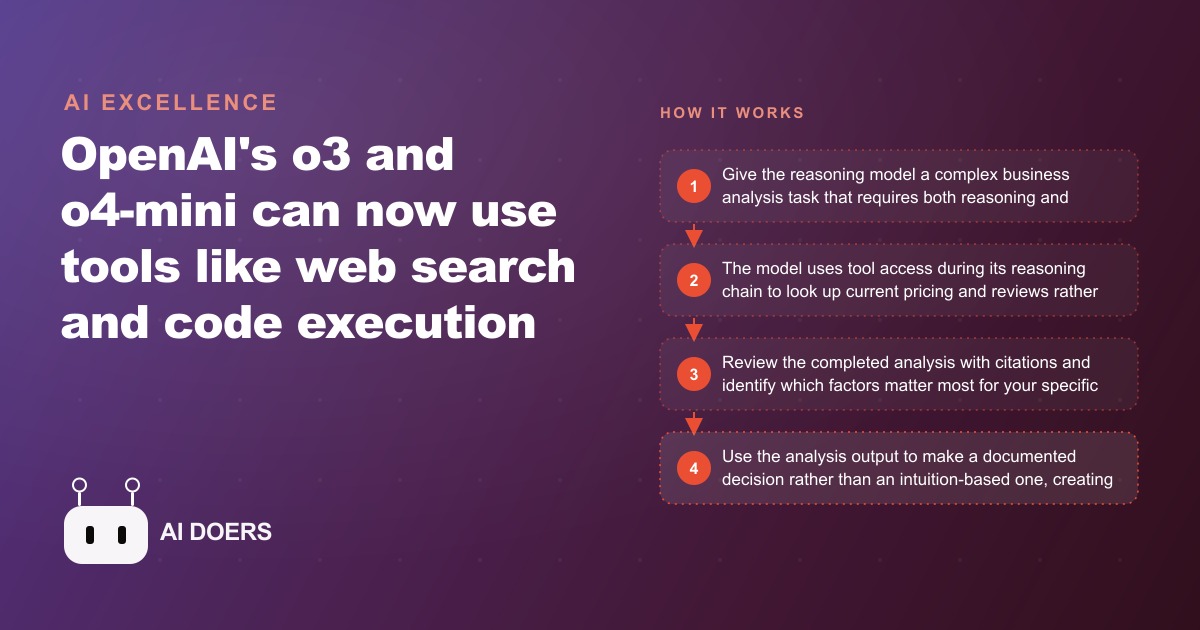
Previous AI model architectures separated reasoning from tool use. A reasoning model would think through a problem, then decide to use a tool, use the tool, get the result, and then continue thinking. These were sequential steps. If the tool result revealed something that should change the early reasoning, the model had to restart or the reasoning chain had already proceeded on incorrect assumptions.
With o3 and o4-mini's new capability, the model can use tools, web search, code execution, image analysis, mid-chain, while it is still building the reasoning. If the model is analyzing a business decision and realizes it needs a specific current price or a recent market fact to continue reasoning correctly, it can fetch that fact immediately and incorporate it into the ongoing reasoning chain without restarting.
For a plumbing company, the most immediately relevant application is not abstract. Consider asking an AI to analyze whether your current pipe supplier relationships are optimal given current market conditions, or to determine the best approach for a specific unusual repair situation where you need to reason about the options while referencing current code requirements. Previously, this required multiple separate queries: ask the AI the question, get an answer based on training data that might be outdated, separately search for current code requirements, and then manually integrate the results.
With reasoning during tool use, a single well-structured prompt produces an analysis that simultaneously reasons about the situation and verifies key facts in real time. The output is a more coherent, more reliable analysis than the manually integrated approach.
What specifically improved in GPT-4.1 that matters for business users?
GPT-4.1's most significant improvement for business use is instruction following for complex multi-part requests. Previous GPT-4 versions would sometimes drop one of several instructions when given a long, multi-part prompt, or would reinterpret an instruction in a way that satisfied the letter but not the intent.
GPT-4.1 shows markedly better performance on requests like: 'Write a customer email responding to a service complaint, in a tone that is professional but warm, acknowledging the problem in the first paragraph without apologizing for anything we do not yet know is our fault, proposing a specific resolution timeline in the second paragraph, and ending with an offer to call the customer directly if they prefer. Keep the total length under 200 words.'
This is a realistic business prompt with five distinct instructions: professional but warm tone, specific paragraph structure, conditional apology language, resolution timeline, offer to call, and length constraint. GPT-4.1 follows all five of these constraints more consistently than its predecessors.
For a plumbing company that generates significant customer communication, including complaint responses, service confirmations, follow-up scheduling, and review request emails, this improvement means the AI-generated drafts require fewer revisions before sending. Less editing time per email multiplied by the volume of customer communications is a meaningful operational time saving.
GPT-4.1 also improves substantially on longer code generation tasks, producing more complete code with fewer missing sections and more consistent variable handling across long functions. For a plumbing company that uses custom automation scripts for scheduling or invoicing, this means AI-generated code requires less debugging.
What is Cling 2.0 and how does it change this breakdown content option for trade businesses?
Cling 2.0 is the second major version of Cling AI's video generation model. The improvements in version 2.0 focus on two areas: motion quality and camera control. Motion quality improvements mean that water, fabric, and complex physical interactions render more realistically without the stuttering or distorted physics that were visible in Cling 1.x outputs. Camera control improvements mean that users can specify camera movements, zooms, pans, and tracking shots more precisely and have the model execute them more faithfully.
For a plumbing company producing before-and-after content or educational video about common plumbing problems, Cling 2.0's improved water physics rendering is directly relevant. Water flowing correctly in a video about drain cleaning or pipe repair is a quality signal that viewers notice, even if they do not consciously identify it as a technical achievement. Water that looks artificial or moves incorrectly undermines the credibility of a video that is otherwise well-produced.
Cling 2.0 is available on the same subscription tier as Cling 1.x with the same credit allocation. For users who generated video with Cling 1.x, the same prompts run through 2.0 will produce noticeably higher quality outputs without any additional workflow change.
What is Gemini 2.5 Flash and when should a business use it instead of Gemini 2.5 Pro?
Gemini 2.5 Flash is a model designed to deliver near-Pro quality at a fraction of the cost and with substantially lower latency. For direct comparison: Gemini 2.5 Pro produces the best quality output for complex tasks but is slower and more expensive per token. Gemini 2.5 Flash produces output that is slightly lower quality on the most complex reasoning tasks but is fast enough for real-time interaction and cost-effective enough for high-volume application use.
For a plumbing company, the model tier choice depends on the application. For one-off complex analysis tasks like market research, supplier evaluation, or proposal development, use Gemini 2.5 Pro or the equivalent highest-quality model. For high-volume, lower-complexity tasks like generating job completion summaries from structured data, producing routine customer communications, or answering common customer questions, Gemini 2.5 Flash's lower cost per output token is appropriate.
For businesses using AI primarily through the chat interface rather than the API, this distinction is less immediately relevant. The model tier decision matters most for businesses integrating AI into automated workflows where the cost per request multiplied by the volume of requests determines monthly cost. If a plumbing company's scheduling software is making 500 AI requests per day, the difference between Flash and Pro pricing is significant. If a dispatcher is having 10 manual conversations per day with an AI assistant, the tier difference is negligible.
What is Claude voice mode and how does it benefit a plumbing business specifically?
Claude voice mode enables spoken conversation with Claude in real time, with the model listening to spoken input and responding in a natural voice with appropriate conversational pacing. This is the same interaction category as ChatGPT's Advanced Voice Mode and Google's Gemini Live.
For plumbing businesses, the primary relevant use case is hands-free AI assistance during the work day. A plumber who is under a sink does not have clean hands available to type on a phone. A dispatcher driving between supply pickups and jobsites cannot type on a phone safely. Voice mode allows both to ask questions of an AI, get information, and dictate notes or messages without requiring hands or screen interaction.
Specific voice mode use cases for plumbing: - Technician asking the AI about the correct pipe fitting for an unusual connection configuration while their hands are occupied - Dispatcher dictating job notes at the end of a call and asking the AI to format them into a structured job record - Owner during a driving commute using voice conversation to work through a business decision or plan a customer communication
The quality of voice mode interaction, the latency of responses and the naturalness of conversational turn-taking, has improved substantially in the 2025 models. The interaction feels less like talking to a machine and more like talking to an assistant, which matters for sustained use over a working day.
How would a plumbing company use the combination of improved instruction following and tool-using reasoning?
Here is a specific scenario for a plumbing company that handles both residential service and light commercial work. The owner is evaluating whether to expand into commercial hydronics, an area that requires different equipment, training, and supplier relationships than their current residential work.
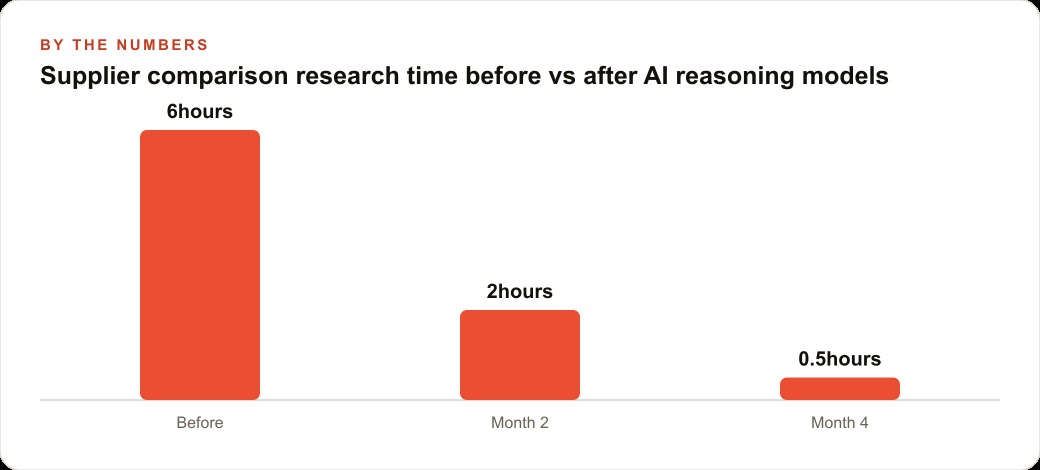
Old approach: the owner spends several hours researching commercial hydronic systems, identifying training certifications, finding suppliers in their region, and thinking through the business case. The research is time-consuming, and the reasoning draws on the owner's existing knowledge plus whatever they can find through manual searching.
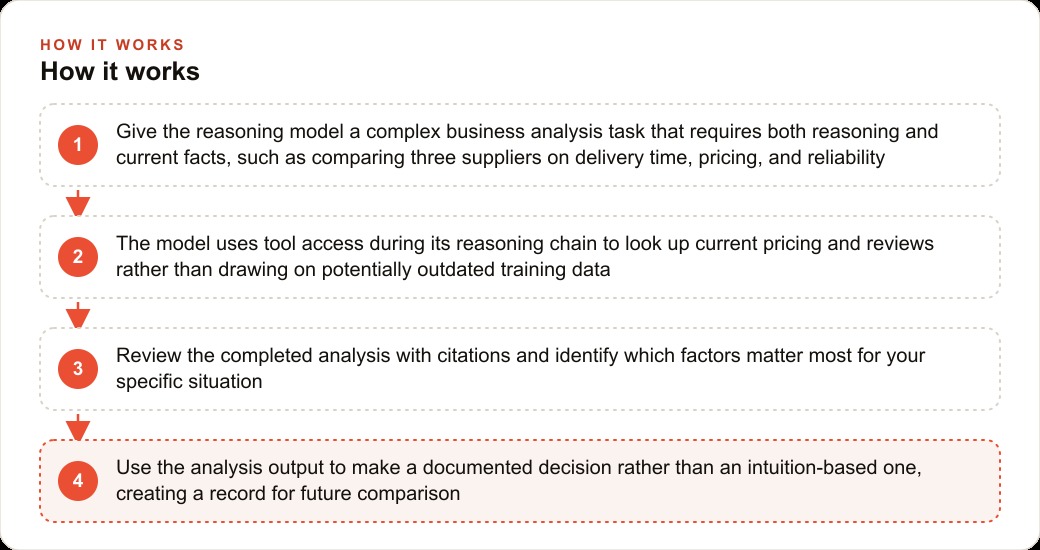
With o3 or o4-mini combining reasoning and tool use: the owner writes a detailed prompt describing the business situation, their current capabilities, their geographic market, and their questions about the expansion. The model reasons through the decision while simultaneously looking up current certification requirements for commercial hydronics in the state, current pricing from major suppliers, the competitive landscape in the local market from available online data, and any relevant recent industry developments.
The output is a structured analysis covering: what the expansion requires in terms of equipment and training investment, what the market opportunity looks like based on current market data, what the realistic revenue timeline looks like given the training and licensing timeline, and what the key risks are. The owner reads the analysis, applies their local knowledge and relationship context that the AI cannot access, and makes a better-informed decision than the manual research process would have enabled.
The time investment: thirty minutes to write the detailed prompt and review the output versus four to six hours of manual research and reasoning.
What are the limitations of these new reasoning and tool-use capabilities?
Tool-using reasoning models still have a fundamental limitation: they can only retrieve and reason about publicly available information. Internal business data, private industry relationships, proprietary pricing, and local market dynamics that are not publicly documented are not accessible through web search during the reasoning chain. The model's analysis of any situation is bounded by what is discoverable through public sources.
For a plumbing company, this means the AI analysis of a supplier relationship is based on publicly available reviews and information, not on the owner's direct experience with that supplier's reliability in their specific region. The AI analysis should be combined with, not substituted for, the owner's experiential knowledge.
The second limitation is that reasoning models are slower than standard models. A task that takes GPT-4o thirty seconds might take o3 three to five minutes for a deeply reasoned response. This makes reasoning models inappropriate for real-time customer interaction applications but very appropriate for complex one-off analysis tasks where quality matters more than speed.
What should a plumbing company do this week with these tools?
Pick one complex business decision you have been putting off because the research time seemed prohibitive. Write a two-paragraph description of the decision, the relevant factors, and the specific questions you need answered to move forward. Submit this to o3-mini or GPT-4.1 with the web search tool enabled.
Review the output with your own knowledge of the local and personal context the AI cannot access. Identify which parts of the analysis align with your experience and which introduce information you were not previously aware of. Make the decision based on the combination of AI analysis and your own judgment.
If the process works well for this one decision, identify the three other business decisions in your planning horizon that could benefit from the same approach. That list is your AI research agenda for the next quarter.
If you want help designing a systematic business intelligence approach for your plumbing company that uses AI tools to continuously monitor market conditions, competitor activity, and pricing, that is a project with clear financial upside worth pursuing together.
That is exactly what we do at AI DOERS. Book a private 30-minute call with Madhuranjan Kumar and we will map the fastest path to it for your specific business.
Book your call →
Madhuranjan Kumar
Madhuranjan Kumar brings 20 years of performance-marketing experience and has managed over $200 million in Facebook ad spend for brands across the United States and beyond. His expertise spans the full modern marketing stack: Meta, Google Ads, TikTok, email automation, CRM, and the websites that hold it together. At AI DOERS he turns that track record into lead-generation systems for businesses across every industry.