
GPT 5.5 Inside Codex: What Actually Changed for Real Work
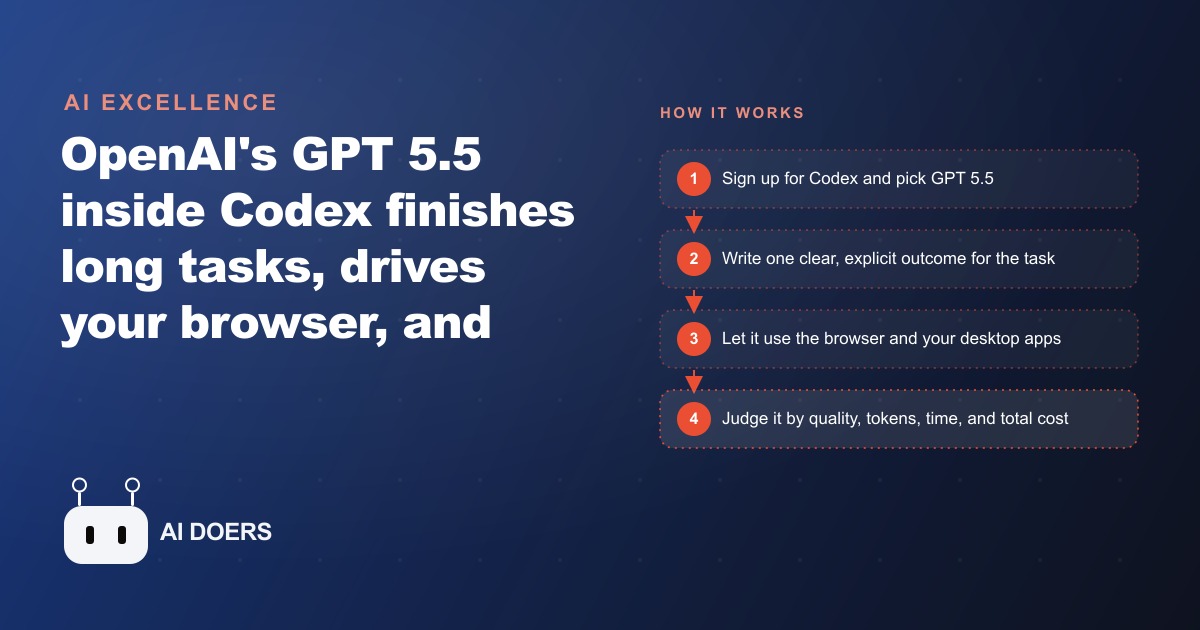
GPT 5.5 is built to finish long tasks, not answer single prompts. Inside Codex it writes documents, drives a live browser, and controls your desktop. Here is how a business should judge it and use it.

There is a distinction that matters more than any benchmark score, any context window size, or any new capability listed in a release announcement. The distinction is between AI that responds to prompts and AI that completes goals. Every model update in the past three years has been measured against the first frame. GPT 5.5 inside Codex is the first model I have spent serious time with where the second frame feels like the honest description.
I am Madhuranjan Kumar. The throughline I keep returning to in everything written here is that the most significant change in AI for business work is not a quality improvement within the existing mode of use. It is a mode change. Moving from directing the AI one sentence at a time and correcting each output to handing it a brief and reviewing what it delivers is a categorically different relationship between a person and a tool. That shift is what GPT 5.5 inside Codex makes available in a concrete, testable way. The shift from prompt-response to goal-completion is the most significant change in AI for business work, and this is the clearest example of it so far.
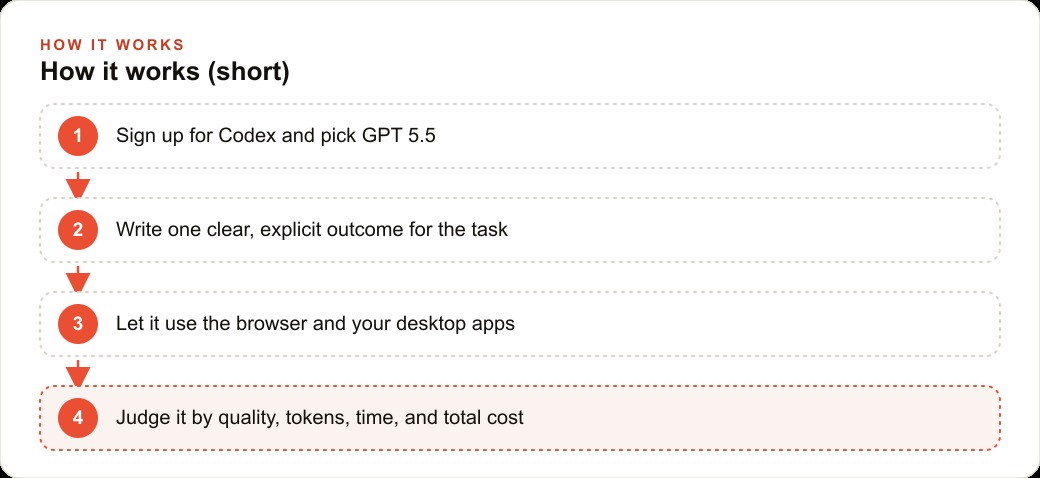
The model is available through Codex, which is OpenAI's environment that merges code-style building with a do-the-work interface. A free ChatGPT account is sufficient to sign up and try it. The twenty dollar per month plan gives a meaningful amount of usage. The entry point is low. The underlying capability shift is real.
What holding intent across a long task actually means and why it reduces retries
Every time you prompt an AI with a short instruction, the model interprets that instruction fresh, without the surrounding context of the larger goal you are working toward. That is fine for single-question interactions. It becomes a compounding problem when the goal requires twenty steps, because each instruction in isolation tends to produce output that is locally correct but gradually drifts from the intended direction by the time you reach step ten.
Holding intent means the model keeps the full goal in view across all twenty steps. It does not simply complete the current instruction. It completes it in a way that serves the overall outcome you described at the beginning. This changes where errors come from. Instead of small individual errors at each step that compound by the end, the model is optimizing for the final result across the entire sequence.
The practical consequence is fewer retries. A model that holds intent tends to need fewer rounds of correction because it is not losing the thread of what you are trying to accomplish. On tasks involving multi-section document generation, the version that held intent across the whole task produced a result that needed light editing. A version prompted step by step on the same task produced a result that needed structural correction by the middle sections because it had stopped tracking the overall argument and started optimizing each section in isolation.
The longer the task, the more visible this difference becomes. For a simple email, holding intent adds little over standard prompting. For a multi-section proposal, a full campaign, or a complex document with multiple related sections that need to be consistent with each other, the difference between a model that holds intent and one that does not shows up clearly in how much correction work follows the first draft.
The browser and desktop demos that prove this is not a research toy anymore
Two demonstrations settled the question of whether this capability has crossed from research interest to practical business tool. The first was a live browser task. Inside Codex, the model drove a real in-application browser to build a simple notes board, then added and moved twenty cards faster than a person watching could have matched manually. The cursor moved with fluid, natural motion rather than the jerky positional jumps that have characterized computer-use demos for the past two years.
That cursor motion is not a cosmetic detail. Fluid cursor movement in a live browser environment reflects underlying control quality that determines whether the model can reliably interact with real web interfaces rather than simplified test environments. The difference between smooth and jerky is the difference between production-ready and demonstration-only, and the motion in the Codex demo was clearly the former.
The second demonstration was computer use that crossed application boundaries. The model opened a real desktop design application, built a presentation inside it, exported that file to the local file system, navigated to a browser, and uploaded the file into a different web service. No human clicks anywhere in the sequence. That is the whole machine being used across multiple applications, not a single browser tab being controlled. The sequence handled a real export workflow, navigated a file system, and completed a web form upload. Every one of those transitions is a step where fragile automation typically breaks. Holding intent across all of them is what kept the full sequence working.
These are the kinds of multi-application, cross-system tasks that eat significant hours in any business operation that touches more than one software tool in a typical workday. When a model can handle that kind of sequence reliably, the economics of automating repetitive multi-step work change in a meaningful way.
Why cost-per-token is the wrong lens and cost-per-finished-task is the right one
The model costs more per million tokens than its predecessor. That number is almost useless as a purchasing decision metric. What matters is the cost to complete a defined piece of work from start to a result that is ready to use.
The comparison that actually helps is this: take one real workflow, such as turning a field inspection report into a branded proposal. Run it with the cheaper model. Count the tokens consumed, time the session, and note how much correction the output needs before it is ready to send. Then run the same workflow with GPT 5.5. Count the tokens, time it, and measure the same correction requirement. The model that costs more per token often costs less per finished, sendable proposal because it reaches the right answer in fewer tokens and requires less correction work.
A cheaper model that consumes millions of additional tokens across multiple drafts, each requiring structural correction before the next attempt, is not cheaper at the task level. It is cheaper only at the token level, which is the wrong unit of account when the outcome you are buying is a finished deliverable rather than a volume of processed text. The sticker price comparison is a distraction. The task-level comparison is the decision.
There is also a time cost that pure token accounting misses. When a model holds intent well and produces a first draft that needs light editing rather than structural rebuilding, the person reviewing saves an hour or more per task. At any reasonable estimate of what a knowledge worker's time costs, saving two hours of correction work on a single task covers a substantial token price difference on its own. The ROI frame must be cost and time per finished deliverable, not cost per million tokens consumed in isolation.
A roofing company that moved from six proposals a day to twenty-two
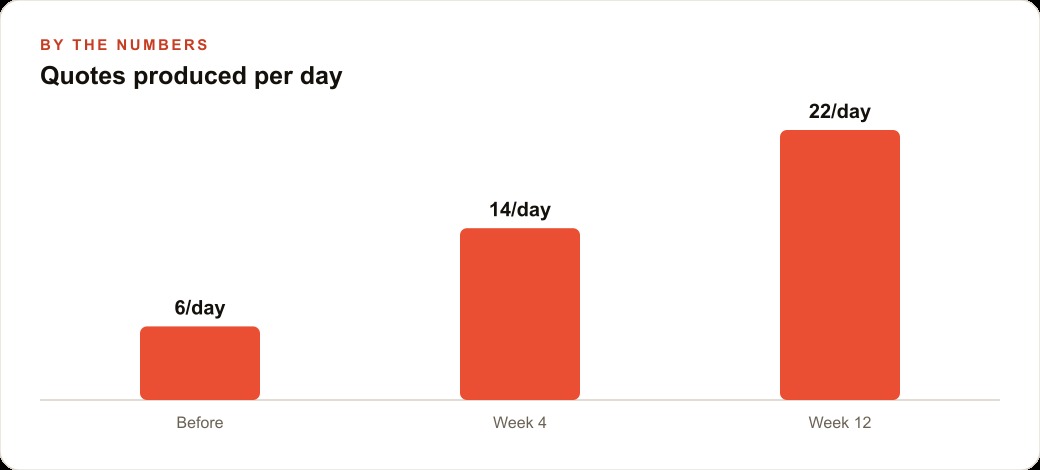
The most concrete example I can walk through is a roofing contractor whose office was the bottleneck between a completed inspection and a signed contract. Inspections happened in the field. An office manager then rebuilt each proposal by hand: pulling measurements and notes from the field report, writing the materials breakdown, creating the price summary with the standard markup applied, and formatting the cover page. Six proposals a day was the comfortable capacity of one office manager giving this task full attention.
With the model handling the first pass on each proposal from an explicit outcome description, the office manager shifted from assembling to reviewing. The model reads the inspection notes, builds the materials section, generates the pricing summary with the correct markup, and produces the cover page formatted appropriately. The office manager reviews for accuracy, corrects anything the field notes left ambiguous, and approves for sending. Proposals that took forty minutes to assemble manually take around eight minutes to review.
At six proposals per day the office manager was at capacity. At the new pace the same person handles twenty-two proposals in a day without overtime. The pipeline throughput tripled. More quotes reach homeowners faster, which means more jobs close before a competitor's quote arrives. The additional closed jobs from faster quoting is the figure that changes the business economics. The model cost is a fraction of the revenue difference that throughput improvement produces.
Every business that runs this comparison on a real workflow will find numbers that come out differently depending on the task, the volume, and the correction requirement. The structure of the comparison is the same: cost per finished, sendable proposal against cost per million tokens. The token price is the entry in a spreadsheet. The proposal throughput is the line on the income statement.
The effort dial and when to use each level
Codex exposes effort level settings that control how much computational work the model applies to a given task. Medium effort handles most practical business tasks competently and efficiently. High effort is appropriate for complex, long-form builds where the model needs to plan across a larger number of interdependent steps. Very high effort is for demanding tasks involving large source documents or many related outputs that must be consistent with each other.
The practical rule is to use medium for everyday work and reserve higher levels for tasks where quality on the first draft matters more than the time taken. A weekly status report does not need maximum effort. A full client proposal built from six months of field notes and three different service categories might justify it.
Running everything at the highest effort level burns tokens faster and takes longer without producing proportionally better results on straightforward tasks. Most business workflows are medium-effort tasks: drafting, summarizing, formatting, structuring, and responding. Those run well at that setting. The occasional high-stakes deliverable justifies moving up a level, and knowing which category each task falls into keeps costs and timelines sensible across a full month of use.
The prompt-writing skill that becomes the real competitive edge
The most durable advantage from working with a model that holds intent is not the model itself. It is the discipline of writing explicit outcome descriptions that serve as the brief the model works from. When a model handles one instruction and responds, the quality of any individual prompt matters moderately. When a model holds a prompt across a long task and optimizes all its steps toward that outcome, the quality of the initial description is the primary lever on the quality of the result.
The difference between a prompt that says "write me a proposal for this inspection" and one that says "produce a three-section proposal from these field notes, with a materials breakdown in section one, a line-item pricing summary at standard markup in section two, and a one-page client cover page in section three, formatted for email attachment" is not just a detail difference. It is the difference between a model approximating what you want and a model building exactly what you described. The first prompt produces a guess. The second produces a brief.
Teams that develop the habit of writing clear outcome descriptions, and that treat those descriptions as reusable templates for recurring workflows, are building a compounding asset. Each well-written outcome prompt is a template for the next time the same task comes up. The investment in writing it clearly the first time pays dividends every time it is reused. As these models become standard across industries, the businesses that have accumulated a library of well-written outcome templates for their specific workflows will be producing higher-quality output faster than competitors who are still writing vague single-sentence prompts and correcting the results one step at a time.
The prompt-writing skill is the competitive edge that compounds as the model quality improves. Better models make better prompts more powerful, not less. The investment is worth making now.
That is exactly what we do at AI DOERS. Book a private 30-minute call with Madhuranjan Kumar and we will map the fastest path to it for your specific business.
Book your call →
Madhuranjan Kumar
Madhuranjan Kumar brings 20 years of performance-marketing experience and has managed over $200 million in Facebook ad spend for brands across the United States and beyond. His expertise spans the full modern marketing stack: Meta, Google Ads, TikTok, email automation, CRM, and the websites that hold it together. At AI DOERS he turns that track record into lead-generation systems for businesses across every industry.