
GPT-5.4 vs Opus 4.6: What the Real Tests Actually Show
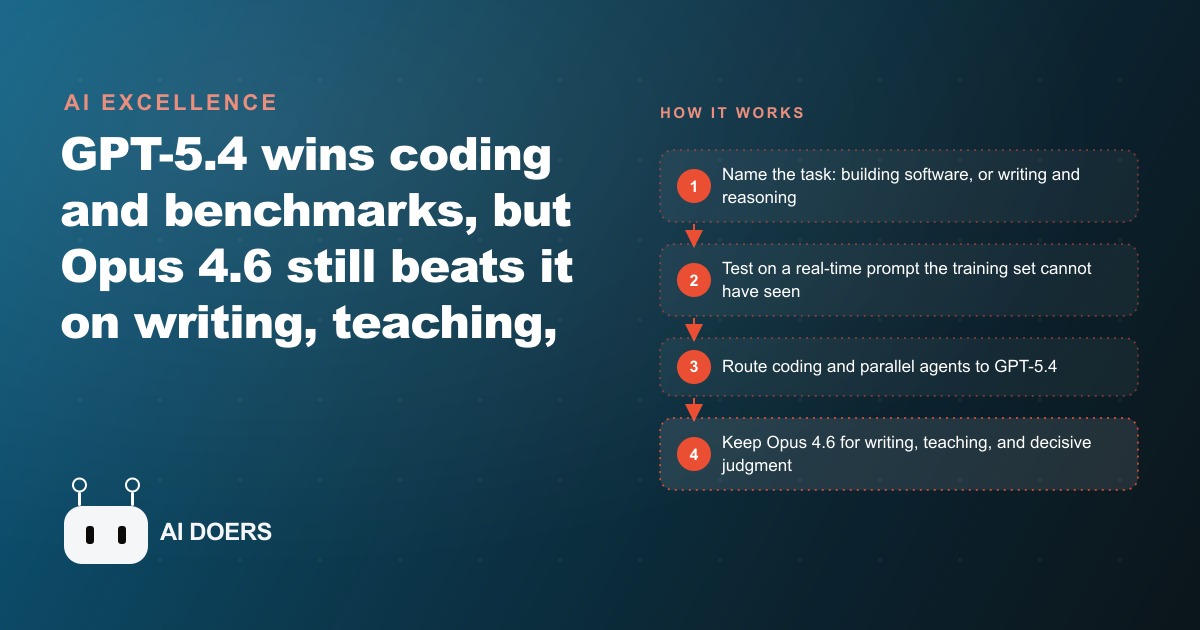
GPT-5.4 wins on coding, agentic browsing, and price, while Opus 4.6 still produces better fiction, clearer explanations, and more decisive judgment. The right model depends on whether your task is building software or reasoning and writing.

The Setup: Same tasks, two of the strongest models, nothing held back
The evaluation framework for comparing GPT-5.4 and Claude Opus 4.6 is simple: identical prompts, identical tasks, direct comparison of outputs. No cherry-picking the categories where one model shines. No grading on a curve for the category where one model is known to be stronger. The same seven tasks given to both, and an honest assessment of which model produced the more useful result and why.
I am Madhuranjan Kumar, and I want to walk through this comparison in enough detail that a business owner can use the findings to make actual task-routing decisions rather than just knowing which model scored higher on an abstract leaderboard.
Chapter One: Benchmark position and where each model leads
GPT-5.4 enters this comparison with strong benchmark credentials in the agentic and coding categories. It leads on computer use, web browsing, agentic browsing, and GDPval. On GPQA Diamond, a rigorous scientific reasoning test, it substantially outperforms Opus 4.6. On Arc AGI 2, which measures general problem-solving beyond pattern matching, it sits close to Gemini 3.1 Pro.
Opus 4.6 enters with its own strong position in natural language quality, instruction-following precision, and what can only be described as tonal intelligence, the ability to match its output length and style to what a prompt actually requires rather than defaulting to a single register.
The benchmark gap between these two models is real. The more interesting question is whether the benchmark gap translates into a gap in the tasks that actually matter for a professional or a business owner. The comparison tasks are designed to probe exactly this.
Chapter Two: The real-time data task and how each model handled it
The first substantive comparison task asks for a visualization of the current Premier League season standings and results. This is a hard task because the current season is outside both models' training data. Producing a useful response requires web search, synthesis of live data, and structured presentation of the result.
GPT-5.4 handled this task well. It initiated a web search, pulled the current standings data, synthesized the recent match results, and produced a clear, well-structured visual representation of the current table. The output was grounded in current data rather than training data, and the presentation was polished enough to use directly.
Opus 4.6 produced a response that was more cautious about the current data gap, which is the appropriate epistemic stance but the less practically useful response for someone who needs the current standings. The GPT-5.4 output was more useful for this specific task, not because of the model's intelligence in a general sense but because its willingness to retrieve and use current data aligned better with what the task required.
Chapter Three: Creative writing where instruction precision determined the outcome
The creative writing task asks for a concise one-paragraph story. The instruction includes a specific constraint: one paragraph only. How each model handles that constraint reveals something important about instruction-following that benchmarks rarely capture.
Opus 4.6 produced a single paragraph with a complete narrative arc, a beginning, a genuine complication, and an emotionally resonant ending, in the space the instruction specified. The paragraph had the density of a short story without exceeding the stated constraint.
GPT-5.4 produced multiple paragraphs. The instruction said one. The output had four. The story itself was competent, but the failure to follow the stated constraint, in a task where the constraint was the entire point of the instruction, is a meaningful mark against its instruction-following. For a business owner who uses AI to produce content under specific format requirements, an instruction-following failure that adds length without being asked is a problem that compounds across every piece of content that needs editing back down.
Chapter Four: The explanation task where teaching quality separated the models
The explanation task asks each model to explain the attention mechanism from the original transformer paper in a way that a non-technical person can understand. This is a task that requires not just knowledge but pedagogical judgment: what context does the reader need first, what analogy makes the mechanism legible, and how much detail is enough to convey the idea without overwhelming the reader.
Opus 4.6 built the explanation from context outward. It established what problem the attention mechanism solves before describing what the mechanism does. It used a concrete analogy to make the mechanical description legible. It provided enough detail to convey the idea without providing so much detail that the non-technical reader would need to track multiple unfamiliar concepts simultaneously. The explanation was genuinely useful for teaching.
GPT-5.4 provided a more compressed explanation that covered the mechanism correctly but did not build the reader's context before introducing the technical concepts. For a reader who already has some familiarity with neural networks, the GPT-5.4 explanation might be sufficient. For the non-technical reader the task specified, the Opus 4.6 explanation was more likely to produce genuine understanding.
Chapter Five: The geopolitics question where opinion clarity mattered
The geopolitics task asks each model to be decisive and opinionated about a contested historical responsibility question, and explicitly instructs the model to avoid both-sidesing the answer. The instruction is direct: give an opinion, name a primary cause, and defend it.
Opus 4.6 named a primary cause with a clear directional statement and a defense that did not soften the claim into meaninglessness. It was opinionated in the way the instruction asked for, while also acknowledging that the question has genuine complexity, which is a different thing from refusing to take a position.
GPT-5.4 spent the majority of its response distributing responsibility across multiple parties despite the explicit instruction to identify a primary cause and be decisive. The hedging was in the structure of the response, not just in qualifications around a clear claim. For an operator who uses AI for analysis that requires strong, defensible positions, this behavior is a genuine limitation that matters regardless of the model's benchmark strength in other categories.
Chapter Six: Autonomous coding where GPT-5.4's parallel agents changed the result
The coding comparison uses Claude Code and Codex side by side for two tasks: a Space Invaders clone and a Minecraft-style game. These are the tasks where the benchmark gap between GPT-5.4 and Opus 4.6 showed up most clearly in the practical comparison.
GPT-5.4 running through Codex produced a Space Invaders implementation with substantially better graphics, smoother physics, and more complete gameplay than the Opus 4.6 implementation. The visual quality difference was significant enough that it was visible immediately without requiring careful comparison. On the Minecraft-style world, GPT-5.4 produced a working implementation in approximately 24 minutes. Opus 4.6 produced an implementation that had the structural elements but lacked the polish of the GPT-5.4 version.
The parallel agent capability in Codex contributed to this outcome. GPT-5.4 ran multiple agents simultaneously: one working on the gameplay logic, another on the rendering layer, another on the asset generation. The parallelism compressed the total build time. Opus 4.6 working sequentially through the same components took longer and produced less polished results.
For coding tasks, GPT-5.4 is the stronger model in this comparison. The benchmark position on coding benchmarks translates directly to practical task performance.
Chapter Seven: Pricing and the decision about which model to use when
GPT-5.4 is priced at approximately $2.50 per million input tokens and $15 per million output tokens. Opus 4.6 is priced approximately twice as high on input and comparably on output. For tasks run at volume, this pricing difference is operationally significant.
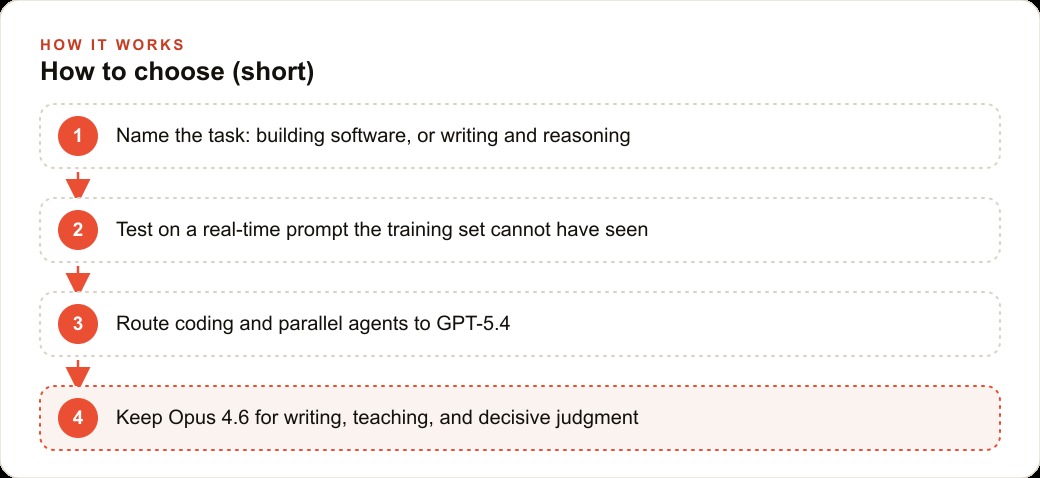
The comparison across the seven task types produces a clear task-routing recommendation. Use GPT-5.4 for coding, for autonomous agentic tasks that require parallel execution, for tasks where real-time data retrieval is part of the task, and for tasks where cost efficiency at scale matters. Use Opus 4.6 for writing tasks with strict format constraints, for explanation and teaching tasks where pedagogical quality determines usefulness, for tasks requiring opinionated analysis with a defensible position, and for anything where instruction-following precision is the primary requirement.
The answer to the question of which model is better is that neither is unconditionally better. They are better in different categories in ways that are consistent and predictable. Routing tasks to the appropriate model based on these category differences costs nothing if you have access to both and produces consistently better results than using one model for everything.
The larger lesson: length allocation as a signal of model intelligence
One of the subtler observations from this comparison is what each model does with response length. Opus 4.6 consistently allocated length appropriately to the task: concise for the task that asked for concision, fuller for the task that required more explanation. GPT-5.4 tended to be verbose when the task asked for brevity and occasionally compressed when the task would have benefited from more development.
This length allocation behavior is not trivial. It is a signal of whether the model is responding to the stated requirements of the prompt or to its own defaults. A model that says more than was asked produces output that requires editing. A model that says less than would be useful produces output that requires expansion. The appropriate length is always context-specific, and a model with good length calibration reduces the editing burden on the operator.
For a business owner producing content, proposals, or analysis with AI assistance, length calibration is one of the practical quality metrics that matters as much as factual accuracy. Accurate content that is twice as long as the format requires is still content that needs to be cut. Opus 4.6's performance on length calibration in this comparison suggests it has stronger prompt-responsiveness in this dimension, even as it falls behind GPT-5.4 on the coding and agentic dimensions.
The cost-per-value calculation that makes the routing decision practical
The comparison between GPT-5.4 and Opus 4.6 is ultimately a cost-per-value problem, not a which-model-is-better problem. Each model produces different value in different task categories. Each model has a different cost per token. The rational approach is to match each task to the model that produces the best value per dollar in that task category.
For coding tasks at scale, GPT-5.4 produces higher quality output at lower cost than Opus 4.6. If you are generating code daily or running agentic workflows that accumulate substantial token counts, the cost difference at GPT-5.4's pricing is meaningful. A workflow that would cost $30 per day to run on Opus 4.6 might cost $15 per day on GPT-5.4 while producing better results in the coding categories that workflow covers.
For writing tasks at scale, Opus 4.6's higher quality on instruction-following and length calibration reduces the editing time required after each generation. The cost difference between the models is partially or fully offset by the staff time saved on editing outputs that are already appropriately formatted and appropriately sized. If a writing assistant that follows format instructions more precisely saves thirty minutes of editing time per day, and the cost of that time is higher than the premium cost of Opus 4.6, the premium model is the more economical choice even at its higher price.
The operators who get the best value from AI models are the ones who have a clear category map of their tasks and the model strengths in each category, and who have thought through the full cost equation including staff time, not just the per-token price. That analysis is not complicated. It requires knowing what tasks you run most frequently, knowing which model handles each category better from a comparison like this one, and doing the arithmetic on the full cost of each option. The arithmetic takes an hour to run once and applies to every task routing decision that follows.
What this comparison says about the competitive landscape going forward
The most interesting meta-observation from this comparison is how close the two models are across most categories. GPT-5.4 leads on coding and benchmarks. Opus 4.6 leads on instruction-following and natural language quality. The gap between them is real but narrow, and it is closing. The comparison that clearly favored one model on most tasks two years ago is now a task-by-task nuanced assessment where neither model has a comprehensive lead.
That convergence is good news for operators who want to use AI effectively. When multiple strong models exist across the relevant task categories, the leverage comes from routing and workflow design rather than from access to the one model that nobody else has. The strategic advantage shifts from which tools you have access to toward how skillfully you use them.
For a business owner in 2026, the appropriate stance toward AI model selection is to maintain access to two or three strong models, understand their category-specific strengths through direct comparison rather than benchmark reports, and develop a clear task-routing practice that uses the right model for the right task. The effort to build that practice pays dividends across every subsequent task. The models will continue to improve. The practice of routing them well is a skill that transfers to every generation of tools that follows.
That is exactly what we do at AI DOERS. Book a private 30-minute call with Madhuranjan Kumar and we will map the fastest path to it for your specific business.
Book your call →
Madhuranjan Kumar
Madhuranjan Kumar brings 20 years of performance-marketing experience and has managed over $200 million in Facebook ad spend for brands across the United States and beyond. His expertise spans the full modern marketing stack: Meta, Google Ads, TikTok, email automation, CRM, and the websites that hold it together. At AI DOERS he turns that track record into lead-generation systems for businesses across every industry.