
What the GPT-5.4 Leaks Actually Mean for Your Business
Behind the leak drama, the upgrades that matter are practical: a bigger memory, fewer made-up answers, and fewer annoying refusals. Here is how to use them.

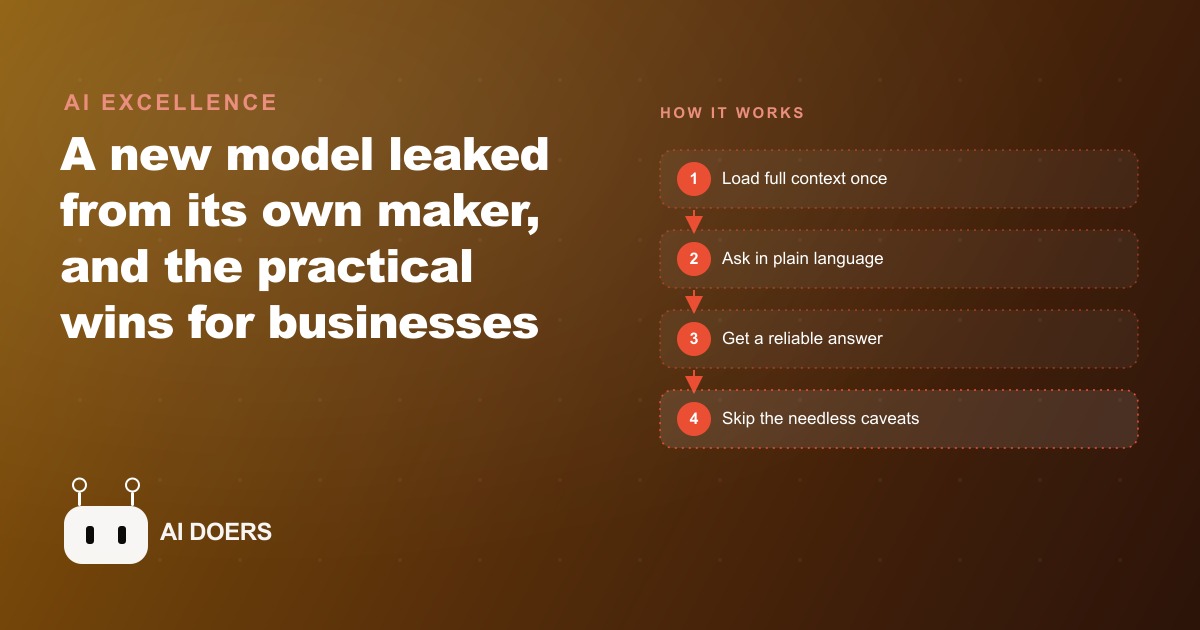
A model leaked from its own maker three times in one week, and the most important thing it revealed has nothing to do with the gossip. Behind the drama of repeated accidental disclosures, there is a practical story about two upgrades that will change how useful AI assistants are for everyday business decisions: a much bigger memory, and meaningfully fewer fabricated answers. I, Madhuranjan Kumar, am going to tell you what the leaks actually show, why the under-discussed reliability improvements matter more than the context window headline, and what this looks like in practice for a business loading a full year of operational records into one conversation.
The fire drill that confirmed it is real: five fixes in five hours
The first leak came from a code change that set the minimum required model to GPT-5.4 in a public repository. It was visible for less than an hour before someone caught it. The second came from an error log on a security blog that carried the model identifier. The third came from a shortcut command in a related tool that referenced the name directly.
What confirmed the model's existence was not any single leak but the response to the leaks. An engineer pushed five code changes in five hours, each one cleaning up a different reference to the model across different codebases. You do not make five rapid successive fixes to the same sensitivity in one afternoon over a typo. That is a fire drill, and it strongly suggests the name was real and the disclosure was unintended. A journalist with a source inside the company later confirmed the model exists and is running on the company's servers.
This matters because the context around the leaks tells you something about the model's timeline. An internal model that triggers a five-hour all-hands cleanup is not six months away. It is close. When a name surfaces in production code, in error messages that real users see, and in tools connected to live services, the model is integrated into existing infrastructure. The official announcement follows the internal readiness, and the internal readiness is already there.
The leak pattern itself is worth noting. This was not a deliberate marketing tease or a staged reveal. These were genuine operational slips, which means the people working with the model daily were treating it as something real and present, not a future project. Engineers reference the tools they are actually using in their code. The references that slipped through were there because the model is part of the active stack.
One million tokens: what a context window that size actually unlocks
Early reports claimed a two million token context window. That number has not held up in follow-on analysis, but the current picture points to a one million token context window, roughly a doubling of the prior generation's capacity.
Context window is the amount of information a model can hold in memory during a single conversation. Smaller context windows mean the model starts forgetting the beginning of a long conversation by the time it processes the end, which creates the frustrating experience of a model that seems to lose track of what you told it twenty minutes ago. A larger context window means the model holds more of the conversation in mind at once.
One million tokens is not an abstract technical specification. It is enough to hold approximately seventy-five thousand words of text simultaneously, which is roughly a full-length nonfiction book, or a year's worth of operational records for a service business, or a complete archive of client correspondence from a professional services engagement. For a business that currently gives an AI assistant fragments of information because the context window cannot hold the full picture, one million tokens changes the workflow fundamentally.
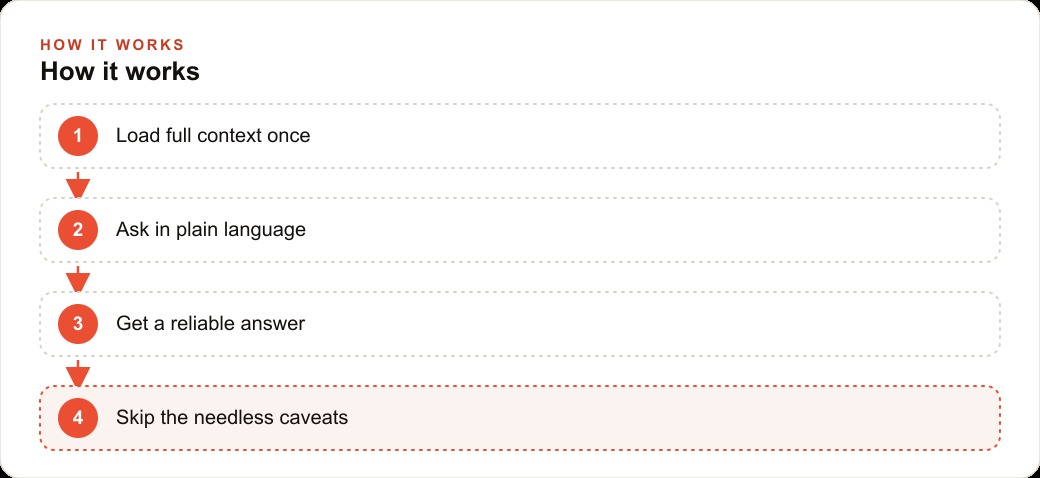
The change it enables is the elimination of pre-summarization. Right now, many business teams spend time extracting and summarizing information before giving it to the AI assistant, because the full record is too large to fit in the context window. That summarization step takes time, introduces human selection bias about what matters, and produces a thinner input than the full record. With a million-token window, you load the full record and ask the question. The model retrieves what it needs from the complete information rather than from a curated excerpt.
For a landscaping company that processes three hundred jobs over a season, the full operational record of field notes, client communication, materials used, hours logged, and pricing outcomes fits well within a one million token context window. The owner asks what was planted at a specific address last spring and gets an answer from the full record rather than from a summary that may or may not have included that detail.
27 percent fewer hallucinations: the upgrade that matters for money decisions
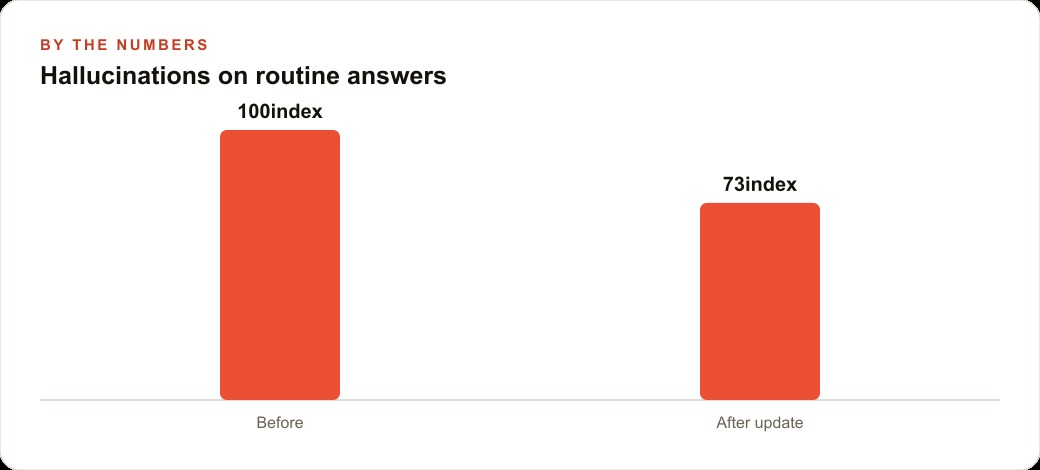
The current default model already cut hallucinations by 27 percent compared to its predecessor. Hallucinations are the cases where the model produces a confident answer that is factually wrong: a price it invented, a policy it fabricated, a technical specification it made up based on plausible guessing.
A 27 percent reduction sounds like a modest improvement until you count the cost of the errors it prevents. For a business using an AI assistant to generate quotes, answer policy questions, or explain pricing to customers, a hallucinated answer creates a commitment that is wrong and must be corrected. That correction creates a customer service conversation that costs time, sometimes damages trust, and occasionally produces a discount or a refund to smooth over the mistake.
The reliability improvement is also what makes it reasonable to use AI output more directly in professional contexts. When the error rate on routine questions is meaningfully lower, the required review of every AI output before it goes to a customer can become lighter. Instead of treating every AI-generated answer as a draft that must be fully rewritten, a more reliable model can produce answers that require spot-checking rather than complete reconstruction.
For businesses running Google Ads campaigns that use AI to generate ad copy or respond to customer inquiries, the hallucination rate directly affects the quality of what reaches prospects. A headline that contains a fabricated claim about pricing or availability creates a mismatch between the ad and the actual experience, which hurts conversion rates and can trigger ad disapprovals. Fewer hallucinations mean the AI's draft output is closer to correct before the human review step.
The 27 percent figure also signals a direction of travel. If the current generation achieved this reduction, the model named in the leaks is targeting further improvement. For business use cases where accuracy is the primary requirement, the trajectory matters as much as the current number. AI tools that were too unreliable for consequential decisions eighteen months ago are becoming reliable enough to trust on routine ones today.
Fewer caveats and refusals: why the quit movement is about tone, not features
The cancellation wave and the reported shift in active users toward competing assistants happened during a period when the default model was delivering answers buried in qualifications, hedge phrases, and unsolicited warnings about things the user never asked about. Ask for a simple summary and receive three paragraphs of caveats about what the summary might miss. Ask for a draft and receive a draft followed by a paragraph explaining why the draft might be wrong.
This is not a small user-experience complaint. It is a trust problem. When an assistant over-qualifies everything, it signals that it does not trust its own output, which means the user cannot trust it either. A tool that routinely hedges on questions where no hedge is warranted trains users to discount its answers, which defeats most of the value of having the assistant.
The quit movement, documented in download comparisons between competing AI applications, is the market expressing a preference for tone as much as for capability. Users did not switch assistants because a competing model scored better on a benchmark. They switched because conversations with the competing model felt more direct, more useful, and less like arguing with a compliance officer.
The current model's behavior update toward fewer unnecessary caveats is a real improvement that shows up in the daily experience of using the tool, not just in technical benchmarks. For a business whose team interacts with an AI assistant dozens of times per day, fewer interruptions from unsolicited hedging adds up to meaningfully more fluid work.
For Facebook and Instagram ads copy that an AI assistant helps draft, fewer refusals and fewer rounds of unnecessary caveats means the drafting process produces usable output faster. The team spends less time arguing with the tool about whether a claim is acceptable and more time actually evaluating whether the copy is persuasive.
The tone dimension is also directly relevant to how businesses position their own customer experience. The quit movement shows that reliability and a respectful, direct tone are what win and keep users. The same standard applies to how your business communicates with its customers. An AI assistant that models direct, low-friction communication is useful in part because it demonstrates what that standard looks and feels like.
The reliability gap is closing, and that is the whole story
The reason to care about GPT-5.4 is not the model number. It is what the convergence of these improvements signals about where AI assistants are in their development. A 27 percent reduction in hallucinations, a context window large enough to hold a full operational year, and fewer friction points from unnecessary hedging and refusals: together, these move AI assistants from tools you use cautiously, with heavy review at every step, to tools you use with a level of trust that approaches what you extend to a capable employee.
That shift has a concrete business implication. When you trust the output enough to use it more directly, the hours you spend reviewing and correcting AI output decrease. The value per hour of AI-assisted work goes up. The tasks you are willing to delegate to the assistant expand. The compounding effect of higher-quality output and lower review overhead is where the real business productivity case is, and it is still underappreciated in most AI conversations.
The context window improvement enables a workflow change for businesses with complex operational records. Instead of extracting and summarizing information before giving it to the model, you give the model the full record and let it extract what it needs. That workflow is simpler, faster, and produces more accurate answers because the model is working from the complete information rather than a human-curated subset.
A worked example: the landscaping company that stopped summarizing before asking
A landscaping company processes an average of three hundred jobs between March and November, producing field notes, materials logs, hours records, client communication, and pricing outcomes for each job. The office manager spent roughly ninety minutes each week preparing summaries to give to the AI assistant before asking questions about seasonal trends, pricing accuracy, and client history, because the previous model could not hold the full record in context.
With a one million token context window and the improved reliability of the current generation, the workflow changes. The office manager loads the full season's operational records at the start of each week. The assistant holds the complete record in context and answers questions directly from it without requiring pre-summarized input.
Illustrative impact: seasonal quoting accuracy improves because the assistant has access to the full pricing history rather than a curated sample. Questions about specific properties get answered accurately in under a minute rather than requiring a manual search through the record. The ninety minutes of weekly summary preparation is eliminated. Across a nine-month season, that is roughly sixty-five hours of administrative work recovered.
The reliability improvement matters most at the quoting stage. A landscaping quote that cites a service the company does not offer, or a price that does not match the actual rate sheet, creates an awkward correction with the client. With fewer hallucinated answers from a model fed the real rate sheet and service list, quotes go out with fewer errors, which means fewer correction conversations and fewer discounted jobs to preserve client relationships.
The assistant also produces direct answers to operational questions without appending paragraphs of warnings about what the answer might not account for. The crew asks a question about a treatment schedule and gets an answer. The answer still needs human judgment applied to it, but it reads like a starting point for a decision rather than a hedge designed to avoid all possible blame.
For a CRM and website stack that includes client communication history, the large context window means the assistant can read the full history of communications with a specific client before drafting an update or a renewal proposal. The draft reflects the actual relationship rather than a generic template, because the model held the full history in mind while writing it.
The GPT-5.4 story is not about a leaked model number. It is about the direction of travel: more memory, fewer fabrications, fewer friction points. Every business that uses an AI assistant benefits from that direction, regardless of which model or provider they are using. The practical work right now is loading the real data, feeding the real rate sheets, and measuring whether the answers you get are good enough to use more directly. That test, run honestly, tells you more about where your specific workflow stands than any benchmark.
That is exactly what we do at AI DOERS. Book a private 30-minute call with Madhuranjan Kumar and we will map the fastest path to it for your specific business.
Book your call →
Madhuranjan Kumar
Madhuranjan Kumar brings 20 years of performance-marketing experience and has managed over $200 million in Facebook ad spend for brands across the United States and beyond. His expertise spans the full modern marketing stack: Meta, Google Ads, TikTok, email automation, CRM, and the websites that hold it together. At AI DOERS he turns that track record into lead-generation systems for businesses across every industry.