
GPT 5.2 Is Built for Real Work: What It Means for Your Business
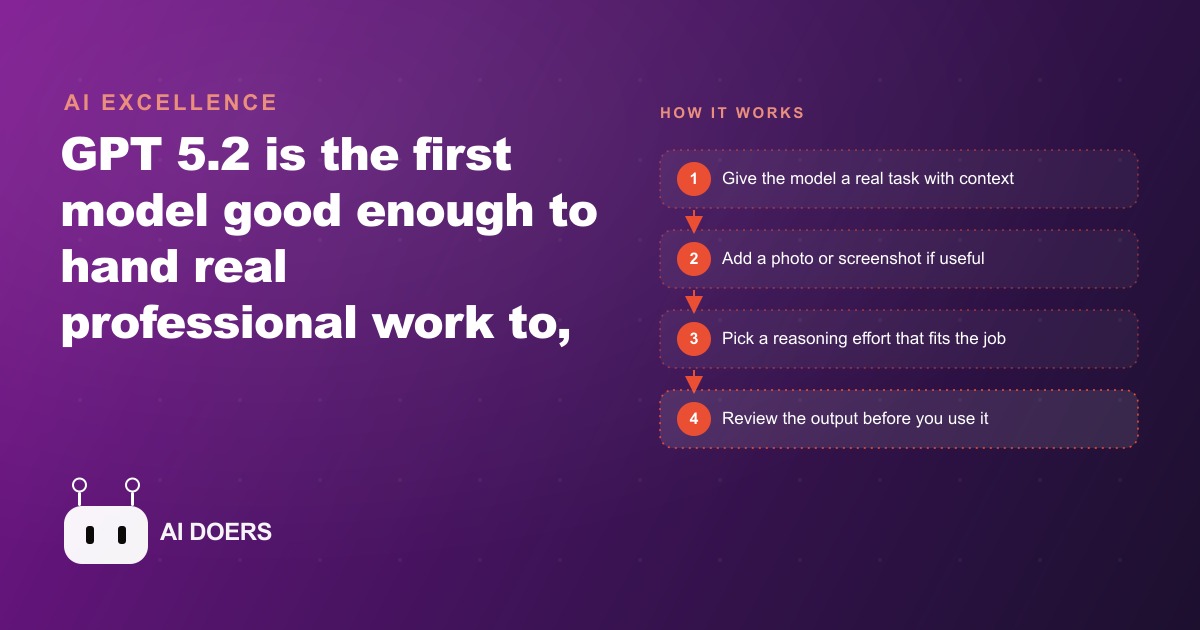
GPT 5.2 is the first model I would actually trust with professional work. It is more reliable, reads images well, handles spreadsheets and presentations, and codes at the top of its class. Here is what that means for a real business.

Seventy-one percent of the time, GPT 5.2 matched or beat human professionals on real business tasks in published evaluations. If that number appeared in a staffing pitch, every business owner in the room would lean forward.
I am Madhuranjan Kumar, and the position I want to stake here is one most AI commentary avoids: the businesses taking on the most risk with GPT 5.2 right now are not the ones deploying it aggressively. They are the ones still using it to polish social captions while competitors hand it quarterly reports, client communications, and analysis work. The reliability bar on this release has crossed a threshold that changes the responsible calculation, and the cautious approach is now the riskier one. This article makes that argument with specifics, and it includes a worked example showing what the shift actually looks like inside a real service business.
The 71 Percent Number Changes the Category
Before this release, using AI for professional work required heavy editing. The outputs were directionally right but contained confident errors that someone with domain expertise had to catch and correct. That editing overhead ate most of the time savings. The rational response was to use AI for drafts and never for final output, and to check everything twice. That was the right model for earlier generations.
GPT 5.2 reduces the rate of made-up answers by roughly 30 to 40 percent compared to its predecessor. That is not a quality improvement in the ordinary sense. It is a change in what category of task you can delegate. A tool that is right 70 percent of the time earns a careful proofreading habit. A tool that is right 95 percent of the time earns a place in the workflow with a light review step. The difference between those two is not marginal. It is the difference between a tool you use occasionally and a tool you build your operations around.
The 71 percent professional parity figure is what makes this concrete. It does not mean the model outperforms specialists on complex judgment calls. It means that on the volume work that fills professional hours, the ordinary tasks that accountants, paralegals, marketers, and operations managers handle every week, the model performs at a level that clears a reasonable professional bar roughly seven times out of ten. For a small business owner paying contractors or managing a small team to produce that volume work, the practical implication is substantial.
The Conservative Approach Is the Riskier One
The owners who tried AI tools in 2023 and walked away after a few confident wrong answers made a rational decision at the time. The error rate was too high to build workflows around. Staying away was correct. Staying away now, with a different tool and a meaningfully different error rate, is not the same calculation. It is a different decision with different consequences.
The risk of under-deploying looks invisible because it is opportunity cost rather than a visible loss. A business spending 20 hours a month producing reports, summaries, estimates, and communications that the model could handle at high quality in five hours is not obviously losing anything on a given Tuesday. But over a quarter, that is 45 hours of capacity that a competing business is redirecting toward sales, strategy, and client relationships. Over a year, the gap compounds into a structural difference in how much output two operations produce with the same headcount.
The conservative business is not taking on less risk. It is trading one kind of risk for another. The visible risk of a wrong AI output that requires correction is real but manageable with a review step. The invisible risk of a competitor operating at materially higher productivity with the same team size is harder to recover from once it has compounded for several quarters. The owners who recognize this asymmetry and act on it now will have pulled ahead by the time the rest of the market catches up.
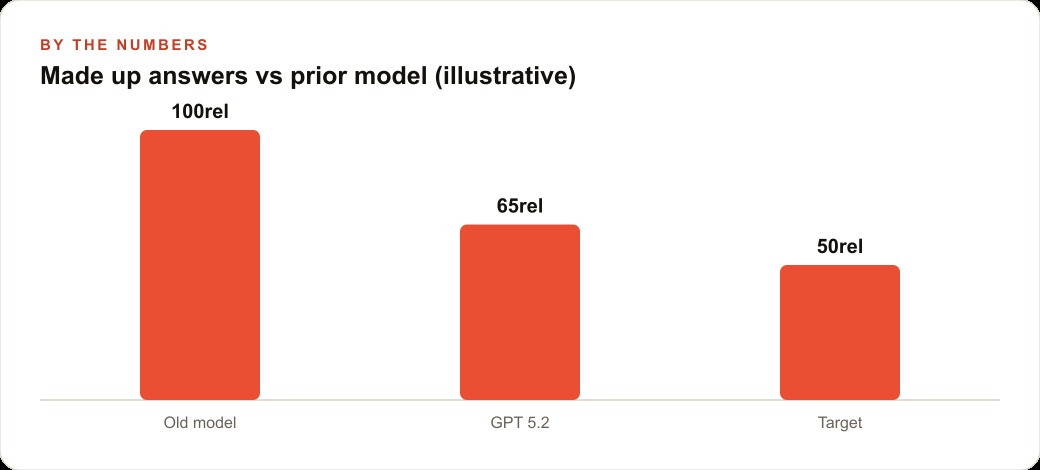
Image Input Opens the Physical World to AI
The vision upgrade in GPT 5.2 is worth treating as its own category of capability, not a minor feature addition. Earlier models could describe an image roughly. This model reads photos and screenshots with accuracy that unlocks real workflows, identifying specific parts, specific text embedded in images, specific states of a physical object, and specific errors in a screenshot or diagram. That is a qualitatively different tool for any business whose work begins with something visual.
Think about how much professional work starts with a picture. A customer sends a photo of a problem. A site visit produces a set of images. A client shares a screenshot of an error. A document arrives as a scan. In each case, the work of interpreting what the image shows, deciding what it means, and turning that interpretation into an action or a communication is work a person currently does by hand. GPT 5.2 can shoulder that interpretation step reliably enough to change the workflow.
For businesses running Facebook and Instagram advertising campaigns at any meaningful volume, the image capability matters immediately in creative review. Reviewing ad creative at scale to check for compliance issues, design inconsistencies, or elements that do not match brand guidelines can now use the model as a first-pass filter. It reads creative against a written spec and flags what does not match. The human review stays as a final check. The volume the human has to process drops sharply, and the speed of the creative review cycle accelerates.
Long Context Means You Can Hand Over Real Work, Not Just Snippets
One of the practical frustrations with earlier AI tools was context collapse. You would paste a long document and the model would answer well about the first few pages and poorly about the rest. Or you would restart a conversation and lose all the background it had built about your situation. GPT 5.2 has near-perfect recall across very long inputs, which changes what category of task you can hand it without fragmenting the work into pieces.
A contract running forty pages can go in whole, with the specific question about the clause that concerns you, and the model reads the entire document. A thread of a hundred customer emails can go in as a single block, with the request to identify recurring complaints and draft a response policy, and the model works across the full thread rather than only the most recent messages. An operations manual, a set of job notes, a detailed financial statement, all of these can be handed over without engineering around context limits.
This matters most for service businesses whose value sits in complex, multi-document work. Legal practices, accounting offices, insurance brokerages, and consulting firms all produce and manage long documents as their core work product. The ability to hand a complete set of files to the model and ask a real question about the whole set, rather than working through it in fragments, is what makes this tool genuinely usable in those environments rather than an interesting demo.
Spreadsheets and Presentations Reveal the Productivity Gap
GPT 5.2 formats spreadsheets the way someone who works in finance actually would: proper column headers, calculated fields, summary rows, consistent number formatting, logical layout. It takes raw numbers, a list of job costs, a set of client invoices, or a table of survey results, and produces a clean and readable spreadsheet from a single prompt. That task previously required either a person fluent in spreadsheets or several rounds of prompting and manual correction.
On presentations, it generates a full slide deck from a single prompt. Give it the topic, the audience, the key points to cover, and the context about your business, and it produces a structured deck with a clear narrative arc, proper slide hierarchy, and readable content. The output needs review and may need adjustments for tone or branding, but the structure and the drafting are done. For a business owner spending two to three hours on a quarterly review deck or a client proposal, getting a strong first draft in ten minutes recovers real time every week.
The productivity gap this reveals is not about replacing anyone. It is about what a single person can produce in a week when drafting and formatting tasks are compressed to fractions of their current time. A team of five that recovers an average of two hours per person per week from documents, spreadsheets, and presentations gains forty hours of capacity per month. That is a full week of work redirected toward higher value activity, and it accumulates every month without any additional hiring.
The Cost Curve Makes Hesitation Increasingly Expensive
The same task that cost a significant amount to run on AI tools a year ago now costs a fraction of that on models that are better by every benchmark. This trend has held consistently across every generation of capable AI, and there is no structural reason to expect it to reverse. Intelligence as a commodity keeps getting cheaper.
For a business owner, every quarter of hesitation represents a full quarter of paying staff rates for work the model could handle at a fraction of the cost, plus a full quarter of compounding productivity advantage that competitors who moved earlier are collecting. The cost argument runs in both directions: AI gets cheaper every year while the opportunity cost of not using it is real and accumulates silently.
The businesses that redirect their people from volume-production work toward judgment, relationships, and creative work will have a durable advantage. Those that continue using people for work the model handles at professional quality are paying a premium that compounds against them every quarter. For businesses running Google Ads campaigns and producing regular performance reports, keyword analysis, and ad copy, the labor component of that work is a direct candidate for partial automation right now.
An Insurance Brokerage Shows What the Shift Looks Like in Practice
As an illustrative example, consider a small insurance brokerage with four people handling client communications, policy comparisons, proposal documents, and renewal reminders for a book of small business clients. A meaningful share of each week goes toward producing comparison documents: pulling options from carrier portals, formatting the comparison into something a client can read, writing the summary that explains the key differences, and drafting the email that delivers it all.
With GPT 5.2 in the workflow, that process changes. The options still require a person to pull from the carrier systems. The formatting of the comparison, the written summary, and the client-facing delivery email become a single prompted task. A staff member pastes the key figures, describes the client's situation and priorities, and the model produces the formatted comparison document, the written analysis of the key tradeoffs, and the draft delivery email in one pass. The staff member reviews each element, adjusts anything specific to this client, and sends.
The review step is not optional and not something to drop over time because the output is polished. A quick read protects quality and catches anything that needs a human touch, particularly for the accuracy of numbers and coverage terms that a client will rely on when making a real financial decision. That review step is where the professional value lives, and it remains the right habit even as the model's reliability improves.
Illustratively, the time recovered on each proposal cycle might be fifty to seventy minutes per client. For a brokerage serving thirty clients with active renewal cycles, that is twenty-five to thirty-five hours per month recovered from proposal production. These figures are illustrative estimates based on typical brokerage document workflows, not a guarantee for any specific operation. The brokerage that runs this well can handle a larger book of business without adding headcount, or can redirect the recovered time toward more complex advisory work and prospecting that genuinely requires a person.
The Dial on Reasoning Effort Is the Operating Detail That Matters
GPT 5.2 lets you choose how hard the model thinks. Fast mode handles everyday tasks quickly. Deep mode handles genuinely complex problems with more careful reasoning. The practical rhythm for a business is to default to medium effort for most tasks and use the heaviest setting for decisions that actually require deep analysis: reviewing a long contract, working through a financial statement with unusual items, or handling a complex customer situation with many interacting factors.
This is the detail that turns the model from an interesting experiment into a reliable professional tool. Using deep mode for everything wastes compute and time on tasks that do not need it. Using fast mode for everything produces thinner output on tasks that genuinely require careful reasoning. The setting exists because different tasks need different amounts of thinking, the same reason different types of professional work carry different billing rates.
Teams that build a simple internal guide mapping task types to reasoning settings, a short document that takes fifteen minutes to write, will get more consistent output quality than teams that leave everything at the default and wonder why some outputs are excellent and others are thin. That operational detail is the difference between using these tools casually and using them in a way that compounds into a real competitive advantage over the quarters ahead.
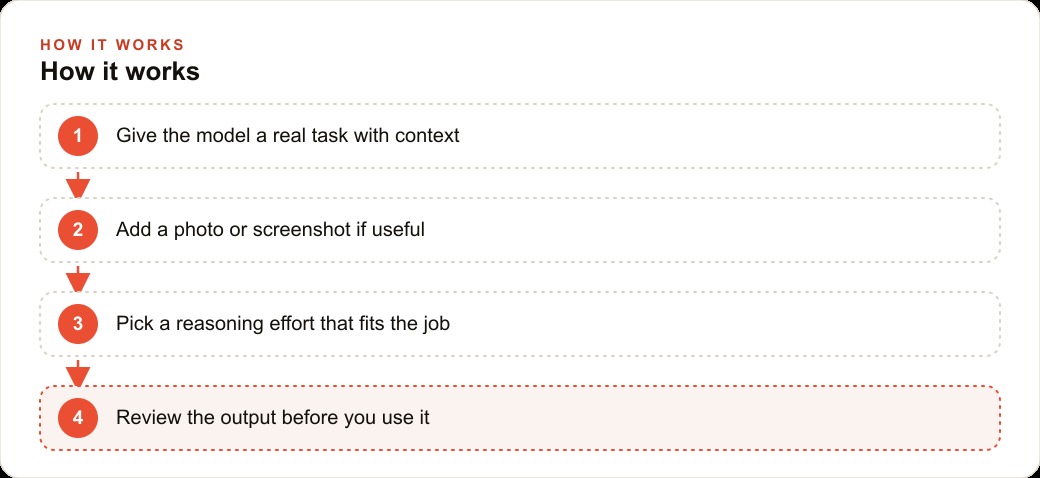
The right starting point for any business is one task, done with real context, with a review step built in from day one. From there, the expansion to the next task and the next follows naturally, and each addition to the workflow builds the institutional knowledge of which prompts produce reliable output for your specific operation. The category has shifted. The businesses that recognize that first will benefit most from the shift.
That is exactly what we do at AI DOERS. Book a private 30-minute call with Madhuranjan Kumar and we will map the fastest path to it for your specific business.
Book your call →
Madhuranjan Kumar
Madhuranjan Kumar brings 20 years of performance-marketing experience and has managed over $200 million in Facebook ad spend for brands across the United States and beyond. His expertise spans the full modern marketing stack: Meta, Google Ads, TikTok, email automation, CRM, and the websites that hold it together. At AI DOERS he turns that track record into lead-generation systems for businesses across every industry.