
GPT-5.1 Is Here, Faster and Warmer, and Better at Doing Exactly What You Ask
GPT-5.1 thinks only as long as a question needs, follows instructions more closely, and sounds more human. Here is what that means for a customer facing business and how I would put it to work.

The most important upgrade in GPT-5.1 is not intelligence, it is obedience
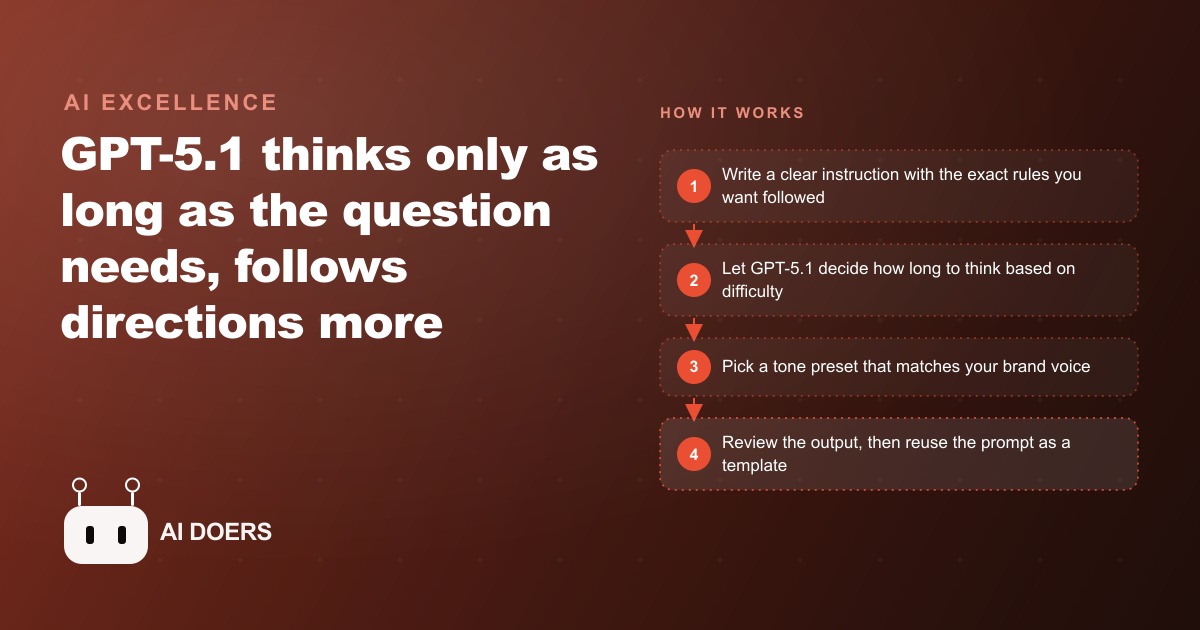
Most model launches sell you a bigger number on a benchmark. GPT-5.1 is interesting for a different reason. Its headline improvements are that it thinks only as long as a question deserves, follows your instructions far more closely, and sounds more like a person. I am Madhuranjan Kumar, and I want to take this release apart along the three axes that actually decide whether a model is useful inside a real business: how it spends its thinking, how faithfully it obeys, and how it sounds to the customer on the other end.
The first facet: thinking that scales to the question
The older version had an expensive habit. It would grind on a simple question with the same heavy effort it applied to a hard one, wasting both time and tokens. GPT-5.1 ships as two coordinated models, a fast instant model for quick conversational answers and a deeper thinking model for genuine problems, and the system routes your request to the right one automatically. More importantly, the instant model now uses adaptive reasoning, so easy questions get quick answers and hard ones get more deliberation.
This sounds like a convenience, but the economics are the real story. When you stop paying for overthinking on trivial requests, the cost of running an AI feature at volume drops without any loss of quality on the questions that matter. A support assistant answering a thousand where is my order questions a day should not burn deep reasoning on each one. Adaptive thinking means it does not. The model matches effort to difficulty the way a competent employee does, spending the expensive attention only where it changes the answer.
The second facet: instruction following you can actually rely on
This is the change I care about most, because it is the one that decides whether AI output is safe to use with less editing. A model that ignores half your rules is a model you have to babysit. In testing, when GPT-5.1 was told to answer in exactly six words, it did, repeatedly. That specific test is trivial, but what it demonstrates is not. Tighter instruction following means that when you write never give medical advice, or always include the booking link, or never quote a price, the model actually holds the line.
Think about what unreliable obedience costs today. Every rule you cannot trust becomes a rule a human has to check, which means the AI never really saves the time it promised. The value of stronger instruction following is that it moves rules from please and hope into reliably enforced, and that shifts the human role from rewriting the output to glancing at it. For any business where a wrong sentence carries real risk, this is the difference between a toy and a tool.
The third facet: tone that a customer will not flinch at
The previous version drew a common complaint. It felt flat, a little robotic, faintly exhausting to talk to. GPT-5.1 gives the instant model a warmer, friendlier, more conversational personality, and it lets you shape that voice with presets like default, friendly, professional, candid, and quirky. Tone reads as a soft feature until you remember that customers are the ones reading the words. A reply that is technically correct but cold still damages the relationship.
The presets matter because brand voice is not one-size-fits-all. A veterinary front desk wants warm and reassuring. A law office wants precise and professional. A youth brand might want candid or quirky. Being able to set that voice once, and trust the instruction following to keep it, means your AI-drafted messages sound like your business rather than like a generic assistant. Tone plus obedience together are what make the output feel authored rather than generated.
The facet that ties it together: documents
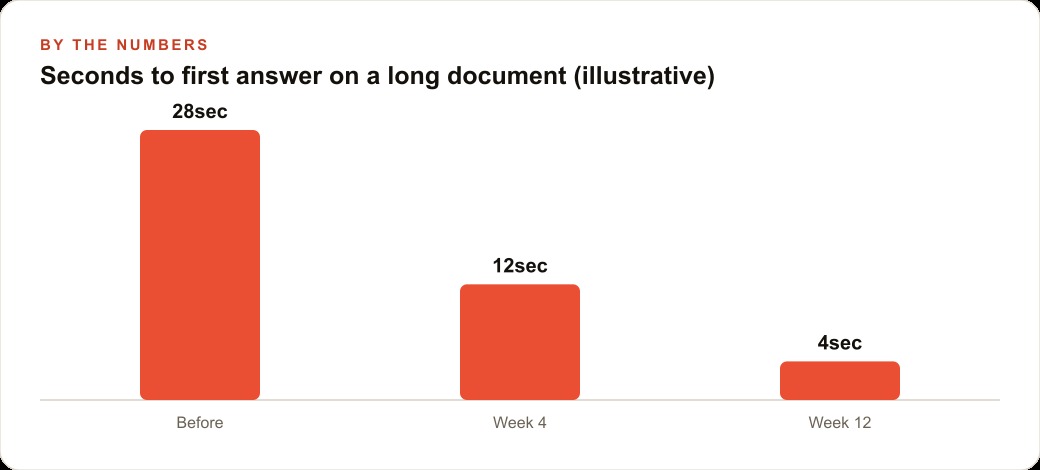
There is a fourth dimension that quietly benefits from all three. Enterprise tests showed the time to a first answer on documents dropping sharply, and accuracy climbing on pulling data out of tables, multi-field forms, and even handwriting. Faster and more accurate document handling is not glamorous, but it is where a huge amount of office time actually goes. Intake sheets, invoices, contracts, lab results. When the model reads them quickly and gets the fields right, the slow desk work shrinks. And because these gains are available in the API, any automation you already run inherits the improvements without a rewrite, along with longer prompt caching that trims repeat costs.
A worked example: a veterinary clinic
Let me assemble the facets into one business. A veterinary clinic is a good test because almost everything the front desk writes is both emotional and safety-sensitive, so it needs tone and obedience at the same time.
Start with the client messages. Owners writing about a sick pet are frightened, so I would use the friendly tone preset to draft calm, kind, clear replies, with a hard rule baked into the prompt that the model never gives a diagnosis and always routes anything urgent to a real appointment. The improved instruction following is what makes that safety rule actually hold, which is the whole reason the clinic can let the AI draft at all. Next, the paperwork. The clinic takes in intake forms, vaccination records, and lab sheets, and the better extraction reads tables and handwriting more accurately, so the model can pull key details into a clean summary the vet scans before the visit. Then the routine writing, like appointment reminders, post-visit care instructions, and follow-up texts, all drafted in the clinic voice and reviewed before sending.
Put rough numbers on it. Suppose the front desk spends four hours a day on messages and paperwork. If faster documents and less editing cut that by a third, that is roughly 80 minutes a day returned to the staff, or about seven hours a week, which is nearly a full extra shift of time with animals and owners instead of a keyboard. Those reminders and follow-ups also drop into the CRM and website stack so no visit falls through the cracks, and the same warm, on-brand voice can answer the inquiries that arrive from the clinic's Facebook and Instagram ad campaigns without a human retyping the same reassurance ten times a day.
The honest limit
Here is the catch that no launch mentions. A model that follows instructions well is only as good as the instructions you give it. Stronger obedience raises the ceiling, but it also means a sloppy prompt gets followed sloppily and faithfully. The work moves from editing output to writing precise rules, and getting those rules right so the model stays safe, on brand, and accurate takes careful drafting and real testing. That is where most owners stall, not on the technology. The reliable instruction following is a gift only if you bring instructions worth following.
What the two-model split means for your monthly bill
The instant-plus-thinking split is not only a speed feature, it is a cost feature, and that deserves its own look because it changes the economics of running AI at any real volume. Under the older model, every request paid roughly the same heavy price whether it was trivial or genuinely hard. When the system routes easy questions to the fast path and reserves deep reasoning for the difficult ones, your average cost per request falls, because most real traffic is easy. A business fielding a thousand customer messages a day, where the vast majority are routine, stops paying premium reasoning prices on the routine nine hundred and only spends the expensive effort on the hundred that need it.
That shift is what makes it realistic to put AI on high-volume, low-margin work that never justified it before. Order-status replies, appointment confirmations, simple FAQ answers, none of these were worth frontier prices at scale, and now they do not have to be. Pair that with the longer prompt caching available in the API and repeat work gets cheaper still, since the model does not re-pay to process the same standing instructions every single call. The practical lesson is to stop treating one model as the answer to everything and start letting difficulty decide the cost.
The tone dial deserves more thought than most owners give it
It is tempting to treat the personality presets as a novelty, but tone is where AI-written text quietly wins or loses a customer, and this release finally makes tone controllable rather than accidental. The reason it matters is that the customer never sees your prompt. They see the sentence, and a sentence that is correct but cold still lands as cold. Setting the voice deliberately, warm for a worried pet owner, precise for a legal client, plain and candid for a straightforward update, means the words carry the relationship instead of undermining it.
The deeper point is consistency. When you save a prompt with a locked tone preset and rely on the stronger instruction following to hold it, every message the team sends sounds like the same business, whether it goes out at nine in the morning or nine at night, from a person or from an automation. That consistency is a brand asset most small businesses never manage to build, because it usually depends on one gifted writer being available. A model that reliably holds a defined voice hands that asset to the whole team at once, which is exactly why the combination of tone control and obedience is more valuable together than either would be alone.
Better document handling is the quiet money-saver
It is easy to fixate on tone and reasoning and skip past the document gains, but for most offices that is where the real hours hide. Intake forms, invoices, contracts, lab sheets, and spreadsheets pass through nearly every business, and reading them by hand is slow, error-prone work that nobody enjoys. When the model both reads faster and extracts more accurately from tables, multi-field forms, and even handwriting, a task that used to demand careful human transcription becomes a quick review of a clean summary. The improvement is not glamorous, which is precisely why it gets overlooked, and precisely why it pays off.
The compounding effect shows up when you connect document extraction to the rest of the work. A form the model reads accurately can feed a summary the staff scans in seconds, which can trigger a warm, on-brand reply drafted in the right tone, which can be logged automatically for follow-up. Each improvement is modest on its own, but chained together they turn a slow manual pipeline into a fast supervised one. That is the pattern worth internalizing from this release. The headline is a warmer, more obedient model, but the deeper win is that faster, more accurate reading lets you automate the boring middle of nearly every office workflow with less editing and more trust.
One more practical note ties the whole release together. Because all of these gains, the adaptive thinking, the tighter instruction following, the warmer tone, and the faster document handling, are available through the API, any automation you already run can inherit them without a rewrite. A workflow that drafts replies, summarizes records, or extracts fields simply gets better the moment it points at the new model, and the longer prompt caching trims the cost of the standing instructions it sends on every call. That is a rare kind of upgrade, one where existing work improves quietly in the background rather than demanding a rebuild, and it means the payoff arrives faster than most owners expect.
How to actually adopt it
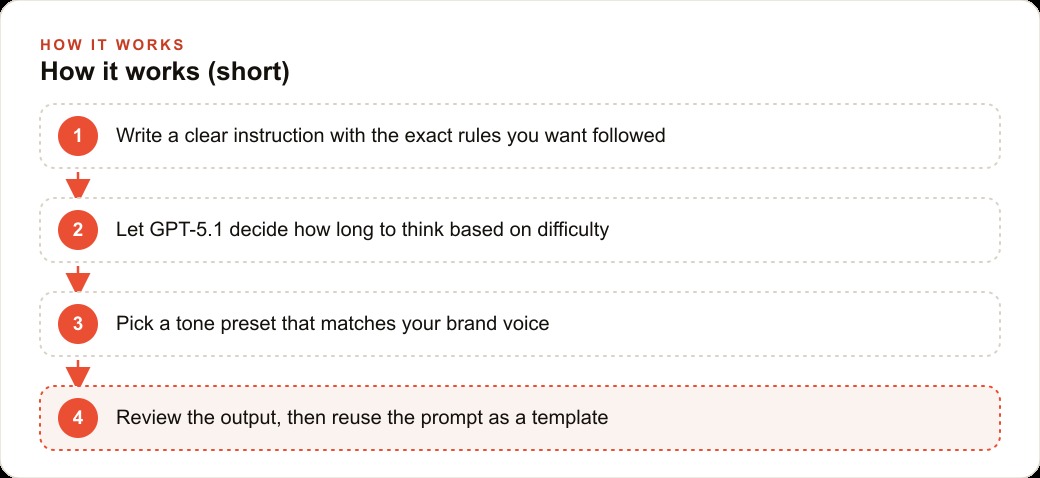
Write one clear instruction for one task, including the exact rules you want held, and run it on real examples until you trust it. Pick the tone preset that matches your brand. Save the prompt as a template so the whole team gets consistent results, then add the document tasks, feeding in a sample form and checking the extraction before you rely on it. Keep each task small and proven before moving to the next, and remember that the same content foundation you build here can feed SEO and organic search when you reuse those clean summaries and descriptions elsewhere.
You can absolutely build your first templates yourself in an afternoon. If you would rather have the prompts written, the safety rules locked in, and the whole thing handed over working, that is exactly the kind of setup I do for clients. Both paths get you there. One just skips the trial and error.
That is exactly what we do at AI DOERS. Book a private 30-minute call with Madhuranjan Kumar and we will map the fastest path to it for your specific business.
Book your call →
Madhuranjan Kumar
Madhuranjan Kumar brings 20 years of performance-marketing experience and has managed over $200 million in Facebook ad spend for brands across the United States and beyond. His expertise spans the full modern marketing stack: Meta, Google Ads, TikTok, email automation, CRM, and the websites that hold it together. At AI DOERS he turns that track record into lead-generation systems for businesses across every industry.