
Google Turned Everything Into AI: The 22 I/O Updates That Matter
At its developer conference Google shipped 22 AI updates headlined by the biggest change to Search in 25 years, a prompt-style search box with file and image uploads, three new Gemini models, and agents that book, call, and build answers for you.

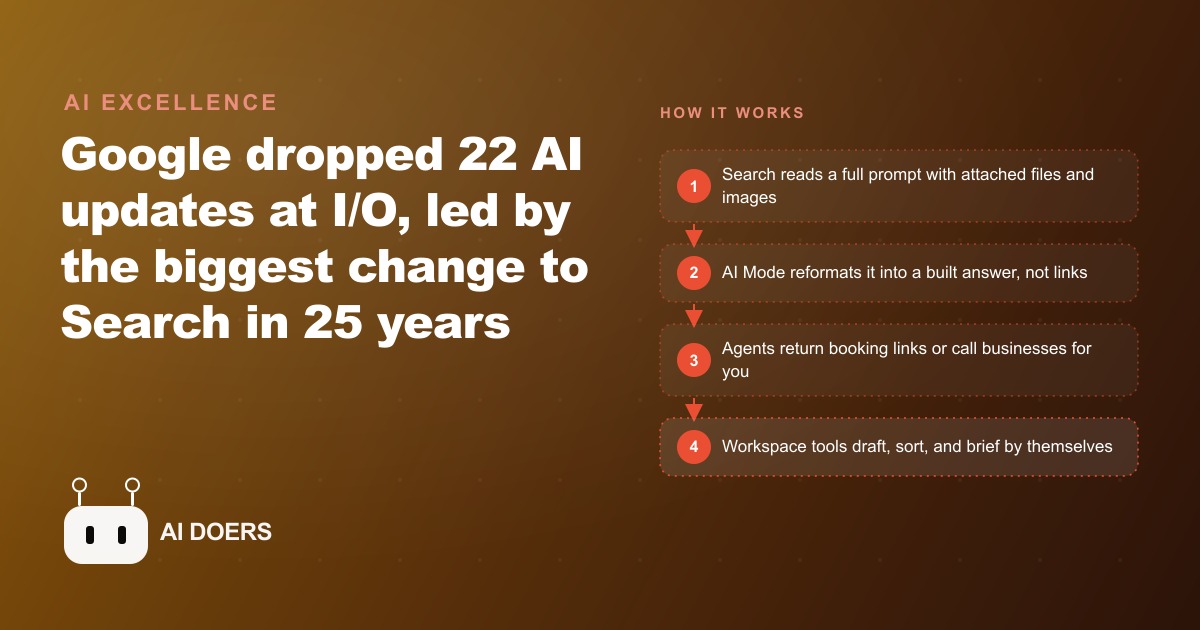
Google just rewired its most important product, and most business owners have not registered what it means yet. At its developer conference the company shipped 22 AI updates, and the headline is the biggest change to Search in twenty-five years: the classic search bar is being replaced by a box that behaves like a chat assistant. I am Madhuranjan Kumar, and I want to break down what actually shipped, then get specific about why the way customers find and choose your business is about to change under your feet.
Search stops returning links and starts returning answers
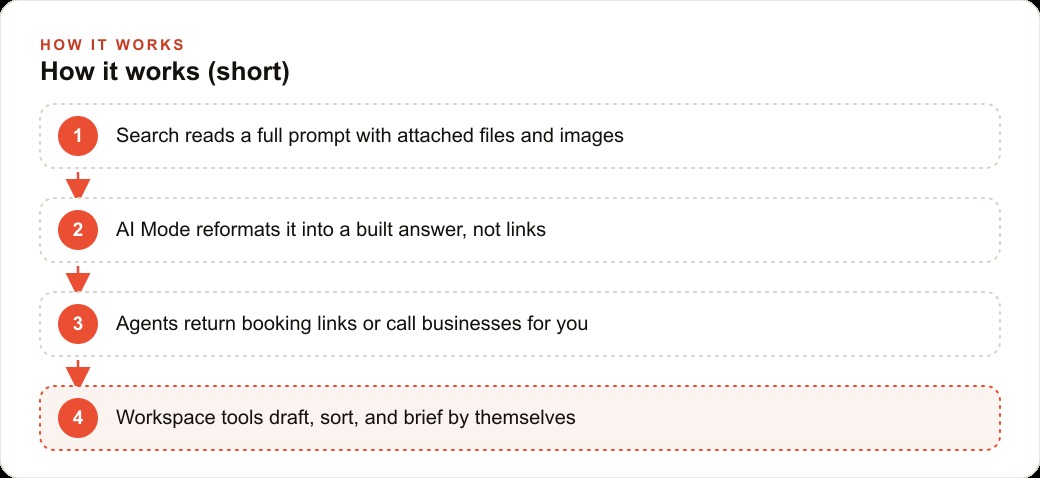
The centerpiece is Search itself. You can now type long, detailed queries and attach videos, files, and images so the search has real context, and the AI Mode that used to be optional is becoming the default. Instead of a familiar list of blue links, it reformats your query into a richer, built answer. For anyone who has used Google the same way for two decades, this is a genuine change to how the front door of the internet works, and it is the update with the widest downstream effect on local businesses. When a search returns one composed answer rather than ten options, fewer people scroll to a list, which means being the source that answer is built from matters far more than sitting somewhere on page one.
Three model tiers sit underneath everything
The engine got a real refresh. A new fast tier now outperforms the previous generation's pro model while running several times quicker, which makes it faster, cheaper, and about as capable as the top models for most everyday jobs, and it is the sensible default for quick, low-cost work. Above it, a new best-in-class reasoning model is arriving that is expected to challenge the leading models from other labs. There is also a multimodal model that starts from video rather than a still image and keeps its output editable with a follow-up prompt, available today inside Gemini. The pattern across the lineup is clear: a cheap fast workhorse for volume, a heavyweight for hard reasoning, and generative media that is editable rather than one-shot.
The real theme is agents that take action
Strip away the model names and the thread tying all 22 updates together is agentic. Google is wiring action directly into the products people already open every day:
- Search can take your price, time, place, and preferences and return direct booking links, and it can even call businesses on your behalf to schedule something like a home repair.
- Generative visual answers build interactive charts, widgets, and small apps from a single query, so a search for a fitness routine returns a working tracker rather than a list of pages.
- A personal agent works across mail, docs, and calendar, and a daily brief summarizes what you missed and suggests the next steps.
- Voice arrives in the workspace, letting you talk to your inbox and turn dictation into a structured draft that pulls context from your other tools.
There is also a new prompt-style search on this breakdown platform that returns direct answers with deep links to the exact moment inside a video. That is great for viewers, but it could quietly reshape how tutorial and how-to content gets watched, which matters to anyone building an audience.
Why this hits local businesses right where customers decide
Here is the part owners need to sit with. Two of these changes land exactly at the moment a customer chooses a business. First, answer-first search means the practice or shop whose online information is accurate and complete is the one the answer gets built from, and everyone else becomes invisible. Second, if Google can call a business on a customer's behalf to book, the business whose booking details are clear and current is the one that gets the call, and the one with stale hours or a vague listing simply gets skipped. This is not a distant trend. It changes how discovery works at the top of your funnel, which flows straight into everything you already run across Facebook and Instagram ad campaigns and Google Ads, because paid traffic still lands on a site that now has to answer real questions plainly.
A worked example: a dental practice adapts
Let me ground this in one business with illustrative numbers. Picture a dental practice competing in a mid-size city where patients increasingly search by asking full questions instead of typing keywords.
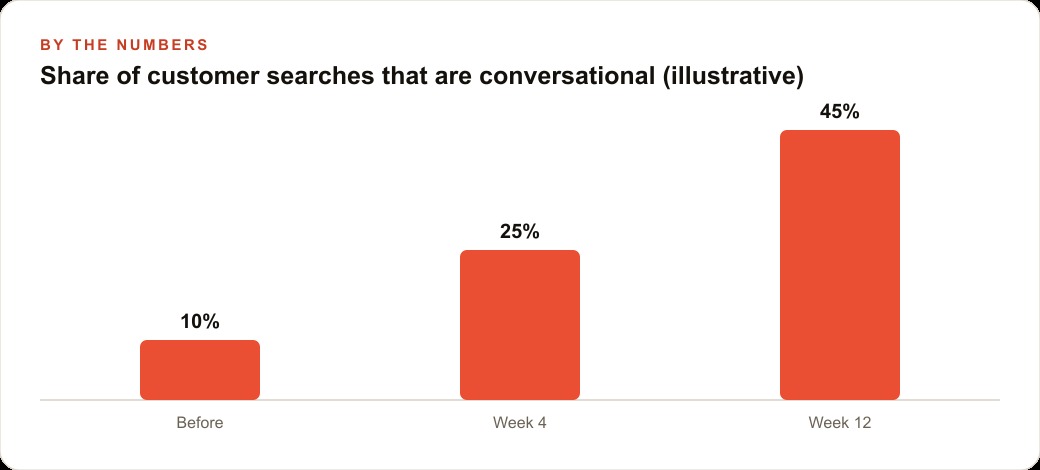
When someone searches for a dentist who offers a specific service nearby, an answer-first result will increasingly summarize a single recommendation rather than show a long list, so the practice's online information, its services, hours, location, and reviews, has to be accurate and complete enough to be the answer the system builds from. If the practice's booking details are current, it is also the one that gets the automated call when a patient asks Google to schedule for them. Say conversational, question-style searches climb from a tenth of the practice's inbound traffic to nearly half over a few months. The practices that rewrote their site and listings to answer real patient questions plainly capture that shift, and the ones that did not watch their share quietly erode. All of this is really an extension of good SEO and organic search discipline, structured, complete, honestly answering the questions patients actually ask.
Internally, I would lean into the workspace agents. A daily brief that pulls from the practice's mail and calendar can summarize the day's new patient inquiries and flag the urgent ones before the front desk even sits down, and voice dictation can turn a quick spoken note into a structured draft reply. Those inquiries should route into the CRM and website stack so nothing slips between the answer-first search finding the practice and a staff member following up. The broader move is simple to state and real work to execute: patients are shifting from keywords to questions, so the website and the listings should answer real questions the way a patient would actually ask them, because that is the format the new search rewards.
What answer-first search does to the click, and to you
The single most consequential shift in this whole announcement is quiet: the click is disappearing. For twenty-five years the entire game of getting found online has been about earning the click, ranking high enough that a customer picks your link out of a list and lands on your page. When search returns a composed answer instead of a list, a large share of those clicks never happen, because the customer got what they needed inside the answer itself. This is sometimes called the zero-click search, and it is not a fringe scenario anymore. It is becoming the default behavior of the front door of the internet.
For a business, that changes the objective. The old goal was to be the link that gets clicked. The new goal is to be the source the answer is built from, which is a subtly different and in some ways harder target. It rewards businesses whose information is complete, structured, consistent, and phrased the way customers actually ask, because that is what the system can lift cleanly into an answer. It punishes vague, thin, or inconsistent listings, not by ranking them lower, but by leaving them out of the answer entirely. There is no page two to fall to. There is the answer, or there is invisibility. That is a starker world, and the businesses that treat their online information as an afterthought are the ones about to feel it.
It also raises the stakes on being reachable. If an agent can call a business on a customer's behalf to book, then the practical winner of that search is whoever has clear, current booking details and easy contact paths, not whoever wrote the cleverest headline. The competition moves from persuasion to presence and accuracy. Being the answer and being callable are the two new positions to hold, and both of them reward diligence over flash.
The content platform change creators should watch closely
One update sits a little apart from the local-business story but deserves a flag, because it changes how a whole category of content gets found. This breakdown platform is getting its own prompt-style search that returns direct answers with deep links to the exact moment inside a video. On the surface that is a viewer convenience, and a real one. Underneath, it changes the economics of how-to and tutorial content. If a search can drop a viewer straight into the ninety-second answer they wanted, the surrounding structure of a video, the intro, the setup, the build to a payoff, matters differently, because people are arriving mid-stream at the exact answer rather than watching from the top.
For anyone building an audience or using video to attract customers, this is worth watching, because it rewards content that answers specific questions cleanly and can be indexed at the moment level. Long, meandering content becomes harder to surface than tightly structured content where each segment answers a nameable question. The lesson rhymes with the search lesson: the systems increasingly reward material organized around the real questions people ask, in a shape a machine can lift an answer out of. Whether it is your website, your listings, or your video, the winning format is the same, plain answers to real questions, structured so a system can find them.
The internal upgrades are the easy, immediate win
Amid all the talk about how discovery is changing, it is easy to miss that a chunk of these updates help you today with no strategy required. The new fast model is a genuinely good default for quick, cheap, everyday answers, faster than the previous frontier model and about as capable for most jobs, which makes it a sensible workhorse for routine work. The workspace features are even more immediately practical. A daily brief that pulls from your mail and calendar can summarize the day's new inquiries and flag the urgent ones before anyone sits down, which for a busy front desk is real time saved on the first morning. Voice in the workspace lets you talk to your inbox and turn a spoken note into a structured draft, cutting the copy-paste that eats small pockets of the day. None of this requires you to reshape your website or rethink your listings. It is available now and it pays off now. So while the answer-first search shift is the big strategic story that deserves careful, deliberate work, I would not wait on the internal tools. Turn them on, let them cut the busywork, and use the time they free up to do the deeper work of getting your public information into the shape the new search rewards. The one is an immediate convenience, the other is a durable advantage, and you can start both this week.
What to actually do about it
The action list is not exotic, which is the good news. Make sure your business information is complete and consistent everywhere a search or an agent might read it. Write your site and listings to answer the real questions customers ask rather than to stuff in keywords. Plan for a world where an agent might handle the booking or the first call, which means your hours, services, and contact details cannot be stale. Internally, try the fast new model as your default for quick, cheap answers, use the workspace voice and brief features to cut copy-paste, and keep an eye on how a prompt-style video search changes the way your how-to content gets discovered.
Adapting to an answer-first, agent-driven search world is mostly about getting your information and content into the shape these systems reward, which sounds simple and takes deliberate work to do well. You can make these changes yourself using the steps above, or if you would rather have your search presence and your internal AI workflows set up for this shift and handed over already working, that is the kind of work I do for clients. The one thing I would not do is wait, because the front door of the internet just changed, and the businesses that reshape their information first are the ones the new search will point customers toward.
That is exactly what we do at AI DOERS. Book a private 30-minute call with Madhuranjan Kumar and we will map the fastest path to it for your specific business.
Book your call →
Madhuranjan Kumar
Madhuranjan Kumar brings 20 years of performance-marketing experience and has managed over $200 million in Facebook ad spend for brands across the United States and beyond. His expertise spans the full modern marketing stack: Meta, Google Ads, TikTok, email automation, CRM, and the websites that hold it together. At AI DOERS he turns that track record into lead-generation systems for businesses across every industry.