
Google's Infinite AI Worlds and the Week AI Learned to Act
Google's Project Genie generates playable worlds in real time, and this week Gemini, Claude, and others gained agentic powers that act inside your apps. Here is what that means for a business and how a brokerage can put it to work.

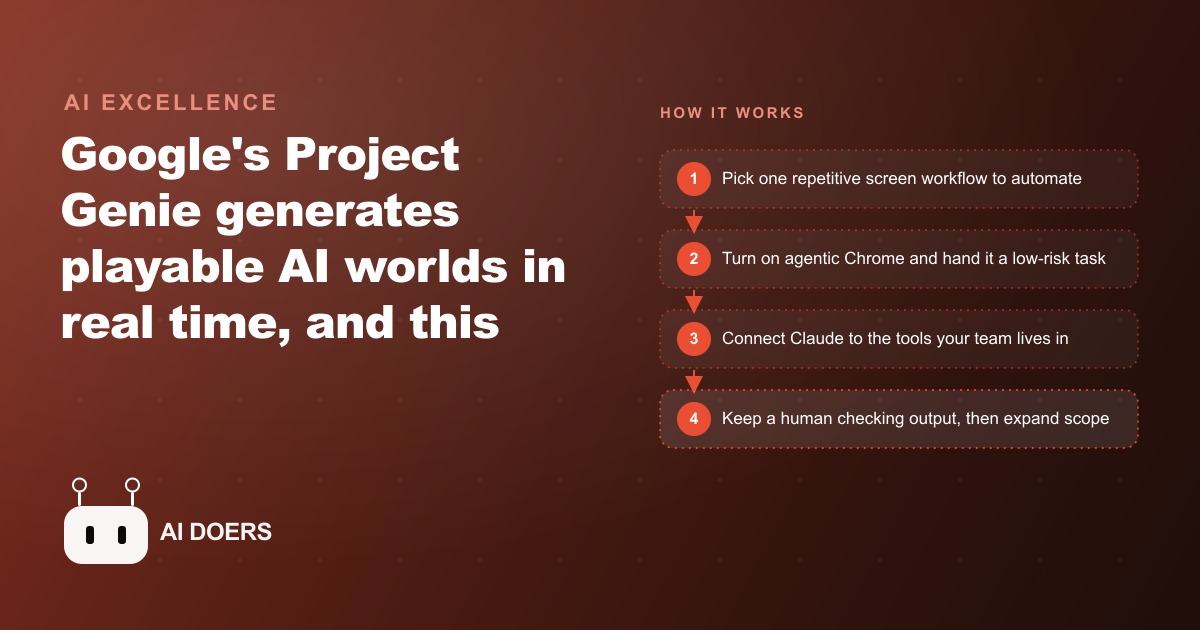
This week in AI ran faster than usual, with Google, Anthropic, xAI, and open-source labs each shipping something worth understanding. I am Madhuranjan Kumar, and the common thread across all of it is that AI stopped being a question-answering tool and started being an action-taking one. Here are the releases from this week that actually matter for a business.
1. Google Genie generates a playable world in real time from a single image
Google's Project Genie went live to a limited group and it is unlike any AI demo before it. You upload a single image or type a text prompt, drop into a navigable scene, and steer a character with keyboard controls for sixty seconds. Every frame of what you see is generated by the AI in real time as you move, not pulled from any pre-built environment. It saves a recording when your session ends.
The practical applications for most businesses are indirect at this stage: the quality is early and the system is limited in access. But the direction is significant. An AI that generates an environment as you interact with it is a qualitatively different kind of system from one that retrieves or describes. The implication for product visualization, training simulations, and interactive experiences is real, and the timeline for that becoming practically accessible is shorter than it would have seemed a year ago.
2. Gemini gained agentic control of Chrome, filling spreadsheets and drafting emails hands-free
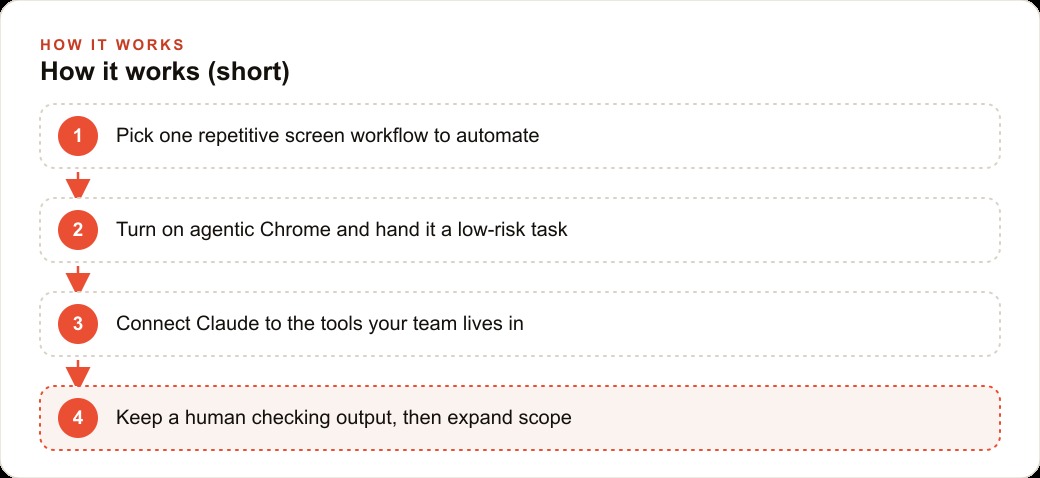
Google put Gemini directly into Chrome with agentic powers, and the demo was concrete: in a live session, it took control of the screen, filled a spreadsheet with names from a document, read a separate document and drafted a matching Gmail reply, then used Nano Banana in the sidebar to modify a room photo. The cursor moved on its own, the fields filled, the email appeared, all while the operator watched.
For any business where employees spend hours on repetitive browser tasks, filling the same forms, copying data from one system to another, drafting near-identical emails from a template, this is not a future capability. It is available now in Chrome through the Gemini agentic integration, and the practical test is identifying one high-volume, low-judgment task and running it under supervision this week.
3. Claude now acts inside Figma, Canva, Asana, and Slack through open connectors
Anthropic added tool connectors through MCP, an open connection standard, so Claude can now take actions inside the tools your team already uses rather than just answering questions about them. Figma, Canva, Asana, and Slack are in the initial set. Claude also shipped as a native Excel add-in, so you can generate and manipulate spreadsheet data without leaving the sheet.
The significance is that you can now describe a workflow that touches multiple tools in a single instruction. Add this asset to the Canva template, create a task in Asana for review, and post the link to the Slack channel is now a plausible single instruction rather than three separate manual steps. For teams whose coordination overhead lives in moving information between these tools, the connectors collapse that overhead.
For businesses running Google Ads campaigns or managing Facebook and Instagram ad campaigns, the design-to-delivery workflow is one of the highest-friction areas. An agent that can modify a Canva creative based on a brief, update the associated tracking task, and notify the team in Slack reduces the coordination cost on every creative iteration.
4. ChatGPT's ad CPM will reportedly run three times higher than Facebook and Instagram
OpenAI is targeting approximately $60 per thousand views for ads inside ChatGPT. The current Facebook and Instagram CPM benchmark is around $20. That gap reflects how much attention is shifting toward AI chat interfaces and how confident OpenAI is that the audience inside ChatGPT represents high intent.
For businesses currently allocating ad budgets, this is useful competitive intelligence. The CPM on emerging platforms is typically high at launch and compresses over time as inventory scales. Whether ChatGPT ads deliver the return at $60 CPM depends entirely on the match between your offer and the audience using the platform, which is worth testing in a limited way once the placement is openly available rather than assuming either direction.
5. GPT-4o is being retired in February, so workflows pinned to it need migrating now
OpenAI is sunsetting GPT-4o, 4.1, 4.1 mini, and o4 mini inside ChatGPT on February 13th. Users who have built custom GPTs or automated workflows that specify these models by name need to update those dependencies to a current model before the retirement date. This is a concrete action item for any business using OpenAI's API or custom GPT configurations.
Model retirement is a recurring event in the AI landscape and one of the practical arguments for building workflows that reference models by their capability tier rather than a specific version name. Migrating now, with time to test the updated workflow against your expected outputs, is significantly easier than migrating under deadline pressure.
6. Open models from Kimi and Qwen are legitimately competitive with the frontier labs
Kimi K2.5 from Moonshot AI is an open visual agentic model that reached the top of the Humanity's Last Exam benchmark, and Qwen3 Max Thinking from Alibaba landed near state-of-the-art on reasoning tests. Both models are freely available, either locally or via API.
The practical implication for businesses is that the cost of AI capabilities that were frontier-only six months ago has dropped significantly. A business building an internal tool or automating a specific workflow no longer needs to budget for the most expensive frontier model to get near-frontier performance. The open model options are now serious enough to evaluate before defaulting to a paid API.
For SEO content production and content workflows specifically, this matters because content volume often benefits from lower per-unit AI cost. A model that performs well at 80 percent of the price of the frontier alternative can produce meaningful cost reductions at scale.
7. NVIDIA's Earth 2 produces 15-day global weather forecasts at a fraction of current cost
NVIDIA launched Earth 2, the first fully open set of accelerated AI models for weather forecasting. It generates 15-day global forecasts with higher accuracy and lower computational cost than current operational methods. The model set is freely available.
For businesses where weather has operational significance, agriculture, construction, events, transportation, this is the kind of AI application that delivers concrete business value without requiring any general AI capability. The specific use is weather intelligence, and the step change in forecast quality and access is real. Whether this belongs in your tool stack depends on your exposure to weather-driven decision-making, but if weather affects your business meaningfully, this is worth evaluating immediately.
The thread connecting all seven releases is the same. AI moved from answering to acting this week, and from closed-lab-only to open-available across more capabilities than any comparable week before it. The teams building habits around these agentic tools now will have a compounding advantage over the ones who wait until the tools are universally obvious. Start with one agentic workflow, run it under human supervision, and build from there. ## The practical response for a business this week
The thread connecting all of these releases is the same: AI moved from answering to acting this week, and the businesses that start building agentic workflows now will compound an advantage over the ones that wait until the tools are universally obvious.
The concrete action for a business this week is to pick one agentic capability and run a real task through it under supervision. For a business with a Google Workspace setup, the natural starting point is Gemini in Chrome: identify the one browser task that takes the most time through repetitive clicking, set up a supervised session where an employee watches the agent work, and evaluate the output quality before trusting it to run unsupervised.
For a business already using Claude in any capacity, the MCP connectors update is worth testing immediately. If the business uses Asana, Slack, or Canva, the connectors are now available and the test is to run a real coordination task, add a design to a Canva template, create the corresponding Asana task, and post the update to Slack, as a single Claude instruction rather than three separate manual steps. The time saved on each iteration is small. The accumulated time saved across hundreds of iterations per month is substantial.
The OpenAI model retirement is the one item on this list that is a deadline rather than an opportunity. Any business using GPT-4o, 4.1, 4.1 mini, or o4 mini through the API or in a custom GPT configuration needs to plan and execute the migration before February 13th. The migration is straightforward for most configurations, but doing it under time pressure increases the risk of missing something. Start the migration review this week, test the updated configuration on a sample of real tasks, and confirm the outputs are comparable before the retirement date.
For businesses running Facebook and Instagram ad campaigns or Google Ads, the $60 CPM signal for ChatGPT advertising is relevant context for 2025 budget planning. The audience shifting toward AI chat interfaces is real, and the premium pricing for access to that audience reflects its composition. Whether ChatGPT advertising is right for a specific business depends on whether the audience matches the offer, and the only way to know is to test when the placement becomes available. Budget a small allocation for the test rather than committing heavily before seeing conversion data.
The NVIDIA Earth 2 weather model warrants a specific evaluation for any business with seasonal or weather-dependent operations. The 15-day forecast quality and the free access make it worth a trial for construction, events, agriculture, and any business where weather drives scheduling or demand. The evaluation is simple: run the model's forecast against your local conditions over two weeks and compare the accuracy to what you currently use. If the accuracy is comparable or better, you have a free upgrade to your weather intelligence with no integration cost.
The week that just passed was the clearest demonstration yet that the AI interface is shifting from a text window to an operating environment that controls real software. The teams building habits around that shift now are three to six months ahead of the ones who are still evaluating whether to pay attention.
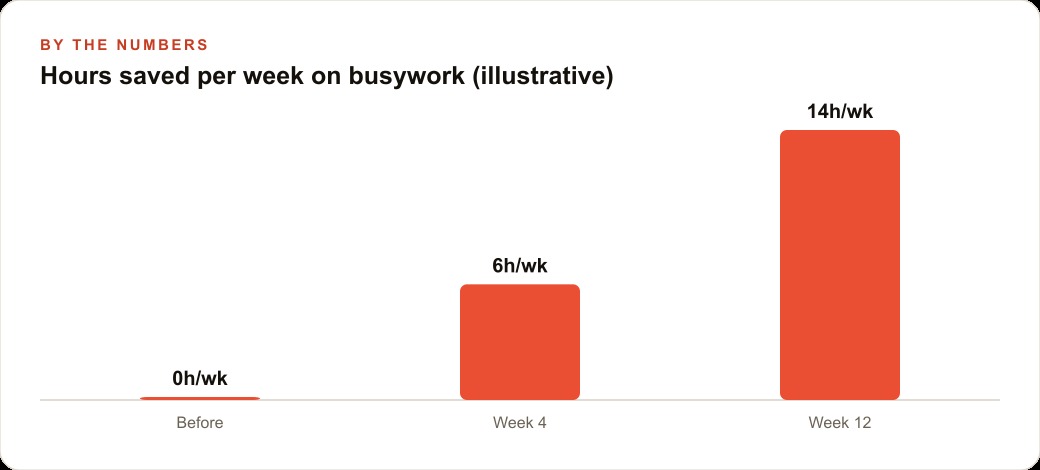
The teams that build habits around agentic workflows now will have three to six months of practice by the time these tools are obvious enough that every competitor starts using them. That lead does not guarantee success, but it represents a meaningful operational advantage in how quickly the team can accomplish research, analysis, and multi-step coordination tasks. The compounding effect of starting earlier is real. The first month of using agentic tools produces modest results because the habits and prompts are still developing. The sixth month produces substantially more value from the same tools because the team knows exactly how to direct them.
The second habit that makes this week's releases relevant beyond the news cycle is documentation. Every team that evaluates a new AI capability this week should write a single paragraph summary of the evaluation: what they tested, what the output quality was like, and whether the capability is worth incorporating into a regular workflow. That paragraph takes ten minutes to write and is infinitely more valuable than a vague memory of having tried something once. The documentation becomes the decision record that prevents the team from re-evaluating the same capability six months from now because nobody remembers what the conclusion was. Build the practice of documenting tool evaluations and the team's AI capability grows from a set of individual impressions into a collective institutional knowledge base that compounds over time. The businesses that will look back on this week as a turning point are the ones that used it to take a concrete first step, not the ones that read about the releases and waited for the tools to mature further. The tools are already mature enough for real use. The maturation still happening is your team's competence with them, and that only builds through practice that starts now.
That is exactly what we do at AI DOERS. Book a private 30-minute call with Madhuranjan Kumar and we will map the fastest path to it for your specific business.
Book your call →
Madhuranjan Kumar
Madhuranjan Kumar brings 20 years of performance-marketing experience and has managed over $200 million in Facebook ad spend for brands across the United States and beyond. His expertise spans the full modern marketing stack: Meta, Google Ads, TikTok, email automation, CRM, and the websites that hold it together. At AI DOERS he turns that track record into lead-generation systems for businesses across every industry.