
Google IO 2025 Showed What AI-Native Products Look Like and What Real Estate Agents Need to Do Right Now
The announcements from Google IO 2025 are not conceptually distant from the real estate industry. Veo 3's photorealistic video, Beam's holographic calling, and AI search transformation affect how properties are shown and how leads find agents.

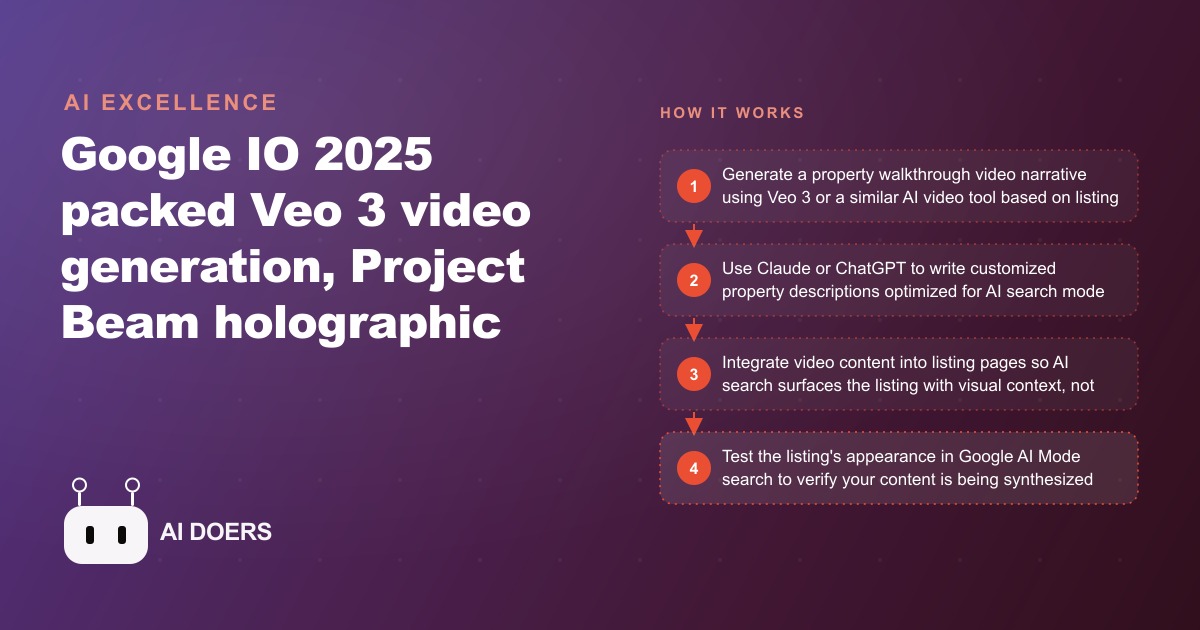
Google IO 2025 did something most keynotes do not: much of what it showed went live or into accessible preview the same week. This was not a stage full of concept videos and someday promises. Veo 3 generating video with synchronized audio, AI Mode turning search results into synthesized answers, Project Beam putting a caller into the room as a three-dimensional presence, Android XR glasses, and Flow for filmmakers all landed inside one week, alongside the release of Claude 4 and word that Apple's legendary former design chief has joined forces with OpenAI on AI hardware. Taken together, it was the clearest picture yet of what AI-native products actually look like when a company with Google's reach ships them at once.
For a real estate agent, the temptation is to treat all of this as distant industry noise. That would be a mistake. Two of these announcements change how properties get shown and how buyers find the agent showing them, and they change it now, not in some hazy future. The rest is important context for where the market is heading over the next two to four years. Sorting the immediate from the eventual is the whole job this week.
Two announcements clear the bar that matters
Not every impressive demo is an operational priority. The ones that matter for a business are the ones where the product is close enough to how people already behave that adoption is fast, and where the gap between what AI can do and what human labor currently provides is large enough to be worth money. By that test, two IO announcements clear the bar for real estate: Veo 3's photorealistic video with audio, and Google's AI Mode in Search. Beam, the XR glasses, and the Flow filmmaking suite are real and they are coming, but they are context for the next few years, not this quarter's to-do list.
That filter is worth applying to every AI headline, not just these. The question is never whether a capability is impressive. It is whether the form factor fits current behavior and whether the labor it replaces is expensive enough to justify changing your workflow. Hold the IO announcements up to that standard and the priority order sorts itself out quickly.
Veo 3 collapses the cost of property video
Veo 3 is Google's video generation model, and the change that makes it matter is that it produces audio in the same pass as the picture. Earlier AI video tools generated visuals only, and the sound had to be added afterward through music tracks, recorded voiceover, or separately generated effects. Veo 3 generates ambient sound, background audio, dialogue, and music as part of the same process. A prompt describing a suburban house at dusk with a couple arriving at the door produces the scene with footsteps on the path and natural street ambience already in the clip.
For property marketing, this rewrites the economics. Video has historically meant either a professional crew with audio gear or silent B-roll that needs music laid in afterward, and both cost real time and money. A tool that produces a complete audiovisual scene from a text description or reference photos changes what a single agent can afford to make. The practical access path is through Google's VideoFX or the Whisk platform, and the Google One AI Premium plan at twenty dollars a month includes Veo 3 Fast, which is the sensible starting point for an agent who wants to test it. For teams producing regular property videos rather than one-off social posts, Flow adds scene management and character consistency across clips, though its professional positioning and pricing make base Veo 3 the right tool for most individual agents at this stage.
AI Mode changes how buyers find listings
This is the most consequential announcement for an agent's marketing, and it is easy to underrate. AI Mode converts the traditional list of blue links into an AI-generated answer that synthesizes information from multiple sources, with citations back to where it came from. When a buyer searches for three-bedroom homes in a given town under six hundred thousand dollars, AI Mode does not just return ten links. It pulls together listing information, market context, neighborhood attributes, and specific listing details into a direct conversational response, and it cites the sources it drew from.
That flips the optimization problem. The old game was ranking a page in a list of links by targeting keywords. The new game is structuring content so an AI can extract accurate, specific, useful information and cite it as a direct answer to a real question. Content that gets surfaced is content that is clearly organized, factually dense, and answers the exact questions buyers ask. On a listing page that means the property description, neighborhood detail, commute distance to local employers, school ratings, and recent comparable sales are all laid out in a form an AI can lift and quote. A listing that buries the key facts in vague marketing copy will not appear in an AI Mode answer even if it once ranked for keywords, which is why this is really a shift in how you approach SEO and organic search rather than a cosmetic change to search.
The context announcements point two years out
Project Beam turns a standard webcam feed into a three-dimensional representation of the caller with eye contact and spatial presence, which hints at how remote showings and consultations will eventually feel. Android XR glasses, shown with Samsung and Gentle Monster, overlay contextual AI information in your field of view, pointing toward a world where a buyer walking a neighborhood gets property and market data without pulling out a phone. And the news that Apple's legendary former design chief, the person responsible for the industrial design of the iMac, iPod, iPhone, and iPad across two decades, has partnered with OpenAI on hardware is a strong signal that AI devices at consumer scale are coming from more than one direction.
None of these is a this-week priority, but together they describe the medium-term shift agents should plan for. Buyers will increasingly interact with AI for property research before they ever contact an agent. The client who walks into a first meeting two or three years from now will have done far more AI-assisted research than clients do today, which raises the bar on what the agent contributes beyond what the AI already provided: specific local knowledge the model does not have, relationship management and negotiation, judgment about physical conditions that require an in-person look, and transaction management. That is where an agent's value concentrates as the machine handles more of the data synthesis.
One more thing worth naming about the context tier: the character-consistency feature in Flow, which keeps the same person or setting looking the same across multiple generated clips, is exactly the capability a real estate team would eventually want for a multi-scene virtual tour where the same representation of a property holds steady from exterior to interior. It is not the right tool for an individual agent today, both on price and on the risk of implying generated footage is the real home, but it tells you where the technology is heading. Watch it, and reconsider when the accuracy and disclosure norms have matured, rather than adopting it before either is ready.
Claude 4 quietly raised the floor for AI writing
Anthropic released Claude 4 during the same week, with improved reasoning, longer effective context, and better instruction-following on complex structured tasks. For an agent using it as a writing assistant, the immediate gain shows up in longer, multi-section documents: comparative market analyses, offer letters with specific negotiation language, and client communication about decisions with several moving parts. The longer context window means you can paste an entire property disclosure, a comparable market analysis, and a client brief into one session and get analysis that integrates all three, instead of chopping the information across separate chats. For agents already using Claude the upgrade is automatic, and for those who have not yet added an AI writing tool, this is a reasonable place to start.
The concrete move: rebuild your next listing for AI search
Here is the specific play, worked through for a four-bedroom, three-bath house in a desirable suburb priced at five hundred eighty-five thousand dollars, with illustrative numbers on the payoff. First, photograph the property at professional quality or hire a photographer for three to five hundred dollars. This is the one input AI cannot replace, because AI-generated property photos produce convincing images of homes that do not exist, which is a false-advertising problem waiting to happen. The photography is non-negotiable.
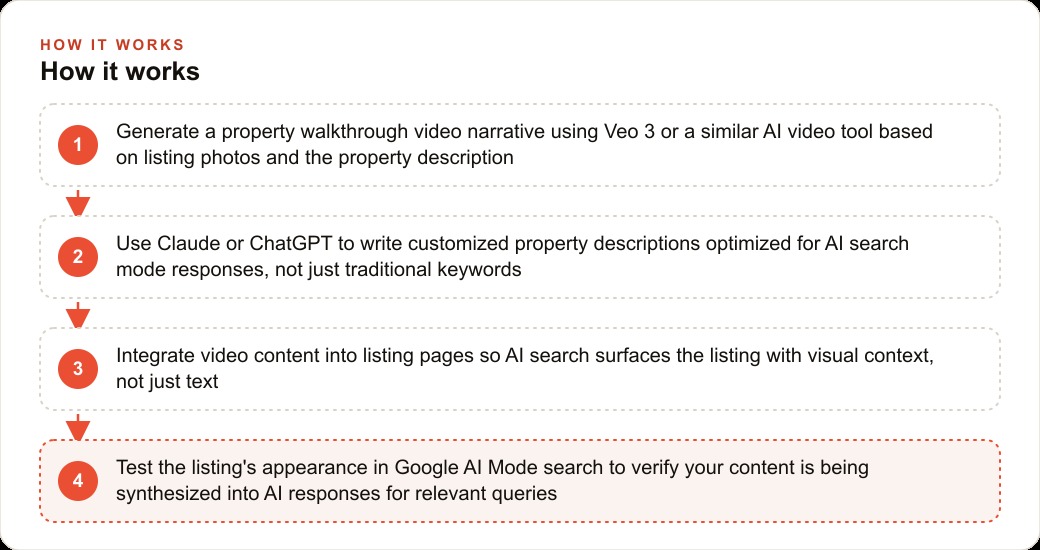
Second, use Claude 4 to draft the listing description with a prompt that names the property details, the neighborhood attributes, the key selling points from your walkthrough, and the target buyer, and that asks for roughly two hundred fifty words organized with the most distinctive features first, written to surface in AI search answers about that bedroom count in that neighborhood. Third, use Veo 3 to generate one supplementary scene-setting video, not a walkthrough of the actual house, which needs real footage, but an atmospheric clip of the neighborhood or the exterior in golden light that gives you motion content for social. Fourth, structure the listing page with explicit sections and headers that AI can parse: Neighborhood, Schools, Commute, Recent Sales, Property Details, and Why This Home, each answering a question buyers actually search. Fifth, verify the listing shows up in AI Mode for two or three relevant queries within two weeks, and if it does not, tighten the structure and add more direct question-answering language.
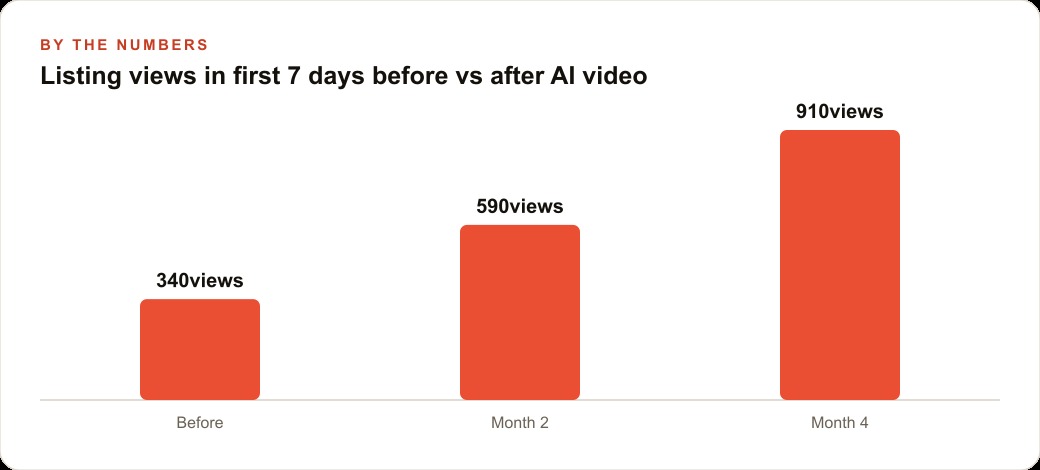
Put rough numbers on it. A listing marketed the old way might draw around three hundred forty views in its first week. The same listing rebuilt for AI search and paired with motion content can climb toward the high hundreds and then past nine hundred over the following months as the structured page starts getting cited in AI answers and this breakdown content gets shared. The leads those views generate need somewhere to land, which is why the whole thing works best wired into a proper CRM and website stack that captures the inquiry and starts the follow-up, and why the best-performing listings are worth amplifying with a small spend on Facebook and Instagram ad campaigns once you know which ones convert.
Two mistakes that will get an agent in trouble
The first is letting an AI-written description make specific property claims that are not verified against the disclosure documents. A generated line like freshly renovated kitchen with new appliances, when the renovation was not recent, is a material misrepresentation, not a stylistic flourish. Read every AI-drafted claim against the paperwork before it goes live. The second is using AI video to imply it depicts the actual property when it does not. Supplementary lifestyle and neighborhood footage, clearly understood as visual context, is fine. A generated walkthrough that resembles the real house without being it sets buyer expectations that the showing will not meet, and that damages the transaction. Keep AI on atmosphere and keep real footage for the property itself.
What to do this week
If AI Mode is available in your region, search three property queries relevant to your market and see whether any of your current listings appear in the synthesized answers. If they do not, study the structure of the listings that do and compare it to yours. Then rewrite your next listing using the AI-search approach above and watch the views and inquiry rate against your recent average over the first ten days. The agents who treat this IO cycle as a prompt to rebuild one listing, rather than as distant news, are the ones who will be visible when buyers start their search inside an AI answer instead of a list of links. If you would rather have someone design the full AI-integrated listing system, covering content, search structure, and lead capture, that is a concrete project worth taking on together.
That is exactly what we do at AI DOERS. Book a private 30-minute call with Madhuranjan Kumar and we will map the fastest path to it for your specific business.
Book your call →
Madhuranjan Kumar
Madhuranjan Kumar brings 20 years of performance-marketing experience and has managed over $200 million in Facebook ad spend for brands across the United States and beyond. His expertise spans the full modern marketing stack: Meta, Google Ads, TikTok, email automation, CRM, and the websites that hold it together. At AI DOERS he turns that track record into lead-generation systems for businesses across every industry.