
GLM 4.5, Free AI Agents, and the Best AI Drops of the Week Explained
This week brought a cluster of genuinely impressive free AI tools, led by GLM 4.5, a model that builds slide decks, writes games, and rivals Claude on reasoning. Here is what each one does and how to use it.

The assumption that collapsed this week
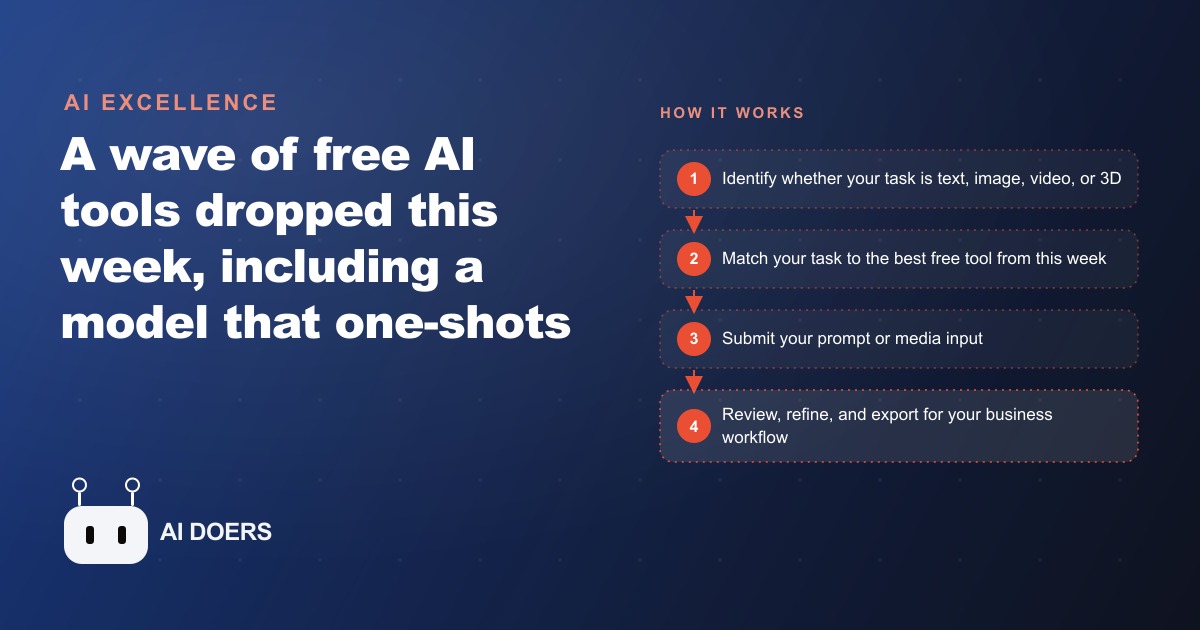
For the better part of a decade, capability in AI has been priced accordingly. The most powerful models cost the most money, the best video tools require a paid tier, and businesses that wanted serious AI-assisted content production had to budget real dollars to access real quality. That assumption died a quiet death this week when a cluster of genuinely impressive AI tools either went free, opened to wider access, or dropped entirely without a cost barrier. The most striking of them, a free open-weight model that outperformed Claude 4 Opus on agentic reasoning benchmarks, builds a complete polished slide deck from a single sentence in under two minutes.
The deeper shift this week is not about any individual tool. It is about what the abundance of free, capable tools means for where value actually lives. Capability is no longer scarce. What is scarce is the judgment to combine the right tools, route the right tasks, and produce output that is genuinely useful rather than technically impressive but practically inert. That is the argument this piece will work through, using the specific tools that arrived this week as evidence.
The architecture that lets GLM 4.5 build a slide deck in two minutes
GLM 4.5 is a free, open-weight large language model from Zhipu AI, accessible at z.ai with a Google account login and no payment required. What makes it remarkable is not just its benchmark standing, though outperforming Claude 4 Opus on agentic reasoning and coding benchmarks while being fully free is a genuinely unusual combination. What makes it remarkable is what its architecture enables in practice.
GLM 4.5 is a thinking model with natively integrated tool use. When you submit a prompt, the model reasons through the task visibly before producing output, and it executes tool calls as part of that reasoning rather than as a separate step. For slide creation specifically, it chains three built-in tools in sequence: a web search tool that reads multiple sources including Wikipedia, news articles, and magazine features; an image search tool that finds photographs of relevant subjects and concepts; and a slide assembly tool that takes all gathered material and renders it into a complete, visually structured presentation.
The result of this chain, executed automatically from a single text prompt, is a multi-slide deck with background colors, headline text, supporting photographs, data points pulled from the sources it read, and consistent layout hierarchy. It does not look like a set of white rectangles with bullet points. It looks like something a designer spent time on, because the model is making actual layout choices rather than defaulting to a blank template. For comparison, the same slide request submitted to a popular competitor tool returns text boxes with minimal formatting, no imagery, and no visual hierarchy. The output gap is significant enough to change what a business can actually use directly versus what still requires additional design work.
For coding tasks, the same architecture enables one-shot application generation. Feed it a prompt describing a game, a calculator, a form handler, or a visualization tool, and it generates fully functional browser-based code in a single pass. The output includes working logic, visual rendering, event handling, and state management without requiring follow-up prompts to patch gaps. That is a meaningful capability for any business that needs simple web-based tools built quickly without developer engagement.
The open-weight nature of GLM 4.5 adds a dimension that matters for certain businesses. Open-weight models can be downloaded, fine-tuned on proprietary data, and deployed on private infrastructure. Companies operating in healthcare, financial services, or legal services that have data residency or compliance requirements can run a customized version of GLM 4.5 on servers they control without routing any data to an external cloud provider. That flexibility has real commercial value in regulated industries where cloud-based API calls raise compliance questions that internal deployment avoids entirely.
What the Nano Banana model signals about spatial AI editing
Alongside GLM 4.5, the week brought a spatial image editing model from the Qwen team, sometimes referred to as the Nano Banana release, that signals something important about where visual AI editing is heading. The model understands the three-dimensional structure of a scene in an image and can edit specific spatial elements while leaving surrounding context intact. You can move an object to a different position in the frame, change its scale relative to other elements, or alter just the background environment while the foreground subject remains unchanged.
This matters because it solves a problem that has plagued AI image editing since the beginning: the tendency of edit requests to alter parts of the image you did not mean to change. Inpainting tools have always struggled with spatial coherence, producing edits that look locally correct but globally inconsistent. A model that understands three-dimensional relationships in the scene before making an edit can preserve what should stay unchanged because it knows what role each element plays in the spatial structure.
For businesses that produce visual content regularly, this signals an approaching shift in product photography, marketing imagery, and social media assets. The ability to take one source image and produce multiple spatial variations, different backgrounds, repositioned products, adjusted scale relationships, without a reshooting session, compresses the cost and time of building a visual content library significantly. What currently requires either a photo studio or a skilled retoucher becomes an instruction to a model that understands space.
The broader pattern these two releases together represent is a compression of the skill stack required to produce professional-grade output. GLM 4.5 compresses research, design, and content assembly. The spatial editing model compresses photography and visual layout expertise. The capability that used to require specialists in each domain is becoming accessible through a well-formed prompt, which means the specialist's value increasingly lies in knowing which prompt to write and which output to ship, not in mastering the production tool itself.
How free tool stacking changes the economics of content production
The standard calculation for content production cost in a service business runs something like this: a freelance graphic designer at $50 to $150 per hour handles presentations and marketing materials; a video editor at similar rates handles social media clips; a photographer handles product and lifestyle imagery; a copywriter handles scripts and captions. Monthly spend for a practice or firm producing consistent content sits between $500 and $2,000 depending on volume and quality.
This week's free tool releases alter that calculation in a way that is not marginal. GLM 4.5 handles presentation assembly from research to designed output. Halo AI video generation through Higgsfield, available free during the current promotional period, handles short-form video content. Idiogram's character feature, which places a face from a single reference photo into any template image, handles lifestyle and persona-based visual assets. Meshy 5's image-to-3D conversion, available on a free tier, handles product visualization. Runway ALF handles video editing by instruction. The stack of tools capable of covering most of a content production workflow now costs, in aggregate, very close to zero at moderate usage volumes.
The operational implication is not that the entire content budget disappears. It is that the ceiling for what a small business can produce internally, without outsourcing, without hiring, and without specialized software subscriptions, has risen sharply. A practice that previously produced four social media posts a week and one client presentation a month because those were all the resources allowed can now produce twenty posts a week and weekly client education decks using the same staff time, because the production work shifts from skilled-labor-intensive to prompt-and-review.
What does not change is the judgment layer. Someone still has to decide which topics are worth a slide deck and which are not. Someone still has to review the research the model pulled and verify the claims before the deck goes in front of a client. Someone still has to recognize when a generated video clip captures the right tone and when it misses. The scarce resource shifts from production capability to editorial judgment, and businesses that develop strong editorial instincts will produce better output than those that automate production without maintaining quality review.
A dental practice that stacks three free tools into a weekly content pipeline
Consider how a dental practice can assemble a weekly content pipeline using the tools from this week with a tool budget close to zero. The practice produces patient education content, social media posts about oral health topics, and periodic procedure explanation materials for use during consultations.
The weekly pipeline starts with GLM 4.5 on Monday morning. The practice owner or a front-desk staff member submits one prompt per education topic to the AI Slides mode at z.ai: teeth whitening options, periodontal treatment stages, Invisalign candidacy criteria, implant healing timeline. Each prompt returns a complete slide deck with research, imagery, and structured explanations in about two minutes. Four topics yields four ready-to-review decks before the first patient appointment. After a ten-minute review pass to verify clinical accuracy, the decks are saved and ready for consultation use or email delivery to patients who need to review options before committing.
For social media, GLM 4.5 drafts short scripts on seasonal oral health topics: back-to-school checkup timing, holiday sugar habits, New Year whitening considerations, summer sports mouthguard recommendations. The scripts run 60 to 90 seconds in spoken form. Halo AI on Higgsfield converts the written content into short animated video clips that pair the narration with visual sequences. During the current free period, the practice can produce a month of video posts without any production spend.
For lifestyle and staff imagery, Idiogram's character feature takes a single reference photo of the dentist or a staff member and places that person into patient education template images, office environment layouts, or seasonal visual themes. A single headshot reference produces dozens of contextually appropriate images without a photo shoot.
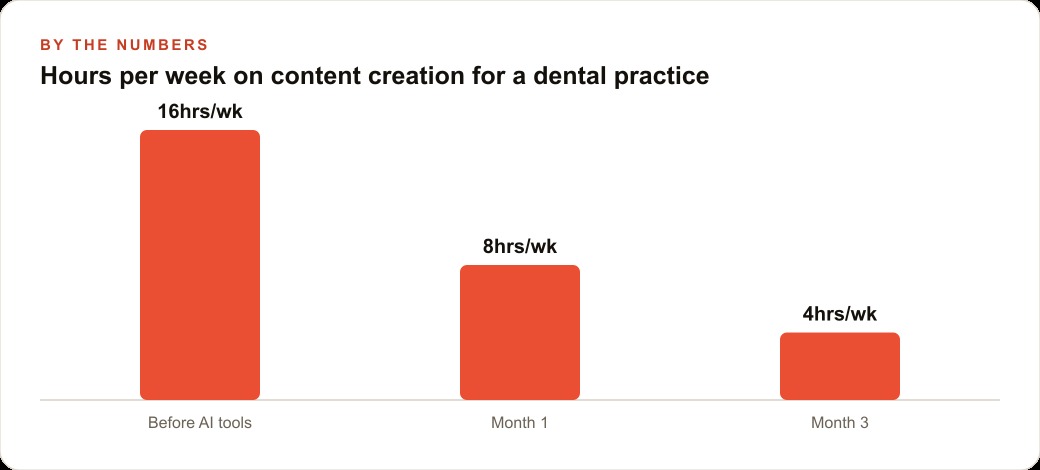
The before-and-after economics of this pipeline are straightforward. Before: the practice spends approximately $300 to $600 per month on a part-time social media manager who produces four to six posts per week and nothing else, with separate occasional spend on professional photography. After: the same staff time is redirected to reviewing AI-generated drafts and approving quality output, total tool spend is near zero at current free-tier access levels, and weekly post volume doubles because production bottlenecks disappear. Over a 12-month period, the savings on tool cost alone range from $3,600 to $7,200, not counting the value of the additional content volume or the freed staff hours.
Why judgment is the only thing that compounds
The tools are abundant and getting more so. Every week adds more capability at lower cost or no cost. ChatGPT's new Study Mode, which guides users through problems step by step rather than simply answering, is a reminder that the interfaces are also improving toward meeting users where they are rather than requiring expertise to extract value.
What compounds in this environment is not access to tools, because access is increasingly not the constraint. What compounds is the ability to decide which tool to use for which task, to review output critically rather than accepting it uncritically, to maintain a consistent editorial voice across machine-generated content, and to recognize when a technically impressive result still misses the mark for the specific audience and context it is serving.
Businesses that develop this judgment now, through practice with the current generation of tools, will apply it to a more capable generation of tools six months from now and be noticeably ahead of businesses that waited for the tools to be perfect before starting. The tools were never going to be perfect. They are going to be good enough to use today and better than that six months from now. Building the judgment layer now is the investment that pays forward continuously, while waiting to start means building it later with no advantage from the time already elapsed.
GLM 4.5 is free to use at z.ai with a Google login. Halo AI on Higgsfield is currently free. Idiogram's character feature operates at free-tier access levels for current usage volumes. Meshy 5 has a free tier. Runway ALF is available on paid Runway plans starting around $15 per month. The entry cost to run a meaningful free-tool content production stack is, at this moment, effectively zero for the core capabilities. The investment required is time spent learning how to use each tool well and developing the editorial instinct to know what good looks like. That investment is the one no competitor can shortcut by subscribing to a more expensive tier.
That is exactly what we do at AI DOERS. Book a private 30-minute call with Madhuranjan Kumar and we will map the fastest path to it for your specific business.
Book your call →
Madhuranjan Kumar
Madhuranjan Kumar brings 20 years of performance-marketing experience and has managed over $200 million in Facebook ad spend for brands across the United States and beyond. His expertise spans the full modern marketing stack: Meta, Google Ads, TikTok, email automation, CRM, and the websites that hold it together. At AI DOERS he turns that track record into lead-generation systems for businesses across every industry.