
General-Purpose Robots Are Almost Here: What It Means for Warehouses and Logistics
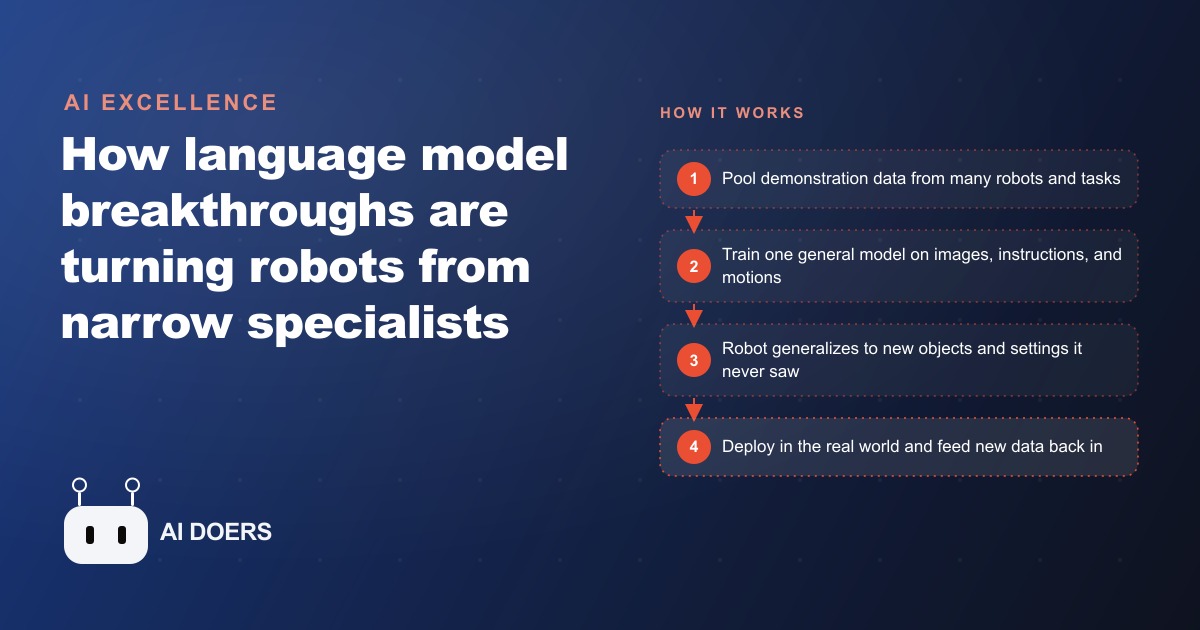
Robots are shifting from narrow specialists to flexible generalists thanks to language model breakthroughs. Here is what is changing and how a warehouse and logistics company can prepare.

Most warehouse operators are solving the wrong problem when they think about robots. The standard framing is labor replacement: robots come in, workers go out, headcount falls, costs drop. That framing drives most of the resistance to automation and most of the disappointment when it underdelivers, because the real opportunity is not replacing labor in general. It is eliminating the specific bottlenecks that make warehouse operations brittle, and the shift from specialist to generalist robots is precisely what unlocks that opportunity.
This distinction matters more than it might seem. A specialist robot that replaces a picker at one station does not make the warehouse more resilient. It makes it differently fragile. You have traded one kind of dependency for another, and the new dependency is harder to fix when it breaks, because a robot that gets stuck in a loop or encounters a SKU outside its training distribution does not ask for help the way a person does. The generalist robot, a system that can adapt to new objects, new layouts, and new tasks without a full retrain, addresses a different set of problems entirely: the brittleness problems, the error rate problems, the edge case problems that cost far more than the direct labor they are adjacent to.
Why the specialist robot has always been the wrong unit of analysis
The history of warehouse automation is a history of systems that work beautifully on the task they were designed for and fail expensively when anything changes. Automated storage and retrieval systems from the 1970s are still running in facilities today because the conditions they were built for have not changed. The moment a facility changes its pick methodology, switches to a different pallet format, or starts handling a new product category, the systems built around the old assumptions become liabilities rather than assets.
Most robots deployed in warehouses today are trained for one task in one setting. Change the lighting, reposition the shelf, or introduce a product with different packaging dimensions, and success rates drop sharply. In many cases you are not adjusting a parameter; you are starting a new training run. For large operations running thousands of identical repetitions per day, that inflexibility is manageable because the environment is engineered to stay constant. For mid-sized operations handling a diverse product mix, the environment is never constant enough to make specialist automation economical across all but a handful of high-volume tasks.
The cost of this inflexibility is hidden in the numbers most operators look at. Direct labor shows up clearly on the line item. The cost of mispicked orders, which studies consistently put between $15 and $50 per incident depending on the product value and return logistics, often sits scattered across shipping, customer service, and returns processing lines rather than appearing as a single, visible number. The cost of retraining and reconfiguring automation when SKUs change sits in maintenance and engineering. The opportunity cost of tasks that are too variable to automate and therefore stay manual is invisible by definition. The specialist-replacement framing directs attention toward the direct labor line and away from all of these, which is why operators focused on it keep being disappointed by automation's actual ROI.
What language models actually changed about robots
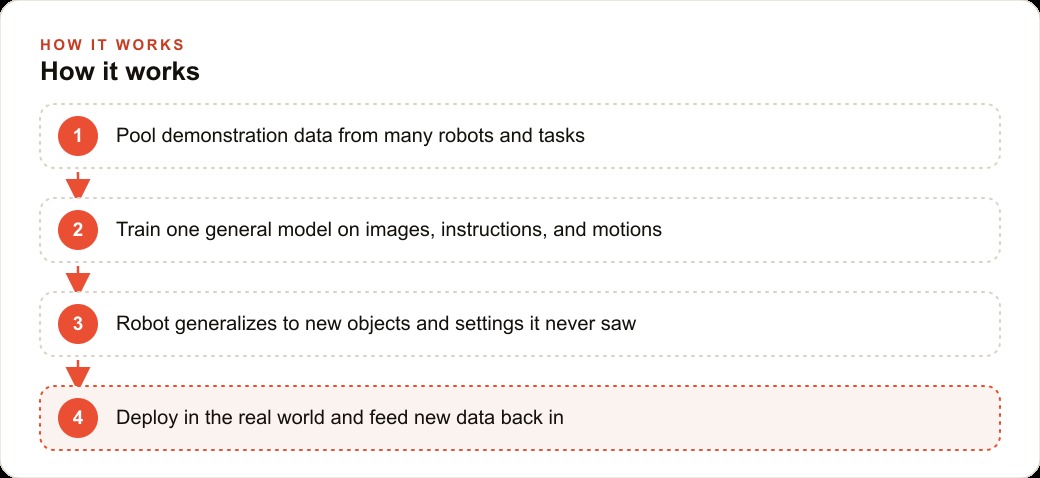
The shift from specialist to generalist robots is being driven by the same transformer architecture that made chatbots so flexible, applied to the problem of physical action. The key technical move was connecting a robot's sensory inputs and motor outputs to language, so the system can reason about tasks in the same way a language model reasons about text problems.
When a robot's understanding of its environment gets tied to language-based representations, it can draw on knowledge acquired across many different tasks rather than being limited to what was directly demonstrated in its specific training distribution. A robot that has learned to handle boxes learns something about how to handle bags, because the underlying model understands structure and material properties, not just a memorized sequence of joint angles. The generalization happens naturally rather than requiring an explicit bridge between task types.
Researchers split robot intelligence into two components. Physical intelligence is the hand-eye coordination required to grip reliably, the balance required to move through a space, and the fine motor control required for delicate manipulation. Cognitive intelligence is the reasoning about what to do based on the current environment and goal. Both components have advanced substantially, but the cognitive side advanced faster and more durably when language model techniques were applied, because the generalization mechanisms developed for text transfer well to the problem of understanding a scene and deciding what to do in it.
The biggest lever in recent results has been data pooling. Training a single model on demonstration data from many different robots performing hundreds of different skills produced large performance gains with no fundamental change to the training method, just more diverse data. The same scaling curve that made language models dramatically better as training data grew is operating in robotics now. A model trained on data from 50 different robot configurations performing 300 different tasks generalizes to a new task in a new environment far better than a model trained on data from one configuration performing one task, even if the single-task model saw more examples of its specific task.
The last stubborn barrier was fine, delicate hand movement, the kind of manipulation required to handle fragile items, operate small fasteners, or pick items from crowded shelves without disturbing neighbors. That barrier is cracking. Researchers now use language models to design the reward signals that train robots on dexterous skills, and in benchmark comparisons those AI-designed reward functions outperform reward functions designed by expert human engineers most of the time. The insight is that language models trained on large bodies of human knowledge contain implicit models of how physical tasks feel and what success looks like, and those implicit models translate into better reward signals than what a single engineer can specify from scratch.
The feedback loop that makes early deployment compound
Once generalist robots begin operating in real environments, they generate data that is fundamentally different from simulation data and from the human-demonstration data used in initial training. Real-world data captures the edge cases, the rare conditions, the unexpected combinations of factors that no simulation or demonstration setup fully anticipates. A robot that fails to pick an item from an unusual orientation generates a failure case that, when added to the training set, makes the next version of the model better at exactly that failure mode.
This feedback loop means the value of early deployment is not just the direct output of the robots currently operating. It is the data those robots generate that accelerates the next training round, which produces more capable robots, which deploy more widely, which generate more diverse real-world data. The loop compounds, and companies already in the deployment phase are generating training data that companies still in the pilot-consideration phase are not.
For logistics and warehouse operators, this creates a practical urgency that goes beyond the capability of current systems. The question is not whether the robots available today are good enough to transform your operation. For most mid-sized operations, they are not. The question is whether starting now with a narrow, well-chosen pilot gets you into the data-generation loop and positions you to adopt more capable systems when they arrive, versus waiting for those systems to arrive and then starting from scratch with no operational experience and no trained integration team. Companies in the first category will scale faster. Companies in the second will pay premium integration costs to close the gap that the first group built.
What a regional distribution center should do about it now
The right move for a regional distribution center is not a large-scale automation purchase. It is a disciplined mapping exercise followed by a narrow, well-measured pilot chosen for maximum data value rather than maximum size.
Start by listing every repetitive physical task that occurs at high volume in the facility: picking items from shelves, packing standard boxes, palletizing completed orders, moving totes between zones, loading trucks in a defined sequence. For each task, note the variation range: how many different SKU dimensions does a picker handle at this station, how often does the box type change, how frequently does the layout of the pick face change. Tasks with lower variation are better early candidates for automation. Tasks with high variation are the ones to watch for generalist systems, but not to pilot first.
Next, get honest about where errors actually cost money. Mispicked items are the place to start this analysis, because mispick rates are usually tracked in warehouse management systems and the cost per incident is calculable from returns data, reshipment costs, and customer service volume. A mispick rate of even 0.5 percent on a facility processing 10,000 orders per day is 50 errors daily. At $25 per incident fully loaded, that is $1,250 per day in hidden cost, or roughly $450,000 annually. A pilot that reduces that error rate even by half generates a clear, measurable ROI that does not depend on optimistic assumptions about throughput speed.
Choose the pilot task based on error cost concentration rather than total labor volume. The task with the highest error cost is usually not the one with the most workers; it is the one where small errors cascade into expensive consequences. Picking fragile items, picking high-value items, or picking items with high return rates all fit this profile. A generalist robot that is slower than a human picker but more consistent on the edge cases that cause expensive errors is a strong business case even before it reaches human-level throughput.
Instrument the pilot floor thoroughly before the pilot begins. Cameras over the pick station, clean records linking each pick to an outcome, and consistent SKU labeling are all required to produce the kind of training data that improves the next model generation. The pilot itself generates operational value from reduced errors. The data it generates generates compounding value in every training round that follows. Both returns matter, and both are lost if the instrumentation is not in place before the pilot starts.
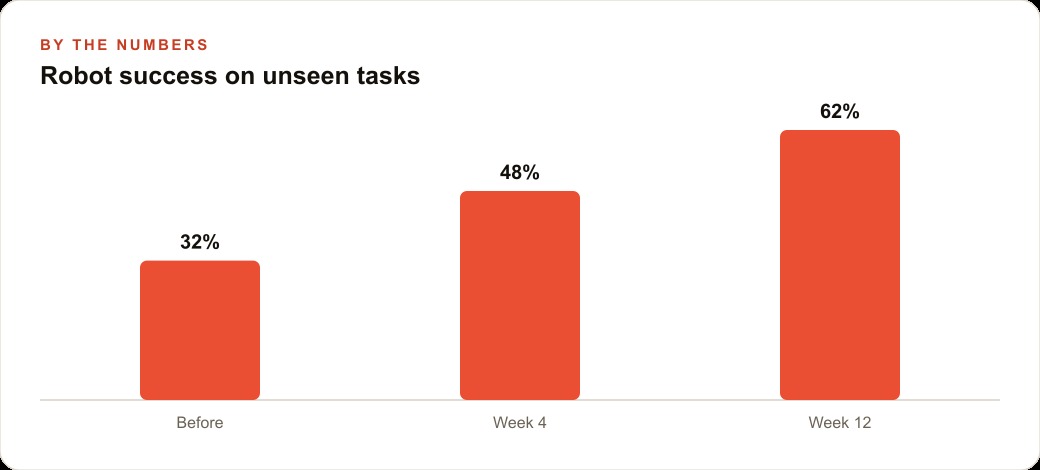
Budget for a learning quarter. The first 60 to 90 days of a robot pilot in a real warehouse produce lower throughput and higher error rates than the steady-state performance the system reaches once it has calibrated to the specific environment. This is not failure; it is the cost of generating calibration data that makes the system reliable thereafter. Operators who evaluate pilot success at day 30 and shut down because throughput is below benchmark are paying the calibration cost and forfeiting the return. Define success metrics that measure 90-day performance and beyond, not week-two performance.
The argument that survives the hype
The contrarian position is not that robots are coming faster than people think, though they may be. It is that the value equation is different from what the standard labor-replacement framing implies. The direct labor line is not the best target. The brittleness cost is.
A warehouse operation that has automated away the tasks that produce the most expensive errors is more resilient, not just cheaper. When a supplier changes packaging dimensions, the generalist system adapts while the specialist retrain loop is still running. When a new SKU category gets added to the product mix, the generalist system handles it while the specialist system rejects it. When throughput spikes for a promotional period, the generalist system scales to the new demand profile while the specialist system was sized for the old one.
The real opportunity is not replacing the worker who picks 200 units a day. It is replacing the process that produces 50 mispicks a day at $25 each and three specialist retraining cycles per year at $30,000 each. Get that framing right before evaluating any robotics proposal, because the proposal that looks smaller and narrower on paper is often the one with the better actual return, and the proposal that promises to replace the most labor is often the one that underdelivers most predictably.
That is exactly what we do at AI DOERS. Book a private 30-minute call with Madhuranjan Kumar and we will map the fastest path to it for your specific business.
Book your call →
Madhuranjan Kumar
Madhuranjan Kumar brings 20 years of performance-marketing experience and has managed over $200 million in Facebook ad spend for brands across the United States and beyond. His expertise spans the full modern marketing stack: Meta, Google Ads, TikTok, email automation, CRM, and the websites that hold it together. At AI DOERS he turns that track record into lead-generation systems for businesses across every industry.