
Link Gemini to a Live Google Doc and Build a Self-Updating Q&A Bot
Gemini Gems can pull answers straight from a Google Doc in real time. Edit the doc and the bot updates instantly. Here is how it works and how a small business can run a self-maintaining knowledge bot.

The front desk at a busy gym answered the exact same four questions roughly sixty times a day: what are the hours, how do I freeze my membership, what is the guest policy, when is it least crowded. By the end of a twelve week experiment, those questions were answered by a bot that stayed correct even when the holiday hours changed, and the whole thing was built on a free plan in under an hour. This is the walkthrough of how that happened, because the tool is almost boringly simple and the payoff is anything but.
I am Madhuranjan Kumar, and the feature at the center of this story is Gemini's ability to link a small assistant to a live Google Doc and answer from it in real time. The key word is live. You are not pasting text into a chat that forgets it, and you are not re uploading a file every time something changes. You edit the document, and the assistant simply knows the new information. Here is how a single location gym went from a front desk that repeated itself all day to a self maintaining answer system, step by step.
Chapter one: naming the real problem before touching any tool
Before building anything, I spent a morning at the front desk just counting. The staff were not annoyed by hard questions. They were worn down by easy ones asked over and over, and worse, by giving slightly different answers depending on who was working. One trainer said the guest policy allowed two visits a month, another said one, and neither was sure. The problem was not a lack of information. It was that the information lived in people's heads and in a stale printout taped under the counter, so it drifted.
That framing decided the whole build. The fix was never going to be a fancy chatbot. It was going to be one trusted source of truth that everyone could see and edit, with a bot that read from it. Getting that diagnosis right first is why the rest went smoothly.
Chapter two: writing the document, which is the actual product
The most important work was not technical at all. It was writing a Google Doc of question and answer pairs in the exact words members actually use. I sat with the front desk and listed every recurring question, then wrote a short, plain answer under each one. What are your hours. How do I freeze my membership and for how long. Can I bring a guest and how often. When is the gym least crowded. How do I cancel. What do the membership tiers include.
This is the part most people underestimate. The document is the real product here, and the bot is just a mouth for it. If an answer is vague or worded in staff jargon, the bot repeats the vagueness. So we spent the time to make each answer complete and phrased the way a member would ask. By the end we had a single clean doc, named it something obvious like Gym Front Desk Answers, and saved it. That doc, not the AI, was the deliverable that mattered.
Chapter three: building the Gem and pointing it at the doc
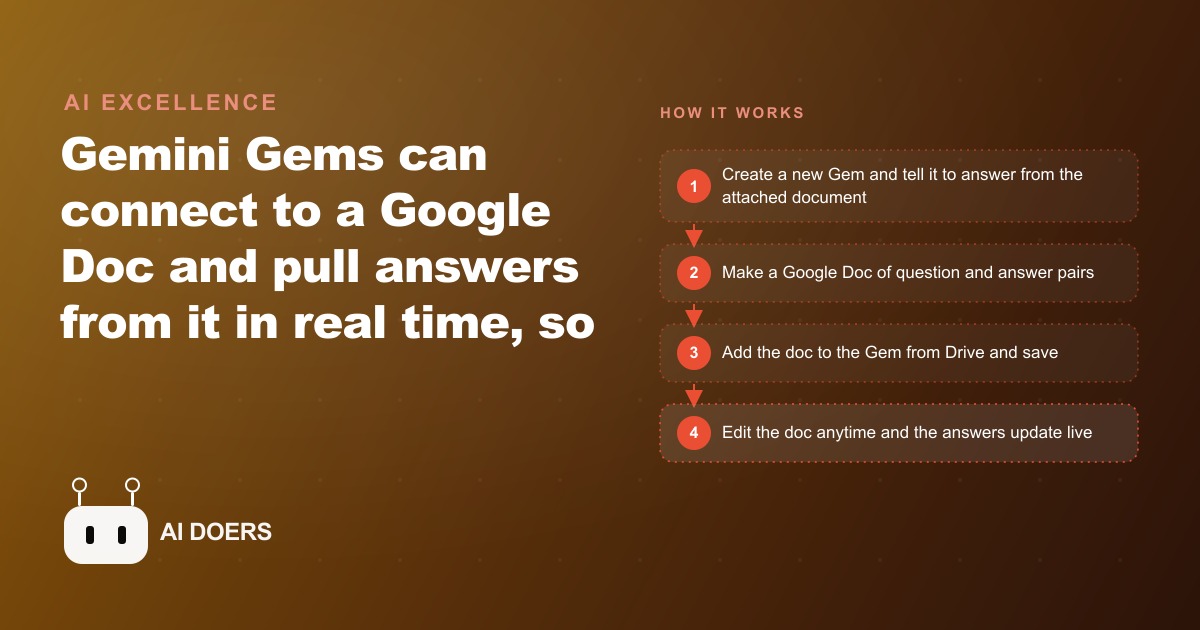
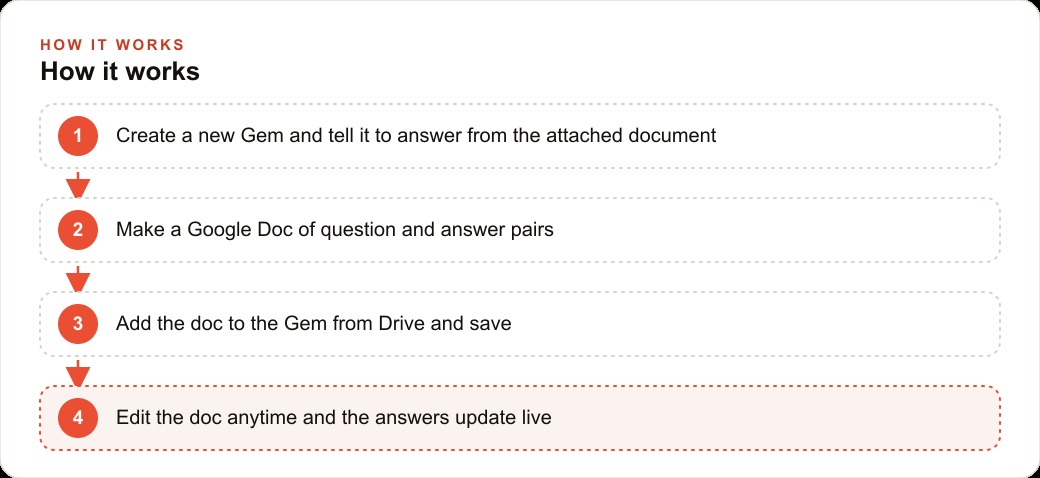
The technical step took about ten minutes. A Gem is a focused version of Gemini built for one job. I created a new Gem and in the instructions field wrote something plain: answer questions using only the knowledge in the attached document, and if the answer is not in the document, say you are not sure and suggest asking the front desk. That instruction acts like the first message in a new chat, framing the job and, just as importantly, fencing the bot in so it does not improvise policies that do not exist.
Then, under the knowledge section, I clicked to add a source and connected the Google Doc from Drive, and saved the Gem. That was the entire setup. No developer, no server, no monthly fee. We tested it immediately by asking about the guest policy, and it returned the exact answer from the doc, phrased more cleanly than the raw note I had typed. The Gem tends to present the information better organized than the source, which was a small pleasant surprise.
Chapter four: the moment that sold the whole team
The test that convinced the manager took thirty seconds. I opened the Google Doc, added a brand new line about a holiday closure that was not there before, switched straight back to the Gem, and asked about holiday hours. The answer was already correct. No save button pressed on the Gem, no refresh, no re upload. The document changed and the bot changed with it, instantly.
That is the feature that makes this different from every earlier attempt. Older approaches needed you to delete and re upload a file, or relied on connectors that were flaky and broke silently. This one stays in sync and behaves. When the manager saw that a single edit to one line made the bot correct everywhere, the objection that this would be a maintenance headache disappeared. Maintaining the bot was identical to editing a Google Doc, which the whole team already knew how to do.
Chapter five: rolling it out to a team that already lived in Docs
The rollout was easy precisely because it required nothing new to learn. Most teams already keep their knowledge in Google Docs, so there was nothing novel about where the information lived. I shared the document with the manager, the trainers, and the front desk, and set a simple rule: when a policy changes, you change the doc, and the doc is the only place you change it.
Over the following weeks the doc grew. Someone added the new class schedule the day it launched, and the bot answered schedule questions live. When the personal training rates changed, the manager edited one line. When a new membership tier launched, it went into the doc and the bot picked it up with no settings touched. Because everyone with access could keep it current the way they already work, the knowledge stopped drifting. Members started getting consistent answers no matter who was on shift, because every answer traced back to one document the team trusted.
Chapter six: the numbers, framed as illustrative
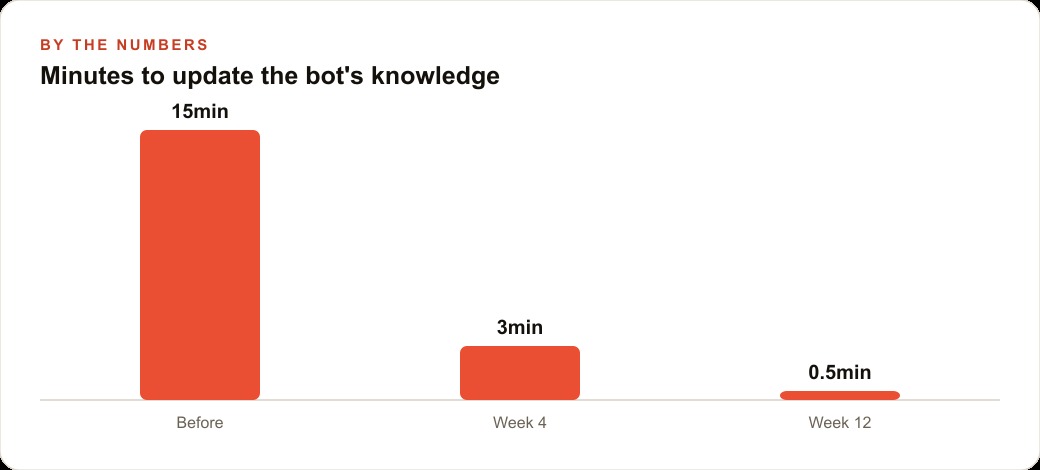
Here is the shape of the change over twelve weeks, and I want to be clear these are illustrative figures, not audited stats. Before the bot, updating the gym's shared knowledge meant editing a printout, reprinting it, and hoping staff read it, which realistically took around fifteen minutes each time a change happened and often did not stick at all. In the first month with the Gem, that update time dropped to about three minutes, because it was just editing one line in a doc. By week twelve, once the habit was set, a knowledge update was closer to thirty seconds, essentially the time it takes to type one corrected sentence.
The bigger win was not the minutes, it was the consistency. The front desk stopped repeating themselves for the easy questions and could spend that attention on members who needed a real conversation. The same reliable answer set also became a quiet asset elsewhere: the clear, member worded question and answer pairs fed straight into the gym's website FAQ and its SEO and organic search presence, and the same content sharpened the copy behind Facebook and Instagram ad campaigns that answer common objections before someone even walks in. Leads who asked a question through the site got an instant, correct reply that flowed into the gym's CRM and website stack for follow up, instead of waiting for the desk to call back.
Chapter seven: where these builds actually drift
The build was quick. The part that decides whether it lasts is judgment, and that is worth naming honestly. Two things determine whether one of these living knowledge bots stays useful. First, the quality of the answers: they have to be clear, complete, and worded the way customers actually ask, which takes real care to write. Second, ownership: someone has to be responsible for keeping the doc accurate, because a source of truth with no owner slowly rots back into being wrong. For the gym, we named the manager as the owner and it held.
The same pattern that worked for the gym extends anywhere a team keeps a living document. Point a Gem at a contract in progress, a report the team updates weekly, or a policy handbook, and the bot answers from the current version every time. The mechanism never changes. Write the doc well, fence the bot to answer only from it, and assign an owner.
Extending the pattern past the front desk
Once the gym saw the mechanism work, the same living document idea spread to places I did not originally plan for, and that is the real lesson of this build. The bot was never about the gym's hours, it was about any knowledge a team keeps current in a doc. So we pointed a second Gem at the trainers' onboarding notes, the running document that explains how the gym likes classes run, how to handle a member complaint, and where the cleaning supplies live. New staff could ask it questions during their first week instead of interrupting a busy trainer, and when a process changed, the same one line edit updated the answer for everyone.
We also aimed a version at the sales side. The gym kept a shared doc of membership tiers, current promotions, and cancellation steps, and a Gem reading from it meant anyone fielding a prospective member's questions gave the same accurate pitch, whether it was the owner or a weekend part timer. When a promotion ended, the manager deleted one line and the bot stopped quoting a dead offer instantly, which is exactly the kind of stale information that quietly erodes trust when a member signs up expecting a deal that no longer exists.
The point that made all of this stick is that the knowledge lived where the team already worked. Nobody had to learn a new content management system or log into an AI dashboard to keep things current. They edited a Google Doc, which every person on staff already knew how to do, and the bots stayed correct as a side effect. That is why the approach survives contact with a real, busy team: it adds zero new maintenance surface. The maintenance was always going to be editing a doc, and now that editing quietly powers an answer system on top.
There is one design choice worth calling out because it is what kept the whole thing reliable, and that is the instruction to answer only from the attached document and to admit uncertainty when the answer is not there. That single sentence in the Gem's setup is the difference between a helper that stays trustworthy and one that starts inventing policies. Without the fence, the model would happily guess at a guest policy or a refund rule based on its general training, and a confident wrong answer about a cancellation fee is worse than no answer at all, because a member acts on it and then feels misled. By forcing the bot to stay inside the document and to hand off to the front desk when it does not know, the gym got a system that fails safely. It never pretends. When the answer exists in the doc, members get it instantly and consistently. When it does not, they get pointed to a human instead of a fabrication. That combination, fast and consistent where it knows, honest where it does not, is exactly what makes staff and members trust it, and trust is the thing that determines whether a tool like this actually gets used or quietly abandoned after the novelty wears off.
What the walkthrough proves
A small business does not need a developer or a subscription to run a self maintaining answer bot. It needs one well written Google Doc, a ten minute Gem setup, and a person who owns keeping the doc true. The gym went from a front desk repeating itself sixty times a day to a system where a single edit updates every answer instantly, all on a free plan.
You can build this yourself with the steps above, or you can bring in someone who has stood up these living knowledge systems many times and have it handed to you ready to run. Either way, the lesson is the same: the magic is not the AI, it is the discipline of keeping one trusted document current and letting the bot speak from it.
That is exactly what we do at AI DOERS. Book a private 30-minute call with Madhuranjan Kumar and we will map the fastest path to it for your specific business.
Book your call →
Madhuranjan Kumar
Madhuranjan Kumar brings 20 years of performance-marketing experience and has managed over $200 million in Facebook ad spend for brands across the United States and beyond. His expertise spans the full modern marketing stack: Meta, Google Ads, TikTok, email automation, CRM, and the websites that hold it together. At AI DOERS he turns that track record into lead-generation systems for businesses across every industry.