
Gemini 3 and the Vibe Coding Boom: Build Interactive Business Tools From a Single Prompt
Gemini 3 turned plain language into working interactive web experiences, and that quietly hands small business owners a way to build custom tools they used to pay developers for.

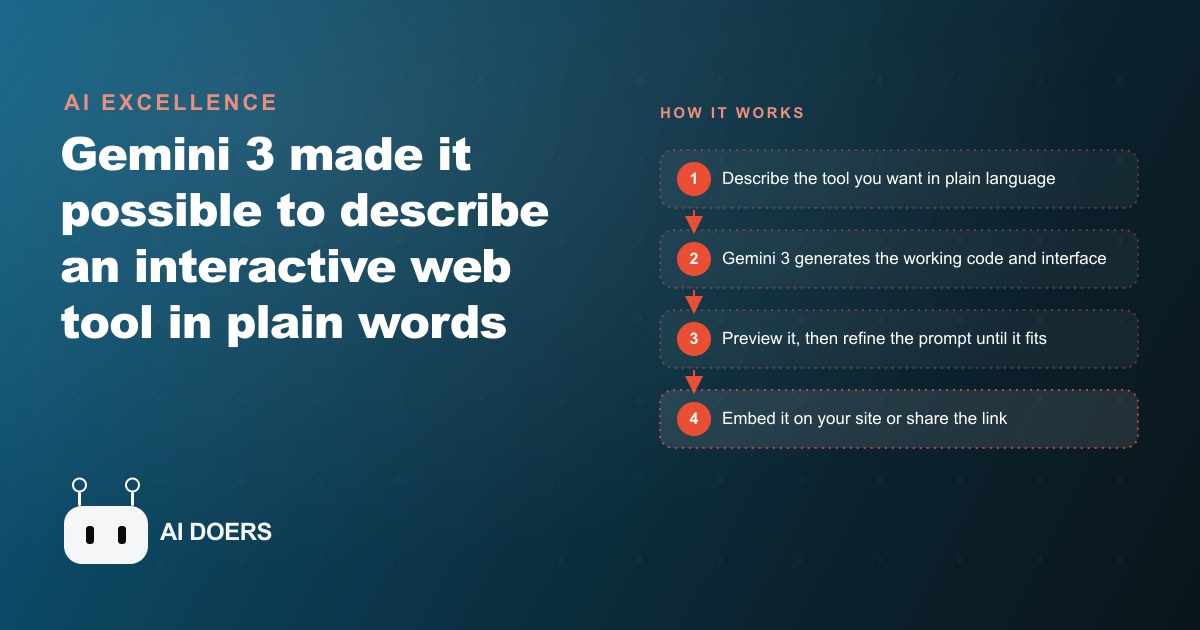
Gemini 3 turned vibe coding from a curiosity into a legitimate business tool
Gemini 3 launched this week and the reaction was immediate and visible across developer communities. Within days, people were generating working 3D scenes from static images, building browser-playable games from single-sentence descriptions, and recreating decade-old personal projects in an afternoon. The vibe coding trend, where you describe what you want in plain language and an AI model produces working interactive code, has existed for a while. What Gemini 3 did was close the quality gap between what people could describe and what the model could actually build reliably.
I am Madhuranjan Kumar, and I want to explain what specifically changed with this release, who it changes things for beyond the developer community, and what the concrete move is for a business owner who has been watching vibe coding from a distance and wondering whether it is actually relevant to them.
The quality threshold that Gemini 3 crossed
Earlier models could handle vibe coding prompts in a narrow band of complexity. Simple components, short scripts, single-purpose utilities. When a prompt asked for something with more visual complexity, interactive physics, or real-time state management, the outputs degraded in specific and predictable ways. The code would be structurally correct but visually wrong. Or it would work once and break on interaction. Or it would produce something so far from what the description implied that iteration became slower than writing the code from scratch.
Gemini 3 pushed that ceiling significantly. The examples that spread after its release were notable not because they were impressive demonstrations but because they were genuinely hard problems that previous models handled poorly. A black hole space visualization with embedded quizzes, rendered in the browser from a prompt describing the concept. A voxel city destruction game with realistic physics. A Rubik's cube in three.js. An interactive Pac-Man planet rendered in three dimensions.
These are not toy examples. Rendering correct 3D geometry in a browser from a text description requires the model to understand spatial relationships, the specific API for the library being used, and how to structure the code so that interactive elements respond correctly. The fact that these examples worked on first or second attempt is the news. Not that they exist, but that the success rate at that complexity level is now high enough to plan around.
Madhuranjan Kumar rebuilt a theme park management game he had originally written in the 1990s. The rebuild included the original's logic for player choices, resource management, and even the ability to adjust the salt level on the virtual concession stand chips. That last detail is not decoration. It signals that the model can translate specific, idiosyncratic requirements into working functionality without the person describing it needing to know how it would be implemented.
The cost equation for custom interactive tools just broke
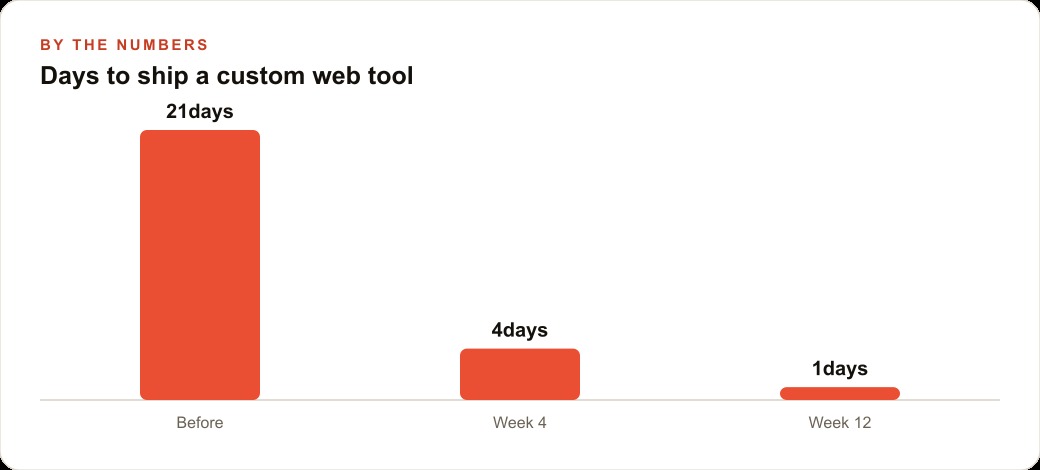
Here is what this means for a business that is not in software development. The cost of building a custom interactive tool, a calculator, a quiz, a configurator, a visualizer, was previously determined by developer time. A simple calculator might cost a few hundred dollars of developer time and a few days. An interactive product configurator with visual feedback might cost several thousand dollars and several weeks. The gap between "we have an idea for a tool that would help customers understand our pricing" and "that tool is live on our website" was measured in weeks and in decisions about budget and priority.
Vibe coding at Gemini 3's current capability level does not make that gap zero. It makes it hours instead of weeks for the simple end of that range, and days instead of months for the more complex end. The economics of the question change. A tool that might have been deprioritized because the development investment was hard to justify against its expected impact becomes something worth trying on a Tuesday afternoon to see if it converts.
For a med spa, that might be an interactive skin concern quiz that ends with a treatment recommendation. For a real estate agent, it might be a mortgage impact calculator that lets a prospect see how a rate change affects their monthly payment for a specific property they are looking at. For a tutoring business, it might be a diagnostic quiz that routes students to the right program based on their responses. None of these are complicated tools. All of them currently sit in the queue of "we should build this eventually" at most businesses that would benefit from them.
The new answer is: build a working prototype this week. Refine it based on whether customers actually use it. Invest in a polished version only if the prototype shows demand.
The five-ideas-in-one-afternoon approach to interactive content
The change in iteration economics produces a new working model for how a business can approach custom interactive content. Instead of briefing a developer on one tool and waiting weeks, vibe coding allows testing five different concepts in a single afternoon to see which one actually serves customers.
A business owner who spends an afternoon with Gemini 3 building five different simple tools, a calculator, a quiz, a comparison widget, a recommendation tool, and a timeline visualizer, and then puts all five in front of customers to see which one they use, gets information that no amount of planning and briefing in advance could produce. Real usage data from a prototype is more valuable than any projection of which tool would be most useful.
This is not a novel concept. The lean startup playbook has been making this argument for years. The missing ingredient was always the cost of the prototype. If building the prototype costs two weeks of developer time, you cannot run five experiments in parallel. If building the prototype costs an afternoon of describing what you want in plain language, you can run experiments continuously and let usage guide the investment.
The concrete move for a service business this week
The most practical starting point for a service business is to identify the one place on its website where a potential customer reads something and thinks "I wish I could see this more clearly" or "I wish I could try this for my specific situation." That is where a custom interactive tool has the highest chance of converting.
For a business with a pricing structure that depends on multiple variables, a pricing calculator that lets someone enter their specific situation and see a quote range is that tool. For a business where customers choose between options that have different implications for their goals, a recommendation quiz that ends with a suggested path is that tool. For a business where the results are visual and the before-and-after is a compelling part of the sale, an interactive before-and-after slider or a treatment visualizer is that tool.
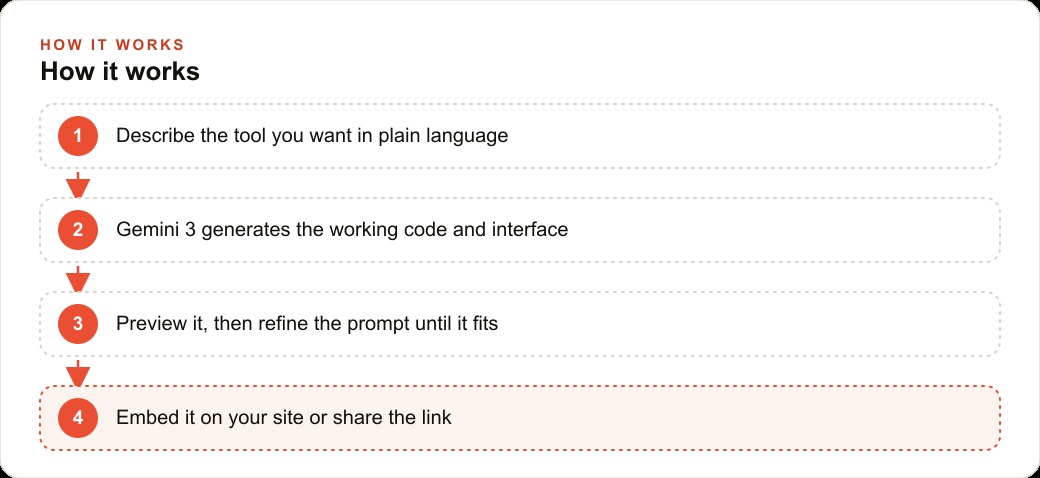
The prompt for Gemini 3 should describe the tool in terms of what the customer does and what they see, not in terms of how it should be built. "A calculator where someone enters their monthly revenue, their average service price, and how many clients they currently have per month, and the calculator shows them how many additional clients per month they would need to hit a revenue goal they enter at the top" is a complete brief. The model handles the implementation.
After the first version appears, the refinement process is also in plain language. Too small on mobile. The button color does not match the site. The result should show two decimal places. Each iteration takes minutes rather than reopening a development ticket.
What the vibe coding ceiling still is
Gemini 3 raised the quality ceiling for vibe coding significantly. It did not eliminate the ceiling. For tools that need to integrate with external systems, pull live data, manage user accounts, or process payments, the plain-language prompt produces a prototype that shows the concept but not a finished product ready to handle real transactions. The final ten percent, the security review, the API integration, the edge-case handling, still requires someone who understands the code.
For most of the tools that would help a service business convert and retain customers, the vibe coding prototype is eighty to ninety percent of the value. A pricing calculator that shows a range is useful even if it cannot generate a binding quote and send it to a CRM. A recommendation quiz that routes to a specific service page is useful even if it cannot automatically book the appointment. The gap between prototype and production matters, but the prototype alone often earns its keep.
The argument for trying vibe coding now rather than waiting for that last gap to close is that the prototype answers the most important question first: do customers actually engage with this? If the prototype shows no engagement, the investment in production is not worth making. If the prototype shows engagement, the investment in production is clearly justified, and the prototype itself has already delivered some of the value while the production version is being built.
Gemini 3's release as a signal about what comes next
Every capability jump in AI models has a pattern: a new quality threshold is crossed, the most enthusiastic early adopters demonstrate what is newly possible, and then the question becomes how quickly the gap between the early adopters and the average business narrows.
The vibe coding quality threshold that Gemini 3 crossed is one that matters for non-technical business owners more than most previous jumps, because it removes the requirement for technical knowledge from the process of building custom interactive experiences. The owner who can describe what they want clearly, in the same language they would use to brief a contractor, can now get a working prototype. The skill is description quality, not coding knowledge.
That shift represents a compressing window for businesses that are waiting. The businesses that start experimenting now will develop a practice of iterating quickly on interactive tools. The businesses that wait will start from scratch in a landscape where the early experimenters have already learned what converts and what does not.
How the med spa example translates to a real implementation timeline
To make this concrete rather than abstract, I want to walk through what a med spa implementing a vibe-coded skin concern quiz would actually experience during the first week.
On day one, the owner describes the quiz concept to Gemini 3. The description covers what questions the quiz asks, the roughly how many steps it takes, and what the end result shows: a recommended treatment category with a short explanation of why. Gemini 3 produces a working quiz in a browser. The owner tries it, finds that one question is confusingly worded, and describes the change. The revised version appears in minutes.
On day two, the owner shares the prototype link with three people who know nothing about the concept to see if they can use it without instructions. They cannot find one button on mobile. That gets fixed the same day.
By day three, the quiz is good enough to put in front of real prospects. The owner adds it to the booking page with a simple heading: "Not sure which treatment is right for you? Take our two-minute quiz." No development ticket. No waiting period. No decision about whether the investment is worth it.
By the end of the first week, the owner has real data. Did visitors who took the quiz book at a higher rate than visitors who did not? If yes, the quiz earned its production investment immediately. If no, the experiment cost an afternoon and produced a clear finding about what does not move the needle.
That feedback loop, from concept to data in a week, is the shift that Gemini 3's capability jump makes possible for a business that would previously have spent weeks in planning conversations before anything was in front of a real customer. The speed is not just convenient. It changes which experiments are economically worth running, which means it changes which questions a business can actually answer about what converts.
That is exactly what we do at AI DOERS. Book a private 30-minute call with Madhuranjan Kumar and we will map the fastest path to it for your specific business.
Book your call →
Madhuranjan Kumar
Madhuranjan Kumar brings 20 years of performance-marketing experience and has managed over $200 million in Facebook ad spend for brands across the United States and beyond. His expertise spans the full modern marketing stack: Meta, Google Ads, TikTok, email automation, CRM, and the websites that hold it together. At AI DOERS he turns that track record into lead-generation systems for businesses across every industry.