
Gemini 3 Built Working Apps From One Prompt, and Your Business Can Use the Same Trick
Gemini 3 turned simple written prompts into working simulators, image to 3D converters, and a video based golf swing analyzer. Here is what that capability really means for a small business and how I would put it to work.

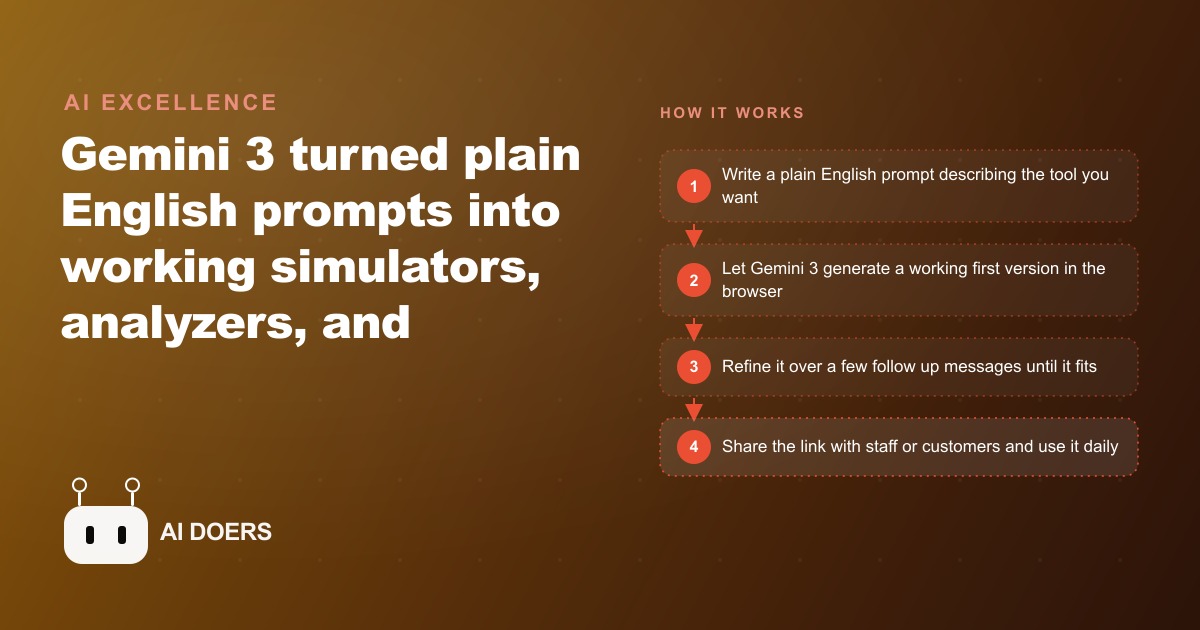
Every previous wave of no-code tools turned out to be low-code in disguise. You still had to learn the platform's logic, drag things into its containers, think about data in the way the tool expected you to think about data. The promise was that non-developers could build things, but the reality was that you were still doing a developer's job using a slightly friendlier interface. Gemini 3's demo wave is the first convincing signal that something genuinely different has arrived. Madhuranjan Kumar's read: the gap between idea and tool is about to close in a way that changes who can compete in markets where custom software used to be a moat.
The gap between idea and tool was not accidental, it was a business model
For three decades, the gap between having an idea for a tool and having a working tool existed because it was expensive to close. You needed a developer who understood your domain, a few weeks of back-and-forth specification, a design round, a build phase, testing, and deployment. That cost was high enough that most small businesses never paid it. They bent their operations to fit whatever off-the-shelf software came closest to their actual need. The accounting software that almost handled their invoicing workflow. The booking system that sort of matched how they scheduled appointments. The form tool that captured most of what they needed to capture.
That gap was not just technical friction. It was a structural business advantage for companies that could afford to close it. Enterprise software budgets exist partly because large companies can commission custom tools that smaller competitors cannot. The gap was maintained by cost, and cost was maintained by the necessity of human developers at every stage of the process.
What the Gemini 3 demos revealed is a model that can replace the translation step. The translation step is the most expensive part of custom software: taking what a person knows they need, expressed in ordinary language, and converting it into instructions a computer can execute. That step used to require a skilled professional and days of iteration. The demos showed it happening in a chat window in under a minute, with a result that was genuinely interactive and functional, not a mock-up or a placeholder. The cost structure of custom software just changed, and the businesses that understand this first are the ones positioned to act before competitors do.
What it means technically that the model reads actual video frames
The golf swing analyzer was the demo that most clearly separated this capability from what came before it. Previous multimodal tools could accept a video file and describe what was in it at a high level, summarize the general activity, or identify the sport being played. What Gemini 3 did was materially different: it analyzed the specific mechanics of the swing across individual frames, identified the precise stages of the motion, scored them against technically correct form, and returned specific corrective cues tied to what it actually observed in the footage.
The distinction matters because the failure mode of the previous generation was always the same: the model was reasoning from a general understanding of what videos of this type usually contain rather than from the specific content of this breakdown you gave it. You could give it a video of a very unusual or incorrect movement and it would still return plausible-sounding generic feedback rather than feedback grounded in what it actually saw.
Reading actual frames means the analysis is tethered to the specific input rather than to statistical patterns from training data. For a business context, this is the difference between a tool that gives everyone the same generic coaching advice and one that notices the specific issue in the specific person's movement at the specific moment it occurred. A form check tool that actually sees what the athlete did is qualitatively more useful than one that guesses based on a video description, and the Gemini 3 demo is the first clear public evidence that this level of video-grounded reasoning is available outside of specialized research contexts.
Why the iteration loop is the real unlock, not the first-generation quality
The demos that went public generated attention mostly because of the quality of the first-generation outputs. A gravity simulator, a ray-tracing scene, a voxel art converter, a working game: the first versions of all of these were impressive enough to share. But the first-generation quality is not the most significant thing about this capability wave, and focusing on it misses what is actually useful for a business.
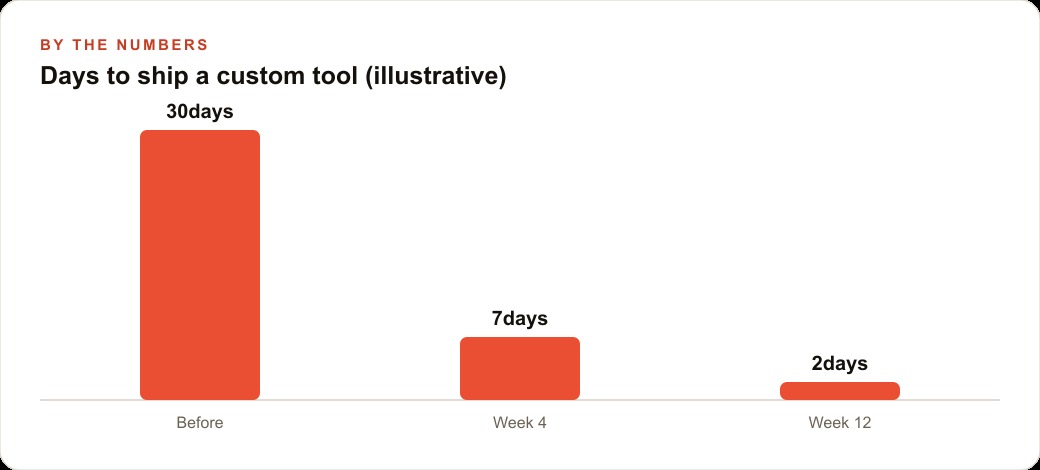
The real unlock is the iteration loop. In every domain where complex software was previously hard to build, the barrier was not just the initial creation but the cost of each revision. Every change that required going back to a developer, re-explaining the new requirement, waiting for it to be built and tested, and reviewing the result, was a reason not to iterate. High revision cost meant fewer experiments, fewer improvements, and a finished product that reflected what the team imagined at the start of the build rather than what they learned during it.
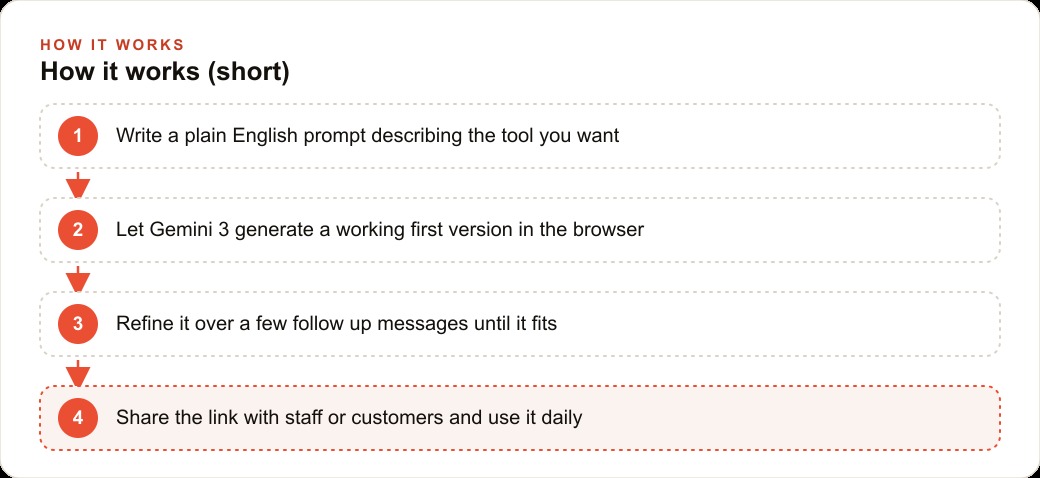
When you can describe what is wrong with the current version in plain language and have a corrected version in thirty seconds, the cost of a revision approaches zero. That changes the calculus of what to build. Instead of investing heavily in specification before building, you can start with a rough first version, see how it behaves on real inputs, and refine it through conversation. The first version does not need to be right. It needs to be a useful starting point for a rapid series of improvements, each one informed by what the previous version revealed about the problem.
For a business building its first internal tools using this approach, this means you do not need to know exactly what you want before you start. You need to know approximately what you want and be willing to describe specifically what is wrong with each version until the tool does what you actually need. That is a skill almost every business owner already has from working with contractors, managing staff, and directing work that gets revised based on what comes back. The technical translation step has been removed. The judgment work remains, and it is exactly the judgment work business owners are already doing.
What the gym and fitness studio use case reveals about where this goes
The golf swing analyzer is not a novelty. It is a template. The same pattern, upload a video, analyze the movement across frames, return specific corrective feedback, applies to any repeatable physical action where form matters and where the gap between good form and poor form has a measurable impact on outcomes. A barbell squat. A kettlebell swing. A tennis serve. A swimming stroke. A running gait. Any of these can be analyzed with the same approach the golf demo used, with the prompt adjusted for the specific movement and the specific criteria that define correct form in that discipline.
For a gym or fitness studio, this is a service layer that did not previously exist at this price point. A form check tool that members can use between sessions, uploading a short video of their lift and receiving specific coaching cues grounded in what the footage actually shows, turns a coaching service the gym already sells into something available outside of floor hours. The trainer does not get replaced. They get freed from the repetitive beginner-level corrections that consume a disproportionate share of floor time, and they can direct their attention to the advanced work that genuinely requires a human eye and accumulated experience.
Here is how Madhuranjan Kumar would set this up for a gym client. Build a simple form check tool where a member uploads a short video of a squat, a deadlift, or a kettlebell swing. The model breaks the lift into stages, estimates depth, bar path, and back angle, scores the overall form, and returns two or three plain-language coaching cues that a beginner can understand and act on immediately. The first version of this tool takes a single focused afternoon to build and refine. In illustrative terms, a trainer who currently spends twenty minutes a day walking beginners through the same squat cues recovers that time for members who need more individualized attention, which improves the experience for both.
The gym also benefits from the image-to-interactive pattern for marketing. Turning a photo of the facility into a short visual explainer, or turning product photos of equipment into something interactive that shows how the equipment works before a prospect visits, creates social content that stands apart from a standard photo post. That kind of distinctive content signals expertise and sets a tone before someone ever walks through the door, which affects the quality of the inquiry and the likelihood of conversion.
The retention implication is the part most gym owners underestimate. Members who feel guided between sessions stay longer and refer more people than members who feel on their own between appointments. A form check tool available at any time, on any device, creates touchpoints outside the building that reinforce the value of the membership. The gym that offers this alongside its in-person training has a retention advantage over the gym that offers in-person training alone. That advantage is now buildable in an afternoon at near-zero cost.
The mental model shift that separates the businesses that will use this from the ones that will not
The businesses that get the most from prompt-to-app capability are not the ones with the most technical knowledge. They are the ones that have already internalized a particular way of thinking about their operations: every time someone on the team does the same structured task more than three times a week, that task is a candidate for a tool.
This mental model is what the demos are really showing. You do not start from the capability and ask what it can do. You start from the repeated tasks in your business and ask whether this capability can handle any of them. When a trainer gives the same squat cue to twenty different members every week, that expertise is a candidate for a tool. When a receptionist types the same appointment confirmation message forty times a week, that message is a candidate for a template or an agent. When an owner explains the same service package to every new inquiry, that explanation is a candidate for an interactive tool that delivers the explanation more consistently and without requiring the owner to be present.
The practical advice from Madhuranjan Kumar is consistent: start with the narrowest possible version of the tool you can imagine, the one that does exactly one thing on one type of input, and build that first. The demos that went viral were narrow. A gravity simulator, not a physics engine. A golf swing analyzer, not a general sports coaching platform. A voxel art converter, not an image editing suite. The narrower the first version, the more reliably it works and the more clearly you can see what the next version should add. Start specific, prove it works, and let the scope expand as the use cases make themselves obvious through actual use.
The honest timeline for a first useful tool is one focused afternoon for a narrow, specific version and one more round of refinement after testing it on real inputs rather than idealized ones. The investment is small. The return is a custom capability that no off-the-shelf software would have sold you, built exactly for the way your business actually works rather than the way software vendors assume it does.
Madhuranjan Kumar's consistent position on timing: the businesses that start building their first internal tools now, while the learning curve is still short and the cost advantage over competitors is still large, will have compounded through several generations of improvement by the time the hesitant majority begins. The advantage is not in having access to the technology, because access is now equal. It is in having a tool that has been tested and refined against your real operations for long enough to actually be reliable when it matters.
That is exactly what we do at AI DOERS. Book a private 30-minute call with Madhuranjan Kumar and we will map the fastest path to it for your specific business.
Book your call →
Madhuranjan Kumar
Madhuranjan Kumar brings 20 years of performance-marketing experience and has managed over $200 million in Facebook ad spend for brands across the United States and beyond. His expertise spans the full modern marketing stack: Meta, Google Ads, TikTok, email automation, CRM, and the websites that hold it together. At AI DOERS he turns that track record into lead-generation systems for businesses across every industry.