
Gemini 3.1 Pro Is Here: What Google's New Model Actually Does Better
Google quietly shipped Gemini 3.1 Pro across its products, and the benchmarks are loud. Here is what actually changed, and how I would put it to work inside a real business.

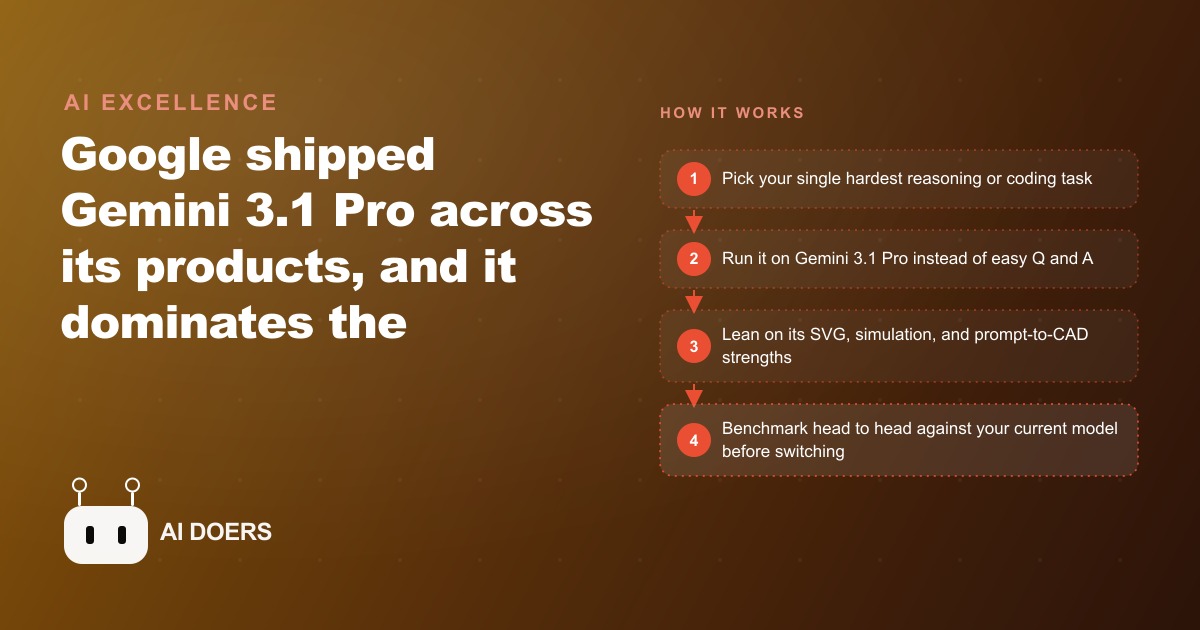
Google quietly shipped Gemini 3.1 Pro across its products last week, and the benchmark numbers that came with it are loud enough that anyone managing business workflows on AI tools should look at them carefully. I am Madhuranjan Kumar, and the story of this release is eight specific capability changes that together make Gemini a different proposition for business use than it was three months ago. Here is what each of those changes actually means and why several of them matter for the work businesses use AI for most often.
Gemini 3.1 Ships Directly Into Google's Existing Product Suite Without a Separate Installation Step
The first and most practically significant fact about Gemini 3.1 Pro is its distribution. It shipped directly into Google Docs, Sheets, Gmail, Google Search, and the Gemini app simultaneously. For any business that already runs its operations through Google Workspace, the model upgrade arrived without requiring any procurement decision, installation process, or change to existing workflows. The team members who use Google Docs to draft client proposals, Google Sheets to build reports, and Gmail to manage client communication got a meaningfully stronger AI model without any transition friction.
This distribution advantage is easy to underestimate because it feels administrative rather than technical. But the history of enterprise software adoption shows clearly that distribution beats capability in determining which tools teams actually use. A tool that requires a separate login, a separate browser tab, and a separate mental model of when to use it is used less consistently than a tool embedded in the applications already open on the team's screens all day. Gemini 3.1 being embedded in Workspace means it benefits from the compliance, security policies, and IT administration that Workspace already handles, rather than requiring separate evaluation and approval by the IT or legal function.
It Already Powered Deep Think Before the General Release, Which Means It Has Production Validation
The Deep Think reasoning mode that Gemini has offered for harder analytical tasks was already running on the Gemini 3.1 architecture before the general release was announced. This means the model was not shipped to public users as the first deployment of the architecture. It had already been running in production at scale in a restricted mode, with real user queries exposing edge cases and failure modes that controlled benchmark testing misses. For a business deploying a new AI tool for real work, the difference between a model being announced and a model that has already been running in restricted production is the difference between v1.0 and a model that has been hardened against the specific types of failures that production traffic reveals.
The practical implication is that Gemini 3.1 Pro is more reliable than a model of equivalent benchmark performance shipped without prior production exposure would be. Reliability matters for business use more than peak benchmark performance, because a model that occasionally fails unpredictably on important tasks at production scale is more disruptive than a model with slightly lower average performance that fails predictably and consistently.
It More Than Doubles Gemini 2.5 Pro on ARC-AGI-2, the Benchmark Designed to Test Novel Reasoning
The ARC-AGI-2 benchmark was specifically designed to resist the pattern-matching strategies that allowed previous models to perform well on benchmarks without demonstrating genuine novel reasoning capability. It presents visual pattern tasks that require identifying rules from examples and applying them to novel cases, a capability that is difficult to approximate through training data memorization. Gemini 3.1 Pro more than doubles the score that Gemini 2.5 Pro achieved on this benchmark, which is the kind of improvement that typically reflects a genuine architectural capability change rather than incremental tuning.
For business applications, the relevance of novel reasoning capability is clearest in tasks where the problem the AI is solving is not a close variant of something that appears frequently in training data. Legal contract review, competitive analysis of markets the model has limited training data about, troubleshooting unusual system behaviors, and designing novel process workflows all benefit from the ability to reason from first principles rather than from pattern matching against memorized examples. The improvement on ARC-AGI-2 suggests Gemini 3.1 Pro is meaningfully better than its predecessor on exactly this class of task.
It Tops the GPQA Benchmark on Graduate-Level Science Questions, Which Matters for Technical Businesses
GPQA measures performance on graduate-level science questions across biology, chemistry, and physics, where correct answers require understanding rather than recall of facts. Gemini 3.1 Pro's lead on this benchmark is relevant beyond the academic framing. For businesses whose AI use involves technical subject matter, whether that is reviewing scientific claims in health and wellness marketing, assessing the technical accuracy of product descriptions in regulated industries, or producing content about technically complex topics for professional audiences, a model's ability to reason correctly about technical subject matter is a direct quality determinant.
Any business producing content in healthcare, legal, financial, engineering, or any other regulated or technically complex field benefits from a model that can flag when a claim is technically incorrect rather than paraphrasing it fluently and incorrectly. That capability is what separates a model useful for professional-grade content production from a model that produces plausible-sounding content that requires the same level of expert review as if the AI had not been involved at all.
On Coding, Gemini 3.1 Pro Ties the Current Best Available Models
The coding evaluation places Gemini 3.1 Pro at the performance level of the current best-performing models on standard coding benchmarks. For a business that was previously choosing between Gemini for its Workspace integration and a different model for its coding performance, this result removes that tension. Gemini 3.1 Pro can now serve both functions without requiring a separate tool subscription and workflow for code-related tasks. For businesses building internal automation, maintaining web properties, or building AI-assisted tools for their operations, the coding capability meeting the top tier means the Workspace-integrated model is now also the right choice for code tasks rather than a compromise choice.
Running web and CRM automation from a model that is also integrated with your Workspace tools eliminates a context-switching cost that has been part of the standard AI-assisted development workflow until now. The code the model writes can reference documents, data, and context from the Workspace environment it is already connected to, rather than requiring manual copy-paste of context across separate tool interfaces.
The Humanities Last Exam Score Improved Significantly Compared to the Previous Generation
The Humanity's Last Exam benchmark aggregates hard questions from multiple knowledge domains, specifically designed to approach the limits of current model capability. Gemini 3.1 Pro's improved score on this benchmark relative to the previous generation is a signal about the breadth of the capability improvement rather than its depth in one domain. A model that improves broadly across a diverse hard-question set has generally improved in ways that transfer to a wide range of real tasks rather than being specifically tuned to perform on a narrow evaluation.
For businesses that use AI across multiple functions simultaneously, a broad capability improvement means the tool that already handles their document work will also do better on the analytical, research, and creative tasks they route to AI, without requiring separate tool evaluation for each function.
Near-Perfect Agentic Tool Use Is the Capability That Matters Most for Automation
Gemini 3.1 Pro's reported near-perfect performance on agentic tool use evaluations is the capability change with the largest potential business impact. Agentic tool use measures whether a model can use external tools reliably, in the right sequence, with the right parameters, without failing or getting stuck partway through a multi-step task. Near-perfect performance means the model can be trusted to complete tool-using workflows without requiring human supervision at each step, which is the foundational requirement for any meaningful automation.
For a business looking to automate any process that involves multiple steps and multiple tools, including customer intake, report generation, data compilation, or content publishing workflows, the reliability of the underlying model's tool use capability determines whether the automation actually works at production scale or requires constant manual intervention. A model with near-perfect tool use is a model you can build real automation on. A model with 80 percent tool use reliability fails one in five complex tool-using tasks, which means constant manual intervention in any high-volume automated workflow.
SVG Generation Quality Visibly Improved and City Planning Simulations Now Work
Two specific creative and simulation capabilities showed notable improvement in the Gemini 3.1 Pro release. SVG generation quality improved to the point where outputs are visibly better structured and more useful as starting points for custom graphics than the previous generation's outputs. For businesses that create diagrams, infographics, or custom graphics for presentations, reports, or social and content marketing, better SVG generation means a shorter path from an AI-generated starting point to a polished deliverable.
The city planning and flock simulation capabilities, which involve modeling complex emergent behaviors in spatial environments, are more directly relevant to architecture, urban planning, logistics, and simulation-based research than to most service businesses. But they demonstrate that Gemini 3.1 Pro's reasoning across complex spatial and multi-agent domains has improved in ways that go beyond text tasks, which suggests the reasoning improvements transfer broadly across modalities and problem types rather than being limited to the text domains where most AI benchmarks focus their evaluation.
You Can Now Prompt Your Way to a CAD Model, Which Changes Prototyping Economics for Product Businesses
The ability to describe a three-dimensional object in natural language and receive a CAD model file represents a capability that was not part of any mainstream AI tool's offering until very recently. For any business that designs physical products, creates branded merchandise, builds custom hardware, or needs 3D models for visualization in proposals or marketing materials, this capability changes the economics of early-stage prototyping. A founder who previously needed to hire a CAD drafter or learn CAD software to produce a first visualization of a product concept can now produce a first-iteration model from a text description, evaluate it, and iterate much faster and more cheaply than the previous path allowed.
The quality of the output is not yet at the level of production CAD work, and it requires review and refinement by someone who understands 3D modeling before it could be used for manufacturing specifications. But as a prototyping and ideation tool that gets a physical concept from a text description to a reviewable 3D representation in minutes, it is a genuinely new capability that compresses a step in the product development process that previously required specialized skills or a budget for specialized services.
The Practical Starting Point for a Business That Has Never Used Gemini
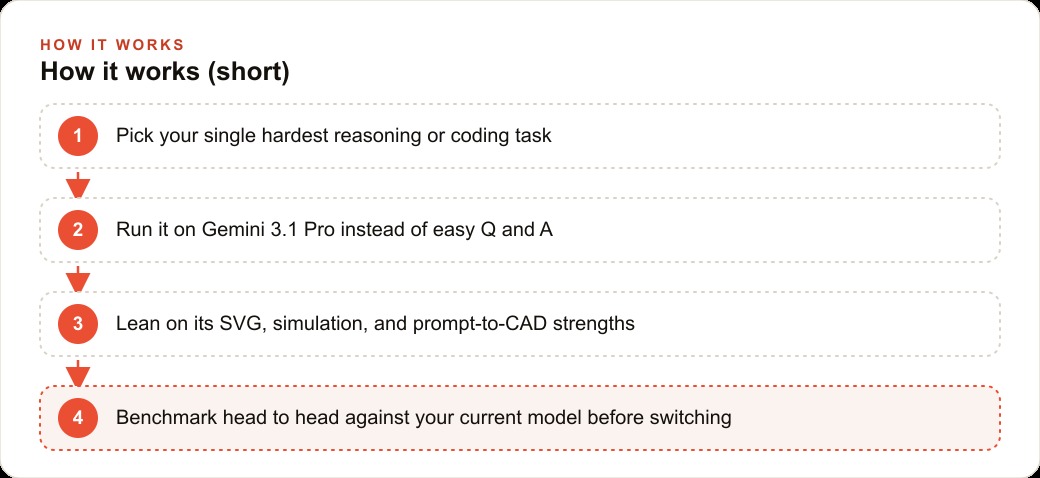
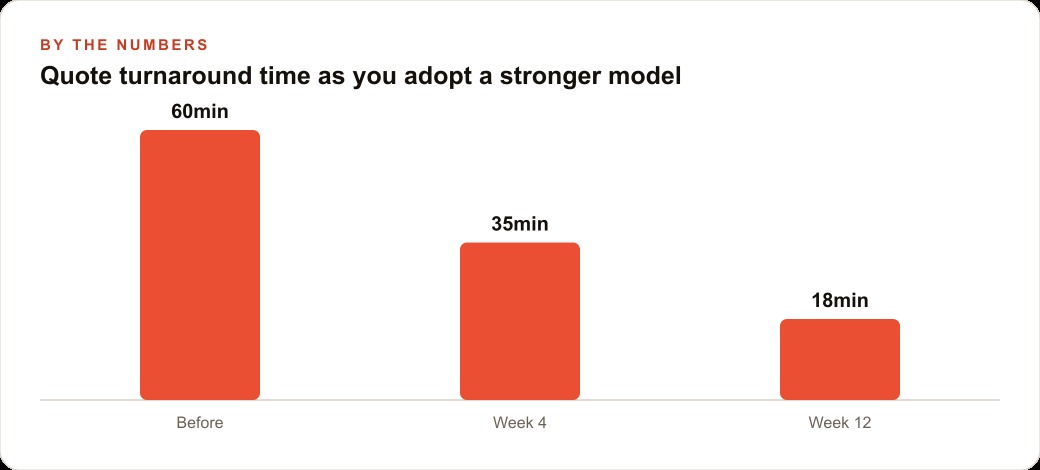
The barrier most business owners face with a new AI capability is not that the tool is hard to use but that the first session feels uncertain: uncertain about what to try, what level of output to expect, and how to evaluate whether it was useful. The fastest way through that uncertainty is to start with a task you already do manually and run both the manual version and the Gemini version in parallel, then compare the time spent and the editing required to reach a publishable result.
For a business that writes regular client-facing content, whether that is proposals, newsletters, social posts, or service explanations, the first Gemini 3.1 Pro test should be on one of those existing content types. Write a prompt that provides the same information you would normally use to draft the piece from scratch, submit it, and measure how long the draft review and editing takes versus how long the manual draft would have taken. That direct comparison, done once on a representative task, tells you more about Gemini 3.1 Pro's value for your specific work than any benchmark number. Do this test this week, on a real piece of content with a real deadline, and you will have a concrete answer about where this model fits into your workflow rather than an abstract impression based on someone else's evaluation.
The Capability That Will Produce the Most Value Six Months From Now Is the One You Build Habits Around Now
Of the eight capabilities described in this piece, the one that will produce the most compound value for a business is the one the business builds a consistent habit around starting this week rather than next month. AI capability improvements do not reduce the value of early habit formation. They increase it, because each model improvement amplifies the skill of the operators who already know how to use the tools effectively. A team that has been using Gemini for structured document production for six months is better positioned to benefit from the next generation of document generation capabilities than a team that waits for the tools to be perfect before starting. The habit is the investment. The tool improvements are the return on a habit already formed.
That is exactly what we do at AI DOERS. Book a private 30-minute call with Madhuranjan Kumar and we will map the fastest path to it for your specific business.
Book your call →
Madhuranjan Kumar
Madhuranjan Kumar brings 20 years of performance-marketing experience and has managed over $200 million in Facebook ad spend for brands across the United States and beyond. His expertise spans the full modern marketing stack: Meta, Google Ads, TikTok, email automation, CRM, and the websites that hold it together. At AI DOERS he turns that track record into lead-generation systems for businesses across every industry.