
From One Prompt to a Live WordPress Site in About a Minute
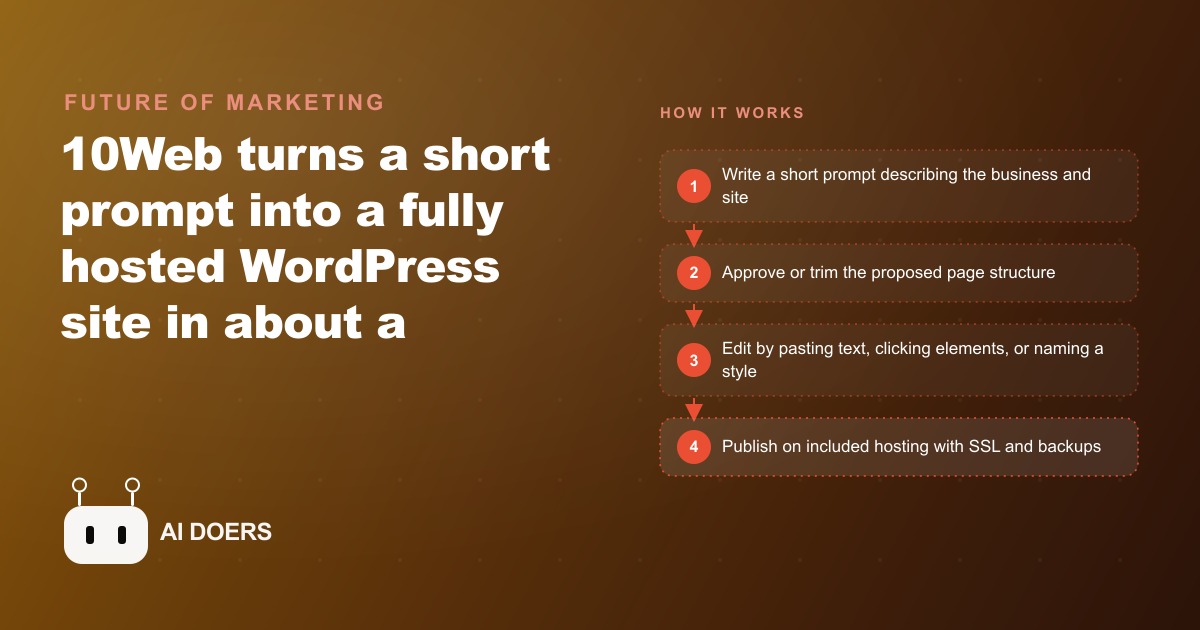
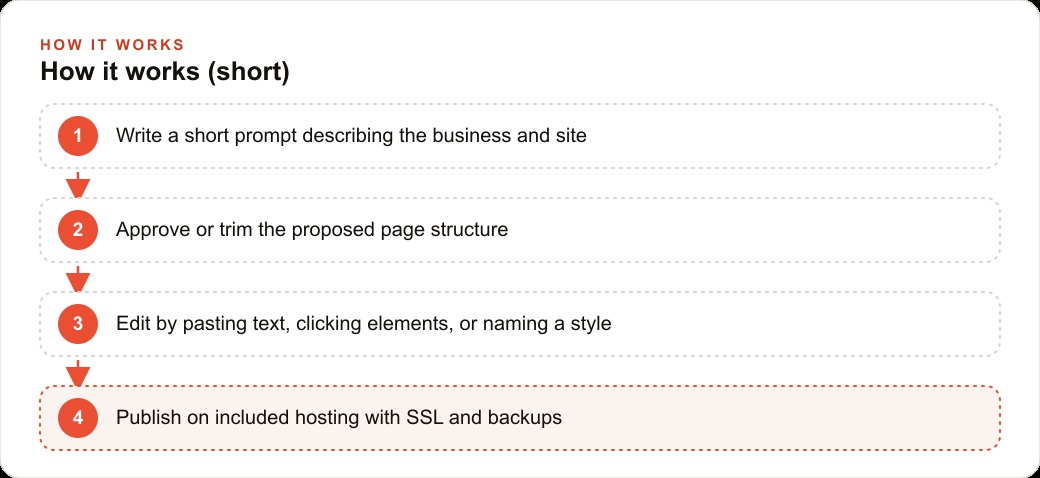
10Web takes a short prompt and produces a fully hosted, native WordPress site in roughly one to two minutes by proposing the structure first, then letting you edit by pasting text, clicking elements, or describing a style, with hosting, SSL, backups, and version history included.

A website that builds itself in about a minute is the most oversold and least understood tool of the year, and I want to argue the unpopular position. The speed is real. 10Web genuinely takes a short prompt and hands you a fully hosted WordPress site in one to two minutes, and I have watched it work on tools that made the same promise and failed. But the minute is a trap. It convinces owners that the hard part is finished when the hard part has not even started. I am Madhuranjan Kumar, and after years of watching small businesses launch pretty sites that never ring the phone, I have a firm opinion here: a site that builds itself in a minute is worth almost nothing until a human does the thirty minutes of thinking the machine cannot do.
The minute is real, which is exactly why it fools people
Let me be fair to the tool before I turn on it. 10Web does something clever that most one-prompt builders get wrong. Instead of dumping a finished page on you and hoping, it proposes a website structure first, a list of pages you approve or trim before anything is generated. You strike the pages you do not need, and it builds around that skeleton. The output is native WordPress, so you can open the normal dashboard and manage posts, media, and pages the usual way, and your content stays portable if you ever move. Hosting, SSL, a CDN, and backups come bundled. There is a code editor for full control and version history so any experiment is one click from undone. On paper, every objection is answered.
That is precisely the problem. When a tool answers every technical objection, owners assume it has answered every objection. It has not. The technical objections were never the reason small businesses stayed offline. Nobody skipped building a website because they were worried about SSL certificates. They skipped it because they did not want to spend money on a designer and did not want to learn a builder. 10Web removes both of those excuses, and in doing so it removes the friction that used to force people to slow down and think. Friction is annoying, but friction is also the thing that makes you ask whether the home page says the right thing to the right customer.
Speed was never the bottleneck
Here is the belief I want to dismantle. The industry keeps selling speed as if slowness were the enemy. It is not. I have never met an owner whose business failed because their website took three weeks to build instead of one minute. I have met dozens whose websites failed because they said nothing a customer cared about, buried the phone number, and answered none of the questions a nervous buyer actually asks before calling.
A one-minute build accelerates the part that was already easy and does nothing for the part that was always hard. Choosing which pages a service business needs, writing copy that answers a worried customer, placing the phone number and quote form where a thumb actually lands, and feeding in real reviews, all of that takes judgment. The tool will happily generate a services page, but it does not know that in your trade the customer decides in the first eight seconds whether you look trustworthy at eleven at night. It does not know that your best margin comes from one specific service that deserves its own page. Speed cannot supply judgment, and judgment is the entire game.
This matters beyond the site itself. A homepage that converts is the foundation that everything paid sits on top of. When you send traffic from Facebook and Instagram ad campaigns to a page that loads fast but says the wrong thing, you are paying for clicks that bounce. The one-minute build does not fix that. If anything it makes it worse, because it lets you skip the uncomfortable step of deciding what the page is supposed to make a visitor do.
What the prompt cannot know about your customer
Give 10Web a one-line description of a licensed plumbing service and it will produce a competent site. What it cannot produce is the answer to the only question that matters: why should this specific homeowner, in this specific panic, call you instead of the next name in the search results. That answer lives in things the prompt never contains. It lives in your actual reviews, your real response time, the guarantee you offer, the neighborhoods you serve, and the tone that makes a stranger trust you with a key to their house.
The AI writes generic copy because generic is all it has. It has your one sentence and a statistical average of every plumbing site on the internet. Average is exactly what you do not want, because average is invisible. The businesses that win a crowded local market win on specificity, and specificity is the one thing a one-prompt builder structurally cannot invent. This is why I keep telling owners that the tool is a starting canvas, not a finished product. Treat the generated site as a very fast first draft and your odds are good. Treat it as done and you have published a brochure that could belong to any competitor in your zip code.
The plumber who launched in a minute and waited three months for the phone to ring
Let me put illustrative numbers to this, because the abstract argument only lands when you see the cost. Picture a plumbing owner who runs 10Web, types one sentence, keeps the default pages, and publishes. Total time invested: about ten minutes. The site looks clean. He is thrilled. Then he waits.
For three months the site draws a trickle of visitors from his existing customers typing his name, and converts almost none of the cold traffic he pays to send. Say he spends 40 dollars a day on Google Ads, roughly 1,200 dollars a month, driving clicks to a home page with a vague headline, a stock hero image, no reviews, and a quote form four scrolls down. At a weak two percent conversion rate on 600 clicks, that is 12 leads a month for 1,200 dollars, about 100 dollars a lead, and half of those never call back because nothing on the page earned the follow-up.
Now run the same tool with thirty minutes of judgment added. The owner trims the structure to a sharp home page, a services page, a service-area page, a reviews block, and a contact page with the quote form above the fold. He pastes his real license details and warranty, uploads actual job photos that land in the WordPress media gallery, and writes a headline that names the city and the promise of same-day emergency service. Same 1,200 dollars of ad spend, same 600 clicks, but now a five percent conversion rate. That is 30 leads for 1,200 dollars, about 40 dollars a lead, and the leads convert better because the page answered the eleven-at-night question. The build tool was identical in both cases. The only variable was the human half hour. That half hour more than doubled the return, and it is the exact half hour the one-minute pitch tells you to skip.
Where the tool genuinely earns its place
I am not telling anyone to avoid 10Web. My argument is against how it is sold, not against what it is. Used correctly, it is a legitimate accelerator. It kills the blank page, ships real hosting and SSL and backups without a separate scramble, and lets a non-technical owner make edits by pasting text, clicking an element, or naming a style, with version history removing the fear of breaking anything. The free plan covers building, editing, and styling, so you only pay when you want a custom domain. For an agency there is even a white-label reseller dashboard that turns the tool into a service you can sell under your own brand. All of that is real value.
The right way to think about it is division of labor. Let the machine do the mechanical ninety percent, the layout, the hosting, the responsive scaffolding, in a minute. Then spend your energy on the ten percent that decides whether the site earns money: the offer, the proof, the copy, and the path to contact. That same content foundation, the reviews and service pages you write with care, also feeds SEO and organic search over time without extra work, so the human half hour pays off twice. And the leads the page does capture should drop straight into a proper CRM and website stack where follow-up automation handles the next few touches, because a lead that sits in an inbox is a lead you paid for and wasted.
The launch is the start, not the finish
There is one more reason the one-minute story misleads people, and it is the part nobody demos: a website is not a thing you build, it is a thing you maintain. The minute gets you a published page. It does not get you the second month, when a customer asks a question the site does not answer, or the third month, when a competitor updates their pricing and yours looks stale, or the sixth month, when you add a service and the site never mentions it. Real sites drift. The ones that keep bringing in calls are the ones somebody tends.
This is where treating the build as finished quietly costs you. An owner who spent a minute and moved on has no habit of looking at the site, so it slowly falls behind the business it is supposed to represent. Reviews go unposted, seasonal offers never appear, the FAQ never grows to match the questions people actually ask on the phone. Each of those gaps is a small leak, and small leaks compound into a site that technically exists but no longer earns its keep. The tool cannot notice any of this for you, because noticing requires knowing your business changed, and only a person knows that.
The good news is that WordPress makes the tending easy, which is one of the genuine strengths of 10Web's choice of platform. Because it is native WordPress, you can add a blog post, update a service page, or swap a photo in minutes from the normal dashboard, and those updates portable, they belong to you. So the honest workflow is not build and forget. It is build fast, launch, then spend a small recurring slice of time keeping the site ahead of the business. An hour a month of updates does more for your phone volume than any amount of one-minute regeneration, because it keeps the page saying true, current, specific things to the customer standing in front of it today. The minute was never the work. The tending is, and it never stops.
The honest verdict
So here is where I land, plainly. The one-prompt website builder is a genuine leap, and the minute is not marketing fluff. But speed is the least important thing about a website, and the industry sells it as the most important thing because speed is easy to demo and judgment is not. A fast build is not a good site. A good site is a fast build plus the human work of deciding what to say, who to say it to, and how to make them act.
If you enjoy the craft, do it yourself. Run the tool, then spend the afternoon making the site actually yours: sharp structure, honest copy, real photos, reviews up top, the phone number impossible to miss. If you would rather not learn what converts by burning a few months of ad spend, hand that half of the job to someone who has done it many times. Either way, please do not publish the one-minute draft and call it finished. The tool did its minute. The part that makes you money is still waiting for a person.
That is exactly what we do at AI DOERS. Book a private 30-minute call with Madhuranjan Kumar and we will map the fastest path to it for your specific business.
Book your call →
Madhuranjan Kumar
Madhuranjan Kumar brings 20 years of performance-marketing experience and has managed over $200 million in Facebook ad spend for brands across the United States and beyond. His expertise spans the full modern marketing stack: Meta, Google Ads, TikTok, email automation, CRM, and the websites that hold it together. At AI DOERS he turns that track record into lead-generation systems for businesses across every industry.