
Free AI Video at Home: How LTX-2 Lets Small Businesses Make Their Own Ads
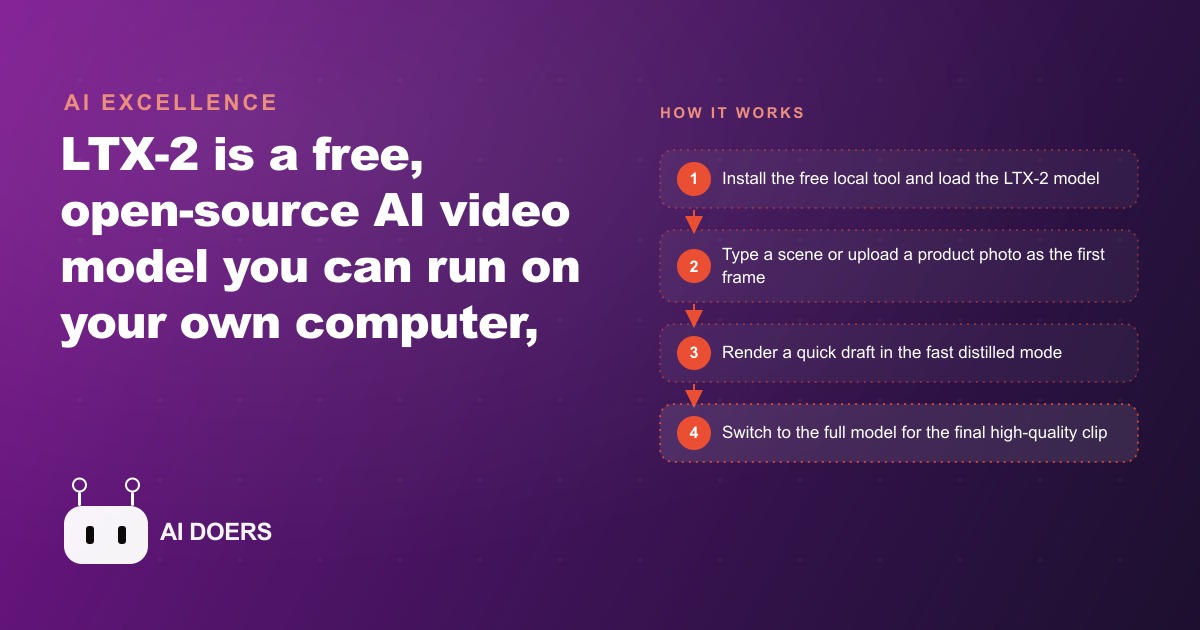
LTX-2 is an open-source AI video model with sound built in that runs on a normal gaming PC. For a small business, that means short marketing clips without a film crew or a monthly subscription.

A thirty-second product video from a professional film crew costs somewhere between three thousand and eight thousand dollars by the time you pay for the director, the lighting rig, the camera operator, the location, and the editing. For most small businesses, that number means one video per year, if that. LTX-2 changes the math so completely that the question stops being whether you can afford video and starts being how many you want to make this week.
LTX-2 is a fully open-source AI video model that runs on a home gaming PC and generates short video clips with audio built in. The weights are free to download. The training code is public. There is nothing to subscribe to, no usage cap to monitor, no enterprise license to negotiate. Once it is running on your hardware, the cost of each video is essentially the electricity your GPU uses.
The open weights distinction that separates LTX-2 from most AI video tools
"Open" is a word that the AI industry uses loosely. Most tools that call themselves open are open in the sense that you can use them through a web interface without paying, which is closer to "free tier" than to "open." The underlying model, its weights, and its training process remain proprietary. You use what the company gives you access to, in the way they choose to give access to it.
LTX-2 is open in the harder sense: the actual weights -- the billions of numerical parameters that define how the model processes inputs and generates outputs -- are freely available to download and run on your own hardware. The training code is published. The training recipes, which describe how the model was trained and what data it learned from, are documented and released.
This distinction matters for several reasons that are easy to overlook when you are focused on whether the output looks good.
When the weights are yours, there is no service disruption. If the company that made a proprietary video tool changes its pricing, takes the service down for maintenance, or goes out of business, your workflow stops. When the weights are on your machine, the tool keeps running. It ran yesterday, it runs today, and it will run next year regardless of what happens to anyone else.
When the weights are yours, you can fine-tune the model on your own data. If you run a business with a distinctive visual style -- a specific color palette, a specific type of lighting, a specific way that your products are photographed -- you can train the model further on examples of that style and get outputs that reflect it. Proprietary models almost never allow this.
When the training code is public, researchers and developers can build on it. The improvements and extensions that the open-source community builds compound over time in a way that proprietary models cannot match. Camera control add-ons, specialized fine-tunes, improved sampling methods -- these are already appearing as third-party extensions built on top of the released code.
For a business using video in its Facebook and Instagram ad campaigns, the practical advantage of owning the weights is that you are not constrained by monthly credit limits or resolution tiers. You generate what you need, when you need it.
Why generating audio inside this breakdown model changes everything
Most open-source video models generate silent video. Audio is either absent entirely or added as a post-processing step using a separate model and a separate pipeline. This creates a fragmentation problem: the visual content and the audio are generated independently, which means they are not synchronized at a generation level. The result often has a timing mismatch that requires manual correction or feels slightly off in a way that is hard to pinpoint.
LTX-2 generates audio as part of the same process that generates this breakdown frames. Dialogue, ambient sound, and sound effects are produced in a single pass that understands the relationship between what is happening visually and what should be heard. The audio model knows that if this breakdown shows a door closing, there should be a sound at the moment the door meets the frame, not a half-second later.
For ads and social content, this native audio integration changes the production workflow significantly. Currently a business producing short video ads needs separate tools for the visual content, the voice-over, the background music, and the sound design, followed by a manual assembly step in a video editor. Each step adds time and each junction between steps introduces the possibility of synchronization problems.
A single model that produces a cohesive visual and audio output compresses that multi-step process into one. The output still needs to be reviewed and may still need some post-processing, but the starting point is a complete audio-visual unit rather than a collection of tracks that need to be synchronized.
For SEO and organic search, video content with native audio is particularly valuable for the search platforms that prioritize video with sound. YouTube, which is the second-largest search engine in the world, processes audio content from videos as part of its indexing. A video that describes what it shows in audio terms, rather than relying only on the visual content, is more findable.
The two-speed rendering strategy that saves hours of iteration
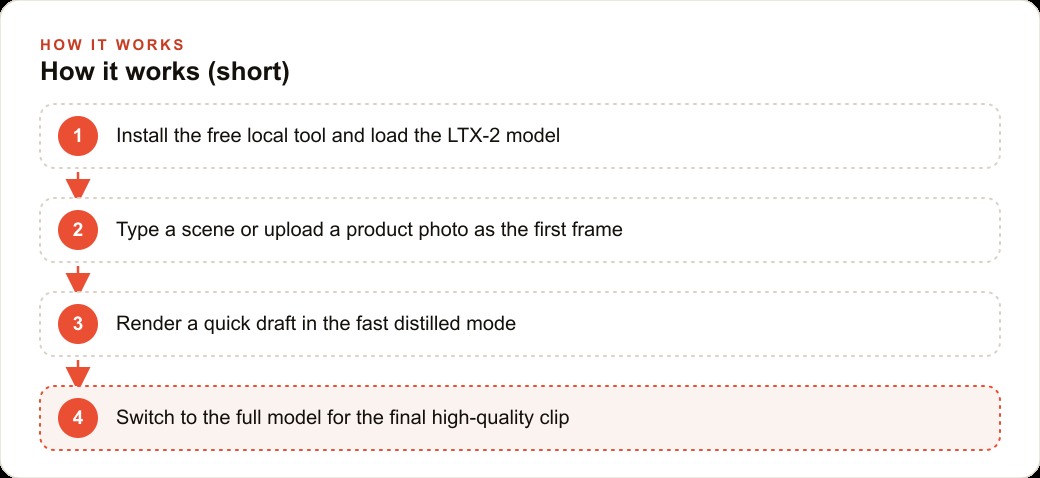
LTX-2 ships with two rendering modes: a distilled model and a full model. Understanding when to use each one is the single most important workflow decision you will make with this tool.
The distilled model is optimized for speed and reduced memory usage. A short clip can render in under a minute on a capable gaming GPU. The output quality is lower than the full model -- there is typically less fine detail, and complex motion can be less coherent -- but the tradeoffs are acceptable for iteration. The distilled model is the tool you use to find out whether your prompt is going in the right direction.
The full model produces the highest quality output the system is capable of. It is slower and requires more GPU memory. It is not the tool you use while you are still figuring out what you want.
The productive workflow is to iterate entirely on the distilled model. You start with a prompt, generate a clip in under a minute, review it, adjust the prompt, generate again, review, adjust again. You do this until the composition, the motion, the lighting, and the timing are working the way you want them. Then, and only then, you switch to the full model and run the final render.
This two-speed approach dramatically reduces the time cost of experimentation. If every iteration took the full model's rendering time, you would run two or three variations and pick the best one. With the distilled model, you can run fifteen or twenty variations in the time one full render takes, which means you arrive at the full render with far more confidence that the prompt is right.
The same logic applies to any iterative creative process. Sketch first, paint second. Draft first, finalize second. Distilled first, full second.
Camera control add-ons and why random motion looks amateur
Video that looks AI-generated often looks AI-generated because of the camera. The content itself might be convincing -- realistic lighting, coherent motion, plausible details -- but the camera moves randomly, or drifts in a direction that does not serve the composition, or holds perfectly still in a way that no real camera ever does. The mismatch between otherwise good content and the camera behavior is what signals that a human did not set up the shot.
LTX-2 has modular camera control add-ons that address this directly. Rather than letting the model determine camera movement freely, you specify the camera behavior you want: a slow dolly to the left, a gentle push-in toward the subject, a locked-off static shot with slight handheld simulation, a pull-back that reveals a wider scene. The model then generates video in which the camera behaves as specified.
This matters because intentional camera movement is a signal of production quality. A slow push-in on a product communicates that someone thought about the framing and chose to move the camera for a reason. Random drift communicates the opposite.
The add-on architecture is also extensible. Because the base model and its training code are public, the community can build camera control modules that address specific types of shots, and those modules can be loaded into the same pipeline. As the library of camera control options grows, the range of shot types you can specify grows with it.
For ads running on platforms that favor video over static images, the camera control add-ons are what make the difference between video that looks like a generated clip and video that looks like it was produced intentionally. The content might be similar; the intentionality of the camera is what distinguishes them visually.
From one product photo to a week of social video
The full input flexibility of LTX-2 becomes most practical when you understand that you can start from a single image rather than generating everything from a text prompt alone.
When you provide a single image as the first frame, the model generates video that extends from that image. It maintains the visual character of the image -- the lighting quality, the color palette, the level of detail -- and generates the motion and continuation from there. The image anchors the visual identity of the clip in a way that a text prompt alone cannot guarantee.
Consider the practical application for a bakery with a signature pastry. The bakery takes one good photo of the pastry on a clean surface with consistent lighting. That photo becomes the first frame. The text prompt describes the motion (the camera slowly circles the pastry, steam rises from the freshly baked surface), the lighting change (morning light from the left shifts to warm ambient as the clip progresses), and any audio elements (the quiet ambient sound of a bakery kitchen in the background).
The distilled model generates a first pass in under a minute. The composition is mostly there but the steam motion is not quite right. The prompt is adjusted to specify the steam behavior more precisely. Another pass. The steam looks better; now the color warmth is slightly off. The prompt is adjusted again. After four or five iterations, the distilled version is working well. The full model renders the final version. The result is a fifteen to twenty second clip that shows the product from an intentional angle, with natural motion, appropriate sound, and the bakery's visual character intact.
That clip becomes multiple pieces of content. Full length for Instagram and Facebook. The first five seconds as a short-form hook. A still frame extracted from the best moment for a thumbnail. The audio stripped for a sound-only platform element.
One photo and one afternoon of iteration produces a week of social content. Run this process on each hero product once a month and you have a consistent content calendar with no recurring production cost beyond the electricity to run the render.
For a business running Facebook and Instagram ad campaigns with video creative, this changes the testing economics entirely. Video ad testing typically requires multiple creative variations to find what performs best. When each variation costs thousands of dollars to produce, you test two or three and pick the best one. When each variation takes an afternoon and costs almost nothing, you test ten or fifteen and let the data tell you which approach resonates. The testing depth you can achieve with free production tools is structurally different from what is possible when each creative costs a production budget.
The combination of open weights, native audio, two-speed rendering, camera control, and image-first generation makes LTX-2 the most complete free tool for video production that currently exists. The constraint is not the model's capability. The constraint is your clarity about what you want to make.
Start with one product. Take one good photo. Write a prompt that describes what you want this breakdown to do. Iterate on the distilled model until it is working. Render the final version. See what you have. The economics of video content just changed, and the businesses that start using the new economics now will have built a content library and a production process before their competitors realize the cost structure has shifted.
That is exactly what we do at AI DOERS. Book a private 30-minute call with Madhuranjan Kumar and we will map the fastest path to it for your specific business.
Book your call →
Madhuranjan Kumar
Madhuranjan Kumar brings 20 years of performance-marketing experience and has managed over $200 million in Facebook ad spend for brands across the United States and beyond. His expertise spans the full modern marketing stack: Meta, Google Ads, TikTok, email automation, CRM, and the websites that hold it together. At AI DOERS he turns that track record into lead-generation systems for businesses across every industry.