
9 Free AI Skills That Give a Real Estate Agency a Technology Edge Without Extra Software Costs
Skills installed in Claude Code or Codex extend what AI can do for your business at no cost. Here are nine that a real estate agency can use to research, write, visualize, and present more effectively.

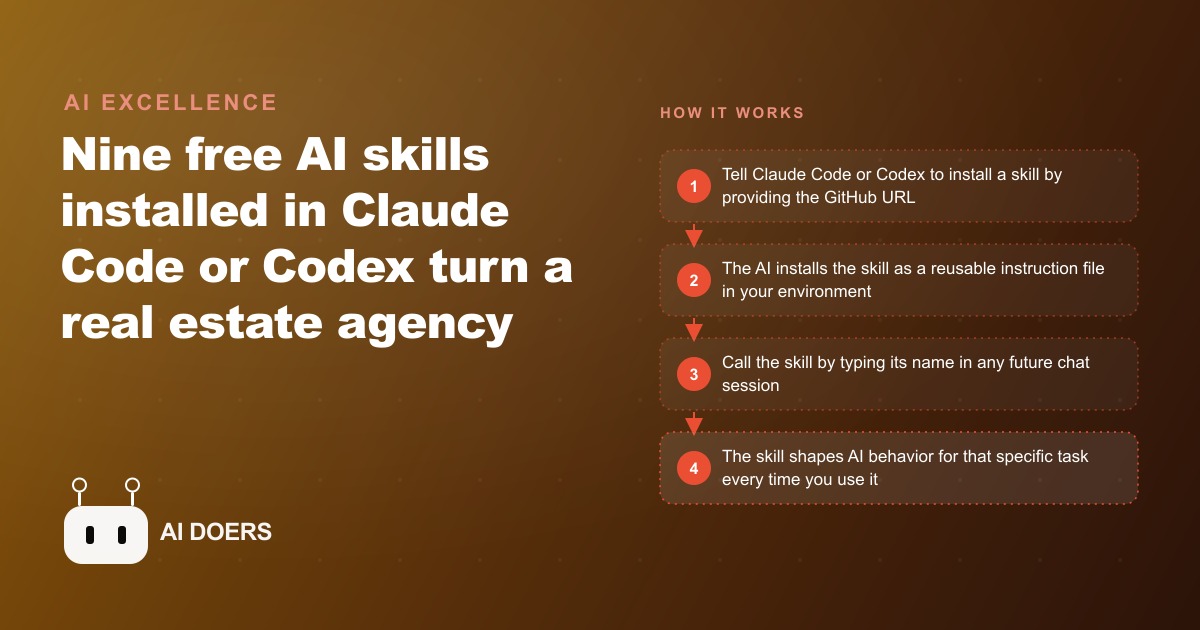
Most business owners who use AI tools every day are using them at about twenty percent of their actual capability, because they have not discovered skills. Skills are a different layer entirely from the standard chat interface, and understanding what that layer actually is changes what you can build with AI without spending anything beyond what you already pay. I am Madhuranjan Kumar, and this piece takes apart what AI skills actually are, how each one works differently from a plain prompt, and what they mean specifically for a real estate agency trying to research, write, present, and win business faster.
What a skill actually is and why it behaves differently from a plain prompt
A skill is a reusable instruction file, typically written in markdown, that is stored in your AI coding environment alongside your project files. When you invoke a skill by name, the AI reads both the skill file and your actual prompt at the same time. The skill provides the behavioral framework; your prompt provides the content. The result is that the same kind of request, asking the AI to improve a piece of writing, produces a categorically different output depending on whether a plain prompt or a trained skill is running underneath it.
The distinction matters because a plain prompt relies on the model interpreting your intent from scratch each time. A skill pre-interprets it correctly. A skill called Stop Slop does not just improve writing in the general sense that a plain instruction to clean this up would. It specifically removes the phrases, cadences, and sentence structures that signal to a trained reader that the content was generated by a machine. The output reads as if a human wrote it because the skill knows specifically what to hunt for, not because the model is trying harder in response to a vague instruction.
The best skills function like having a specialist in the room who runs the same structured process every time you call on them. The same research process, the same quality filters, the same output format. That consistency is what makes skills worth building into a workflow rather than treating as occasional experiments.
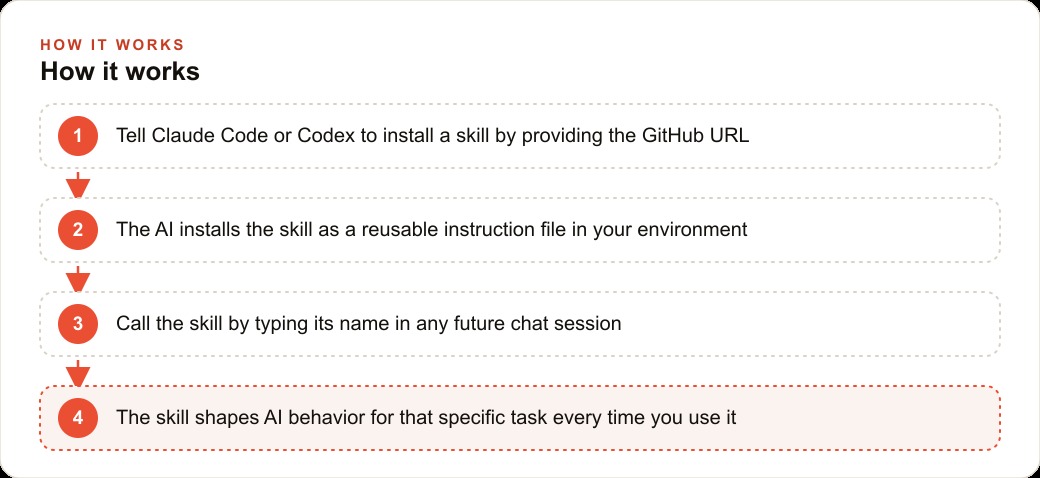
Installation is simpler than it sounds. In Claude Code, Codex, Cursor, or VS Code with AI capabilities, you paste the GitHub URL of the skill and tell the AI to install it. The tool handles the download and configuration. After that the skill is available in any future session by name or slash command. There is no manual file management required.
The research layer: sentiment before the appointment
The Last 30 Days skill is the most immediately useful research tool a real estate agent can install. It searches Reddit, X, YouTube, Hacker News, Polymarket, and GitHub across the past 30 days and synthesizes what people are actually saying about a topic, including excitement, concern, confusion, and emerging speculation. The output is a structured summary of live internet sentiment, not a curated list of industry articles.
For a buyer consultation preparation, this changes the quality of insight dramatically. An agent asking it to search for what buyers and sellers are saying about a specific neighborhood in the last 30 days gets back synthesized community discussion: what concerns came up in local forums, what people said about pricing trends, what drove specific decisions in that area recently. That is real-time market intelligence assembled from actual buyer conversations, not from lagged MLS data.
For listing appointments, the same skill reveals how sellers in a market are currently thinking and what they are worried about. An agent who walks into a listing presentation already knowing the sellers' common objections, derived from live forum discussions rather than intuition, is prepared in a way that differentiates from a competitor relying on general scripts. The research is specific to this market moment, not drawn from playbooks built in a different market environment.
The time saving is significant too. What used to require hours of manual scrolling through local Facebook group discussions, Reddit threads, and community forums takes minutes with this skill. The agent spends that recovered time with clients rather than with search results.
The content layer: removing the AI signature from your writing
Stop Slop is a skill that specifically identifies and removes the language patterns that mark AI-generated writing as AI-generated. In real estate marketing, this matters because listing descriptions, property emails, and social content are increasingly written with AI assistance, and the output that comes back from a plain prompt has recognizable tells. Phrases like nestled in a serene setting or boasting an open floor plan appear across thousands of listings and read as templated rather than specific.
The Stop Slop skill removes those patterns and outputs writing that reads as written by a person who knows the property and the market. The difference is visible to the reader even if they cannot articulate exactly why one description feels more authentic than another. Authenticity in listing copy is not a soft benefit. It affects how many people schedule a showing and how buyers perceive the seriousness of the marketing behind the property.
For an agent running Facebook and Instagram ads alongside organic marketing, the content quality benefit compounds. Ad copy that reads as genuinely human outperforms AI-flavored copy in engagement metrics because people respond more readily to writing that feels like it came from a real voice. The Stop Slop workflow is: draft quickly in any AI tool for speed, run through the skill before anything goes to the MLS or the ad platform, and publish the cleaned output.
The knowledge layer: your document archive as queryable memory
Graphify turns a folder of documents into a queryable knowledge graph. For a real estate agency that accumulates market reports, comparable sale summaries, neighborhood analysis documents, and past transaction notes, this skill converts a static archive into an asset the whole team can query in plain language.
The practical use is this: an agent preparing to show homes in a neighborhood can ask the knowledge graph what the recurring buyer concerns have been for that area over the last quarter, instead of reading through forty separate documents. The graph synthesizes an answer from the actual documents in the archive rather than from general market knowledge. That is the difference between advice calibrated to this agency's actual experience and advice that could apply to any agency anywhere.
The token efficiency benefit is also real. When an AI assistant has to read forty documents in full context each time someone asks a question, the token cost is high and the context window fills up quickly. Graphify maps the relationships between documents and stores them in a queryable structure, so the assistant can retrieve relevant information efficiently rather than brute-forcing through everything. The queries run faster and cost less.
For an agency building organic search content about neighborhoods they specialize in, the knowledge graph is the raw material for that content. The agency's proprietary knowledge of local market patterns, derived from years of actual transactions, becomes accessible to the content production process in a way it was not when it lived in separate documents across different team members' folders.
The presentation layer: motion content from a single prompt
The Remotion best practices skill generates animated content from a text prompt. For a real estate agency, the immediate use is monthly market update posts for social media. An agent who wants to share median home price changes in a market over the last 12 months can provide the numbers and a brief script, and the skill produces an animated chart or data visualization that plays as a short clip.
This matters because video and motion content outperforms static images in organic reach and in paid ad performance consistently. The barrier to producing motion content was always this breakdown editing step, which required either technical skill or a production budget. With the Remotion skill, that barrier is effectively removed. The agent records a brief voiceover explanation of the market data, the skill produces the animated chart to accompany it, and the combined result is a professional-looking market update post that no competitor relying on static infographics can match in terms of attention capture.
For a business running paid social ads in competitive local markets, the ability to produce animated creative at low cost and high frequency creates a meaningful testing advantage. More creative variations tested at low cost means better data on what resonates with local buyers and sellers, and better data translates directly into lower cost per lead over time.
The advisory layer: a virtual team for strategic decisions
The G-Stack bundle installs 23 specialist roles inside Claude Code: a CEO who stress-tests ideas, an engineering manager who reviews architecture, a designer who identifies generic output, a security reviewer, a QA lead, and others. For a real estate agency owner considering a significant business decision, activating the G-Stack office hours skill and describing the decision triggers a structured analysis where the AI acts as each specialist in turn, surfacing questions and risks from multiple functional perspectives simultaneously.
The practical value is preparation quality. Before a major listing appointment against a well-established competitor, running a G-Stack CEO review on the pitch strategy surfaces the questions the seller is most likely to ask and the weak points in the positioning that a smart seller will probe. After a G-Stack session, an agent leaves with 15 to 20 specific challenges to prepare for rather than a general sense that they should be ready for tough questions.
This applies equally to agency expansion decisions, technology investment decisions, and team hiring decisions. The G-Stack review does not replace judgment. It structures the thinking before judgment is exercised. An agent who has pre-answered the 15 hardest questions a seller or a partner is likely to ask enters any high-stakes conversation with a materially different level of preparation than one who relied on general experience.
The discipline that keeps skills useful after installation
Skills compound in value over time, but only if they are used consistently rather than sporadically. The most common failure mode is installing a skill, using it twice, and never developing a real sense of its output range. The businesses that build durable competitive advantages from skills are the ones that work a single skill into a repeating workflow before adding the next one.
For a real estate agency starting with skills, the installation order should follow the workflow. Install Stop Slop first because the benefit on listing descriptions is visible immediately and creates positive momentum. Install Last 30 Days second because the research value shows up on the first appointment it is used for. Install Graphify third, once the agency has accumulated enough market documents to make the knowledge graph substantively useful.
The skill that handles motion content, whether Remotion or Hyperframes, is the last to add because it has a slightly longer learning curve for prompting and produces the most value for an agency that already has a social content habit in place. Adding it to an existing workflow takes thirty minutes. Starting a social content workflow from scratch and adding the skill at the same time is two different learning curves running simultaneously.
Skills are not replacements for judgment. Stop Slop produces cleaner copy, but an agent still needs to confirm the copy matches the property. Last 30 Days synthesizes sentiment, but an agent still needs to distinguish what matters to a real buyer from what is noise. The skill amplifies the quality of what an experienced agent already brings to the work. It does not substitute for the experience itself.
That is exactly what we do at AI DOERS. Book a private 30-minute call with Madhuranjan Kumar and we will map the fastest path to it for your specific business.
Book your call →
Madhuranjan Kumar
Madhuranjan Kumar brings 20 years of performance-marketing experience and has managed over $200 million in Facebook ad spend for brands across the United States and beyond. His expertise spans the full modern marketing stack: Meta, Google Ads, TikTok, email automation, CRM, and the websites that hold it together. At AI DOERS he turns that track record into lead-generation systems for businesses across every industry.