
Four Claude Code Upgrades That Turn It Into a Real Business Partner
Most people use Claude Code in a way that feels productive but never moves money. These four upgrades fix that by improving the quality and speed of what you ship.

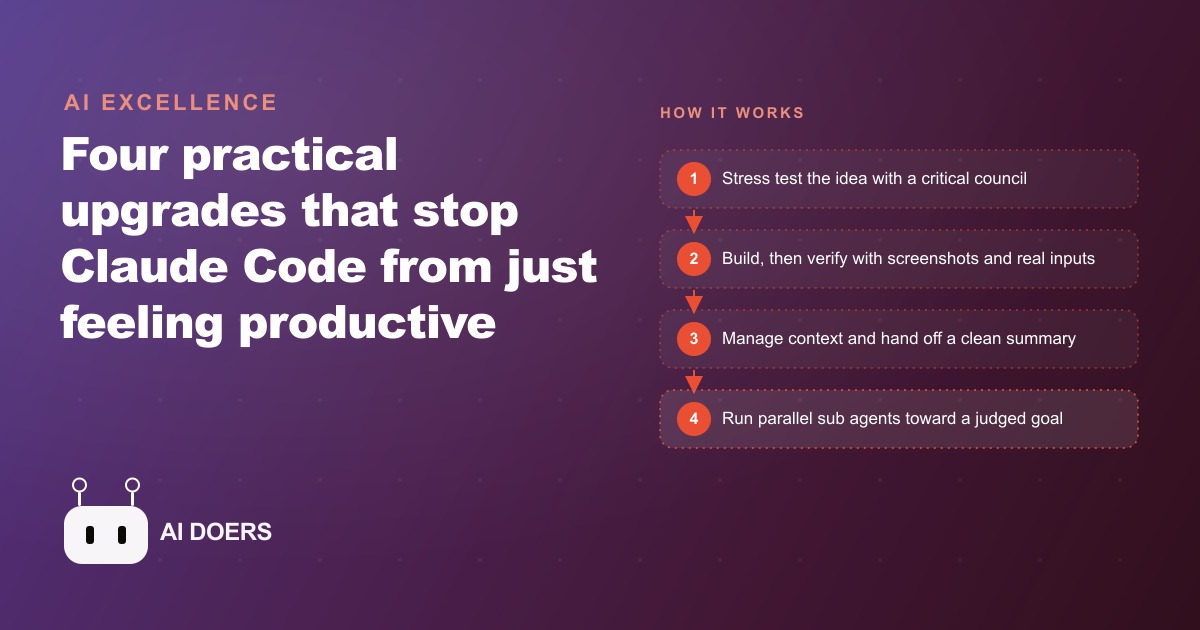
Claude Code, used the default way, feels productive but rarely moves money. Most people open the tool, type a request, take the first answer, and assume it is the best they could have gotten. It usually is not. The tool is optimized to make you feel that progress is happening. That is a very different thing from progress actually happening in your business. I am Madhuranjan Kumar, and I want to be direct about this because the gap between feeling productive and being profitable is where most people lose weeks without noticing.
Your business income rides on two things: the quality of what you produce and the speed at which you can produce it. Claude Code can push both of those levers meaningfully, but the default usage pattern pushes neither. Below are four specific upgrades that change the output in measurable ways. They work whether you are building software, running a service business, or using AI to accelerate consulting and delivery work.
The yes-man problem nobody talks about
Models are tuned to be agreeable. When you describe an idea and ask for feedback, the model finds merit in it because it was trained on interactions where agreement produces a better-rated response than disagreement. This is well documented and it is a real operational problem, not a theoretical concern.
If you describe a product idea and ask whether it sounds strong, Claude Code will confirm the concept has potential. If you outline a service package and ask whether you should launch it, it will affirm the logic sounds solid. If you show it a landing page strategy and ask whether the positioning is right, it will tell you the reasoning makes sense. None of those affirmations are useful if the underlying idea is flawed. You build the wrong thing faster because the tool agreed with you, and you do not realize it until you are looking at a finished product that nobody wants.
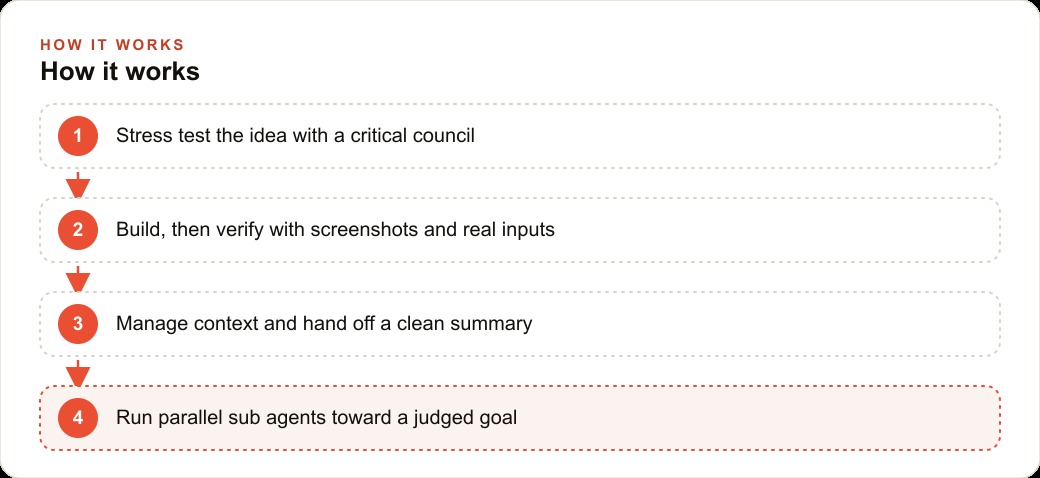
The fix is a structured critic council before any building starts. Before writing a line of code, before drafting a page, before planning an automation, you prompt a small set of adversarial personas to attack the idea from different angles at the same time. One is a contrarian looking for fatal structural flaws. One is a researcher pulling real market context about whether similar things have failed before and why. One represents the actual buyer asking whether they would pay and articulating the specific objection that would stop them. A final judge synthesizes their input and gives one verdict: green light, reshape the core offer, or stop. You also ask for the cheapest test you can run in the next 48 hours to get a real market signal before building anything expensive.
This single step changes the quality of what gets built because it removes agreement from the process before the building starts. On every project where the council reshapes the offer before work begins, the reshaped version consistently produces better results than the original would have. The cost of the step is one extra prompt before you open the code editor.
For a business running Facebook and Instagram ads to test new offers, this step catches the wrong offer before it goes into production. A landing page built on a flawed premise will not convert regardless of how well it is technically built. The critic council runs in five minutes. The wrong landing page wastes five days of build time and budget. That is not a theoretical saving. It is a real one that compounds across every project you run.
Finished is not the same as working
The model tells you something is finished when it means the code was written. Those are not the same thing. Finished means done in the model's sense of the word. Working means a real user can complete a real task without hitting a wall. The gap between those two definitions is where most AI-assisted builds break down, and it is invisible until a real user encounters it.
The fix is a verification loop that runs before anything gets reported as complete. After the model builds a feature, a page, a form, or an automation, it starts a local server, drives a real browser to the output, takes screenshots of each section, and reviews them against the spec. It does not report done until every section in the screenshot matches what was asked for. Then it goes further: it stress tests by submitting forms with malformed email addresses, inputs with extra spaces, unusually long strings, and the edge cases that real users produce without trying. Whatever breaks in that stress test gets fixed before you see the output.
This upgrade alone removes a full category of problem from your delivery workflow. The silent failures, the ones you do not discover until a client hits them, stop reaching clients because they are caught inside the build session. That is not just a quality improvement. It is a trust improvement that compounds over time. A client who never encounters a broken form or a broken flow trusts you with more work. A client who hits a broken form on the first project rarely comes back.
For any business where the website or software tools handle lead capture, the verification loop is especially important. A broken form on a landing page is not just a technical failure. It is a paid traffic loss. Every click from a Google Ads campaign that reaches a broken form is money spent with no return. The verification loop costs nothing to add and recovers that loss before it happens. Build it into every session as a non-negotiable final step, the same way a contractor walks through a finished room before calling the client to view it.
The scope creep that follows a "finished but broken" delivery is more costly than most people track. When a client or teammate reports a problem after delivery, you context-switch back into a completed project, reconstruct what was built, diagnose the problem, fix it, and re-deliver. That sequence typically costs two to four hours of work for a defect that would have taken ten minutes to catch during the original build session. At a rate of three broken deliveries per month, the rework bill runs six to twelve hours per month, which is a full working day lost to re-doing work that was already supposedly done. The verification loop closes that leak completely. The rework also signals to clients that your delivery process lacks a quality gate, which erodes confidence faster than almost any other operational failure.
The scope creep that follows a "finished but broken" delivery is more costly than most people track. When a client or teammate reports a problem after delivery, you context-switch back into a completed project, reconstruct what was built, diagnose the problem, fix it, and re-deliver. That sequence typically costs two to four hours of work for a defect that would have taken ten minutes to catch during the original build session. At a rate of three broken deliveries per month, the rework bill runs six to twelve hours per month, which is a full working day lost to re-doing work that was already supposedly done. The verification loop closes that leak completely.
The context window quietly degrades your output
Here is something most people do not notice: long sessions get worse. The model's output quality degrades well before the context window is technically full, because the relevant detail gets diluted by the volume of earlier conversation. Decisions made early in a session carry less weight later in the same session. The model starts filling gaps with guesses rather than with decisions that were already documented an hour ago. The output gets sloppier and you attribute it to the model's general limitations when it is actually a session management problem.
The fix has two parts. First, monitor your context usage actively and clear early, before the window is crowded, rather than pushing to the limit and hoping the quality holds. Second, run a session handoff before clearing: write a tight summary of every significant decision made, every key file and its current state, the exact status of the work in progress, and the precise next steps. Clear the context. Paste the handoff summary into the fresh session. The new session starts with the same knowledge the old one accumulated, without the noise of every intermediate exchange that built up to get there.
This is not a workaround for a model flaw. It is the correct way to work at scale on any long-running project. A session that runs for six hours without a handoff is working against you by the end. A series of two-hour sessions with clean handoffs produces better output across the same six hours, because each session starts sharp and stays sharp throughout its run. The total context consumed is the same. The quality of what you get from that context is substantially different.
The handoff document also becomes a project record. You can hand it to someone else, resume after a break, or use it as the briefing document for the next phase of the same project. A well-written handoff summary is worth more than any single output the session produced.
Running parallel agents is the only way to match a team
A single Claude Code session is one worker doing one task at a time. If you need a landing page, three email variations, a revised pricing page, and a consultation script, you are working through a queue. One task, in sequence, one at a time. You are the bottleneck because you are the only one moving work from one step to the next. Every piece of work waits for the piece before it to finish.
Parallel sub-agents remove the queue. You break the work into independent pieces, each with its own clean context and clear scope, and assign them to separate agents running simultaneously. Then you define a clear goal with a separate evaluator that decides when the combined output is truly complete: not complete because the worker said so, but complete because an independent check confirmed it meets the defined spec.
This is the upgrade with the largest impact on output volume because it changes the fundamental unit of work from one task at a time to multiple tasks in parallel. For a solo operator managing multiple client projects, this is the difference between running one project at a time and running three. The constraint was never the model's capability. The constraint was the sequential flow that forced you to babysit every handoff.
The evaluator step matters just as much as the parallelism. Without a defined goal and an independent judge, parallel agents produce parallel first drafts. With a clear spec and a separate check, they produce outputs that meet a defined standard before you see them.
What this looks like when the numbers change
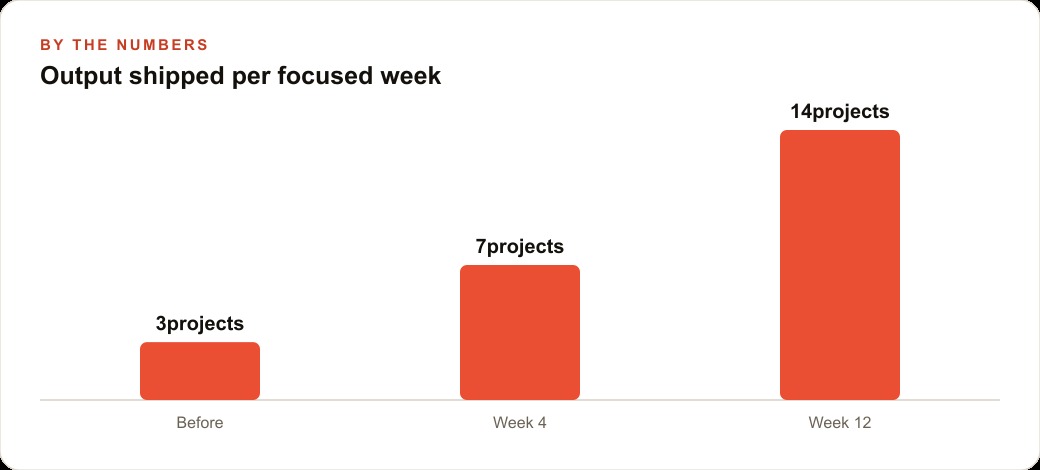
Consider a service business owner who builds and delivers client work using Claude Code as the primary production tool. Before these four upgrades, the workflow was: receive a request, describe it to the model, take the output, review it manually, find problems, correct them by hand, deliver. Three complete projects per week was a strong week. Errors that reached clients came from skipped verification and from building on ideas that were never challenged before the build started.
After the four upgrades, the same owner runs the critic council on every new project idea before building anything. In the first month, the council reshapes the approach on three separate projects. In each case the reshaped version produces better client outcomes than the original would have. The verification loop catches broken form inputs on four builds that would have reached clients. Context handoffs every two hours keep each session producing tight, consistent output rather than drifting. Parallel sub-agents allow three pieces of client work to progress simultaneously during build sessions.
Fourteen projects delivered in the same week that used to produce three. The work did not get easier. The process got better. The tool was always capable of supporting that output level. The default usage pattern was preventing it.
For any business using Claude Code to build, automate, or research, those four upgrades are not optional refinements. They are the difference between a tool that generates activity and a tool that generates revenue. The default settings feel productive. The upgraded settings are productive. The difference shows up in your output count and your client outcomes, not in how busy the sessions feel.
That is exactly what we do at AI DOERS. Book a private 30-minute call with Madhuranjan Kumar and we will map the fastest path to it for your specific business.
Book your call →
Madhuranjan Kumar
Madhuranjan Kumar brings 20 years of performance-marketing experience and has managed over $200 million in Facebook ad spend for brands across the United States and beyond. His expertise spans the full modern marketing stack: Meta, Google Ads, TikTok, email automation, CRM, and the websites that hold it together. At AI DOERS he turns that track record into lead-generation systems for businesses across every industry.