
Flux One Context Solves AI Image Consistency, Claude Gets a Voice, and Duolingo Goes AI-First: What It Means for Insurance Agencies
The two biggest limitations of AI-generated marketing content have been visual consistency and voice interaction. Both moved forward significantly this week. For insurance agencies that live on trust and relationship, the implications are direct.

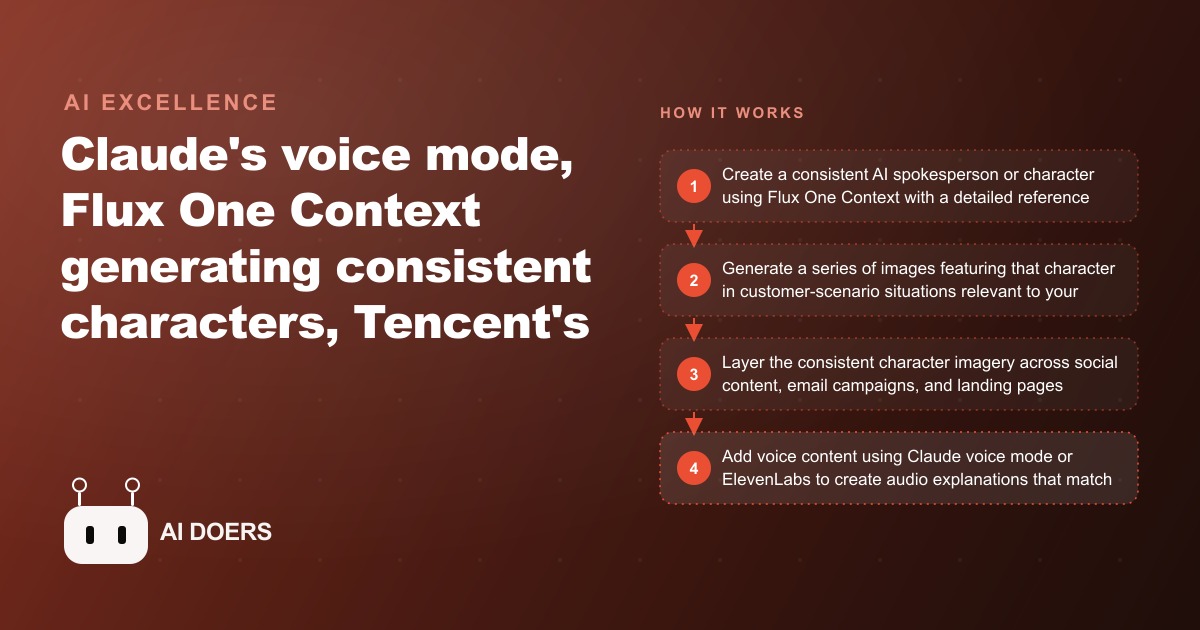
What is Flux One Context and why does character consistency matter so much?
Flux One Context is a model from Black Forest Labs that generates images with a consistent character or person appearing across multiple distinct scenes. If you generate an image of a professional woman in a business setting and then generate a second image of the same woman talking with a family at their home, then a third image of the same woman reviewing documents at a desk, all three images feature someone who looks convincingly like the same person: same face, same general appearance, consistent across scenes.
This solves one of the most limiting problems in AI image generation for marketing. A business that wants to feature a consistent spokesperson, a consistent customer archetype, or a recurring brand character across their content could not previously do this reliably with AI. Each generation produced a different-looking person. The workaround was to use stock photography, which means your 'brand character' is the same stock model that competitors also use, or to invest in a photo shoot with a real person, which costs thousands of dollars and takes weeks of lead time.
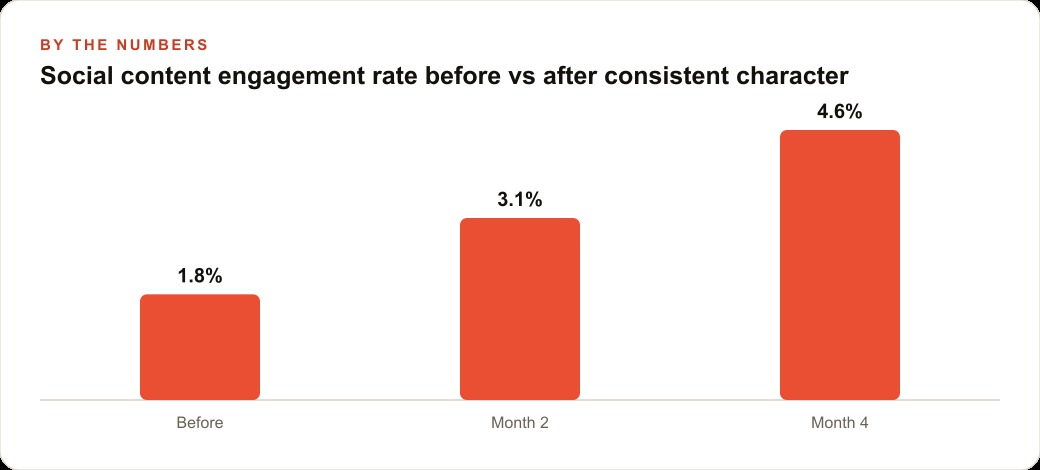
For an insurance agency, which builds its brand primarily on trust, relationships, and the feeling that the agency genuinely understands its clients' lives and risks, having a consistent visual character that appears across multiple client-situation scenarios is a meaningful content capability. The character does not need to be identified as AI-generated to any audience unless required by platform policy. It is simply a consistent visual representation of the 'customer who benefits from working with this agency.'
What does it mean for Claude to have a voice mode?
Anthropics' Claude voice mode enables spoken conversations with the Claude AI model. You speak, the model listens, and it responds in a natural voice with appropriate pacing and turn-taking. This is the same category of feature that OpenAI introduced with ChatGPT's Advanced Voice Mode, which became widely used for hands-free AI assistance and conversational brainstorming.
For insurance agents, voice mode for AI has two relevant use cases. The first is internal: using voice conversation with Claude while driving between client meetings to review a policy summary, think through an objection response, or draft a client email that gets transcribed while you talk. Hands-free AI assistance during the significant amount of time that insurance agents spend in their cars is a meaningful productivity surface.
The second use case is client communication preparation. Before a client call about a complex life insurance case or a commercial policy renewal, having a voiced conversation with Claude where you talk through the key points, potential objections, and the client's specific situation produces a better mental model than re-reading notes. The conversational format mimics the actual meeting better than text review.
Voice mode does not change what Claude can know or reason about. It changes the interaction modality, which is meaningful for specific use cases but does not expand the fundamental capability.
How does Tencent's lip sync tool fit into a video content workflow?
Tencent's lip sync tool synchronizes facial movement to audio in video, including AI-generated video. If you have a video of an AI avatar or a real person speaking, and you want to replace the audio with a different track, perhaps a different language version or a cleaner recording, the lip sync tool adjusts the mouth movement to match the new audio.
For an insurance agency producing educational video content, this has a specific useful application. You produce one high-quality video of your AI spokesperson or your own on-camera presence explaining a policy concept. You then generate language-adapted versions using translated audio and Tencent's lip sync tool, producing Spanish, Vietnamese, or Mandarin versions of the same video without re-filming. The visual content is identical; only the audio and the synchronized lip movement changes.
This capability is particularly valuable in insurance markets with significant non-English-speaking populations, where educational content in a client's first language meaningfully improves comprehension of coverage options and reduces errors in policy selection. Most small insurance agencies have never been able to produce multilingual educational video because the cost of re-filming or voice-over dubbing was prohibitive. AI tools change that cost structure dramatically.
What is the Duolingo AI-first move and why did it generate controversy?
Duolingo announced that it would replace most of its human contract workforce for translation and content creation with AI tools, framing the decision as part of its shift to an 'AI-first' operating model. The announcement generated significant criticism because of the speed and scale of the workforce reduction and because Duolingo's business is built on language learning, an area where some argued that human expertise should remain central.
The controversy is real and the ethical dimensions of large-scale workforce displacement are worth taking seriously. But the business lesson for small agencies is distinct from the workforce ethics debate. Duolingo's move is evidence that one of the world's most used language learning platforms has concluded that AI tools can handle a substantial portion of its content creation and translation work at sufficient quality to replace contract labor.
For an insurance agency, the relevant inference is about which tasks in your own operation are approaching the threshold where AI tools can handle them at the quality level you need, and which tasks require human expertise that AI cannot replicate. The answer will be different for every business, but the Duolingo example suggests the threshold is moving faster than most business owners expect.
Which insurance agency activities benefit most from these new tools?
Insurance agencies have a specific content challenge: they need to produce a high volume of educational content because their products are complex, their customers are confused by the options, and trust is built through demonstrated expertise rather than brand familiarity. Most small agencies struggle to produce educational content consistently because they lack the time and the creative production capability.
The combination of Flux One Context for visual consistency, Claude voice mode for audio content creation, and lip sync tools for multilingual adaptation addresses this content challenge more comprehensively than any previous combination of available tools.
Specifically, the insurance agency content types that benefit most are: policy comparison explainers featuring a consistent visual advisor figure in different client situations, video explanations of coverage gaps that are most commonly misunderstood, and scenario-specific guides that show what happens in different claim situations. These content types require consistency across multiple pieces, educational clarity over visual spectacle, and adaptability to different client demographics.
How would a mid-size insurance agency build this content system?
Here is a practical workflow for an independent insurance agency with eight agents, primarily personal lines with some small commercial. The agency currently produces one or two social media posts per week, mostly promotional, and has no consistent visual brand character. Monthly content production cost: approximately $800 for a part-time social media contractor.
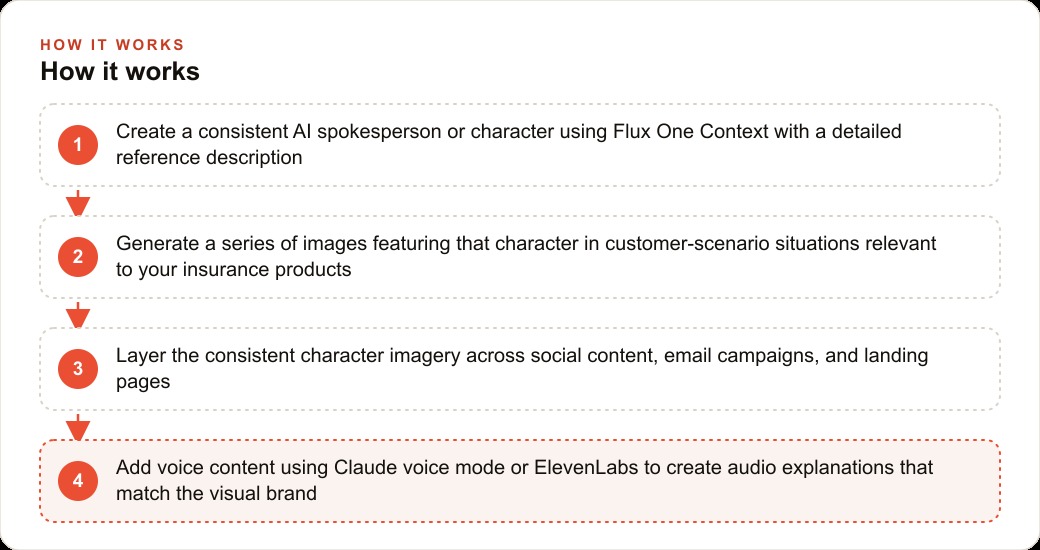
Week one: use Flux One Context to create a consistent AI visual advisor character. The prompting process involves describing the character in detail: a professional woman in her early 40s, warm but professional presentation, in various settings relevant to insurance clients. Generate twenty scenes featuring this character: at a home discussing homeowners coverage, reviewing auto policies, in a meeting with a small business owner, looking at paperwork with an elderly couple. Select the twelve that are highest quality and most visually distinct for a content calendar.
Week two: pair each image with a caption written by Claude. The caption prompt template: 'Write a 150-word educational social media caption for an insurance agency. The image shows our advisor with a client in this situation: [describe scene]. The educational point is: [policy concept]. Tone: warm, clear, genuinely helpful. No jargon.'
Week three: use Claude voice mode to dictate a short audio explanation for two of the educational topics, then edit the transcript into a written blog post or email newsletter piece. The voice mode conversation produces a natural, conversational tone that reads better than typed-to-be-read content.
Month two: test creating a two-minute YouTube Shorts video using an AI avatar for one of the twelve content topics. Use the caption content as the script, generate the avatar video in HeyGen, and post it on YouTube Shorts and Facebook Reels.
By month three, the agency has a consistent visual character appearing across all social content, twelve pieces of original educational content per month, two short-form videos, and two email newsletter pieces. Monthly tool cost: approximately $80 for HeyGen plus the Flux One Context credits, roughly $150 total. The savings versus the $800 contractor cost is $650 per month, and the content volume is substantially higher.
What are the pitfalls to avoid with consistent AI characters in insurance marketing?
The first pitfall is overusing the AI character to the point where it becomes the face of the agency at the expense of the actual agents' visibility. Trust in insurance is personal and people need to know they are working with a human who can advocate for them. The AI character should establish the educational brand and attract prospects, but the actual agents should appear in content regularly, including video, to establish personal relationships before clients call.
The second pitfall is assuming consistency at the image generation stage means consistency at the print resolution stage. Test any images that will be printed for brochures or signage at actual print resolution before committing to a production run. AI image quality at print resolution sometimes reveals artifacts that are not visible in digital preview.
The third pitfall is using AI visual characters in testimonial-style formats that could be construed as implying real client experiences. If the AI character appears in a scenario that resembles a testimonial, with a statement like 'I felt so much safer knowing my coverage was right,' and the character is not disclosed as AI, this creates a false testimonial risk. Reserve the AI character for educational and explanatory content where the relationship to a real person is clearly illustrative rather than testimonial.
What should an insurance agency do first this week?
Test Flux One Context by generating six images of a professional character in customer-scenario settings. You do not need a paid subscription to start: check the current access model on Black Forest Labs' website, as the model may be accessible through free generation platforms that have integrated it.
Write a caption for the best image using Claude's free tier. Review the image and caption together as if you were seeing it on a competitor's social feed. If you would stop scrolling for it, it is worth building out the full content system.
If you want help designing the complete visual and voice content strategy for your agency, integrating consistent AI imagery with your actual agents' personal brand presence, that is a focused project worth working through.
That is exactly what we do at AI DOERS. Book a private 30-minute call with Madhuranjan Kumar and we will map the fastest path to it for your specific business.
Book your call →
Madhuranjan Kumar
Madhuranjan Kumar brings 20 years of performance-marketing experience and has managed over $200 million in Facebook ad spend for brands across the United States and beyond. His expertise spans the full modern marketing stack: Meta, Google Ads, TikTok, email automation, CRM, and the websites that hold it together. At AI DOERS he turns that track record into lead-generation systems for businesses across every industry.