
5 ChatGPT Updates You Probably Missed That Are Now Saving Me Hours Every Week
ChatGPT releases updates frequently, and the biggest features grab the headlines. But some of the most useful updates have gone almost unnoticed. These five changes, including deep research reading your own files, new connector apps, and improved note-integration, are worth knowing about.

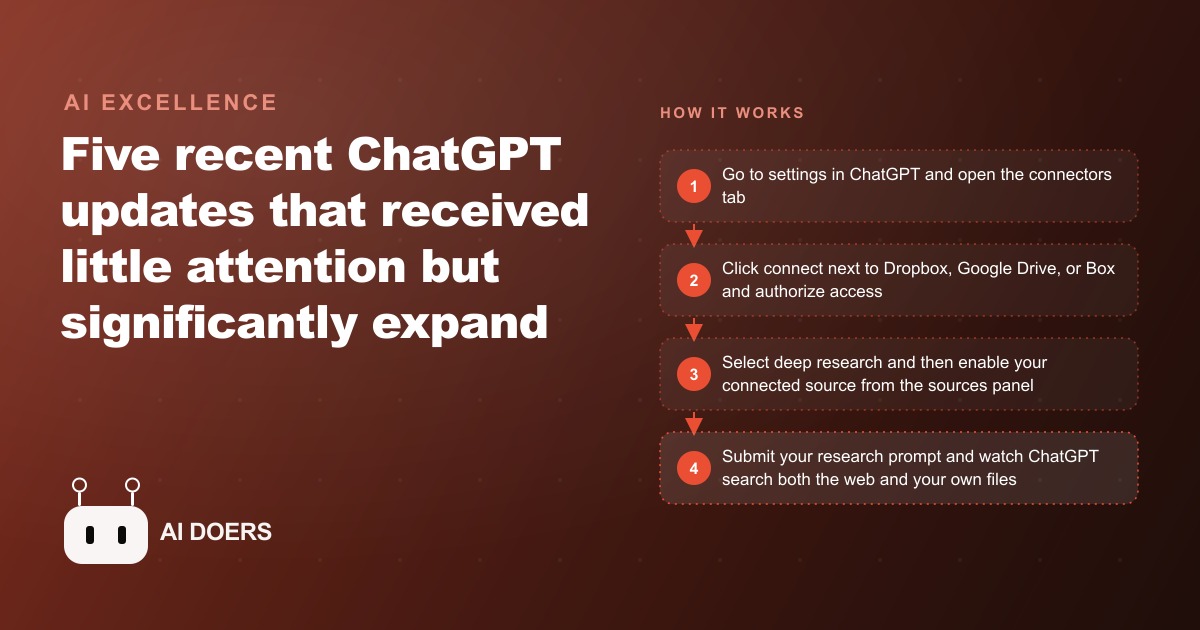
If you have been saving detailed notes to a cloud folder for years, the ChatGPT connector update just made that habit worth more than it was last week, and most people will not notice the difference until they try the same research prompt both ways.
The connector update is officially described as a feature: ChatGPT can now access files in Dropbox, Google Drive, and Box during deep research sessions. That description is technically accurate and completely undersells what it means. The connector update is not a feature. It is a knowledge architecture shift. It changes the relationship between the notes and documents you have already created and the AI systems you use to do research. Your cloud folder is no longer just storage. It is a queryable knowledge base that an AI can search in real time while synthesizing a research report on your behalf.
Madhuranjan Kumar examines the five dimensions of this shift that most people have not yet connected.
What deep research with connected files actually does that web-only research cannot
Deep research in ChatGPT, before the connector update, was a powerful but impersonal tool. You submitted a research question, the system browsed dozens of web pages, synthesized the findings into a structured report, and cited its sources. The quality of the report was high for questions with good public web coverage. But the report was built entirely from publicly available information. It had no knowledge of your specific situation, your organization's existing work on the topic, or the relevant institutional knowledge you had accumulated over years.
Deep research with connected files adds a second layer to the same process. The system still browses the web for external information. It also searches your connected cloud storage for files that contain relevant information about the research topic. The resulting report synthesizes both layers, and it cites its sources across both so you can see exactly which findings came from external sources and which came from your own files.
The practical difference is best understood through a concrete comparison. A web-only research session on evaluating a new supplier category returns a report built from industry publications, analyst pieces, and general best-practice documentation. That report tells you what the industry knows about the topic. It does not know what your organization specifically needs, what your past experience with similar suppliers has revealed, or what criteria your team developed from real projects.
A connected research session on the same topic returns a report that incorporates the external industry knowledge and pulls in your own supplier evaluation documents from past projects, your team's internal notes on what went wrong with previous supplier decisions, and any criteria documents your operations team saved about what a qualified supplier in this category looks like. The resulting report is research on your actual situation rather than research on the general topic.
That difference, between a general report and a specific one, is the difference between information you need to translate into your context and a synthesis you can act on directly. The translation step is where much of the research value gets lost in practice. When a researcher reads a general report and then applies their own knowledge to adjust for their specific situation, the quality of that mental translation depends on how well they can access and integrate their own institutional knowledge. Connected deep research does that integration inside the research process.
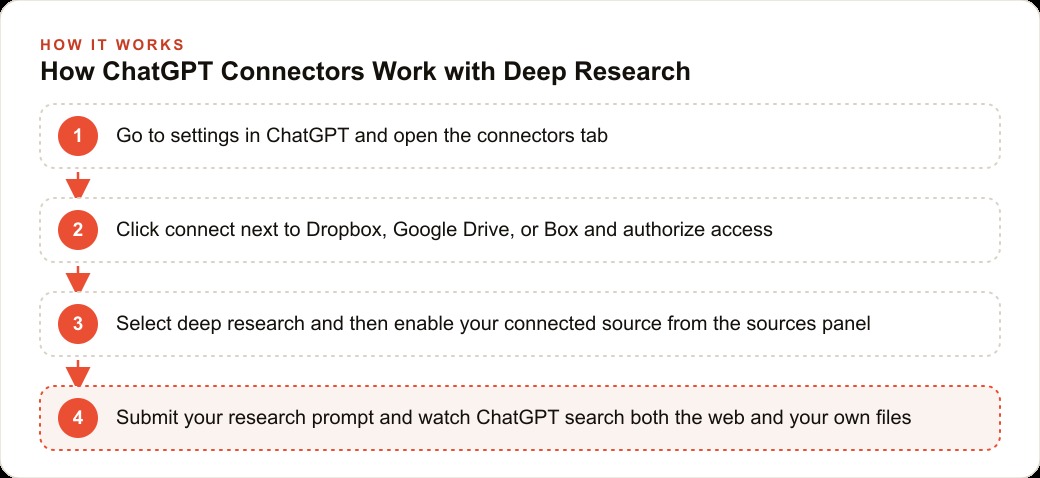
Why the quality of your cloud folder organization now affects the quality of your AI research output
The connector update made cloud folder organization matter in a way it did not before. Previously, an organized cloud folder was a convenience for the humans who used it. Files that were well-named and logically grouped were easier to find manually. Files that were poorly named and disorganized were harder to find. The quality of the organization affected the efficiency of the people searching it.
Now the quality of the organization also affects the quality of AI research that searches it. A cloud folder with descriptively named files in logically grouped subfolders is a high-quality input source for an AI search. The AI can find relevant files quickly, read their content in context with related documents, and incorporate them accurately into a research report. A cloud folder full of files named "draft-v3-final-FINAL.docx" and "meeting notes copy.pdf" and "untitled document (12)" is a low-quality input source. The AI can search it, but it will find fewer relevant files, miss connections between related documents, and produce a report that reflects only the portion of your organizational knowledge that happened to be filed in a way the search could interpret.
This creates a new return on investment for the work of organizing and naming files well. The return previously was personal efficiency: you could find files faster. The additional return now is AI research quality: every well-named file in a well-organized folder is a direct contribution to the quality of every research session that searches that folder in the future.
The implication is that the cleanup work many people have postponed, the folder that everyone has planned to organize when there is time, has a new, concrete, measurable value attached to it. An afternoon spent renaming files with descriptive titles and moving them into logically labeled subfolders is now worth more than it was before the connector update. The investment pays off not just once but in every future research session that benefits from finding the right file instead of searching past disorganized storage.
A simple naming convention is sufficient to capture most of the benefit: date, topic, and a brief description. A file named "2026-03-15 supplier-evaluation-criteria packaging-category" is findable by the AI and findable manually. That format takes a few seconds longer to type than "new doc" and pays for the extra time every time the file is relevant to a future search.
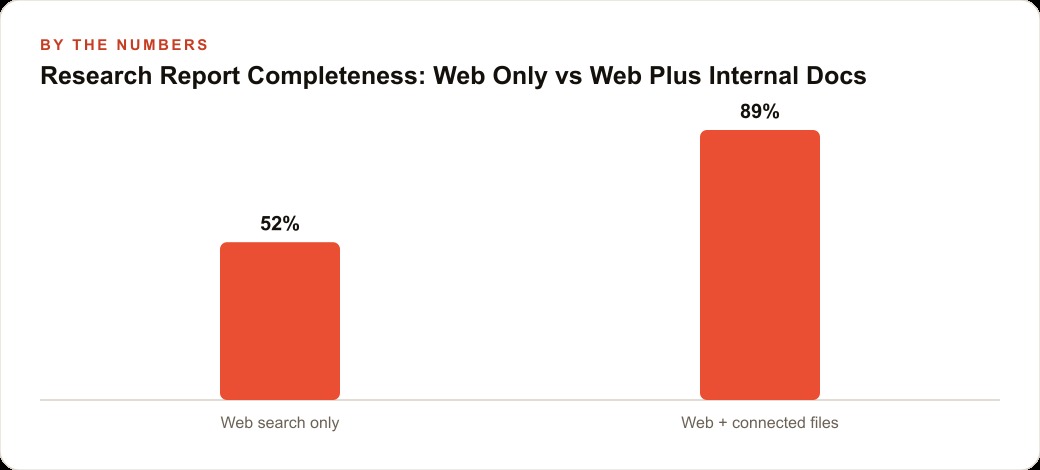
The compounding dynamic: why next month's research session will be better than this month's without any new configuration
The compounding effect is the dimension of the connector update that is least obvious and most valuable over time.
Each time you conduct a research session with connected files, and each time you save a new note, document, or reference to your connected cloud storage, you are adding to the knowledge base that future research sessions can draw on. You do not need to do any additional configuration. The files are just there, in the folder, when the next research session searches it.
This month's research session on your industry's regulatory changes produces a report that references three of your internal documents. If you save that report to your cloud storage, next month's research session on a related topic will find that report, along with the three documents it referenced, and incorporate all of them into the new report. The knowledge compounds without any active effort beyond the habit of saving finished research to your cloud folder.
Over six months, the research quality available through connected deep research is materially better than it was at the start, even if nothing has changed in the configuration, no new connectors have been added, and no new settings have been adjusted. The only requirement is the discipline to save documents to the connected storage rather than leaving them in local downloads folders or email attachments that the connector cannot access.
This is a meaningful departure from how most productivity tools work. Most tools are as good as they were the day you set them up, or they require active maintenance to improve over time. The connector-enhanced research system improves passively as your document collection grows, which means the value of setting it up now is higher than the value of setting it up in six months, because six months of consistent saving produces a richer knowledge base for every research session that follows.
The practical framing for a business owner is this: every note you save today is a direct investment in the quality of research you will be able to do in six months. Notes that go into a connected cloud folder compound. Notes that sit in local files, email drafts, or messaging apps do not.
A chiropractic clinic that ran the same protocol research with and without connected files and measured the difference
The most direct way to understand what the connector update changes is through a specific comparison between the same research task run with and without connected files.
A two-practitioner chiropractic clinic with 180 active patients maintains their treatment protocols, clinical research references, and provider notes in a shared Google Drive. The owner wanted to research the current evidence on soft tissue manipulation approaches for screen-related cervical strain, a condition appearing in an increasing share of their patient base.
The research prompt was run twice with the same wording. The first run used deep research with no connected sources: standard web-only research. The second run used deep research with the Google Drive connector active.
The web-only report returned a solid synthesis of published research from chiropractic association guidelines, general physiotherapy sources, and ergonomics literature. It took about 22 minutes to complete and produced a well-structured summary of the external evidence base. The clinic owner estimated they would have spent roughly three hours reaching a comparable synthesis manually by searching across sources individually.
The connected research report took about 28 minutes and produced something qualitatively different. It found the clinic's existing cervical protocol document in Google Drive and incorporated it directly into the analysis, specifically noting where the current protocol aligned with the latest external evidence and where it differed from updated recommendations. It also found a research summary one of the practitioners had saved 18 months earlier containing notes from a professional development course on cervical soft tissue work. Those notes had not been actively referenced since they were saved. They were directly relevant. The connected report surfaced them and integrated them into the synthesis.
The output from the connected run required about 15 minutes of the owner's review time instead of the 45 minutes the web-only report required. The difference was not in reading speed. It was that the connected report had already done the step of comparing external findings to internal practices, which was the time-consuming step the web-only report left to the reader.
Across four similar research cycles over the following six weeks, the clinic's average research session time fell from roughly two and a half hours to under 45 minutes. The quality of the resulting protocol updates was higher because the connected reports were surfacing internal documents that had been forgotten but remained relevant. The return on setting up the connector, measured in recovered clinical owner time, covered the cost of the ChatGPT Plus subscription within the first month.
The note-saving habit that makes every connector more valuable six months from now than it is today
The single most valuable behavioral change that follows from understanding the connector update is starting or improving a consistent note-saving habit in your connected cloud storage.
The logic is direct. The connector can only search files that exist in your connected storage. Every meeting summary, every client conversation note, every piece of industry research you read and found valuable, every internal policy document, every project retrospective that went into a local notes app or stayed in an email thread or got saved to a desktop folder that is not connected is invisible to future research sessions. Those notes have value only to you and only when you actively remember and retrieve them.
The same notes, saved consistently to a connected cloud storage location with descriptive file names, become part of a searchable knowledge base that an AI can query anytime you are doing relevant research. The value of the note does not expire after the project it was written for ends. It continues to contribute to the research quality of every future project that touches the same subject matter.
The practical habit change is small. Identify one cloud storage location as your primary note destination. Set Dropbox, Google Drive, or Box as the default save location for notes from meetings, research sessions, and professional reading. Establish a simple naming convention and use it consistently. The naming convention does not need to be elaborate. Date, topic, and brief description is sufficient to make files searchable by both humans and AI.
The return on this habit compounds over time in a specific way. Month one of consistent saving produces a small knowledge base with limited research value beyond the obvious recent files. Month six produces a knowledge base that covers every topic the business has touched in the intervening period. Month twelve produces an institutional memory that is deeper and more comprehensive than what any individual on the team could reconstruct from their own recollection.
The developer-built connectors available through the connector settings extend this further. Beyond Dropbox, Google Drive, and Box, developers can build custom connectors that link ChatGPT to other enterprise systems. For businesses that maintain important information in specialized tools, those custom connectors bring the same compounding dynamic to additional knowledge sources. Each new connected source is another layer of institutional knowledge available to future research sessions without any additional retrieval effort.
The connector update does not require a new tool, a new platform, or a significant new investment. It requires a new relationship with a tool most people already use: their cloud storage. The businesses that start treating their cloud folders as active knowledge assets rather than passive storage systems will have a meaningfully better AI research capability in six months than the businesses that continue to save files wherever is most convenient in the moment. The gap between those two groups will be visible in the quality and specificity of every research report they produce, and it will widen with every passing month that the note-saving habit compounds.
That is exactly what we do at AI DOERS. Book a private 30-minute call with Madhuranjan Kumar and we will map the fastest path to it for your specific business.
Book your call →
Madhuranjan Kumar
Madhuranjan Kumar brings 20 years of performance-marketing experience and has managed over $200 million in Facebook ad spend for brands across the United States and beyond. His expertise spans the full modern marketing stack: Meta, Google Ads, TikTok, email automation, CRM, and the websites that hold it together. At AI DOERS he turns that track record into lead-generation systems for businesses across every industry.