
How to Fine-Tune Your Own AI Model, Step by Step
Fine-tuning shapes a small open model around your own data so it outperforms bigger models at one task. Here is how it works, and how I would use it to give a business a real edge.
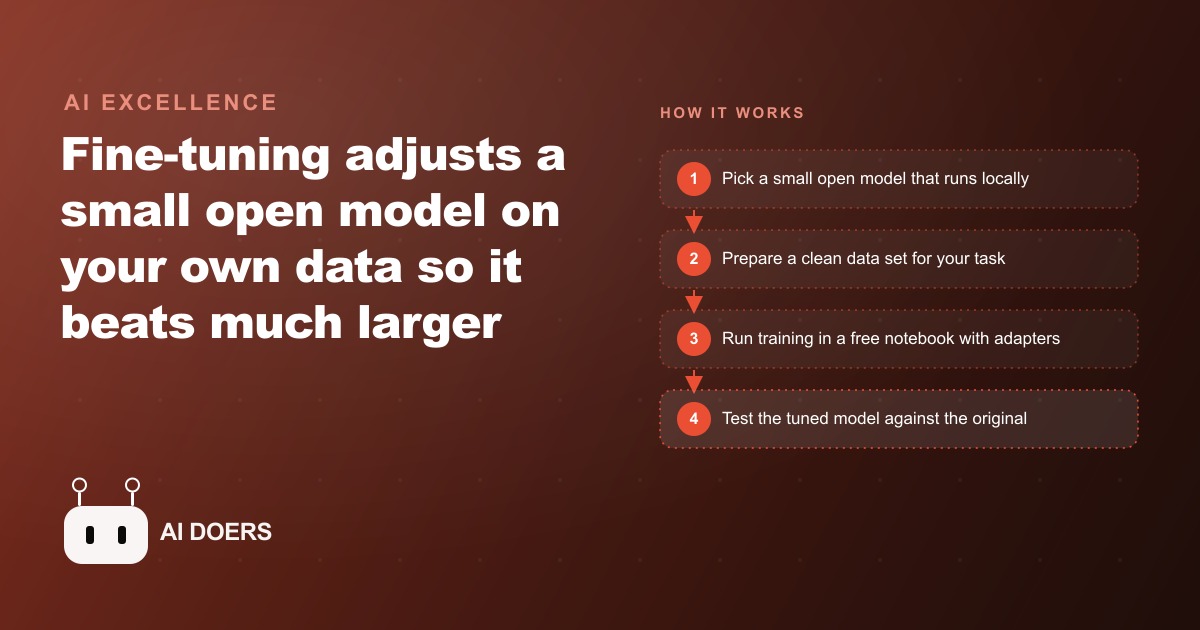
A small model fine-tuned on your own data can outperform a model ten times its size on the specific task you care about, and it can do it on hardware that fits under a desk. I am Madhuranjan Kumar, and this matters for business owners not as a technical curiosity but as a practical answer to a question that keeps coming up: why does the general AI assistant keep almost getting it right but never quite getting it right? The answer is that it is trying to be good at everything. Fine-tuning makes it excellent at one thing.
What fine-tuning actually changes inside a model, and why that matters
A base model is trained on an enormous and varied corpus of text. It learns grammar, reasoning patterns, factual associations, and writing styles from billions of examples. The result is a model that is broadly capable: it can write a poem, explain a tax concept, debug code, and draft a business email. That breadth is its strength for general use. It is also a limitation for specialized work.
Fine-tuning adjusts the model's weights, the numerical parameters that encode what it has learned, using a focused dataset of examples specific to one task. The model's general knowledge is preserved. What changes is the priority it assigns to patterns from the fine-tuning data when generating output for that task. After training on hundreds of examples of the firm's contract language, the model does not forget how to write prose. It learns that when asked to draft a service agreement, the patterns to prioritize are the ones that match the firm's established style, clause structure, and preferred wording.
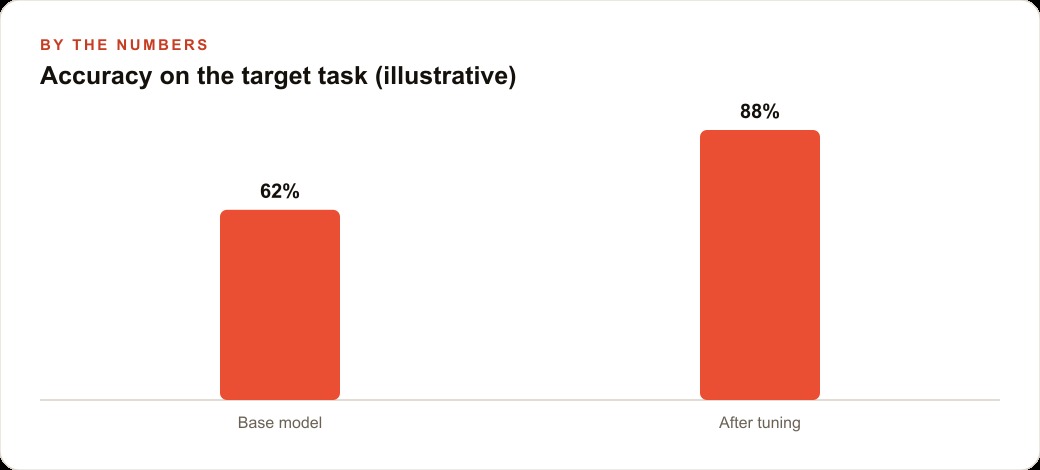
The practical consequence is that a small fine-tuned model often produces better output for its target task than a much larger general model, while being faster and cheaper to run. The larger model has more general capability. The smaller tuned model has more relevant capability for the specific job. For a business doing the same category of specialized work repeatedly, that trade is almost always the right one.
The dataset problem: where almost every fine-tuning attempt actually stalls
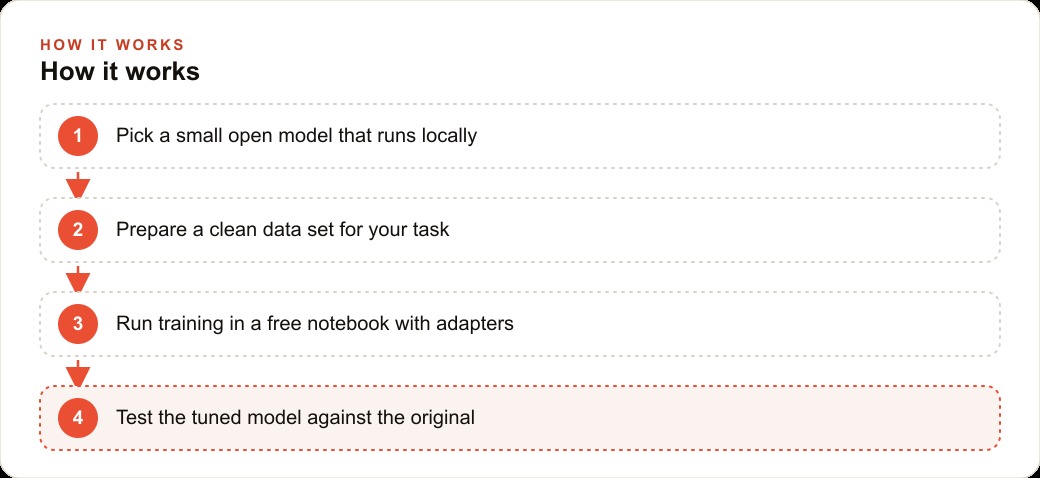
The training code for fine-tuning a small model is available, the compute is available for free in a hosted notebook, and the process of running the training is well documented. None of those are where people get stuck. The dataset is where almost every fine-tuning attempt stalls.
A fine-tuning dataset is a collection of examples, each formatted as an input paired with the correct output. For a model being trained to draft contract clauses in the firm's style, each example might be a clause type paired with a well-drafted example of that clause. For a model being trained to categorize customer support tickets, each example is a ticket text paired with the correct category label. The quality and consistency of these examples is what determines whether the trained model actually improves.
The most common dataset problems are not obvious. The examples are formatted correctly but some of them reflect inconsistent human judgment, which the model learns and reproduces as inconsistency. The dataset has enough examples of common cases but too few of the edge cases that matter most. The format used in the dataset does not match what the model expects, which causes training to appear to succeed but produces no actual improvement. Running a short training pass and checking the output against the base model before committing to a full dataset build is the best way to catch format problems early.
For a law firm building a fine-tuning dataset, the raw material is existing approved documents. The work is extracting the right pairs from them: clause type on one side, the firm's preferred language for that clause on the other. That curation takes time and judgment, and shortcuts in it show up directly in the quality of the trained model.
For businesses thinking about how this connects to client communication and follow-up workflows, the same discipline that goes into building a fine-tuning dataset applies to web CRM data quality. The model learns from the examples you give it. The CRM retains the history you keep in it. Both are only as useful as the data they are built on.
Adapters: why you do not need to retrain the whole model to get results
Retraining a full language model from scratch requires resources that only large organizations have: thousands of GPUs, enormous datasets, and months of compute time. Fine-tuning without adapters is also expensive, because updating all of a model's parameters on new examples requires significant memory and processing time, even for a small model.
Adapter-based fine-tuning, associated with techniques like LoRA, takes a different approach. Instead of updating all of the model's parameters, it introduces a small set of additional parameters trained specifically on the fine-tuning data, and the original model weights are left largely unchanged. The adapter is a thin layer that modifies the model's behavior on the target task while the underlying model remains intact.
The practical effect is that fine-tuning with adapters is fast and cheap. A small model can be tuned on a focused dataset in minutes to a few hours using a free GPU in a hosted notebook. The resulting adapter file is small enough to store and distribute easily. If the fine-tuning does not produce the desired result, the original model is unchanged and the process can be repeated with a revised dataset. The low cost of iteration is what makes it practical for a business to experiment with fine-tuning rather than committing to a large upfront investment.
The free GPU in a hosted notebook is a real option, not a theoretical one. Several platforms provide notebook environments with GPU access at no cost for typical fine-tuning workloads. The compute that would have cost thousands of dollars in cloud fees a few years ago is now available for a session that costs nothing.
A tuned model as a competitive moat that the next GPT release cannot erase
Most AI products built on top of general models are fragile in a specific way. They work because the general model is capable enough to handle the task with a well-crafted prompt. When a new model release is better at that task, the product improves automatically. When a competitor uses the same general model with a similar prompt, they can produce very similar output. The competitive advantage is thin because the underlying capability is available to everyone.
A fine-tuned model is different in a way that matters for business. The model has been trained on your specific data: your approved language, your categorical judgments, your task-specific examples. A competitor who wants to replicate that model needs to collect the same data, curate it with the same care, and run the same training. They cannot simply use the same general model with a similar prompt and get comparable results. The gap between what the tuned model produces and what a general model produces on the same task is a real advantage that cannot be closed without the underlying data.
This is what gives a fine-tuned model its character as a moat. It is not impenetrable. A sufficiently motivated competitor with access to similar data can close the gap over time. But the advantage is genuine, compounding as more examples are added to the training data, and not directly threatened by general model improvements. A new general model release may be better overall, but the fine-tuned model on your specific task, trained on your specific data, still knows your task better.
For businesses that are building their client acquisition pipeline alongside internal tools, this moat logic applies to how they approach Meta ads creative and targeting work as well. Custom data, carefully curated and applied, outperforms generic approaches over time in both contexts.
Local inference and the privacy case for running a small specialized model
One of the reasons fine-tuning a small model is particularly compelling for professional services is privacy. When a lawyer, an accountant, or a medical practice uses a general-purpose AI assistant through a cloud API, every input sent to the model passes through a third party's infrastructure. The service agreement may restrict how the provider uses that data, but the data leaves the organization's control in the moment it is sent.
A small fine-tuned model running locally means the inference happens on hardware the organization owns. The client matter being reviewed, the contract being drafted, the patient record being summarized: none of that text leaves the building. The model runs on the local machine, the output is generated locally, and the only data that ever leaves is whatever the user chooses to send somewhere explicitly.
This is particularly relevant for firms subject to professional confidentiality requirements. A law firm cannot assume that a general AI assistant's terms of service satisfy the confidentiality obligations it owes its clients. A locally running model sidesteps that concern entirely because the question of what the AI provider does with the data never arises.
The capability trade-off is real. A small local model does not match a large cloud model's general knowledge or reasoning breadth. But for the specific task it was trained on, a well-tuned small model often performs comparably to or better than the large general model, and for many professional services tasks the relevant knowledge is in the firm's own documents rather than in general world knowledge.
The before-and-after comparison that tells you whether the training worked
Fine-tuning produces a model. The question of whether that model is actually better than the base model on the target task requires a comparison, and that comparison is the step most people skip because they assume the training worked if it completed without errors. Training can complete without errors and produce a model that is no better, or even worse, on the task of interest.
The comparison process is simple. Take a set of test inputs that were not included in the training data: inputs that represent the real task the model is supposed to handle. Run each one through the base model and through the fine-tuned model. Compare the outputs side by side, evaluating whether the fine-tuned model's outputs are consistently closer to what you actually want.
For a law firm that trained the model on contract drafting, the test inputs are clause types the model has never seen in training. The base model produces a generic clause. The fine-tuned model produces a clause that sounds like the firm's standard language. If the fine-tuned model's clause is consistently indistinguishable from what a senior associate would write, the training worked. If the fine-tuned model's clause is generic with occasional phrases that resemble the firm's style, more training data is needed.
This comparison also reveals overfitting: the failure mode where the model has memorized the training examples instead of learning the underlying patterns. An overfitted model produces excellent output on inputs that closely resemble the training data and poor output on inputs that differ from it. Catching overfitting requires testing on inputs that are genuinely different from the training set, which is why the separation of training and test data is important from the start.
The law firm: fine-tuning a small model on contracts and approved language
The firm had a specific problem that a general AI assistant did not solve reliably enough to trust. Routine contract drafting, service agreements, engagement letters, standard limitation-of-liability clauses, took a senior associate three to five hours per document because every first draft from a general assistant needed substantial revision to match the firm's established language and risk posture. The associates knew what the firm's standard language was. The general model did not.
The starting point was the dataset. The firm had years of approved contracts in its document management system. The curation work extracted pairs: clause type as input, the firm's preferred language for that clause as output. Focusing on the twenty clause types that appeared most frequently across the firm's work produced roughly four hundred examples after removing duplicates and examples reflecting outdated or superseded language. Curation took one associate two days.
The training ran in a free hosted notebook on a small open model using adapter-based fine-tuning. The total training time was under two hours. The test comparison ran the fine-tuned model and the base model against thirty clause types that had been held back from training. On twenty-four of the thirty, the fine-tuned model's output was preferred by the senior associate reviewing it, with the margin of improvement largest on the clause types that were most heavily represented in the training data.
Illustratively, if fine-tuning brings the average first-draft time for a routine service agreement from three hours to under one, and the firm handles forty such agreements per quarter, the time recovered across a year is substantial at any billing rate. The model runs locally on the firm's own hardware, which means client matter content never leaves the firm's infrastructure. The associate's judgment remains in the process: every clause is reviewed before it goes into a document, and the model's output is a starting point, not a finished product.
The moat aspect is equally important. The model was trained on the firm's own language and risk preferences. A competing firm using the same base model with a similar prompt produces generic output. Closing the gap between the two would require the competing firm to build its own dataset from its own approved language, which is the same work the first firm has already done. The advantage is real and durable in a way that a prompt engineering trick never is.
For firms building their client development alongside internal tools, the discipline of good data that makes fine-tuning work applies directly to how SEO content compounds over time: specific, well-curated inputs produce better results than generic ones in both contexts, and the investment in quality compounds rather than depreciating.
That is exactly what we do at AI DOERS. Book a private 30-minute call with Madhuranjan Kumar and we will map the fastest path to it for your specific business.
Book your call →
Madhuranjan Kumar
Madhuranjan Kumar brings 20 years of performance-marketing experience and has managed over $200 million in Facebook ad spend for brands across the United States and beyond. His expertise spans the full modern marketing stack: Meta, Google Ads, TikTok, email automation, CRM, and the websites that hold it together. At AI DOERS he turns that track record into lead-generation systems for businesses across every industry.