
Explorable AI Worlds From a Single Photo: Genie 3 and Your Business
Google's Genie 3 turns one image and a short prompt into a world you can actually walk through. Here is what this leap in AI world models could mean for businesses that sell an experience.

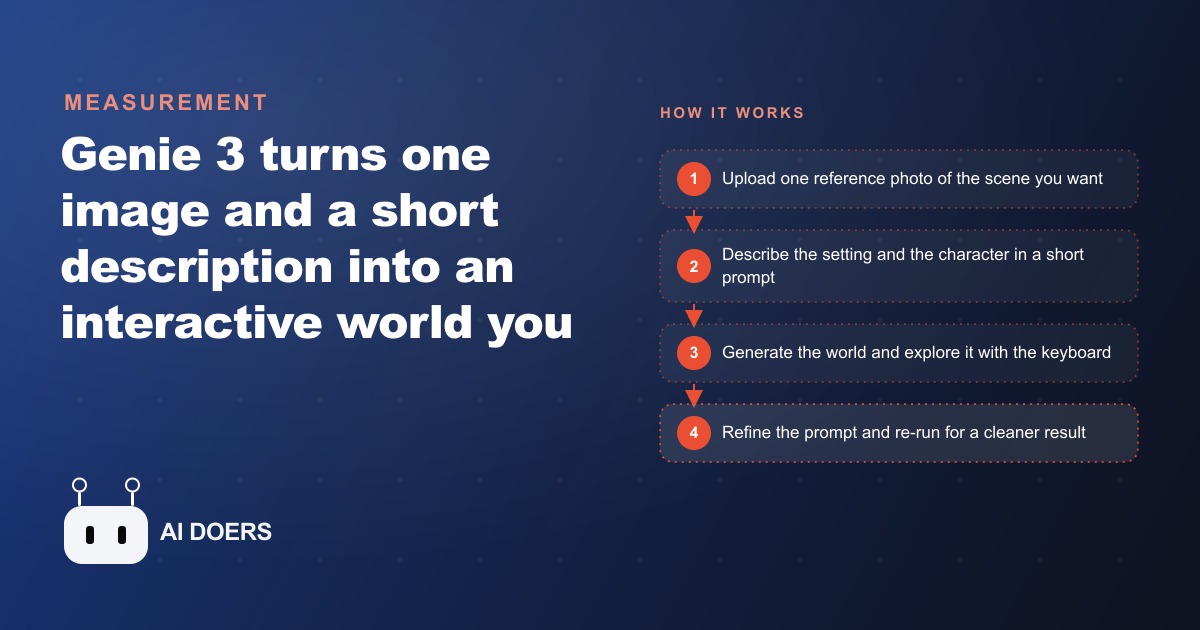
Google DeepMind released Genie 3 this month, and nearly every headline positioned it as a tool for generating video games. That framing captures the demo and misses the opportunity entirely. The businesses with the most to gain from a model that turns one photo and a short prompt into a walkable interactive world are not game studios. They are experience-based sellers: real estate agents, hotel operators, venue managers, retailers with showrooms, event spaces, photography studios, and hospitality businesses of every kind. I am Madhuranjan Kumar, and I want to explain why the gaming frame is the wrong frame, and what the right one looks like for businesses that sell an experience before they sell a product.
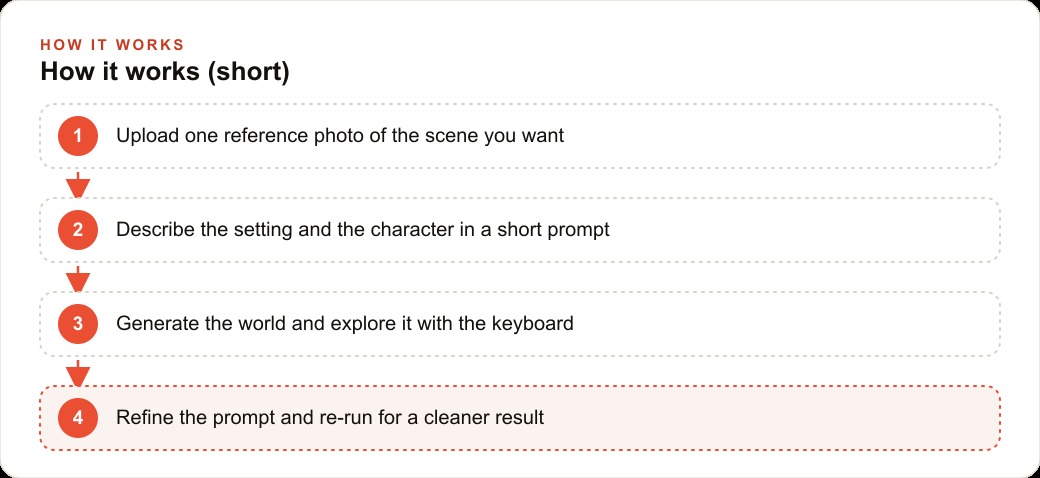
Genie 3 takes a single reference image and a short description of a setting and character, then generates an environment you can move through with a keyboard. It is not an animation, and it is not a traditional game engine. The AI builds the world live as you explore it. You can walk down a forest trail, cross a muddy creek, wander through a warmly lit interior, or stroll across a fantasy courtyard, all from one starting photograph. The scene maintains spatial logic as you move. Heavy things move with appropriate weight. Surfaces respond to contact differently based on what they are. The lighting, whether cloudy daylight through a window or golden-hour warmth on a character, lands convincingly because the model is rendering atmosphere and not just pasting shapes together. For now it sits behind a premium subscription, and early sessions can time out or produce occasional artifacts. But the direction the technology is pointing is clear, and it points at something most experience-based businesses are not yet looking at.
Genie 3 is being discussed by gamers but the biggest opportunity belongs to experience-based businesses
The gaming framing is understandable. The demos use game-like characters and settings, the interaction model is familiar from decades of video game conventions, and the technical audience that first evaluated the model naturally reached for game development as the organizing frame. That frame is accurate and also limiting.
What Genie 3 actually does is generate a convincing, explorable version of a real or described space from a single photograph and a short text prompt. Strip the game-character overlay and what remains is a technology that allows any seller of any physical space or experience to give a buyer or guest a walkable preview before they commit. The hotel room you are considering booking. The wedding venue you are trying to picture in the early morning light. The apartment you might rent but cannot fly to view. The restaurant private dining room you are deciding whether to reserve for an event. Each of these is a sale that currently depends on photographs and video, both of which hold the viewer at a distance. A walkable preview changes the relationship between the offer and the decision.
The businesses that succeed with immersive technology are always the ones that understood the underlying function early rather than waiting for the polished product to arrive. The first real estate brokerages that used virtual tours gained a showing advantage that lasted years. The first hotels that put 360-degree photos on their booking pages saw measurable increases in conversion. Each of those technologies was rough in its first year and the early adopters built workflows and reference assets before the broader market caught on. Genie 3 is at that same early stage, which means the businesses that start building their reference photography library and their prompting approach now are the ones positioned to deploy it effectively when access widens.
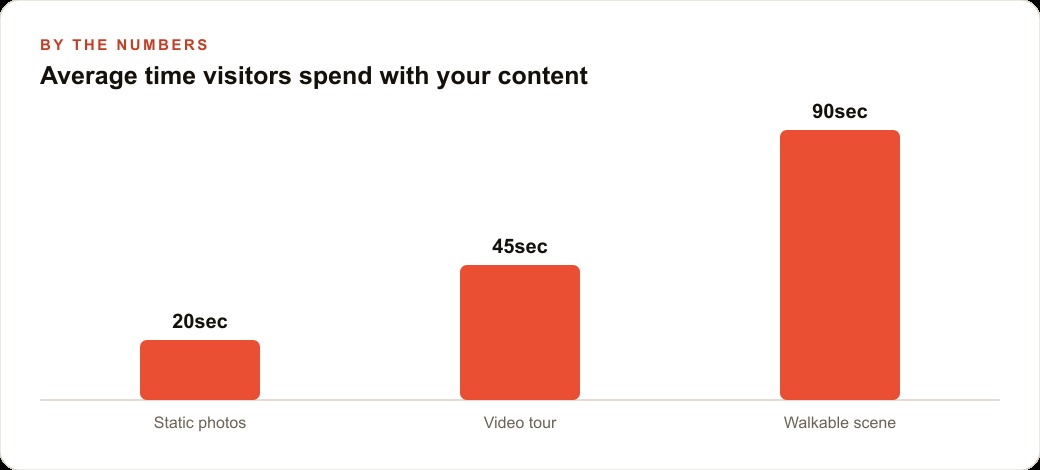
A walkable preview holds attention longer than any photo or video can
The relevant metric for any content that introduces a space to a potential buyer is how long it holds attention and how much of the experience it conveys. Static photos hold attention for a few seconds on average. A well-produced video tour holds attention for somewhere between thirty seconds and a few minutes, depending on how compelling the edit is. A space someone can actually move through and explore holds attention for substantially longer, and more importantly, it produces a different quality of engagement: the person is making decisions about the space rather than passively observing it.
That shift from observation to decision is what makes immersive preview technology valuable for experience-based businesses. A couple walking through a proposed wedding venue setup, even in a rough early-model version, is not watching a video. They are asking themselves whether they would like to be married in this room, and they are getting a proprioceptive answer that a photograph cannot produce. A hotel guest stepping into a rendered version of a suite before booking is not evaluating pixels. They are assessing whether the space will feel right for their trip.
The conversion implication is direct. When a buyer has already spent five minutes moving through a space, the emotional work of imagining themselves in it has largely been done. The remaining friction is practical: price, availability, logistics. The aesthetic and experiential question has been answered by the preview. For any experience-based business where the aesthetic and experiential question is the primary decision driver, reducing that friction without requiring a physical visit is a significant commercial advantage.
For businesses currently using meta-ads to drive inquiry and booking for spaces or experiences, the creative implication is significant as well. An ad that sends a user into a brief walkable preview of the venue or space, rather than into a static image or a landing page with photos, changes the entire emotional arc of that click. The user arrives at the decision already oriented toward the space in a way that photographs do not produce. The ad is not just showing the space. It is letting the prospective guest experience it.
The early fragility is a reason to prepare, not a reason to wait
The case for waiting is obvious and wrong. Genie 3 today has real limitations. Sessions can time out unexpectedly. Stray objects sometimes appear in generated scenes. Heavy demand slows the model down. Early-model outputs are impressive but not polished enough to use as finished client-facing assets without some curation. These are real limitations, and they will all be addressed as the model matures and access scales.
The case for waiting because of these limitations misunderstands how early technology adoption creates competitive advantage. The advantage does not come from using the finished, polished, widely available version of the technology. The advantage comes from having built the reference assets, the prompting library, and the internal workflow before the technology becomes polished and widely available. By the time the limitations are gone, the businesses that waited are starting from scratch on the same day that early adopters begin deploying finished experiences built on assets they have been curating for months.
The specific preparation that matters right now is reference photography. Genie 3 generates its world from a starting photograph. The quality and character of the generated world depends substantially on the quality and composition of the starting image. A business that has a library of high-quality reference photographs of its spaces, taken from useful angles and in good light, can immediately prompt richer, more accurate generated worlds than a business that has only the marketing photos that already exist on its website. Starting that library now, before access is needed, is the investment that produces the advantage later.
The prompting approach also rewards early experimentation. The combination of image and text prompt that produces a convincing walkable version of a space is not obvious from the technology description alone. It takes several tries to understand what makes the model produce coherent results versus fragmented ones, which lighting conditions translate well, which architectural features the model renders convincingly, and what text descriptions lead to the best spatial output. That knowledge is not available from reading about the technology. It only comes from using it. The businesses that begin accumulating that knowledge now, treating early sessions as experiments rather than deliverables, will have a working methodology when the access widens.
Experience-based sellers are sitting on an immersive tool they do not know exists yet
The hospitality and events industry spends an enormous amount on photography and video production designed to help buyers imagine themselves inside a space. The photography is often excellent and this breakdown is often well-produced. Both are fundamentally limited by the same constraint: they are created from a fixed perspective, and the buyer can only view them from the perspective Madhuranjan Kumar chose. The buyer cannot walk to the corner of the room to see how it feels from there. They cannot check whether the natural light hits the table in a way that works for a dinner event. They cannot assess the sense of arrival when walking through the entrance from the approach angle their guests will actually use.
These are things a walkable preview can provide, because the viewer is navigating the space rather than watching someone else navigate it. The perspective is the viewer's own, which is the perspective that actually matters for the buying decision.
For a wedding venue operator, this is a tool that makes every inquiry more efficient. Instead of scheduling site visits for couples who may not ultimately convert, the venue can let them walk the space first and book the site visit only when the preliminary exploration has already answered the aesthetic question. The site visit then focuses on logistics and relationship, which are the things that actually benefit from an in-person conversation. The total number of site visits goes down; the conversion rate of those visits goes up.
For a hotel, it is a tool that addresses one of the most common friction points in booking: the gap between how the room looks in photographs and how it will actually feel. A guest who has already walked through a rendered version of the room type they are considering has had the experiential question answered before they arrive. The check-in experience confirms what they expected rather than introducing uncertainty about whether they made the right choice.
For a real estate agent, it is eventually a tool that makes it practical to let buyers explore a shortlist of properties before scheduling in-person showings, which are expensive and time-consuming for both parties. A buyer who has walked through five properties virtually can arrive at the first in-person showing already narrowed to two or three genuine contenders. The agent's time is spent on the deals that are actually moving rather than on early-stage exploration that the virtual tool could have handled.
The right move now: build the reference photography archive before the access widens
The practical step available to any experience-based business right now is straightforward and does not require Genie 3 access today. It is building the reference photography archive that will serve as the input layer when access is ready.
The photographs that matter most are not the polished marketing shots already on the website. Those images are designed for a viewing experience. The images that produce the best generated worlds are reference photographs taken to capture the spatial reality of the space: the corners, the light at different times of day, the approach angles guests actually use, the relationship between the ceiling height and the floor area, the way natural light moves through the room across a day. These are practical documentation photographs, not hero shots, and they are not expensive to produce.
A business that commissions one good photography session specifically to build this reference library, taking twenty to forty images of each key space from useful angles and in varied light conditions, has the raw material ready to deploy when the technology matures. That library does not expire. The images taken now are valid inputs for generated worlds built next year or the year after. The asset is built once and retains its value as the technology improves.
The second practical step is staying familiar with what the model produces as access becomes available. Running occasional test sessions, using the reference photographs as input and varying the text prompt to explore what works, produces the institutional knowledge about which prompts and which source images lead to the most convincing outputs. That knowledge is not transferable from description. It is accumulated through use, and the businesses that begin accumulating it while access is still limited will have a meaningful practical advantage when access becomes standard.
For businesses currently investing in seo-content to build organic visibility for their spaces and experiences, immersive previews represent a future content format that will likely become as standard as photography is today. Building the reference asset library now and staying informed about the technology's development positions the business to lead in that transition rather than scrambling to catch up when the rest of the market arrives. The gaming community will keep most of the early coverage. The experience-based businesses that read past the headline will capture the opportunity.
That is exactly what we do at AI DOERS. Book a private 30-minute call with Madhuranjan Kumar and we will map the fastest path to it for your specific business.
Book your call →
Madhuranjan Kumar
Madhuranjan Kumar brings 20 years of performance-marketing experience and has managed over $200 million in Facebook ad spend for brands across the United States and beyond. His expertise spans the full modern marketing stack: Meta, Google Ads, TikTok, email automation, CRM, and the websites that hold it together. At AI DOERS he turns that track record into lead-generation systems for businesses across every industry.