
Every AI Model Explained: The Four Buckets That Make Sense of Them All
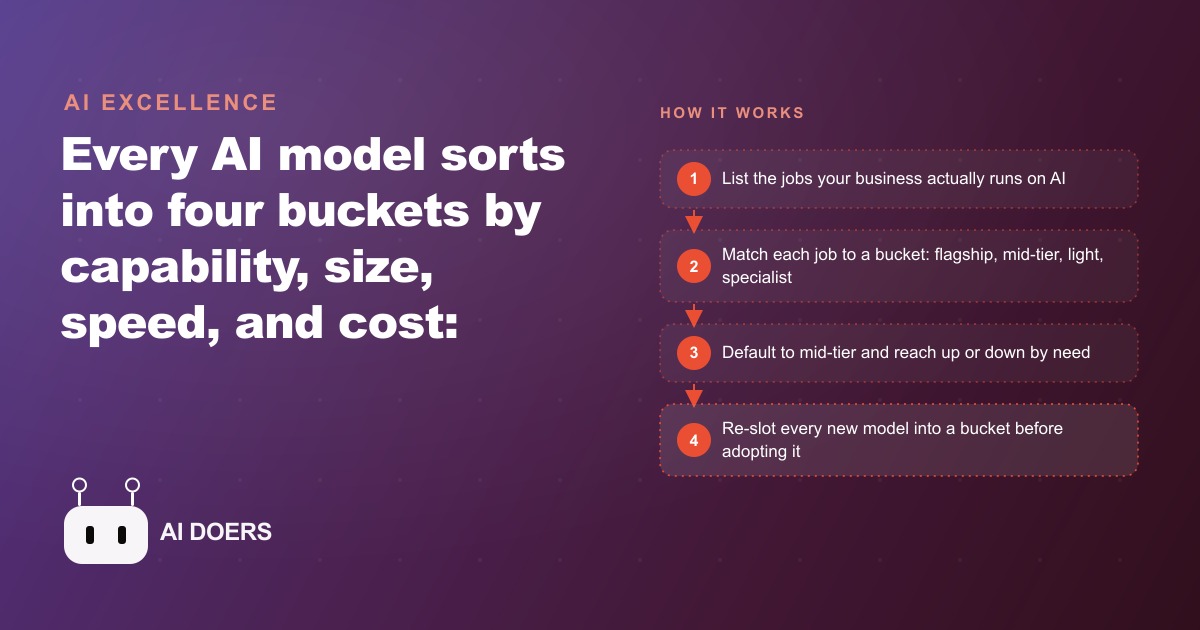
Every AI model sorts into one of four categories set by capability, size, speed, and cost: flagships like GPT 5.2 and Claude Opus 4.6, light models like Gemini 3 Flash, mid-tier workhorses like Claude Sonnet 4.5, and specialists like Perplexity Sonar.

Most businesses are paying flagship prices for tasks a mid-tier model handles just as well, and that oversight now has a name and a fix.
The fix is a four-bucket framework. Every model on the market, from the largest multimodal flagships to the smallest distilled fast models, sorts cleanly into one of four categories: flagship, mid-tier, light, and specialist. Once you can slot any new release into one of those buckets, the constant stream of model announcements stops feeling like noise and starts behaving like a menu you already understand. The structure has been stable across every major release cycle of the past two years. Only the specific models filling each position have changed, not the shape of the map.
The Four Buckets Organize Every Model That Exists or Will Exist
The four buckets are defined by a single underlying trade-off. Capability costs compute, compute costs time and money, and every model sits somewhere on that curve. Flagships sit at the high end: the most capable, the most expensive, the slowest on response time, reserved for the tasks that are genuinely hard. Mid-tier models cover the majority of everyday work at significantly lower cost and faster speed. Light models sacrifice depth for responsiveness and suit tasks where an answer in seconds beats waiting for marginal extra quality. Specialists are trained narrowly for one domain and outperform general-purpose models on that specific task while performing worse than mid-tier on anything outside it.
GPT 5.2 sits in the flagship bucket as the best-rounded option: it handles multimodality, chains multiple actions, and can process five hundred rows of customer feedback, draft a response template for each complaint category, and generate a banner image from a single prompt. Claude Opus 4.6 also sits in the flagship bucket, with its edge specifically in writing and code. It is the slowest and most expensive option and does not generate images, but for coding tasks and long-form writing it is the strongest available choice. Grok is an unusual flagship because despite high capability scores it is also fast, inexpensive, and carries a two-million-token context window, making it useful for long documents and for tasks where the reply needs emotional nuance. Gemini 3 Pro completes the flagship tier with its strongest showing in multimodality, particularly in style and character consistency across generated image and video sets.
Claude Sonnet 4.5 is the mid-tier workhorse most useful in daily business work. It retains the writing and coding strengths of the Opus line at a fraction of the cost and runs noticeably faster. Gemini 3 Flash leads the light tier, retaining ninety to ninety-five percent of Gemini 3 Pro's capability through knowledge distillation while returning answers in a fraction of the time. Kimmy K2.5 sits at the intersection of flagship capability and open-source licensing: it runs locally, costs nothing per query, and keeps data entirely off third-party servers, which changes the economics and privacy posture for sensitive or high-volume workloads. Perplexity Sonar holds the specialist bucket for research, returning attributed, verifiable answers on current information rather than synthesized recall.
The Four-Bucket Reality Matters Because Mid-Tier Now Covers Most Real Business Work
The pattern that emerges from mapping real business tasks to buckets is consistent: roughly eighty percent of what a business actually uses AI for every week sits comfortably within mid-tier capability. Drafting emails, summarizing meeting notes, writing first drafts of blog posts or ad copy, reformatting data, answering internal questions from a document, creating templates, explaining a concept for a client. These tasks do not require flagship-level reasoning. They require competent, fast, accurate output. Mid-tier models deliver exactly that at a price point that changes the calculation for daily use.
The remaining twenty percent of tasks that genuinely benefit from flagship capability are the ones where the problem is complex, the document is long, or the reasoning must compound across many steps. A contract analysis, a piece of technical writing that must stay internally consistent across twenty pages, a coding task that requires holding a large codebase in context and reasoning across it. These are the cases where the flagship premium pays for itself. Routing correctly means identifying which twenty percent actually deserves it rather than sending everything to the most well-known name by default.
What changed in the past year is that the light and mid-tier buckets improved dramatically relative to flagships. A light model from two years ago was noticeably weaker than its flagship counterpart on almost every task. Today the gap has narrowed to the point where a light model handles most everyday tasks acceptably, and the cost difference is large enough that routing even a fraction of workload away from flagship tier produces real savings. That compression of quality down the price curve is the trend that makes bucket thinking actionable now rather than just theoretically sensible.
Routing Correctly Cuts Costs by Sixty to Seventy Percent Without Cutting Quality
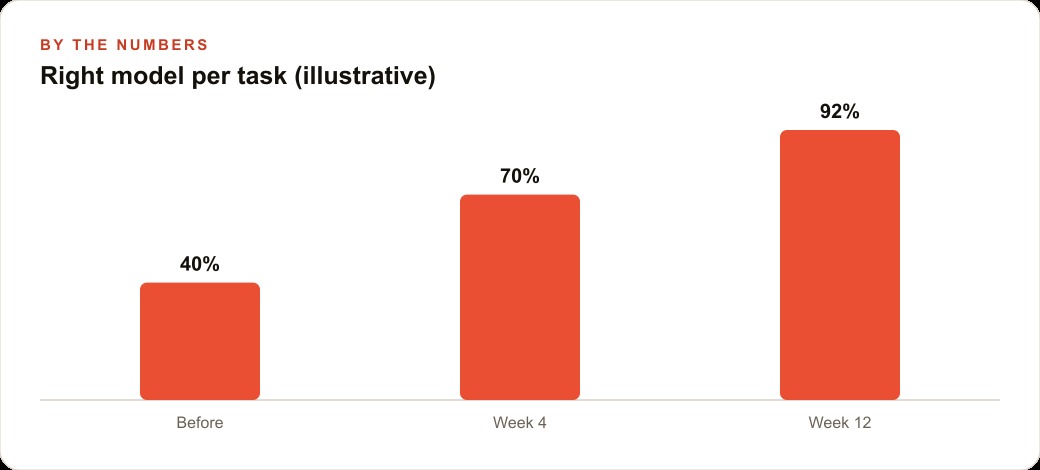
The cost difference between always using a flagship and routing correctly across all four buckets is not marginal. For businesses paying API costs rather than flat subscriptions, the gap between flagship and mid-tier pricing runs several times per query. Routing the eighty percent of everyday tasks to mid-tier and reserving flagship for the hard twenty percent can reduce total API spend by sixty to seventy percent while producing equivalent or better results, because each task now receives the model best matched to its actual difficulty.
For businesses on flat subscriptions, the cost saving appears as speed and quality rather than billing. A mid-tier model running a routine email draft returns the result faster than a flagship handling the same task. Faster output means less friction in the workflow and more tasks completed per hour. The flagship reserved only for hard tasks also produces noticeably better output on those tasks because it is no longer being asked to waste capacity on things that do not need it. Correct routing is not only about money. It is about matching the quality of the output to the actual requirements of each task.
The Concrete Move for Any Business Is to Map Real Tasks to Buckets This Week
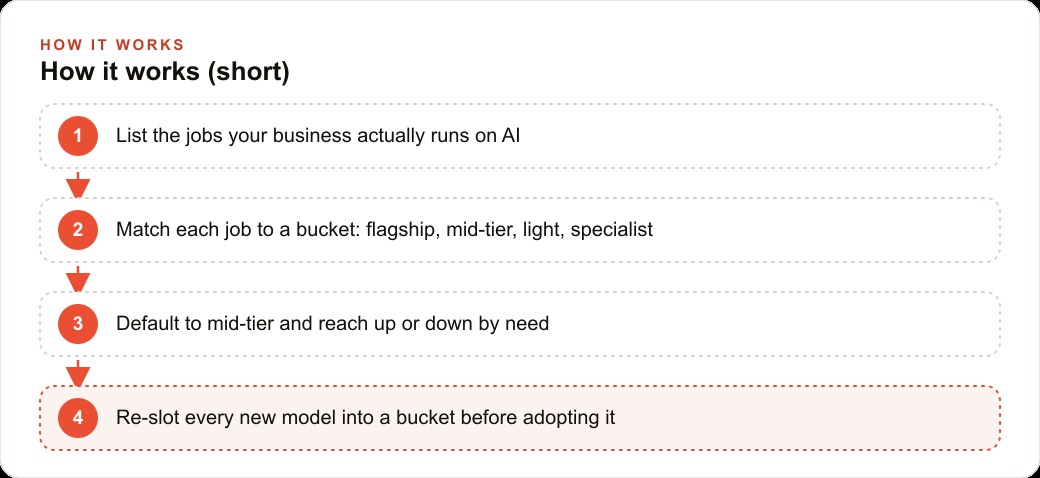
The implementation of this framework starts with a list. Pull up the most common AI use cases from the past month and categorize them honestly. Which ones needed deep reasoning, long context, or complex chaining across multiple steps? Which ones just needed a competent first draft? Which ones needed a fast, short answer where waiting thirty seconds was genuinely a friction point? Which ones needed verifiable citations rather than the model's own synthesis?
The answers will almost certainly show that the majority of what a business uses AI for every week belongs in mid-tier and that a handful of tasks belong in flagship or specialist. Build a simple routing habit around that map. Default to mid-tier, reach for flagship when the task is genuinely hard or stakes are high, reach for light when speed and brevity are the priority, and reach for a specialist when verification matters. When a new model is announced, resist the urge to evaluate it in the abstract. Ask which bucket it belongs to and whether it beats what is currently in that slot on actual tasks. Run a short comparison and make a decision based on real results rather than benchmark tables or marketing copy.
The Photography Studio Routing Example Shows the Numbers
A photography studio running its work through AI faces four distinct task types with very different requirements. Client email responses and booking confirmations need professional tone and fast turnaround but are not complex reasoning tasks. Album captions for a wedding delivery need to be warm, consistent in voice, and produced quickly while the couple is still waiting. Concept boards for a new branded shoot require multimodal capability: the studio needs the AI to understand visual references, suggest a coherent visual direction, and maintain style consistency across a set of images. Research tasks around gear pricing, competitor studio packages, or market trends need accurate, attributed information rather than confident synthesis that may be fabricated.
Routed correctly: client emails go to mid-tier, album captions go to light tier for speed, concept boards go to a multimodal flagship for its visual consistency strength, and research goes to a specialist for attributed answers the studio can actually verify and share with clients.
The illustrative cost difference is meaningful at scale. If the studio runs two hundred AI tasks per month and currently sends all of them through a flagship model, the cost is whatever flagship pricing applies multiplied by two hundred. Routing sixty percent of tasks to light tier, thirty percent to mid-tier, and only ten percent to flagship cuts that total by roughly sixty to sixty-five percent at typical pricing differentials. The caption work comes back faster. The research comes back with sources. The concept board work benefits from multimodal strength instead of wasting it on routine email. Each task type receives the model that actually wins on it rather than the model that handles everything adequately.
The compounding benefit appears over time. A studio that builds this routing habit in one afternoon stops overpaying immediately and starts getting better-matched output on every task. The investment is mapping the task list once and building a simple mental routing rule. Everything else follows from that single decision.
When New Models Arrive, Slot Them Into a Bucket Before Adopting
New model announcements arrive fast enough that tracking individual models is no longer a viable strategy for any business. New versions appear monthly, established names receive point updates that change their behavior significantly, and entirely new entrants arrive from multiple regions faster than anyone can individually evaluate. The four-bucket framework stays stable regardless of how fast the landscape moves because the buckets are defined by function and trade-off, not by product name or vendor.
The right response to each new release is one question: which bucket does this belong to, and does it beat what is currently in that slot on my actual tasks? That question takes five minutes to answer with a short comparison test on real common task types. If the new model beats the current mid-tier choice on drafting tasks that represent most of a business's workload, it earns a promotion. If it only outperforms the current flagship on specific reasoning tasks, it earns a conditional role for those specific cases. If it benchmarks well on standardized tests but underperforms on actual tasks, the benchmark is less useful than the real-world test.
Open-source models deserve specific mention here. Kimmy K2.5 demonstrates that open-source has crossed the threshold where it competes meaningfully with hosted flagships on most tasks. The case for running an open-source flagship locally is no longer primarily about capability. It is about privacy, cost at volume, and data residency. A business handling sensitive personal, financial, or health information that routes those queries through a hosted commercial API is making a choice with privacy and compliance implications that a local model eliminates structurally. For the right workloads, that is the strongest argument for open-source: not benchmark performance, but the permanent removal of the privacy trade-off.
The Specialist Tier Is Underused by Most Business Teams
Most teams that have adopted AI tools are using flagship or mid-tier models for tasks a specialist handles better by design. Research that requires verifiable citations is the clearest case. When a mid-tier or flagship model is asked to summarize current events, pricing trends, or market data, it produces a confident-sounding answer that may or may not be accurate and never comes with sources a business can check or share. A specialist research model returns the same summary with citations that can be clicked through and verified. For any output that will be shared externally, presented to a client, or used as the basis for a real decision, those attributed answers are worth the extra step of routing to a different tool.
The specialist tier also matters for domain work that general-purpose models handle poorly. Legal and medical query work where accuracy is load-bearing, scientific research where the answer needs to reflect current literature rather than training data, financial analysis where numbers need to be current and verifiable: these are the tasks where a specialist model justifies its position by outperforming everything else on the one thing it was built for. A business that sends those tasks to a general-purpose mid-tier or flagship is getting answers that may be accurate but cannot be easily verified, which is a meaningful gap in any context where the cost of an error is high.
The specialist tier is not a replacement for general-purpose models. It is a targeted tool for the specific subset of tasks where verification and domain depth outweigh the convenience of a single unified interface. Map those tasks correctly in the four-bucket framework and the specialist earns its place without any further deliberation about when to use it.
That is exactly what we do at AI DOERS. Book a private 30-minute call with Madhuranjan Kumar and we will map the fastest path to it for your specific business.
Book your call →
Madhuranjan Kumar
Madhuranjan Kumar brings 20 years of performance-marketing experience and has managed over $200 million in Facebook ad spend for brands across the United States and beyond. His expertise spans the full modern marketing stack: Meta, Google Ads, TikTok, email automation, CRM, and the websites that hold it together. At AI DOERS he turns that track record into lead-generation systems for businesses across every industry.