
11 Reader: The Free ElevenLabs App That Makes Any Written Content Into Something You Can Listen To
ElevenLabs released a completely free mobile app that turns articles, PDFs, and documents into natural-sounding audio. Here is how it works, every feature explained, and how to build it into a productive daily habit.

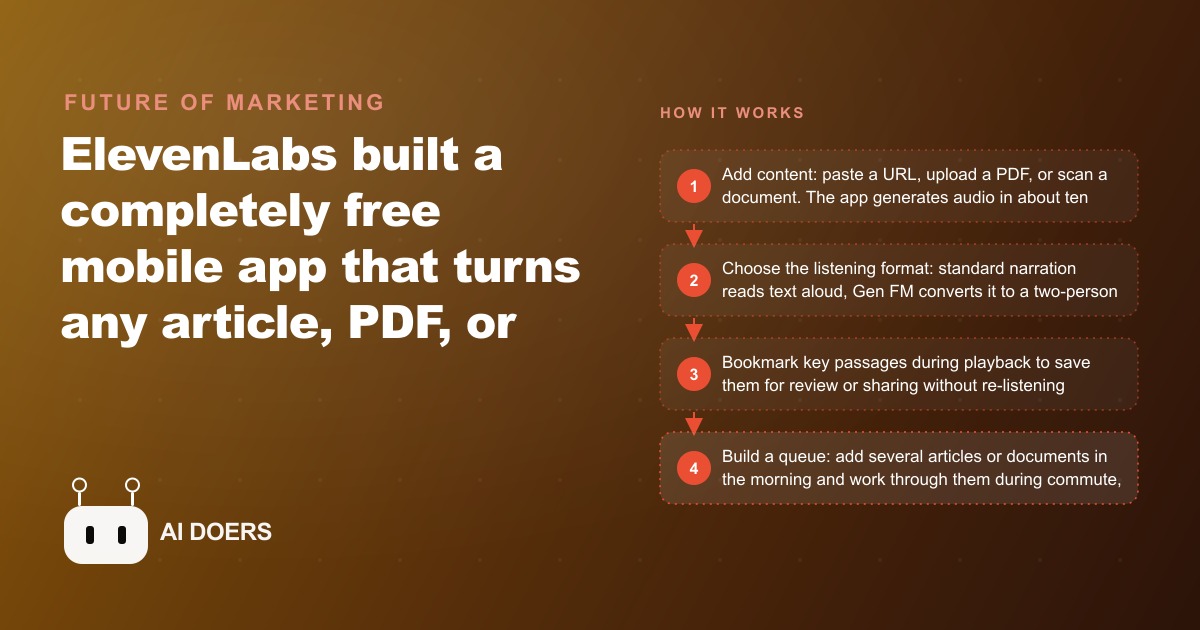
Most professionals do not have a reading problem. They have a reading time problem. There is always one more article, one more report, one more competitor teardown that would sharpen a decision, and never a quiet hour to get through it. ElevenLabs just released a free mobile app called 11 Reader that quietly fixes this, by turning any article, PDF, or scanned document into audio that sounds like a real person reading to you. This is a playbook for turning that app into a daily habit that gives you back hours every week, and I will walk you through it stage by stage.
I am Madhuranjan Kumar, and the reason I care about this tool is not the novelty. It is that the voice quality is finally good enough to hold your attention through a long document, which is the exact threshold that decides whether a listening habit survives past the first day.
Stage 1: Understand what you are actually installing
Before you build a routine, know the tool. 11 Reader is a mobile app from ElevenLabs, the company best known for the highest quality AI voices available. It does one thing well: it converts written content into natural sounding audio. The input can be a web link, a PDF, raw pasted text, or a document you photograph with your phone camera.
The single most important fact is the price, which is nothing. This is not a trial that asks for a card, and not a free tier with a hard cap most people will hit. It is genuinely free, funded as a product led growth strategy so people experience the voice quality before they ever reach the paid tools elsewhere on the platform. A premium version is planned for later, but the free tier is expected to remain. That means you can build this habit at zero cost and never worry about a meter running.
Stage 2: Set up your first source in under a minute
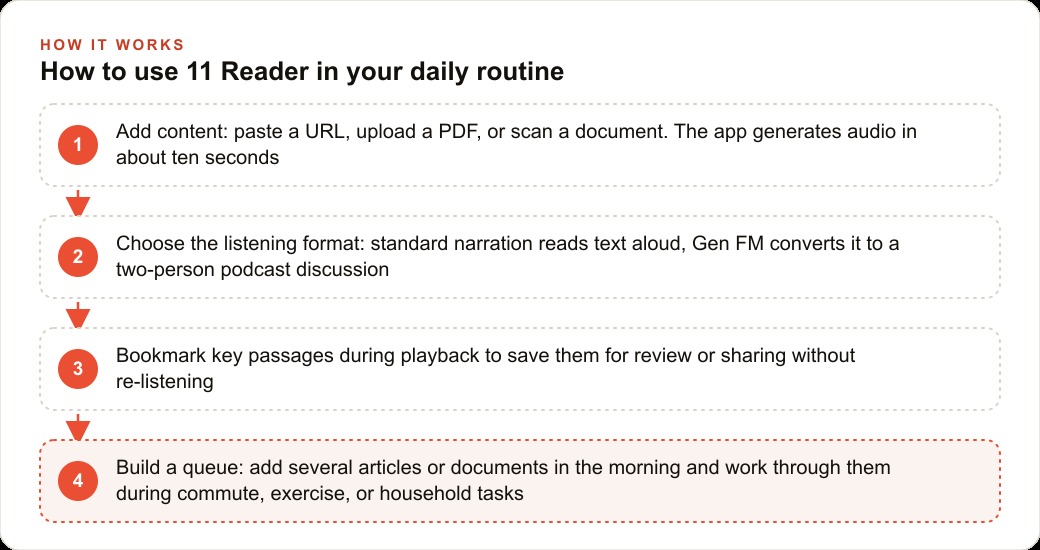
The setup is deliberately trivial, and that is the point. Download 11 Reader from the iOS or Android store, log in with a Google or email account, and tap the plus button to add your first piece of content. Paste a link to any article you have been meaning to read, and the app generates the audio in about five to ten seconds regardless of length. You can start listening immediately.
Do not skip the voice test on day one. Listen to the first sixty seconds, and if the default voice does not suit you, cycle through two or three others before you settle. The right voice for sustained listening is personal, and five minutes spent finding it pays back over months. A calm, clear voice with a tone of quiet authority tends to work best for information, because it carries you through dense passages without fatigue.
Stage 3: Match the format to the material
This is the stage most people miss, and it is where the real gains hide. 11 Reader has two listening modes, and using the wrong one wastes the tool. Standard narration reads the text aloud cleanly, and it is the efficient choice for news, lighter articles, and anything where you just need exposure to the ideas.
For dense, technical, or academic material, switch to Gen FM. Instead of reading the text verbatim, Gen FM has two AI voices discuss and explain the material as a conversation. That dialogue structure is closer to how podcast learning works, and it gives your brain natural entry points into complex ideas. A research report or a long analysis piece that would be a slog in narration becomes genuinely followable as a discussion. It takes roughly sixty to ninety seconds to generate for an article length source, and it is worth the wait when comprehension, not just exposure, is the goal. My rule of thumb is simple: if you would need to reread a paragraph on the page, use Gen FM.
Stage 4: Build the morning queue
A tool without a trigger dies quietly. The habit that makes 11 Reader stick is a five minute morning queue. Before your day starts, add two to three pieces of content: a couple of article links from newsletters you follow, one PDF that landed in your inbox, maybe a competitor's recent post you want to understand. That is the entire setup, and it takes about five minutes.
Then attach the listening to time you already spend with your ears free and your eyes busy. A forty minute walk. A twenty minute commute each way. A forty five minute workout. A routine household task. These are the slots where the app converts dead time into informed time. The discipline is to queue what you will realistically finish. Loading ten articles and listening to two produces the same result as never starting, and it trains you to ignore your own queue. Start with two or three, and expand only once the pattern is automatic.
Stage 5: Capture what matters without stopping
When you hear something worth keeping, tap the bookmark button during playback and the passage is saved. You can return to it later, share the clip, or jump straight back to that exact point without re listening to find it. This turns passive listening into something you can act on, which is what separates entertainment from research. Bookmark a stat, a phrasing, or an idea in the moment, and review your bookmarks at the end of the week.
Two more capabilities extend the routine. Voice cloning lets you train the app on a specific voice and have all content read in it, which is useful if you produce audio versions of your own documents and want a consistent branded narrator. And the thirty two language support means a team that works across languages can generate audio of a document in each member's primary language, making dense material more accessible to people who process spoken language faster than written text.
A worked example: the multi industry consultant
Let me show the full playbook running for one person. Picture an independent consultant who advises small business owners on marketing and growth, serving clients across five industries: retail, food service, home services, healthcare administration, and professional services. Staying credible across all five demands constant research, and that reading normally gets crammed into evenings and weekends because client work fills the core hours.
Here is the routine rebuilt around 11 Reader. Each morning, before calls begin, the consultant spends five minutes queuing content: three or four article links from industry newsletters, a PDF case study that arrived overnight, and a competitor's recent blog post. During a forty minute morning walk, the two densest pieces go through Gen FM, so the analysis is easy to follow, while the lighter blog post plays in standard narration. By the time the walk ends, roughly sixty minutes of reading has been consumed in forty minutes. On a twenty minute drive to a client site, the remaining queued pieces finish. By midday, five research items are done, and not one came out of the working day.
Put a number on the month. This workflow adds roughly eight hours of research consumption capacity without adding eight hours to the week, because it runs on time that was previously music or idle. For a consultant who bills two hundred dollars an hour, eight recovered hours of staying sharper than the client is a serious return on a free app. The visible payoff is better conversations, because the consultant is consistently more current than the people paying for the advice.
Where this fits the rest of your marketing
The habit compounds beyond personal research. The same infrastructure that reads industry reports can read your own content, which means the blog posts and case studies you write for SEO and organic search can be turned into audio versions your audience listens to on the go, extending one piece of writing into two formats at no extra cost. If you run Facebook and Instagram ad campaigns, listening to competitor creative breakdowns and platform update posts during dead time keeps you ahead of changes without carving out desk hours. And branded audio versions of your client deliverables can be handed off cleanly if they live in your CRM and website stack, so a client who prefers to listen gets the same document in the format they will actually consume.
The mistakes that quietly kill the habit
Four errors undo the whole system. First, over queuing. Keep it to two or three pieces until listening is automatic. Second, using standard narration for material that needs real comprehension, when Gen FM would have made it stick. Third, underrating how much voice quality matters, especially if a robotic app burned you before, because this one is noticeably better and worth a second try. Fourth, restricting the tool to work content, when the built in library of books, papers, and articles can replace time you currently spend on lower value audio.
Stage 6: Turn listening into output, not just intake
The habit so far is about consuming more, but the strongest version of this routine closes a loop back into work you produce. Every article you listen to and bookmark is raw material. When a passage sparks an idea for a post, a client email, or a section of a report, the bookmark is already there waiting. At the end of the week, a ten minute review of bookmarks becomes a content planning session with the sourcing already done. This is how listening stops being passive and starts feeding the things your business actually ships.
The voice cloning and language features extend that output side further. A consultant who writes strategy documents can produce a branded audio version in a consistent cloned voice, so a client who prefers to listen gets the same deliverable in the format they will actually finish. A team serving customers in more than one language can generate audio of the same document in each audience's language, which turns one written asset into several usable ones at no extra cost. The infrastructure that reads industry research to you is the same infrastructure that reads your work to your customers, and most people only ever use half of it.
Why the retention gap is the real argument
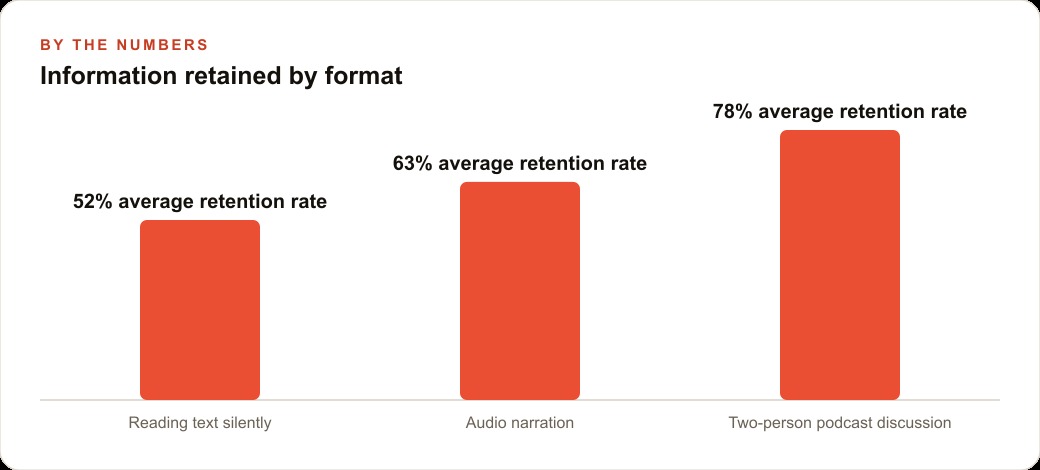
It is worth being precise about why format matters, because it is easy to treat audio as merely convenient. Comprehension is not flat across formats. Reading text silently, straightforward narration, and a two voice discussion do not leave the same amount behind. The discussion format tends to hold attention and aid recall on dense material specifically because the back and forth forces the ideas to be restated and connected, which is closer to how a good tutorial works than how a dry document reads. That is the entire reason Gen FM exists, and the entire reason you should reserve it for the material where understanding, not just exposure, is the point.
So the discipline is not just to listen more. It is to route each piece to the format that will actually stick. News and light updates through narration, where speed is the win. Research, reports, and technical analysis through Gen FM, where retention is the win. Get that routing right and the same hour of listening delivers noticeably more than a scattershot approach, which is the difference between a habit that makes you sharper and one that just fills the silence.
The one hour a day this quietly gives back
Add the pieces together and the payoff is not really about a single app. It is about reclaiming a category of time that was previously either idle or spent on low value listening. A commute, a walk, a workout, a chore: an hour or more each day where your eyes and hands are busy but your attention is free. For a professional whose edge is staying better informed than the people they serve, that hour compounds into a real advantage over a month, without stealing a single minute from the working day or the evening. The tool is free and the setup is trivial, so the only thing standing between you and that hour is the decision to queue two articles tonight and press play tomorrow.
The starting point costs nothing but two minutes and an email address. Download the app, queue two articles tonight, and listen tomorrow morning. Build the five minute queue habit for one week before you expand it, and let the pattern prove itself. The tool is free, the setup is trivial, and the only scarce ingredient is the discipline to press play on the research instead of the playlist.
That is exactly what we do at AI DOERS. Book a private 30-minute call with Madhuranjan Kumar and we will map the fastest path to it for your specific business.
Book your call →
Madhuranjan Kumar
Madhuranjan Kumar brings 20 years of performance-marketing experience and has managed over $200 million in Facebook ad spend for brands across the United States and beyond. His expertise spans the full modern marketing stack: Meta, Google Ads, TikTok, email automation, CRM, and the websites that hold it together. At AI DOERS he turns that track record into lead-generation systems for businesses across every industry.