
Droid by Factory AI: A Coding Agent That Runs Every Model
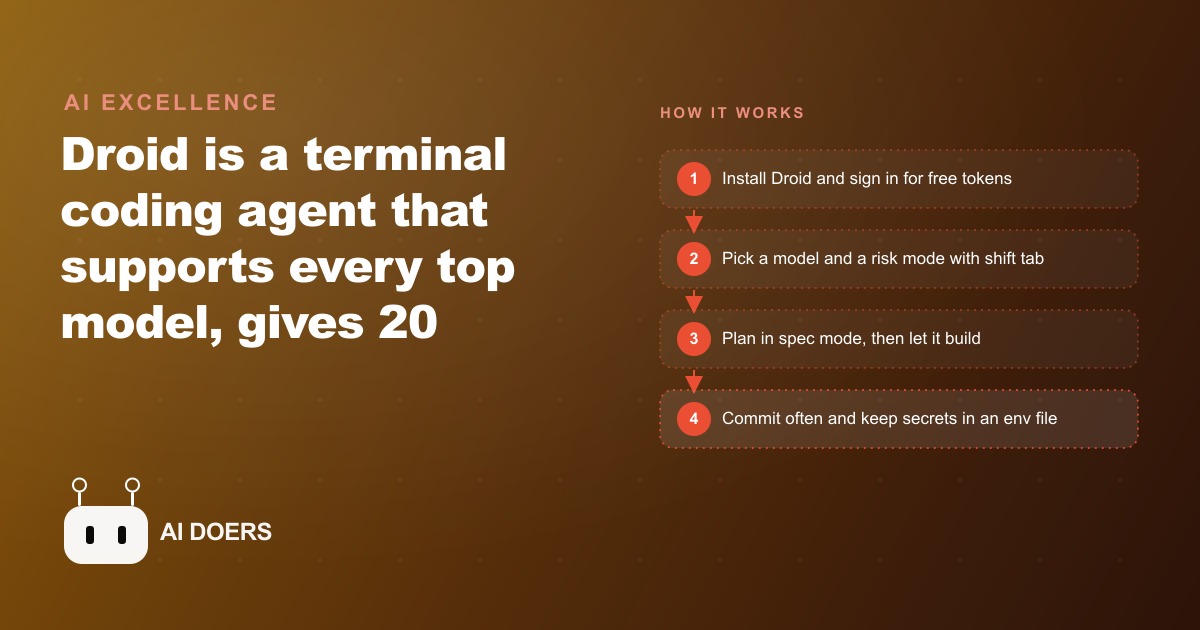
Droid is a polished terminal coding agent that supports every top model and ships with 20 million free tokens. Here is what makes it stand out and how I would put it to work for a real local business.

The fastest AI model available today will not be the fastest AI model available in six months. That sentence is not speculative. It is the established pattern of the last four years, and it has a direct implication for anyone who has invested significant time learning a single-model coding tool. Everything you learned about how to get good output from that specific model, the prompt patterns that work, the quirks to work around, the places where it excels and the ones where it needs a workaround, is at risk of becoming less valuable the next time a new leading model ships.
My name is Madhuranjan Kumar. Droid by Factory AI is an interesting tool for a specific reason I want to argue clearly here: not because it is technically superior on any single task, but because it separates the workflow from the model. That separation is architecturally valuable in a way that model-specific tools are not, and over a 12-month horizon it means your learning compounds in a fundamentally more durable way.
The model landscape is changing too fast for any single-model tool to hold its advantage
In the last 24 months, the best available coding model has changed at least five times depending on how you define best and for what task. Models that were the clear recommendation in mid-2024 were surpassed within months. Models that were state-of-the-art in early 2025 were already being described as the mid-range option by year end. The release cadence from the major labs has accelerated, and every new release reshuffles the rankings on at least some task categories.
For a developer or non-technical business owner building with AI coding tools, this creates a structural problem with single-model tools. When you invest 40 hours learning how to get high-quality output from a tool built specifically around one model's capabilities, you are making an investment with a time-limited return. The day the next leading model ships, some portion of that investment becomes a workaround for an outdated approach. The prompt patterns optimized for the previous model's strengths may not serve you as well with the new one.
Model-agnostic tools like Droid solve this at the architecture level. The workflow, how you structure tasks, how you move from spec to plan to build, how you use version control and risk modes to keep the agent's output safe and reversible, stays constant regardless of which model is running. When a better model ships, you switch the picker and keep building with the same workflow. The 40 hours of learning you invested compounds into better output with the new model rather than requiring you to start over.
This is not just a convenience feature. Over 12 months, the compounding value of workflow permanence across multiple model generations is substantial. A developer who spent January through March learning Droid's workflow with one model, then switched to the improved next model in April and a new release in September, has a progressively more skilled practice built on a stable workflow foundation. A developer who spent the same period learning a tool that only runs one specific model has a skill that is partially obsolete by September when that model is no longer the best option for most tasks.
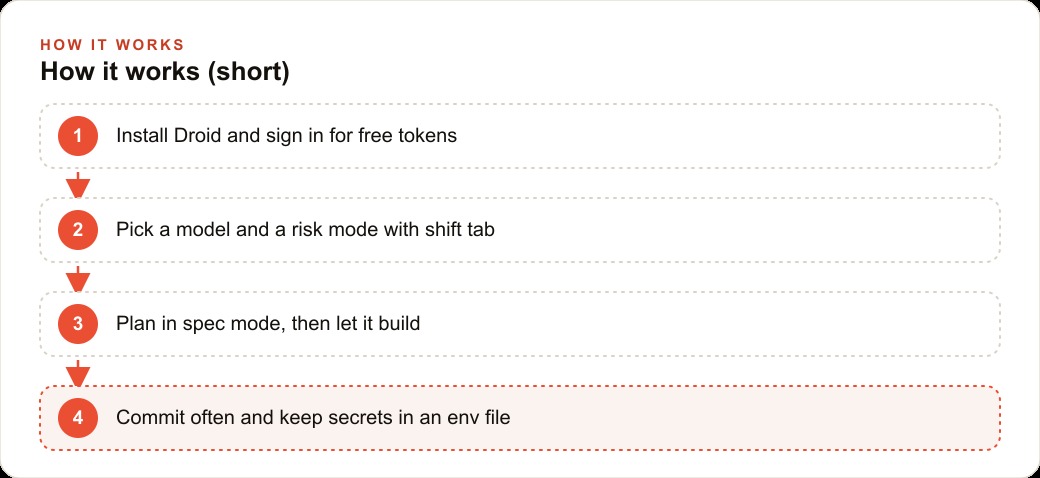
Droid's model-agnostic architecture means your workflow investment compounds regardless of which model leads next quarter
Droid's model picker shows every available model with its credit cost per query. The practical selection on any given task is a judgment call: lighter models for research and planning passes, where the task is to understand the shape of a problem rather than generate final code, and heavier models for the actual build and refinement, where quality of output matters most. Making that judgment well is a skill that develops quickly and stays relevant regardless of which specific models are in the picker.
The research-before-build behavior is the other piece of the workflow that compounds across model switches. When you give Droid a task involving a library or framework, the first thing it does is pull current documentation through a web search. It does not rely on its training data, which may be months old, to generate code for a fast-moving library. It reads the actual current docs and proposes an architecture based on what the library actually supports today. That behavior is built into the agent workflow, not into any specific model. It works the same way regardless of which model you have selected, and it prevents the class of errors that come from training-data assumptions about an API that has changed since the model was trained.
The shift-tab risk modes, which move between approval-only, plan, reversible, and full auto, give you a consistent safety framework that applies regardless of which model is running. You learn the modes once. The discipline of starting in plan mode for any task touching real business data, then switching to reversible for the build, then reviewing before running anything that cannot be undone, is a judgment practice that stays useful as long as AI coding agents exist. The models get better. The need for human judgment about what the agent should be allowed to do does not go away.
Because Droid runs in the terminal, you can open multiple instances and run different tasks simultaneously: one building a feature, one investigating a bug, one generating documentation for work already completed. Coordinating that parallel workflow is a directing skill. Knowing which tasks can run simultaneously without conflicting, which to sequence first because its output is an input to another, and how to review parallel outputs efficiently: that is the craft. The models make the parallel execution possible. The workflow intelligence is still yours.
The real investment is in how you direct the agent, not in which model is running beneath it
Directing an AI coding agent well is a skill that is underestimated by most people who have spent time with AI coding tools. The common mental model is that a better model makes the prompting problem easier, and over time you just ask it things and it figures out the rest. The opposite is true at the high-performing end. The better the model, the more precisely it can execute a well-formed brief, and the more the quality of the brief determines the quality of the output.
Writing a good task description for Droid means specifying the goal in testable terms, describing the constraints that matter, identifying the tools and libraries to use, and indicating where the agent should stop and ask rather than make a judgment call. That is not a natural writing style for most people. It is a skill that develops with practice. The people who get dramatically better output from AI coding agents than average are not the ones with access to better models. They are the ones who learned to write briefs that give the model enough specificity to execute correctly without enough ambiguity to make expensive wrong turns.
Because that skill is model-agnostic, it appreciates in value as new models ship. A person who writes excellent task briefs today will get better output from the model that releases next quarter than from the current generation, because better models are better at faithfully executing precise specifications. The direction skill is not a complement to a specific model's capabilities. It is a complement to any capable model, and the capable models keep getting more capable.
Droid also updates your readme and documentation as it goes, so the project stays workable instead of being a one-off change nobody can build on later. That automatic documentation habit is something most developers know they should do and rarely do. Having the agent do it continuously means the project stays usable by anyone on the team, or by a future version of yourself six months from now when you have forgotten the details.
A dental practice using Droid to build internal tools replaces 6 hours of manual weekly work for under $50 in total token cost
I want to ground this in numbers because the ROI of a coding agent for a non-technical business owner is often presented abstractly.
A dental practice with four treatment rooms and two front-desk staff has a recurring manual process that consumes roughly 6 hours per week across the team: generating a recall list of patients overdue for cleanings based on the practice management system's appointment export, cross-referencing that list against patients who have already been contacted in the last 30 days, and outputting a formatted call list for the front desk sorted by how overdue each patient is. That process requires one staff member to export a report, open it in a spreadsheet, apply filters, deduplicate against the contact log, sort, and format the output. It takes about 90 minutes each Monday. An equivalent process for overdue checkup reminders runs Tuesday. A revenue-by-treatment-type summary is built manually on Friday afternoons and takes about 2.5 hours.
Madhuranjan Kumar worked through building this with Droid for a practice exactly like this one. The first session used spec mode to describe all three recurring tasks in plain language, without writing any code. Droid researched the common formats for practice management system exports, confirmed which library approaches would handle CSV parsing correctly, and proposed a clean architecture: three separate scripts with a shared utility layer that handled date parsing and formatting consistently. That planning session used approximately 40,000 tokens on a mid-tier model. At typical token pricing for that model, the cost was approximately $2.
The build session, running in reversible mode with version control initialized from the first commit, produced the three scripts in approximately three hours of interaction. The practice's office manager reviewed each plan step, approved the builds sequentially, ran the scripts against sample export data to verify output, and committed at each milestone. Total token usage across the build session was approximately 180,000 tokens on a mix of mid-tier and higher-quality model passes for the final refinement. Token cost: approximately $11.
Testing against real data, with the office manager reviewing output against manually-produced lists for accuracy, took one additional session of approximately 60,000 tokens. Cost: approximately $3.50.
Total token cost to produce three scripts that eliminated 6 hours of weekly manual work: approximately $16.50. Total wall-clock time investment from the practice's side, reviewing plans and outputs rather than writing code: approximately 5 hours over two days.
The scripts now run in under 3 minutes for each of the three tasks. Six hours of weekly manual work, at a staff fully-loaded cost of $28 per hour, was costing the practice $168 per week or $8,736 per year. The scripts eliminated that cost for a one-time investment of $16.50 in tokens and 5 hours of the office manager's time. Droid also updated the readme for each script as it built, meaning a new staff member or contractor can understand and extend the scripts without asking the original developer for context.
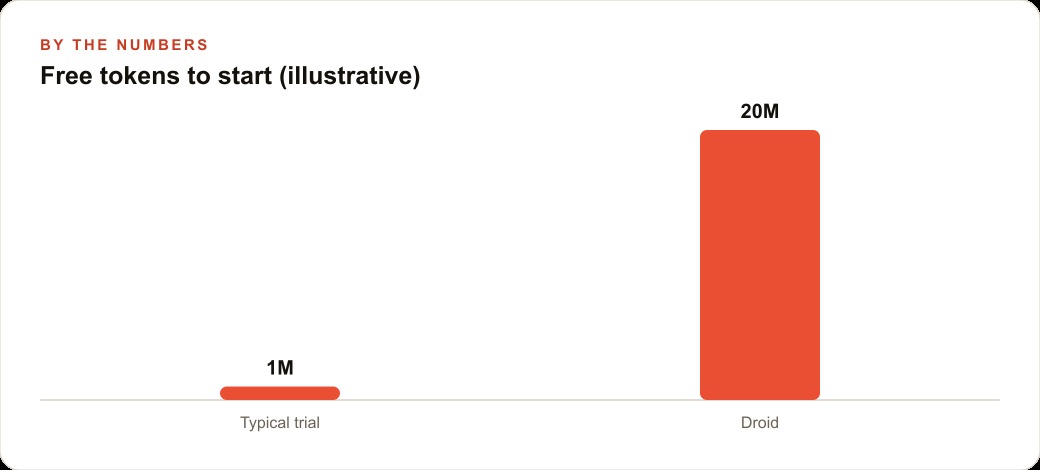
The 20 million free tokens that Droid provides on signup mean the practice described above could have built these three scripts entirely within the free tier. All three sessions combined used approximately 280,000 tokens, a fraction of the 20 million available before any payment is required.
Model-agnostic tools build a compounding advantage that model-locked tools cannot replicate
The argument across this essay is not that Droid is the best tool available for any specific coding task today. It may or may not be, depending on the task and which models are currently available in the picker. The argument is that the model-agnostic architecture, combined with the workflow primitives: spec mode, risk modes, parallel instances, auto-documentation, and web-sourced research before building, creates a learning investment that appreciates rather than depreciates as the model landscape evolves.
The business that learns to use a model-agnostic coding agent in 2026 is not just faster at building tools today. It is positioned to absorb the improvements in AI coding capability over the next 12 to 24 months without rebuilding its practice from scratch each time a new leading model ships. The workflow primitives stay constant. The quality of output from those same primitives keeps improving because the models running beneath them keep improving. That is a durable compounding advantage, and it is the one that distinguishes tools worth learning deeply from tools worth experimenting with once.
The practical takeaway is a decision rule: invest your learning time in tools that separate workflow from model, and treat model quality as a variable you can dial up over time rather than a permanent commitment. The 20 million free tokens that Droid provides on signup give you a meaningful runway to test that proposition without a financial commitment. Build one real internal tool for your business, measure the time it saves against the token cost it required, and compare the ratio. If the dental practice scenario is any guide, the ratio will make the decision obvious.
That is exactly what we do at AI DOERS. Book a private 30-minute call with Madhuranjan Kumar and we will map the fastest path to it for your specific business.
Book your call →
Madhuranjan Kumar
Madhuranjan Kumar brings 20 years of performance-marketing experience and has managed over $200 million in Facebook ad spend for brands across the United States and beyond. His expertise spans the full modern marketing stack: Meta, Google Ads, TikTok, email automation, CRM, and the websites that hold it together. At AI DOERS he turns that track record into lead-generation systems for businesses across every industry.