
Did Claude Cowork Just Kill OpenClaw? Here Is the Honest Answer
Anthropic's Claude Cowork plus Dispatch and a computer use preview replicate roughly 90 percent of what people wanted from OpenClaw with far less security risk. But OpenClaw stays relevant because it is free, open source, model-agnostic, runs on nearly any hardware, and keeps deep personal memory.

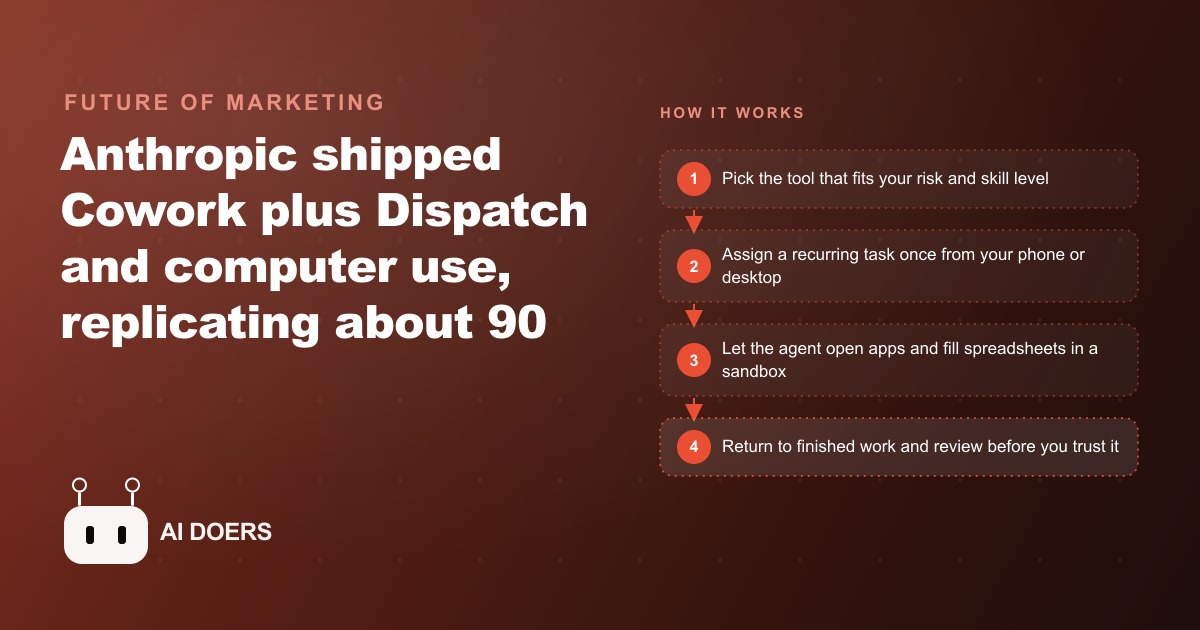
Anthropic shipped a wave of features that made their agent look almost identical to the fastest growing open-source project ever, and the question of which one a business should use is more nuanced than any headline has made it.
OpenClaw became the fastest growing open-source project ever before Anthropic responded
The scale of OpenClaw's adoption is the first thing worth understanding, because it explains why Anthropic's response was so fast and so substantial. Built by Peter Steinberger, OpenClaw is an open-source AI agent that runs on your own machine, keeps files and memory on your hardware, and lets you drive it from anywhere through Telegram or WhatsApp. When it launched, the project grew faster than any open-source project on record. Fortune, CNBC, and Forbes covered it. Mac Mini inventory dried up across retailers because people were buying them specifically to run a dedicated OpenClaw server. A developer tool was causing a hardware shortage, which is the kind of indicator that tells you something is genuinely different about the moment.
What made it resonate so strongly was a specific combination of properties that no major AI vendor was offering: persistent memory that grows over time on your own machine, full computer access without cloud dependency, and complete model flexibility so you were never locked into one company's pricing or capabilities. People who used it described the experience of an assistant that actually remembered who they were and could act on their machine the same way they would. That is a different product experience than any chatbot, and the community response reflected it.
The cultural weight of OpenClaw's success is why Anthropic's response mattered as much as it did. When the fastest growing open-source project ever is a direct challenge to your product roadmap, you respond at product speed, not sales cycle speed.
Cowork plus Dispatch delivers roughly 90 percent of what made OpenClaw compelling
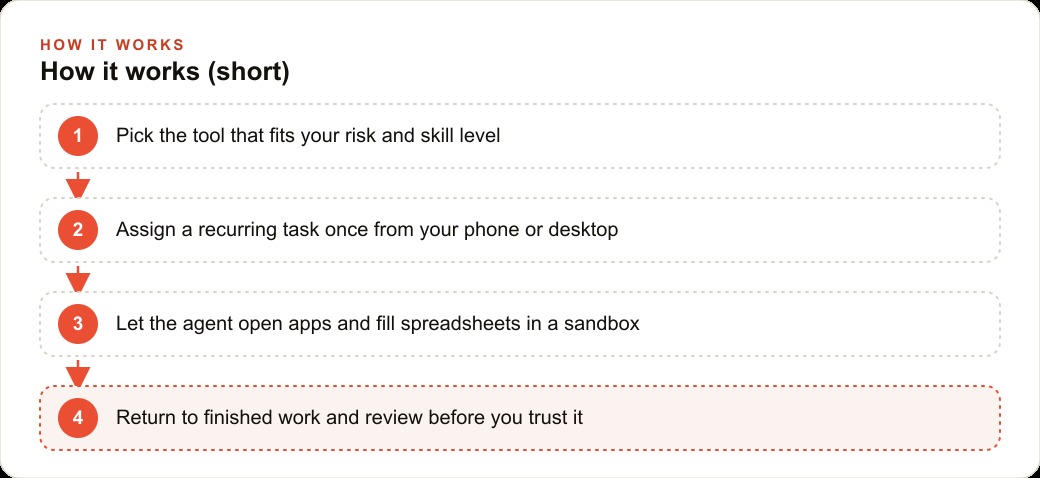
Anthropic's response was Claude Cowork and the Dispatch feature. Cowork is a persistent agent environment where you assign tasks once and the agent carries them out on a schedule. Dispatch lets you trigger that work from your phone, switch your attention to something else, and come back to finished results on your desktop. Tell it once to scan email every morning or pull a report every Friday, and it handles it. Alongside these, Anthropic shipped a computer use preview inside Cowork and Claude Code, where the agent opens applications, navigates the browser, and interacts with on-screen elements the way a person at a desk would. Currently Mac-only and in research preview, but the direction is clear.
The most balanced assessment of this release is that it delivers roughly 90 percent of what people actually used OpenClaw for, with substantially lower security risk. That 90 percent figure is meaningful. The core value of OpenClaw for most users was persistent task scheduling, computer access, and not having to set up a separate local machine. Cowork handles all three in a hosted environment that requires no installation, no self-hosting, and no command-line configuration. For the majority of business owners who were attracted to OpenClaw but held back by the technical setup, Cowork is the practical path in.
The 10 percent that remains with OpenClaw is not noise. It is where OpenClaw's advantages are most distinctive, and each of those advantages is worth understanding before you commit time and data to either option.
The sandbox is not a limitation; for most businesses it is the entire point
Claude Cowork runs on its own sandboxed virtual machine. When the agent opens a browser, fills a form, or reads a file, it does so inside a contained environment that is separated from your main machine and its data. A mistake, whether from a misunderstood instruction or a malicious injection through a document the agent is reading, has a limited blast radius.
Many people encounter the sandbox description and immediately frame it as a restriction. That framing is backwards for most business contexts. The sandbox is the feature, not the compromise. A business owner whose agent is sorting emails, filling spreadsheets, and managing calendar entries is dealing with data that belongs to real people: customers, clients, employees. The agent is touching the most sensitive information in the operation. A sandbox that limits the consequences of an error is exactly the right design for that kind of access.
The contrast with OpenClaw's full system access is worth making explicit. OpenClaw can do everything on your machine, and that power is genuinely useful for complex workflows. But it also means a clever instruction embedded in an email the agent is reading could, in theory, instruct it to do something harmful with your file system. Prompt injection attacks targeting autonomous agents are a real and studied category of vulnerability. In a sandboxed environment, the worst outcome of such an attack is a confused output in the agent's workspace. In a full-system-access environment, the outcome depends on what the injected instruction said to do.
For a small business running financial records, client information, and operational data on the same machine, that risk profile difference is significant enough to make the hosted sandbox the better starting choice.
OpenClaw's full system access is its greatest strength and its most serious risk
OpenClaw's full system access means the agent can read, write, move, or delete any file on your machine. It can open any application. It can run terminal commands. It can interact with your operating system at a depth that Claude Cowork's sandbox does not allow. For certain categories of work, this power is genuinely necessary and there is no substitute for it.
Developers using OpenClaw for code generation workflows can have the agent build, test, and commit code autonomously. Researchers can have the agent download datasets, process them in local scripts, and write results to disk without any hosted environment in the middle. System administrators can run maintenance scripts, rotate logs, and audit configurations through the agent interface from anywhere. These are real use cases that the sandbox prevents, and they represent the technical power user cases where OpenClaw retains a clear advantage.
The risk is proportional to the power. An agent with full system access that receives a bad instruction, whether from user error or from a malicious injection in content the agent is processing, can cause harm at the scale of a person sitting at the machine with full privileges. A deleted folder. A sent email you did not intend to send. A file moved to the wrong location. The consequences are real and sometimes irreversible. The risk management approach for full system access requires deliberate configuration of what the agent is allowed to touch, careful review of what it does, and awareness of what content it is reading when it has full permissions active.
Full system access is the right tool for technical users with specific workflows that require it. For a non-technical business owner who wants to automate inbox management and spreadsheet updates, it is a significant risk that is not justified by the task.
The memory advantage still belongs to OpenClaw and it compounds over time
Memory is where OpenClaw has the clearest structural advantage over Claude Cowork, and it is the feature that makes longtime OpenClaw users most reluctant to switch. OpenClaw saves context locally and builds it over time. Every interaction, every preference you express, every piece of personal or business context you share with the agent goes into a local memory store that persists across sessions and grows richer with each use.
The practical experience is an agent that becomes more accurate about your preferences over time. It knows which email tone you use with different clients. It knows which categories of expense to flag versus approve. It knows the personal medical context you shared six months ago and references it when you ask a related question now. That accumulating personal context is what makes some users describe OpenClaw as feeling like a collaborator rather than a tool.
Claude Cowork handles context differently. It maintains context within a session and can reference information from prior conversations in some configurations, but it does not have the same locally persisted, continuously growing memory architecture. The difference matters most for users who want an agent that becomes more personalized over time rather than remaining at a consistent general capability.
For a business owner, the memory advantage translates into an agent that requires less re-briefing over time. Early in OpenClaw usage you spend time explaining your preferences and business context. Later, the agent already knows them and you spend that time on the task instead. That compounding personalization is a genuine feature, and it is the most cited reason that users who try both tools often return to OpenClaw for their most context-dependent work.
Model freedom matters more than most owners realize until they hit a lock-in moment
Claude Cowork is built on Claude. That is both its advantage (the agent and model are developed by the same team and tuned for each other) and its constraint (you are using Claude, and you pay Anthropic's pricing for every token). If a task you need to automate turns out to work better with a different model, you are working within the platform's constraints.
OpenClaw is model-agnostic. You can configure it to use any API-accessible model, from the major commercial providers to open-source models running locally. That flexibility means you can choose the fastest model for a quick categorization task, the most capable model for a complex research job, and the cheapest model for a high-volume repetitive task, mixing models based on the job's requirements. As new models are released, you can switch to them without waiting for a platform update.
The lock-in moment that makes model freedom feel important is when you have built a workflow around one model's capabilities and then discover that a newer or differently-designed model handles your specific task significantly better. In a model-agnostic system, you update the configuration and continue. In a single-model platform, you wait for the platform to adopt the capability or rebuild the workflow elsewhere.
For a business owner just starting with AI tools, model freedom matters less than getting started quickly with something reliable. For a business owner who has been running AI tools for a year and has developed opinions about which models handle which tasks best, model freedom becomes a real operational consideration that affects both cost and output quality.
Hardware flexibility keeps OpenClaw relevant on platforms Cowork cannot reach
Claude Cowork's computer use feature currently runs on Mac desktop. OpenClaw runs on Linux, Mac, Windows, headless servers, and hardware as small as a Raspberry Pi. That hardware range matters for two different types of use cases.
The first is business infrastructure that runs on non-Mac hardware. Many business servers run Linux. Many Windows workstations are used for operations work. If your business's operational machine is not a Mac desktop, Claude Cowork's computer use feature is simply not available in its current form. OpenClaw on Linux or Windows handles those environments today.
The second is edge hardware deployment. A Raspberry Pi running OpenClaw can serve as a dedicated local agent for a specific function: managing a security camera system, running intake processing for a physical location, or handling automation tasks for equipment that operates continuously. The cost of that hardware is minimal. An agent running on it 24 hours a day for a specific operational task is a legitimate deployment pattern that Claude Cowork's hosted model cannot replicate.
Hardware flexibility also matters for privacy-sensitive industries. A medical office, a legal firm, or a financial advisory business might have regulatory reasons to keep agent processing entirely on-premises. A local deployment on their own hardware, running an open-source or API-connected model they have evaluated, keeps all data within the environment they control. The hosted cloud option sends information off-premises to Anthropic's infrastructure, which creates compliance questions in regulated industries.
The big-tech acquisition pattern tells you where this competition is heading
The pattern worth naming here is one of the most consistent in technology business history. An independent product demonstrates strong demand for a new capability. A large, well-resourced company with an adjacent product observes that demand and rebuilds the capability natively within their existing platform. The independent product either gets acquired or loses the mainstream market while retaining a specialized user base.
Twitter and TweetDeck is one version of this. Salesforce and third-party CRM add-ons is another. Instagram and Snapchat Stories is a third. In each case, the original independent product created something people wanted, a large platform rebuilt it, and the original product either got bought or retained users whose needs exceeded what the native implementation offered.
OpenClaw is a strong enough cultural and technical phenomenon that it survived the first wave of this pattern. The fact that it became the fastest growing open-source project ever means it has a large community and ongoing development investment. It will not simply disappear because Anthropic shipped Cowork. But the mainstream of business users who were curious about OpenClaw but not technically prepared to set it up will default to the hosted option. OpenClaw's continued relevance depends on it maintaining genuine advantages in memory, model flexibility, and hardware reach, which it currently does.
For business owners, the strategic reading of this pattern is simple. Start with the hosted option because it is accessible, lower risk, and adequate for the majority of use cases. Add the local option only when a specific requirement makes it the better tool for a specific job. The pattern tells you that hosted will eventually match most of what local can do, but "eventually" is still years away for the memory and model flexibility features.
For a small business, the right starting point is hosted first and local only when you have a specific reason
A property management company that manages 50 residential units across three buildings illustrates where the hosted approach wins clearly. The work is mostly repetitive screen tasks: reviewing maintenance requests, sorting them by property and urgency, drafting replies to tenants, filling the owner-statement spreadsheet, assembling the monthly delinquency list.
Using Claude Cowork with Dispatch and computer use, I would set up a morning scan of the maintenance inbox. The agent sorts new requests by property and urgency using categories the manager defined in advance. It drafts replies to routine requests for manager approval before anything goes to tenants. It opens the owner-statement spreadsheet, pulls the month's known expenses, and fills the recurring line items. It assembles the Friday delinquency list from the rent ledger. The manager reviews a morning summary and approves the replies rather than doing each task from scratch.
The 3 hours per day of repetitive screen work becomes a 30-minute morning review. That time recovery is real and it happens quickly because the hosted setup requires no local configuration, no spare machine, and no API key management. The sandbox matters here because the agent is touching financial records belonging to real tenants and property owners. A full-system-access agent on the same machine as those records introduces risk that is simply not necessary for this set of tasks.
The local option becomes relevant for this company only if they later decide they need the agent to have persistent memory of each owner's communication preferences, or if they want to run a specific local model to keep financial data entirely off external servers. Both are legitimate reasons to add a local deployment later. Neither requires doing it from day one. The sequence matters: start with hosted, build a track record, and identify the specific capabilities that would add real value beyond what hosted delivers. Then add local as a targeted expansion, not as a starting requirement.
That is exactly what we do at AI DOERS. Book a private 30-minute call with Madhuranjan Kumar and we will map the fastest path to it for your specific business.
Book your call →
Madhuranjan Kumar
Madhuranjan Kumar brings 20 years of performance-marketing experience and has managed over $200 million in Facebook ad spend for brands across the United States and beyond. His expertise spans the full modern marketing stack: Meta, Google Ads, TikTok, email automation, CRM, and the websites that hold it together. At AI DOERS he turns that track record into lead-generation systems for businesses across every industry.