
DeepSeek R1 and the Real Start of the Reasoning Model Era
DeepSeek R1 is an open-source reasoning model that matches OpenAI o1 at roughly 96% lower cost and even runs on a local machine. Here is what reasoning models change, and how a small business can put one to work without overpaying.

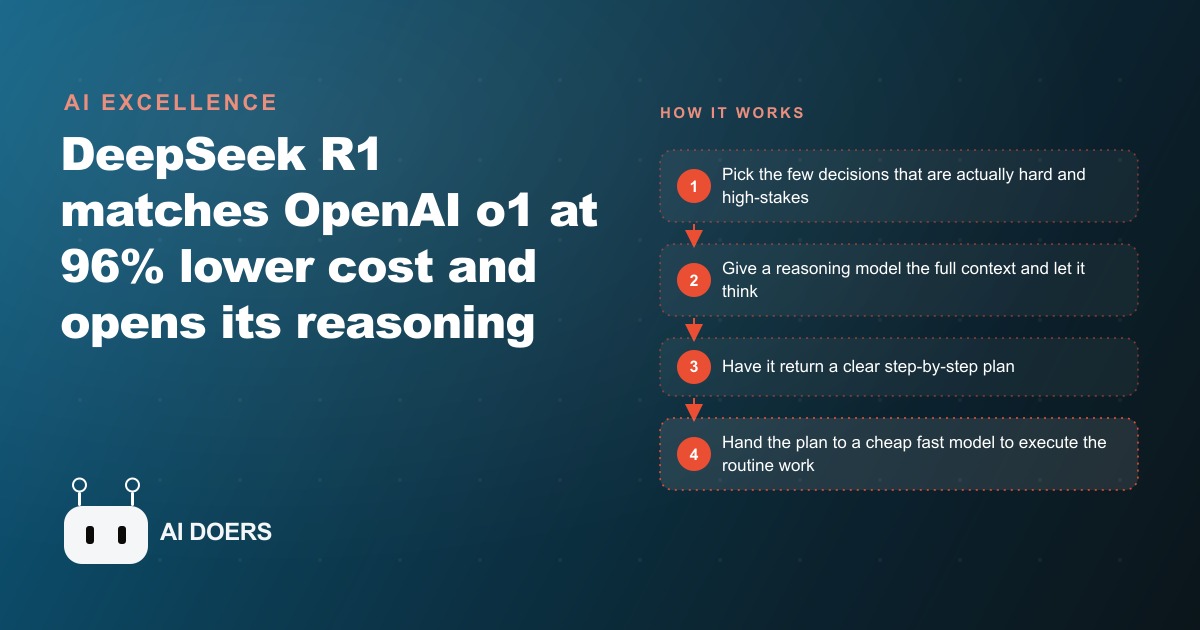
A model that thinks longer produces a better answer, and DeepSeek R1 is the release that made that idea cheap enough for anyone to use. It matches OpenAI o1 on performance at roughly 96 percent lower cost, ships as open source, and even runs on a local machine with a CPU that has at least 48 gigabytes of RAM. I am Madhuranjan Kumar, and I want to take reasoning models apart from an angle most explainers skip: not what they are, but why the way they think changes the economics of running a small business. The interesting part is not that R1 is cheap. It is that a genuinely different kind of intelligence just became affordable, and using it well means using it differently.
The one shift under everything: thinking time is now a dial you turn
The idea at the center of this era is almost too simple to sound important. The longer a model spends reasoning before it answers, the better its result tends to be. For years the only way to make a model smarter was to feed it more training data during its initial build. That approach is hitting a wall, because the world is running out of fresh high-quality data to feed. Reasoning models route around that wall by spending more compute at the moment of answering instead of only at the moment of training.
This is why the era arrived now and not two years ago. Intelligence used to be baked in once and frozen. Now a portion of it is a dial you turn at the moment you ask a question, by letting the model think for longer. That reframes the whole cost conversation. You are no longer paying a fixed price for a fixed brain. You are choosing, task by task, how much thinking to buy. Understanding that single shift is what separates owners who overspend on AI from owners who spend almost nothing and still get sharp answers where it counts.
What "reasoning" actually is when you look inside
Strip the marketing away and a reasoning model does something concrete: it writes a long, high-quality internal chain of thought before it commits to a final answer. Instead of blurting out the first plausible response, it stops and re-checks whether its approach is even right. It breaks a problem into smaller steps. It tries several strategies and compares them before choosing one. That internal deliberation is the reasoning, and it is why these models feel less like autocomplete and more like a careful colleague working through a problem on paper.
The facet that fascinates me most is that nobody hand-coded this behavior. The DeepSeek team did not write rules that said "re-check your work" or "explore alternatives." They simply rewarded longer, higher-quality reasoning during training, and the reflection and exploration emerged on their own. The model taught itself to think. For a business owner, the practical read is that you now have access to a model that genuinely plans rather than one that merely predicts the next word, and that difference is exactly what makes it worth a higher per-answer cost on the right tasks.
Why openness matters more than the price cut
The 96 percent cost reduction grabs the headlines, but the more durable facet is openness, and it works on two levels. First, DeepSeek published how R1 was built, so the method itself is out in the open rather than locked in one lab. Second, and more usefully, R1 shows its reasoning openly instead of hiding it. That matters because a model that reveals its high-quality chain of thought can have that thinking distilled into smaller, cheaper models trained for specific jobs. Closed models that hide their tokens prevent exactly this. Open reasoning tokens are what let a small business shrink a frontier-grade capability down onto affordable hardware.
Add the local option and the picture sharpens. A distilled version runs on your own computer if you have a CPU with at least 48 gigabytes of RAM. Put the three pieces together, open weights, an open method, and a version that runs locally, and you get more than a discount. You get frontier-grade thinking that never has to leave your building, which is the difference between an interesting demo and something you can safely point at real business data.
The counterintuitive facet: how you prompt a thinker is backwards from what you learned
Here is the part that trips up almost everyone coming from older models. The prompting tricks that made GPT-4 shine often hurt reasoning models. Elaborate few-shot examples, hand-written chain-of-thought scripts, and heavy critique instructions were the standard toolkit, and with a reasoning model they get in the way. Research showed that zero-shot prompting, simply stating the task plainly, gives the best results for o1-class models, because the model already does the step-by-step thinking internally and your scaffolding just clutters it.
The specifics are worth memorizing. One or two examples help, but five degrade the output, so include only the most relevant context and stop. Telling the model to think carefully and spend as much time as it needs raised reasoning tokens by 16 to 30 percent and lifted accuracy, while asking it to hurry lowered both. So the counterintuitive rule is: say less, then tell it to take longer. If your instinct from the older era is to over-specify, you will make a reasoning model worse. This facet alone is worth the price of understanding the technology, because it changes how you talk to the tool every single day.
The pattern that saves the money: plan expensive, execute cheap
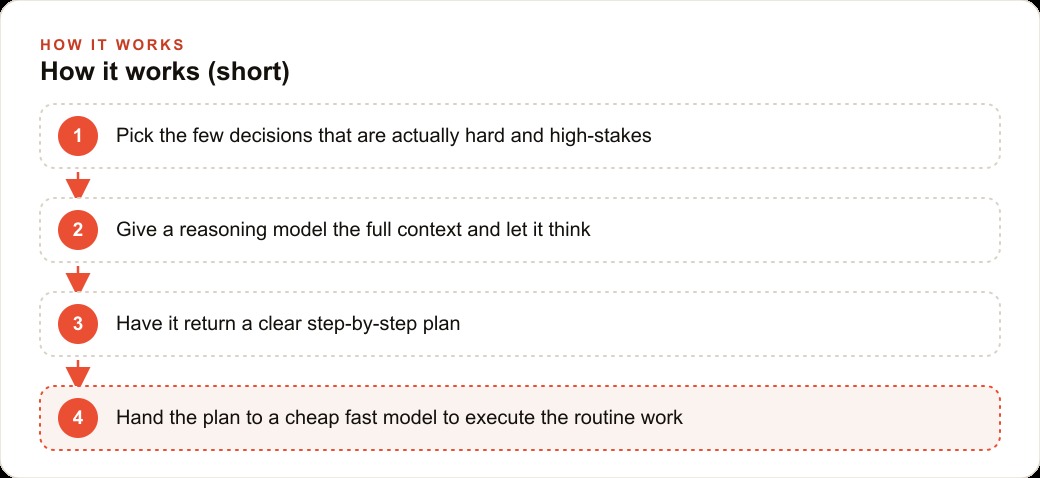
Everything above points to one operating pattern, and it is the one I set up most often. Reasoning models trade speed and cost for intelligence, which means they are wasteful on routine work like drafting a quick reply or sorting an inbox. Keep cheap, fast models for that. Save the reasoner for the few steps that genuinely benefit from deep thinking, then hand its output to a cheaper model to carry out.
Concretely, that means letting a reasoning model like R1 or o1 write a detailed step-by-step plan, then passing that plan to a fast, inexpensive model to do the routine execution. You get most of the intelligence at a fraction of the cost. This split is also why reasoning models pair so naturally with agent workflows: for a logistics-style agent juggling twenty or thirty tools, the reasoner designs the sequence and a cheaper model makes the actual calls. The leads and outputs those workflows produce can flow straight into your CRM and website stack, so the expensive thinking happens once and the cheap execution scales underneath it.
Worked example: a roofing company that runs on a plan instead of a scramble
Let me make this concrete with a roofing company, using illustrative numbers to show the economics.
The owner's hardest weekly problem is scheduling and sequencing: which crew goes to which job, in what order, around weather, material deliveries, and inspection windows. That is exactly the multi-step planning a reasoning model is built for. I would give R1 the full context, the open jobs, crew sizes, drive times, the weather forecast, and material lead times, and let it think through the week. It returns a clear day-by-day plan: this crew starts the tear-off Monday because rain clears by ten, that job waits until shingles land Wednesday, this inspection gets booked Thursday afternoon. The reasoning model does the hard thinking once.
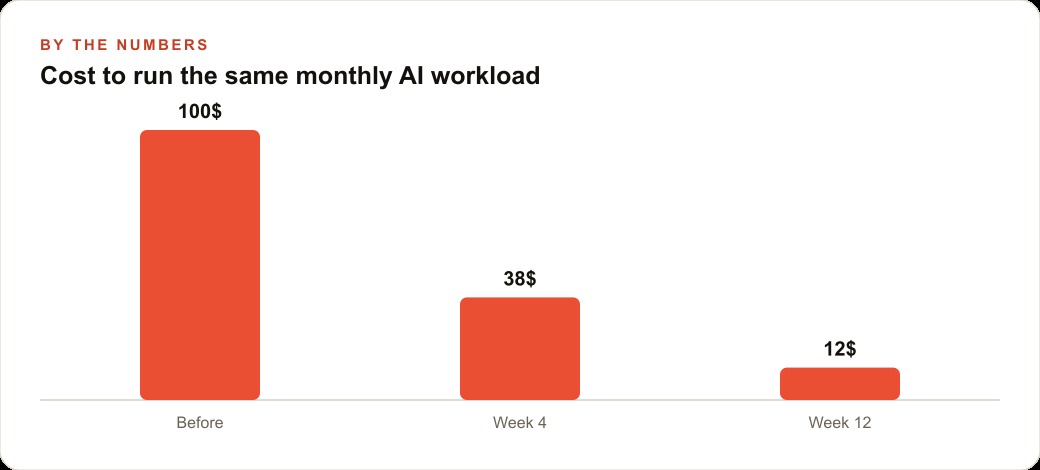
Then the cheap fast model does the rest. It takes that plan and turns it into crew text messages, customer appointment confirmations, and a materials order, none of which needs deep thought. On the numbers, imagine the company was running its whole AI workload through a single premium model at about 100 dollars a month. By routing only the weekly planning and the occasional tricky estimate to the reasoner, and everything else to a cheap model, that bill falls toward 38 dollars by week four and closer to 12 dollars by week twelve, while the output actually gets sharper because the hard problems finally get real thinking. The same split works for bidding: let the reasoner work through an estimate where roof pitch, access, and tear-off complexity all interact, then let the cheap model format the quote and write the follow-up. And when you prompt the reasoner, remember the counterintuitive rule, state the task plainly, give one or two examples at most, and tell it to take its time.
The distillation angle most owners overlook
There is one more facet worth taking apart, because it quietly changes what a small business can afford to run. Because R1 generates high-quality reasoning openly, that reasoning can be used as training material to teach smaller models a specific skill, a process called distillation. A big, expensive reasoner effectively tutors a small, cheap one on exactly the kind of problem you care about, and the small model inherits a surprising amount of the thinking. Closed models that hide their tokens make this impossible, which is why open reasoning is more than a philosophical nicety. It is the mechanism that lets frontier-grade judgment trickle down onto hardware a normal business can own.
For an owner, the practical read is that you are not locked into paying premium rates forever. Today you might run the full reasoner for a hard weekly decision. As the ecosystem matures, a distilled model trained on that exact class of decision can handle more of it locally, on your own machine, for nothing per token. The direction of travel is toward cheaper, more private, more specialized reasoning, and the businesses that start building the plan-then-execute habit now will be positioned to ride that curve down as it keeps falling. You do not need to run a distillation yourself to benefit. You just need to understand that the openness of R1 is what makes the whole cost curve bend in your favor, and to design your workflow so it can swap in cheaper models underneath without changing how you work.
This is also why I tell owners not to over-invest in any one provider's proprietary tricks. The durable skill is knowing which of your decisions deserve real reasoning and how to prompt a thinker plainly. That skill transfers across every model, open or closed, local or cloud, and it is the part that keeps paying off as the underlying models get cheaper year after year.
What this changes for a normal business
The lesson underneath DeepSeek R1 is not "AI got cheaper." It is that a model which genuinely plans is now affordable, private, and controllable, and that the way you use it is different from everything you learned in the chatbot era. You point it at the two or three decisions a week that are actually hard, you prompt it plainly and let it think, and you let a cheap model handle everything downstream. That discipline is what keeps a monthly AI bill small while the quality of your decisions climbs. The clearer thinking also tends to show up in the parts of the business you measure, from cleaner scheduling to tighter follow-up across Facebook and Instagram ad campaigns where a well-planned promotion beats a rushed one.
If there is one sentence to carry out of all this, it is that a reasoning model rewards restraint. Point it at fewer things, feed it less scaffolding, and give it more time, and it repays you with genuinely better judgment on the decisions that actually shape your week. The businesses that treat it like a faster chatbot will overspend and underuse it. The ones that treat it like a specialist consultant, brought in only for the hard calls and briefed plainly, will get frontier-grade thinking for a fraction of what it used to cost. That is the whole opportunity DeepSeek R1 opened, and it is available to a small business today, not someday.
You can set this up yourself, and I would encourage any owner to try it on one real decision this week. If you would rather have someone identify exactly where reasoning pays off in your business, wire up the plan-then-execute split, and get the prompts right the first time, that is the kind of build I do for clients, and you can bring me in to handle it.
That is exactly what we do at AI DOERS. Book a private 30-minute call with Madhuranjan Kumar and we will map the fastest path to it for your specific business.
Book your call →
Madhuranjan Kumar
Madhuranjan Kumar brings 20 years of performance-marketing experience and has managed over $200 million in Facebook ad spend for brands across the United States and beyond. His expertise spans the full modern marketing stack: Meta, Google Ads, TikTok, email automation, CRM, and the websites that hold it together. At AI DOERS he turns that track record into lead-generation systems for businesses across every industry.