
DeepSeek R1 Puts Boardroom-Grade AI Reasoning in the Hands of Every Small Retailer
A Chinese AI lab built a reasoning model that matches OpenAI o1 at 5% of the cost, and the open-source release means retail store owners can use it free or deploy it privately right now.

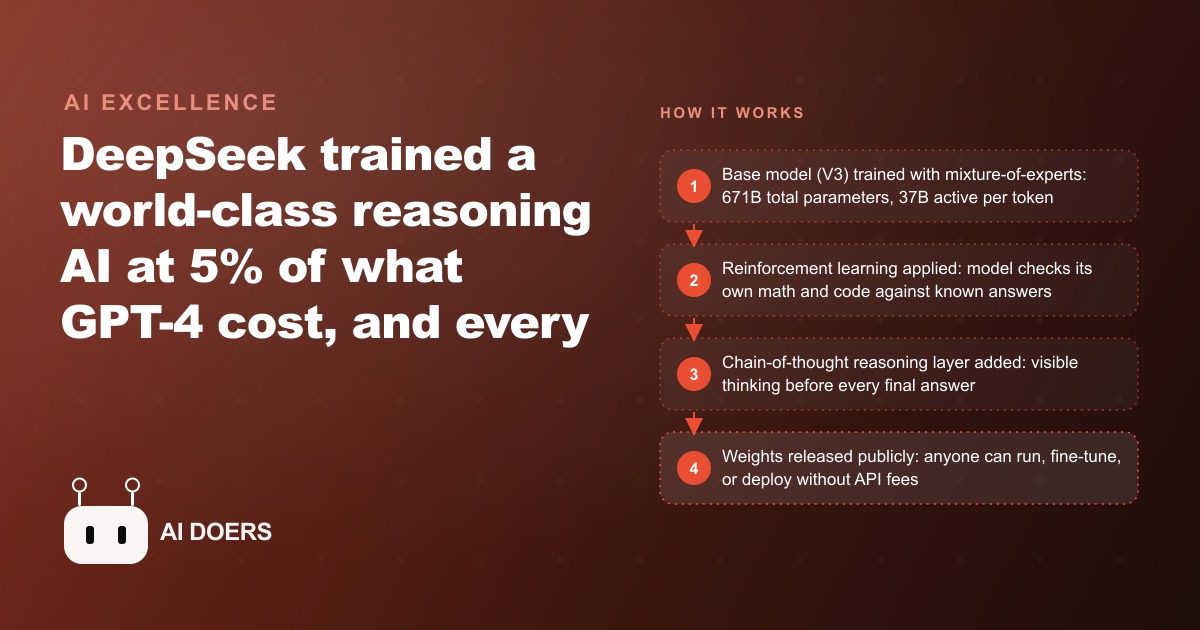
On January 27, 2025, Nvidia lost approximately $465 billion in market capitalization in a single trading session. The cause was not a product recall, a regulatory fine, or a missed earnings report. It was a benchmark result published by a Chinese AI research lab that most people outside the industry had not heard of three months earlier.
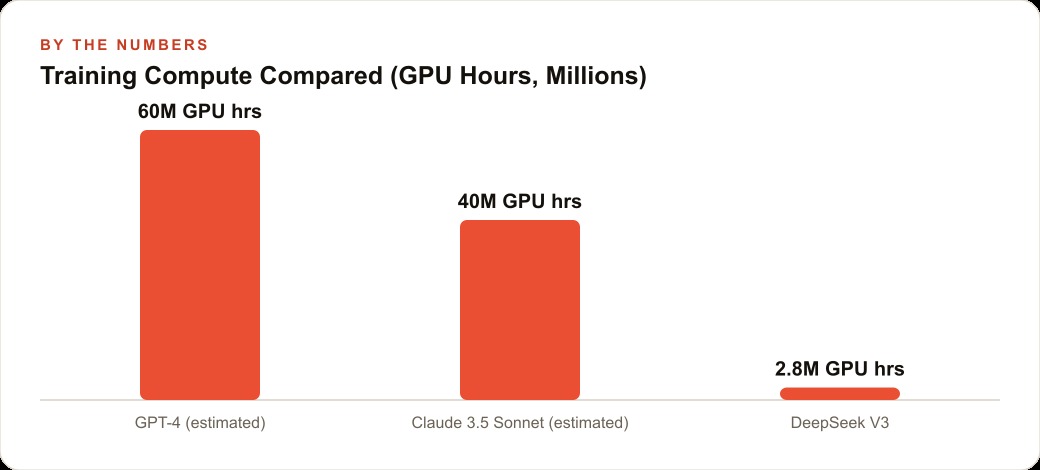
The lab was DeepSeek. The finding was that their model, R1, had matched OpenAI o1 across standardized evaluations of mathematics, coding, and complex reasoning, and it had done so after training on roughly 5 percent of the estimated compute budget for GPT-4. Investors who had built significant positions on the premise that frontier AI required ever-larger GPU clusters saw that premise challenged before most of them had finished reading the summary.
What happened that morning was not primarily a story about AI capabilities. It was a story about economics. Specifically, it was a story about what happens when the cost of a critical resource falls by an order of magnitude, and about why history suggests that cheaper access to a resource does not reduce its consumption. It expands it.
The Day a Benchmark Result Moved $465 Billion
The scale of the market reaction is worth sitting with, because it reveals something about the expectations that had been priced in before that January morning. Those expectations rested on a specific chain of reasoning: frontier AI requires large models, large models require enormous compute, enormous compute requires Nvidia GPUs, therefore AI growth means GPU demand grows indefinitely. The logic was not unreasonable. Every major frontier release through 2024 had required more compute than the previous one, and no ceiling was visible.
DeepSeek's training numbers broke that chain at the second link. The V3 base model, which underpins R1, trained in approximately 2.78 million H800 GPU hours. Estimates for GPT-4 training run around 60 million GPU hours. That is not an incremental efficiency improvement. It is a factor of more than twenty.
Several analysts and technology executives disputed the claim quickly. One prominent executive estimated that DeepSeek had actually used around 50,000 H100 chips, which are subject to US export restrictions to China, but attributed the training to the export-compliant H800 for regulatory reasons. A major investment bank raised similar doubts. The dispute matters for evaluating the precise training cost, but it does not change the practical situation: the model exists, its performance is verifiable, and its weights are publicly available regardless of how you interpret the training cost claims.
The concept that makes sense of what followed is the Jevons Paradox. In 1865, the economist William Stanley Jevons observed that when James Watt's steam engine dramatically improved coal efficiency, coal consumption did not fall. It tripled. Cheaper and more efficient access to steam expanded the number of applications for steam, which expanded total coal consumption. The same pattern has repeated through every major resource cost collapse in the industrial era: electricity, computing, telecommunications, data storage.
Cheaper frontier AI follows the same logic. The businesses that could not previously justify an enterprise AI contract will run the free tier. The use cases that did not exist at $0.06 per 1,000 tokens exist at $0.006 per 1,000 tokens. The class of problems that required a dedicated data science team becomes approachable for a single operator with a workstation. Total consumption goes up. The Nvidia selloff priced in a static demand interpretation. The Jevons reading suggests total AI compute demand rises as the marginal cost of AI reasoning falls, because the number of viable applications multiplies faster than the cost per application drops.
What 37 Billion of 671 Billion Parameters Actually Means
The technical architecture that made the training economics possible is a method called mixture of experts. Understanding it at a rough level explains both the cost efficiency and the practical deployment characteristics that make R1 accessible to organizations without enterprise budgets.
In a standard dense language model, every parameter in the network activates for every token the model processes. A model with 70 billion parameters fires all 70 billion of them for each token, at each step. The compute cost scales directly with the total parameter count. This is why larger dense models are both more expensive to train and more expensive to run in production.
Mixture of experts changes the architecture by organizing the network into specialized sub-networks, each trained to handle a particular kind of input. For any given token, the model's routing mechanism sends that token to the most relevant subset of these specialists, and only those specialists activate. The rest of the network stays dormant.
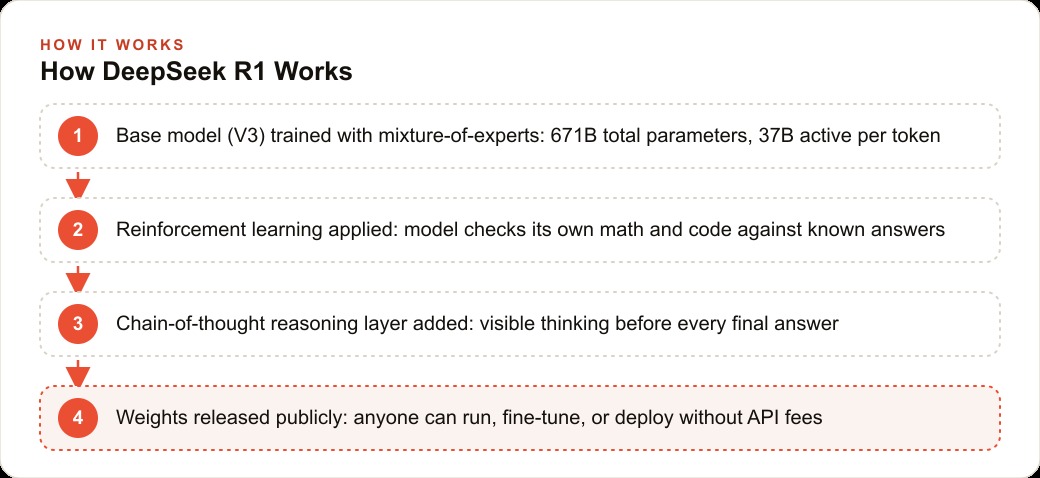
DeepSeek V3 contains 671 billion total parameters organized across many expert sub-networks, but only approximately 37 billion of those parameters activate for any single token. The routing mechanism identifies the relevant specialists, the token passes through them, and the next token is processed. The model has the total capacity of a 671 billion parameter system without paying the compute cost of activating all 671 billion on every step.
The savings at training time are direct. Training a 671 billion parameter dense model would require roughly 18 times the compute of training a 37 billion parameter model at comparable efficiency. By activating only the relevant experts per token, DeepSeek achieved a training budget that was a fraction of what a comparable dense model would have cost. The quality of the routing mechanism is a significant technical contribution, because poor routing sends tokens to irrelevant experts and wastes the specialization advantage entirely. The model's competitive benchmark performance suggests the routing is working well.
At inference time, the same efficiency carries through. Running a 37-billion-active-parameter workload on local hardware is tractable for a business with a current-generation workstation. Distilled versions of R1 run at approximately 63 tokens per second on a modern consumer GPU, which is sufficient for most business analysis tasks. The alternative, running a full-scale dense model with no local deployment option, would require either expensive cloud API spending or hardware that falls outside the budget of most small and mid-size organizations.
How the Training Method Built Visible Reasoning Into the Model
The R1 layer adds a second technical contribution on top of the V3 base. Where V3 was trained primarily on next-token prediction across a large text corpus, R1 was trained using reinforcement learning on tasks with objectively verifiable correct answers.
The process runs as follows. The model receives a problem, a mathematics question or a coding task, with a known correct answer. The model produces a response. Correct responses receive a reward signal. Incorrect responses do not. Across many iterations and many problems, the model learns the reasoning patterns that lead to correct answers and unlearns the patterns that produce confident but wrong ones.
What emerged from this process, without being explicitly designed into the training, is a visible chain of thought. When you engage R1 in deep think mode, the model produces a thinking section before its final answer. You can watch it work through the problem step by step, consider and discard approaches, identify errors in its own intermediate reasoning, and arrive at a conclusion. The thinking is not added for presentation purposes. It is the actual reasoning process the reinforcement learning developed, now surfaced in the output.
This matters for two practical reasons. First, the visible reasoning allows you to audit the model's work before acting on the result. If R1 is calculating a supplier cost comparison and makes an arithmetic error in step four of its reasoning, that error is visible in the thinking output. You catch it before it propagates into a purchasing decision. A model that delivers a confident wrong answer with no visible reasoning process is considerably harder to catch. Second, because the training rewarded verifiably correct answers on math and code specifically, the model is particularly strong on tasks with objective outcomes. It earned its benchmark scores on exactly the categories of analysis most useful for business operations: financial calculations, logical comparisons, structured data analysis.
The access path at the free tier is simple. Navigate to deepseek.com, log in with a Google account, and toggle the deep think option before submitting a prompt. No subscription is required. The thinking panel appears above the final answer and updates in real time as the model reasons through the problem.
What Open Weights Mean for a Retailer Running Their Own Hardware
The third significant feature of R1, distinct from the training efficiency and the reasoning capability, is that the model weights are publicly available for download and local deployment. Any developer can pull the weights, run them on hardware they control, and use the model without sending data to a third-party server and without paying per-call API fees indefinitely.
For a retailer handling data that carries genuine competitive value, this is the most commercially important feature of the release. When a business uses a cloud AI service, every prompt and every document pasted as context travels to that service's servers. For analysis involving supplier contract terms, current inventory positions, promotional pricing under development, or customer purchase histories, the exposure is real. In competitive markets where supplier relationships and pricing strategy are meaningful advantages, sending that information to an external service is a risk some organizations are not comfortable accepting regardless of the provider's privacy policies.
Deploying a distilled R1 version locally eliminates the exposure. The model runs on hardware in the business's own building, on a network the business controls, with data that does not leave. A distilled 70 billion parameter variant runs comfortably on a workstation with a modern GPU. The 7 billion parameter variant runs on considerably less powerful hardware. LM Studio, a free desktop application, handles the model loading and provides a usable chat interface that works entirely offline after the initial download.
Consider how a mid-size retailer with approximately 400 SKUs across three product categories, sourcing from eight suppliers, would use this in practice. Each quarter, those suppliers send updated price lists. Comparing the lists to find the optimal order allocation, accounting for minimum order quantities, freight cost differences across suppliers, and payment term variations, is a multi-hour spreadsheet task that typically falls to the owner or an operations manager during an already busy week.
With a local R1 deployment, the process changes. The price lists, formatted as plain text or CSV, go into a structured prompt asking the model to calculate the total landed cost per unit for the top 80 SKUs across all eight suppliers, flag any item where switching suppliers saves more than 8 percent at current order volumes, and identify the five suppliers where the business has the most spend concentration. The reinforcement-learned math accuracy means the calculations come back with a reasoning trail you can audit rather than a spreadsheet to re-check manually. Because the model is running locally, none of the supplier pricing data leaves the building.
In illustrative terms, a process that previously required four to six hours of spreadsheet work completes in under an hour of supervised AI session time, with human effort spent reviewing the model's reasoning rather than performing the calculations. Across four quarterly price reviews in a year, the time recovered is meaningful on its own. The same local deployment handles other data-sensitive tasks: margin modeling using actual invoice data, demand forecasting using real sell-through history by SKU, analysis of customer purchase patterns from the full POS export rather than a manually sanitized summary prepared specifically to avoid sharing sensitive information externally.
The economics of local deployment favor adoption. The distilled R1 model is free. LM Studio is free. The compute cost is electricity on hardware the business already owns. The annual all-in cost, once the setup is complete, is near zero. Comparable analytics capabilities in an enterprise contract, with data privacy guarantees and on-premises deployment options, would represent a significantly larger ongoing spend.
The broader story that R1 represents is a compression of the timeline between when a capability is available to well-funded institutions and when it becomes accessible to an independent retailer with a capable workstation. The Jevons Paradox has played out in every prior technology cost collapse. Businesses that build habits around these tools while the adoption gap is still meaningful accumulate a compound operational advantage, because their prompt libraries improve, their workflows mature, and their teams become more efficient with each iteration of a process that competitors are still handling manually.
That is exactly what we do at AI DOERS. Book a private 30-minute call with Madhuranjan Kumar and we will map the fastest path to it for your specific business.
Book your call →
Madhuranjan Kumar
Madhuranjan Kumar brings 20 years of performance-marketing experience and has managed over $200 million in Facebook ad spend for brands across the United States and beyond. His expertise spans the full modern marketing stack: Meta, Google Ads, TikTok, email automation, CRM, and the websites that hold it together. At AI DOERS he turns that track record into lead-generation systems for businesses across every industry.