
DeepSeek OCR: Why Turning Text Into Images Could Make Your AI Tools Far Cheaper
A new model compresses written text into images to fit roughly ten times more into an AI's memory. Here is what that means for any business that runs AI over piles of documents.

# 6 Categories of Business Documents Where Ten-Times Compression Changes What AI Can Afford to Read
Context windows cost money, and most businesses have far more documents than they can afford to feed into an AI model at any useful scale. The standard response to this constraint has been selective use: upload one document at a time, ask a narrow question, move on. What DeepSeek's image-based OCR compression approach changes is the denominator. If you can fit ten documents in the space that used to hold one, the economics of AI-assisted document review shift fundamentally for every category of business that runs on paperwork.
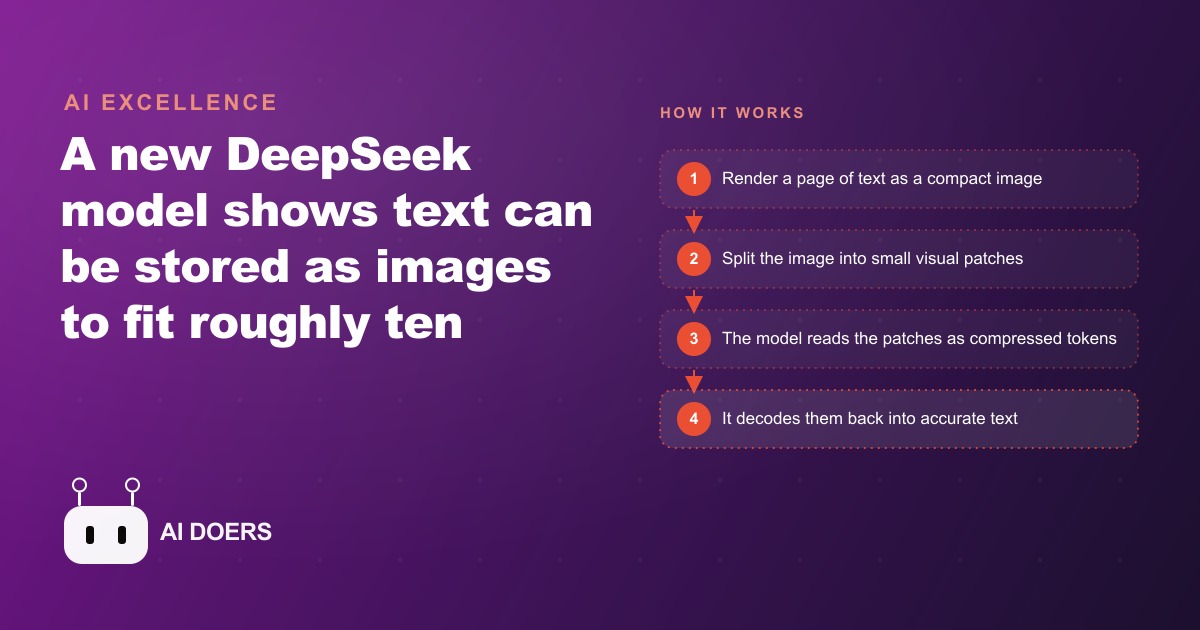
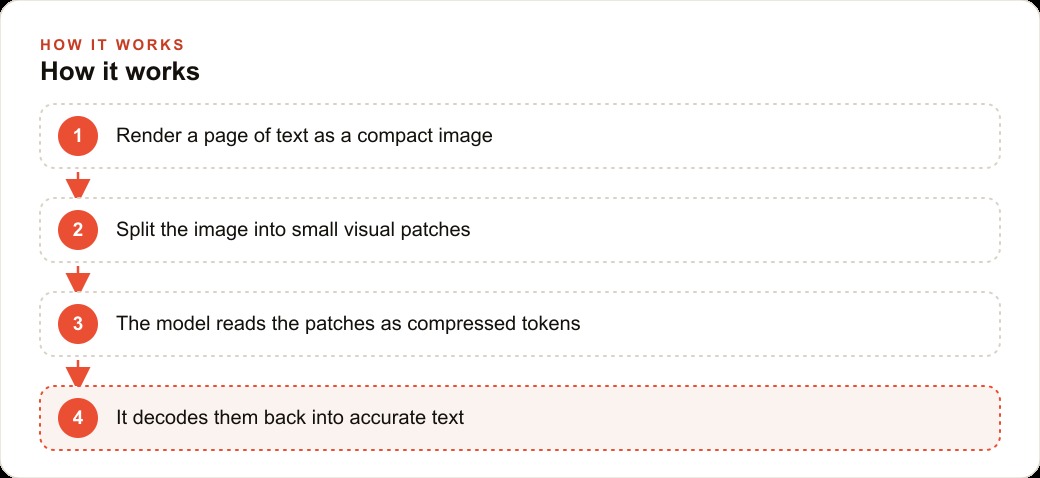
The approach treats text as a picture. Instead of converting a document to raw text and feeding that to a language model, the document is rendered as an image at a high compression ratio, and a vision-capable model reads the image directly. At a compression ratio of nine to ten times, accuracy stays in the ninety-six to ninety-seven percent range. At twenty times compression, accuracy drops to around sixty percent, which is too unreliable for most business use. The practical window is eight to twelve times compression, where cost per document drops dramatically and accuracy remains commercially useful.
Madhuranjan Kumar has been tracking how this kind of approach changes the business case for AI-assisted document processing across different industries. The categories below are the ones where the compression ratio changes not just the cost but what is practically possible.
Technical Equipment Manuals for Field Service Teams, Where the Document Volume Makes Traditional AI Lookup Prohibitive
Field service organizations carry a documentation burden that most office-based businesses do not. An HVAC company, a medical device repair firm, or an industrial equipment maintenance team needs technicians to have accurate, current technical information available at the point of service. The manuals exist. The problem is volume. A mid-sized HVAC company might maintain technical documentation for four hundred or more equipment models, each with a manual that runs a hundred pages or more. That collective library is too large to hold in any conventional AI context at current pricing.
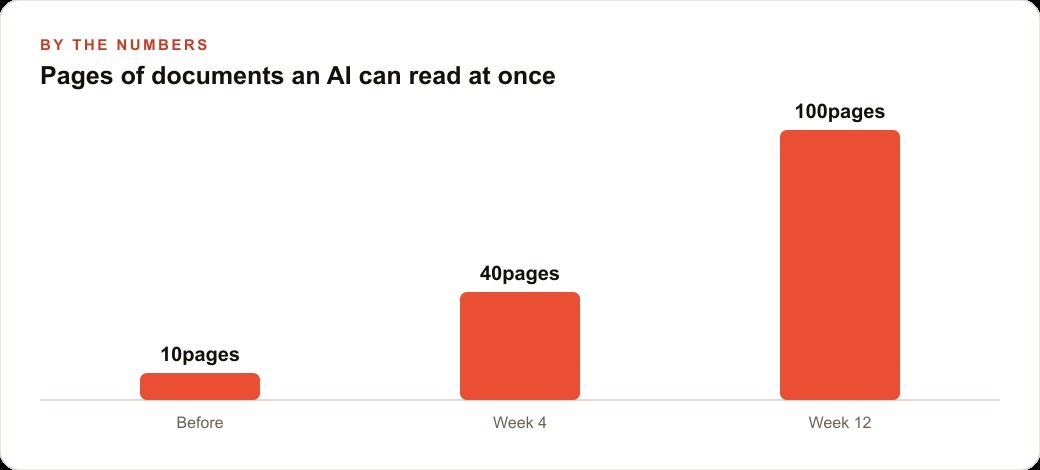
Image-based compression changes this in a specific way. A manual that previously required forty thousand tokens to feed to a language model in text form can be compressed into approximately four thousand to five thousand tokens as a vision input. At that ratio, the entire library of four hundred manuals fits into a context window that would have held forty at standard token pricing. An on-device lookup tool that queries the full library in real time becomes commercially viable where it was not before.
The document type is especially well suited to image-based compression because technical manuals are highly structured. Diagrams, parts lists, torque specifications, and circuit schematics are already visual by nature. A vision model reading a compressed image of a wiring diagram is reading the document in its native format rather than reading a text approximation of it. The accuracy advantage for structured technical content is material.
Legal Contracts for Professional Services Firms, Where Clause Comparison Across a Portfolio Is the Expensive Part
Law firms, consulting firms, real estate agencies, and any professional services organization that works with contracts faces a specific challenge that volume compression addresses directly. Individual contract review is manageable. Reviewing a portfolio of three hundred contracts for a specific clause, a change in liability language, or a renewal term that is about to expire requires either human hours or a technical solution that fits the whole portfolio in context simultaneously.
At current text-based token pricing, fitting three hundred standard commercial contracts into a single AI context session is expensive enough to be impractical for all but the highest-stakes applications. At ten times compression, the same portfolio becomes affordable to query in bulk.
Legal documents are well suited to image-based compression because their structure is highly regular. Standard indemnification language, governing law clauses, and termination provisions appear in consistent locations across contracts of the same type. A vision model reading a compressed image can locate structural elements by position and visual pattern as well as by content, which in some cases is faster and more reliable than pure text extraction.
The business application this enables is portfolio-level contract intelligence: asking which contracts in a set have a specific provision, flagging contracts that are missing standard language, or identifying expiration dates across a large renewal calendar without requiring a human to open each file individually.
Insurance and Compliance Records for Regulated Industries, Where the Audit Load Is Constant and the Documents Are Numerous
Regulated businesses carry compliance documentation burdens that are genuinely large in volume and genuinely serious in consequence. A healthcare practice, a financial advisory firm, a construction company, or a food manufacturer has to maintain documentation that demonstrates regulatory compliance across multiple programs simultaneously. The documents are not small, they accumulate continuously, and they need to be searchable on short notice when a regulator asks for them.
The practical limitation of AI-assisted compliance review has been the same as for other document categories: fitting a meaningful portion of the compliance library into context at one time is expensive. Image-based compression at nine to ten times makes it feasible to query the full compliance record rather than a curated subset.
This category is especially well suited to compression because compliance documents tend to be dense with structured information, forms, certificates, inspection records, and signed acknowledgments, where the data content is high relative to the prose content. A compressed image of a signed inspection form loses no meaningful information at a nine-to-one ratio because the informational payload of that document is contained in a small number of filled fields rather than in long prose passages.
Supplier Catalogs for Retail and Wholesale Buyers, Where the Purchasing Decision Depends on Cross-Catalog Comparison
Buyers at retail and wholesale companies spend a meaningful portion of their time comparing options across supplier catalogs. A category manager at a regional grocery chain might be working with catalogs from forty suppliers in a given product category, each running hundreds of SKUs with their own pricing structure, minimum order quantities, and lead time terms. Comparing these systematically requires either a custom data integration for every supplier, which is expensive and fragile, or manual review, which is slow and error-prone.
Supplier catalogs are unusually well suited to image-based compression because they were designed to be read visually. Tabular pricing, product photography with specifications listed below, and grid-layout product families are all formats that a vision model reads accurately even at high compression. The visual structure of a catalog communicates information in ways that a text extraction does not fully capture.
The business application is cross-catalog search and comparison at the time of a purchasing decision. Instead of asking a buyer to maintain a curated comparison spreadsheet that is always partially out of date, a compressed catalog library allows real-time queries: which suppliers have a specific SKU in stock, what is the lowest case price for a given product across all active supplier relationships, which catalog has the most current pricing for a seasonal item. These questions are answerable manually. The compression ratio changes whether answering them automatically is economically sensible for a company operating at mid-market scale.
Patient Records and Clinical Notes for Healthcare Practices, Where the Information Needed Is in the Document and the Stakes Are High
Healthcare is the document-intensive industry where the stakes of information retrieval failures are most visible. A clinical team managing a patient with complex history needs to be able to locate specific information across a record that may span years and dozens of individual documents. The challenge is not that the information does not exist. It is that retrieving it quickly during a clinical encounter is difficult when the record is large and the relevant information is distributed across multiple document types.
Medical records contain a mix of structured and unstructured content that makes them a moderate fit for image-based compression rather than a perfect one. Structured content such as lab results, medication lists, and vital signs tables compresses well and remains accurate at nine-to-one ratios. Dense clinical narrative in a handwritten or dictated note compresses less predictably, and accuracy for handwritten text at high compression ratios is lower than for printed text.
The appropriate use for healthcare is therefore selective: compressing structured record components, lab reports, imaging summaries, and typed clinical notes, to enable bulk querying across a patient population, while maintaining lower compression ratios or text extraction for free-text clinical narratives where accuracy is most critical. At the right compression ratio for each document type, the result is a queryable record library that a clinician can interrogate across a patient population in ways that individual-document lookup tools do not support.
Internal Policy Libraries for Multi-Location Operators, Where Consistent Application Depends on People Finding the Right Answer Quickly
Retail chains, franchise operators, restaurant groups, and any business running more than a handful of locations faces a policy documentation challenge that grows in direct proportion to headcount. The policy exists. The procedure is written down somewhere. What fails in practice is retrieval: a store manager who needs to know the correct return policy for a specific product category, or an HR coordinator who needs to locate the leave accrual rule for a specific employment classification, spends time searching through a policy library that was not designed to be searched efficiently.
Internal policy documents are well suited to image-based compression because they tend to be formatted documents with clear headings, numbered sections, and defined structure, rather than flowing prose. The informational content is high relative to the visual complexity. A compressed image of a five-page policy document retains the structure that makes it scannable, and a vision model querying it can locate the relevant section accurately at nine-to-one compression.
The business application is a natural language policy query tool that spans the full policy library rather than requiring an employee to know which document contains the answer they need. "What is the policy on employee discounts for part-time staff?" The model queries the compressed library and returns the relevant passage with the document name and section. This removes a retrieval step that in practice often results in the wrong policy being applied because the employee guessed rather than searched.
Here is a concrete illustration of what the compression ratio change makes commercially viable. An HVAC company maintains technical documentation for four hundred equipment models. Each manual averages one hundred and twenty pages, making the library roughly forty-eight thousand pages total. Before image-based compression, the cost to feed the full library into an AI context for real-time lookup would make the tool economically impractical for most queries. Technicians handled this by calling dispatch, who searched manually or called the equipment manufacturer directly. The average lookup took between twenty and twenty-five minutes.
Across a team of six field technicians doing an average of eight lookups per day, the total time lost to manual lookup was between nine hundred and sixty and twelve hundred minutes per week, or sixteen to twenty hours of billable field time. At a labor rate of seventy-five dollars per hour, that represents twelve hundred to fifteen hundred dollars per week in field labor going to information retrieval rather than to service work.
At ten-to-one compression, all four hundred manuals fit into an AI context at a query cost that makes real-time lookup commercially viable. The illustrative savings on field labor alone, at conservative estimates, runs to over sixty thousand dollars annually. The infrastructure to build the lookup tool, including setup, indexing, and monthly model inference costs at current pricing, runs well under six thousand dollars per year. The compression ratio is what moves this from an interesting idea to a project with an obvious return. Image-based compression will not replace thoughtful document organization or human judgment about which AI answers require verification. What it will replace is the ceiling that made comprehensive AI document access economically impractical. That ceiling has moved, and the businesses that recognize it early will build the infrastructure while the setup cost is still low.
That is exactly what we do at AI DOERS. Book a private 30-minute call with Madhuranjan Kumar and we will map the fastest path to it for your specific business.
Book your call →
Madhuranjan Kumar
Madhuranjan Kumar brings 20 years of performance-marketing experience and has managed over $200 million in Facebook ad spend for brands across the United States and beyond. His expertise spans the full modern marketing stack: Meta, Google Ads, TikTok, email automation, CRM, and the websites that hold it together. At AI DOERS he turns that track record into lead-generation systems for businesses across every industry.