
DeepSeek Explained: Why A Cheap Open AI Model Changes The Game
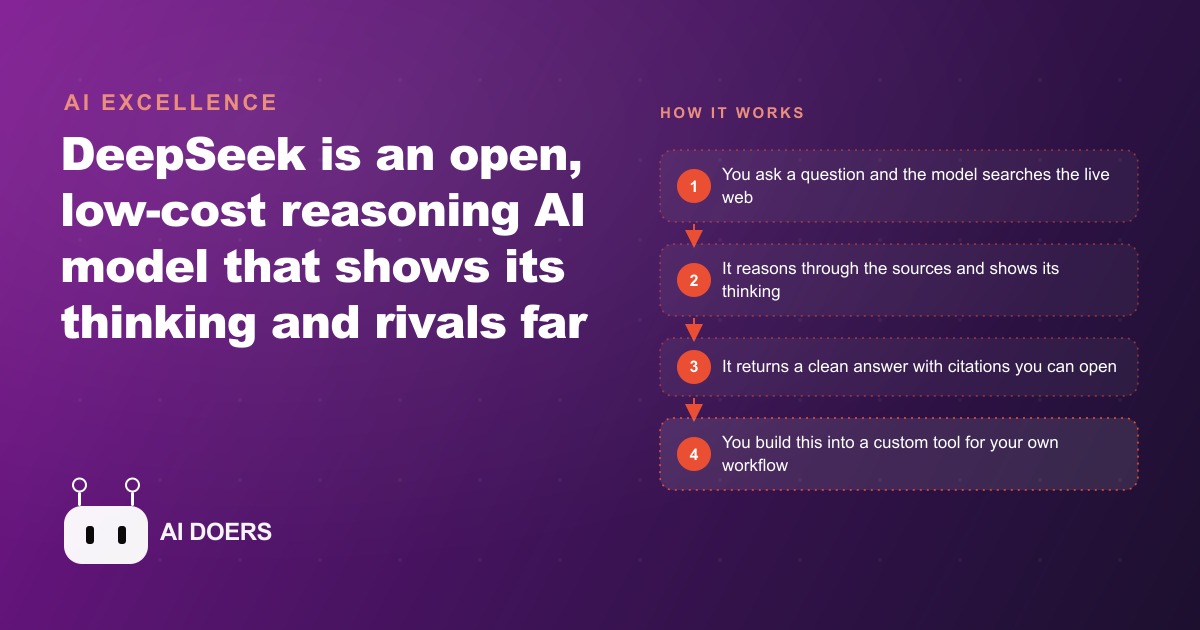
DeepSeek is an open, low-cost reasoning AI model that shows its work and rivals far more expensive systems, a shift that puts powerful, affordable AI within reach of any small business that wants to build with it.

DeepSeek climbed to the top of the app charts almost overnight, and the reason was not hype. It delivered strong results at a fraction of the cost of the big closed models, and it was released openly so the whole field could study how it works. I am Madhuranjan Kumar, and here are the reasons a cheap, open, reasoning model quietly changes what a small business can afford to build, with a running example of an electrician who put it to work.
1. It thinks out loud, and you can read the reasoning
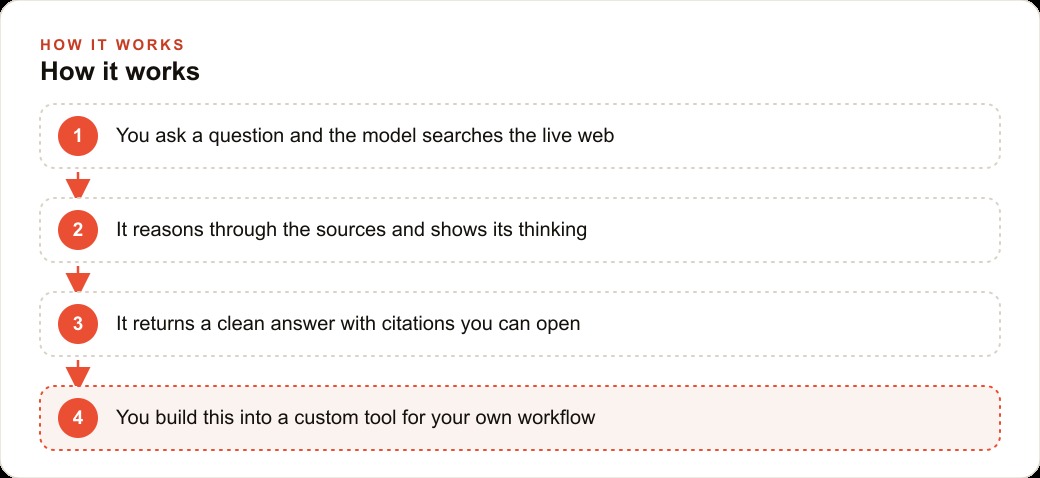
DeepSeek belongs to a family called reasoning models. Instead of firing back an instant reply, it pauses and works through your question for a while, and unlike some closed systems it lets you read that raw chain of thought. You watch it consider the problem, weigh the sources, and only then write a clean answer. That visibility is not a gimmick. It is trust. When you can see the steps that led to a conclusion, you can catch a wrong turn before it costs you, which matters a great deal the moment you point a model at real work instead of casual chat.
2. It is open, so the whole field can build on it
DeepSeek was released openly, with its methods shared rather than locked behind a wall. That openness has two effects. It lets other labs learn from the approach and improve, which pushes the whole field forward. And it means you are not permanently married to one vendor's pricing and policies, because open models can be run and adapted more freely. For a small business, the practical upshot is optionality. You are building on something the entire industry can inspect and extend, not on a black box that could change its terms overnight.
3. It costs a fraction of the closed giants
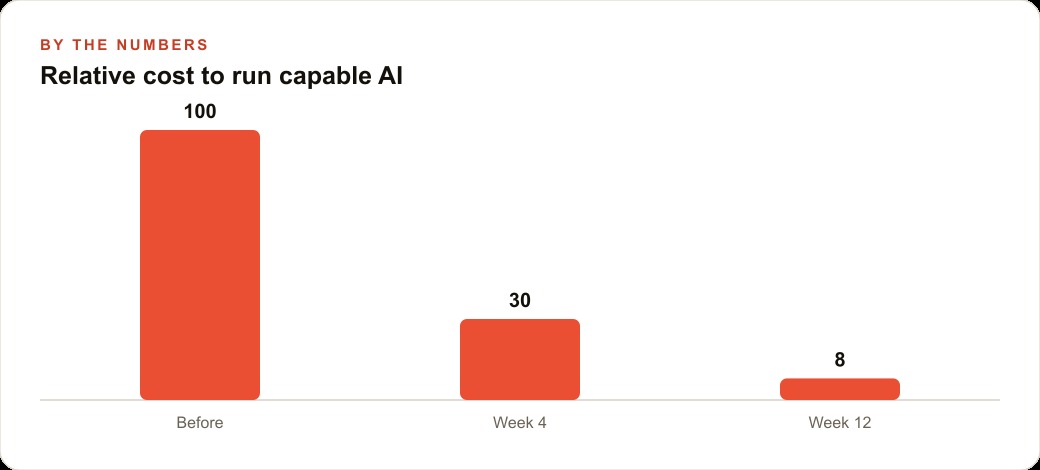
The headline is cost. DeepSeek can be dramatically cheaper to use than the leading closed models for comparable quality, which means the price of strong AI is falling toward the floor. This is the number that changes the calculus for a small operator. When a capable model costs pennies per question instead of enterprise rates, you can leave a tool running for your whole team all day without the bill becoming a reason to switch it off. Cheap changes not just how much you use AI, but what you dare to build with it.
4. It pairs live web search with reasoning
DeepSeek can first search the internet, gather a wide set of sources, and then reason over them, showing that thinking on screen before returning a tidy answer with citations you can open and verify. That mix of search plus reasoning makes it behave like a research assistant that checks its facts before it speaks, rather than a chatbot guessing from memory. For any business whose questions depend on current, verifiable information, this is the difference between an answer you can act on and one you have to double-check by hand.
5. Its competition drags every price down
A strong, cheap challenger forces every other lab to ship better models for less. That is not a side effect, it is the main event for buyers. The whole market gets more capable and more affordable at once, which means even if you never run DeepSeek directly, its existence makes the tool you do use cheaper and better. The winners of this price war are the businesses smart enough to build while the cost of intelligence keeps dropping.
6. Different training gives it a different feel
Models trained on different data develop different strengths and even a different feel, so the best model for a task depends on the task. This is worth knowing because it kills the idea that there is one perfect AI to pick and never revisit. The practical move is to stay flexible, use the model that fits the job, and be ready to switch when a better or cheaper option appears. A cheap open model makes that switching cost low, which is exactly the point.
7. You can build with it, not just chat with it
Here is the shift that matters most. When a strong model costs very little to run, you stop renting a generic chatbot and start composing your own software tuned to your exact work. Custom software, which used to demand a big budget and a dev team, becomes something a single owner can assemble. A restaurant can build a tool that answers menu and allergy questions from its own data. A real estate team can build a research assistant that pulls current listings and reasons over them. As these models keep getting better at coding, the cost of making tailored tools for your team drops toward nothing, and that same content and data foundation quietly strengthens your SEO and organic search presence as a bonus.
8. An electrician's research assistant, built for coffee money
Let me make it concrete with an electrician, because it shows every point above landing at once. The business runs on two kinds of questions: the ones customers ask before they book, and the ones the crew asks in the field. So I would build one small research-and-answer tool powered by a cheap reasoning model to handle both.
On the customer side, the tool takes a question like, my breaker keeps tripping, is this dangerous, searches for current safety guidance, reasons over it, and returns a calm, safe answer that ends with a clear option to book an inspection. Because the model shows its reasoning and cites sources, the answer reads as trustworthy rather than as a guess, and every good answer nudges a worried customer toward a booked job. Those bookings flow into the company's CRM and website stack, where follow-up handles the next touch so a hot lead never goes cold.
On the field side, the same tool points at current code references and the company's own job notes, so an apprentice can ask about panel ratings or wiring requirements and get an answer grounded in real sources, with citations to open. The low cost is what makes this realistic. The electrician is not paying enterprise prices to run a heavy model all day. The per-question cost is tiny, so the tool can stay on for the whole team without blowing the budget, and if one model is slow or overloaded, the tool switches to another in a sentence. The result is a research assistant that screens customer questions into booked jobs and backs up the crew on site, built for the cost of a few cups of coffee a month.
9. The barrier is lower than the headlines suggest
The last point is a mindset one. The story around DeepSeek got buried in noise about geopolitics and benchmarks, but the simple, important fact underneath is that powerful AI is getting cheap and accessible, and that changes what a small business can afford to build. You do not need a research team or a big budget. You need one repeated question your business answers all the time, a cheap capable model, and the willingness to build a tight tool that does that one thing well before expanding. The businesses that internalize this early will be composing their own software while their competitors are still paying monthly for a generic chatbot they barely use.
10. Intelligence itself is becoming a commodity
Step back from the specifics and the real story is bigger than one model. What DeepSeek proved is that top-tier reasoning is no longer a scarce, expensive resource guarded by a couple of giant labs. When a strong model can be released openly and run cheaply, intelligence starts to behave like a commodity, something abundant and inexpensive that you build on top of rather than pay a premium to rent. That is a genuine turning point for small business, because every previous wave of powerful technology arrived expensive first and cheap later, and the businesses that moved during the cheap-and-early window captured the advantage before it became table stakes. We are in that window now.
The practical meaning is that the constraint on what you can build is shifting from cost to imagination. A year ago, running a capable model all day for your whole team was a budget decision that many small businesses lost. Today the per-question cost is small enough that the real question is not can I afford it but what would I actually build if the intelligence were nearly free. That is a much better question to be stuck on, and the owners who ask it early will be the ones with custom tools running while their competitors are still comparing monthly chatbot plans.
11. Stay flexible, because the best model keeps changing
Because prices are falling and new models keep arriving, the smart posture is to avoid locking yourself to any single one. Build your tool so the underlying model can be swapped in a sentence, and you inherit every future improvement and price drop without rebuilding anything. One week a cheap open model is the best value, the next week a competitor undercuts it to win back attention, and your business benefits from the fight as long as you stayed flexible enough to switch. That flexibility is not an advanced technique. It is a design choice you make on day one, and it is the difference between riding the falling price curve and being stranded on last year's expensive contract.
How to start this week
Pick one repeated question your business answers constantly. Choose a cheap reasoning model, and build a simple tool that searches the web, reasons over the sources, and returns a cited answer in your brand's voice. Keep the scope tight, one question type done well, then expand. Point it at your own notes and references so it answers from your reality, not just the open internet. Because the cost is low, you can leave it running for the whole team. Read its reasoning to catch mistakes, and refine the instructions until the answers sound like you.
12. Your own data is what makes it yours
The final advantage is easy to miss because it is not about the model at all. A cheap capable model becomes genuinely valuable the moment you point it at your own notes, your own job history, your own references, so it answers from your reality rather than the open internet. Two electricians can run the identical model, but the one who fed it years of job notes, preferred parts, and local code references gets a tool that sounds like the business and knows its context, while the other gets a generic assistant anyone could have. The low cost is what makes this practical, because you can afford to build and run a tool tuned to your data instead of settling for a one-size-fits-all subscription. In a world where the intelligence is nearly free and available to everyone, your data and your specific workflow become the real moat, and a cheap open model is simply the cheapest way to put that moat to work.
The bottom line
The noise around DeepSeek was about charts and geopolitics. The signal was much simpler and much more useful: strong reasoning AI is now open, inspectable, and cheap enough that a small business can stop renting a generic chatbot and start building its own tools. The electrician who screens customer questions into booked jobs and backs up the crew on site is not running an enterprise budget. That business is spending coffee money because the price of capable intelligence has collapsed, and it stays flexible so every future price drop and model improvement lands in its lap automatically. The window where this is an advantage rather than table stakes is open right now, and the owners who build during it will look prescient in a year for having done the obvious thing early.
You can build this yourself, and a cheap capable model makes a first version very achievable this week. If you would rather have someone choose the right model, wire in your own sources, and stand up a tool that answers reliably from day one, that is exactly the kind of build I do for clients, and you can bring me in to handle it.
That is exactly what we do at AI DOERS. Book a private 30-minute call with Madhuranjan Kumar and we will map the fastest path to it for your specific business.
Book your call →
Madhuranjan Kumar
Madhuranjan Kumar brings 20 years of performance-marketing experience and has managed over $200 million in Facebook ad spend for brands across the United States and beyond. His expertise spans the full modern marketing stack: Meta, Google Ads, TikTok, email automation, CRM, and the websites that hold it together. At AI DOERS he turns that track record into lead-generation systems for businesses across every industry.