
DeepSeek 3.2: A Cheaper Open Model That Acts Like a Frontier Agent
DeepSeek released an open, MIT licensed model that scores at the top on math and tool use while costing far less to run. Here is what that means for a real business and how I would put it to work.

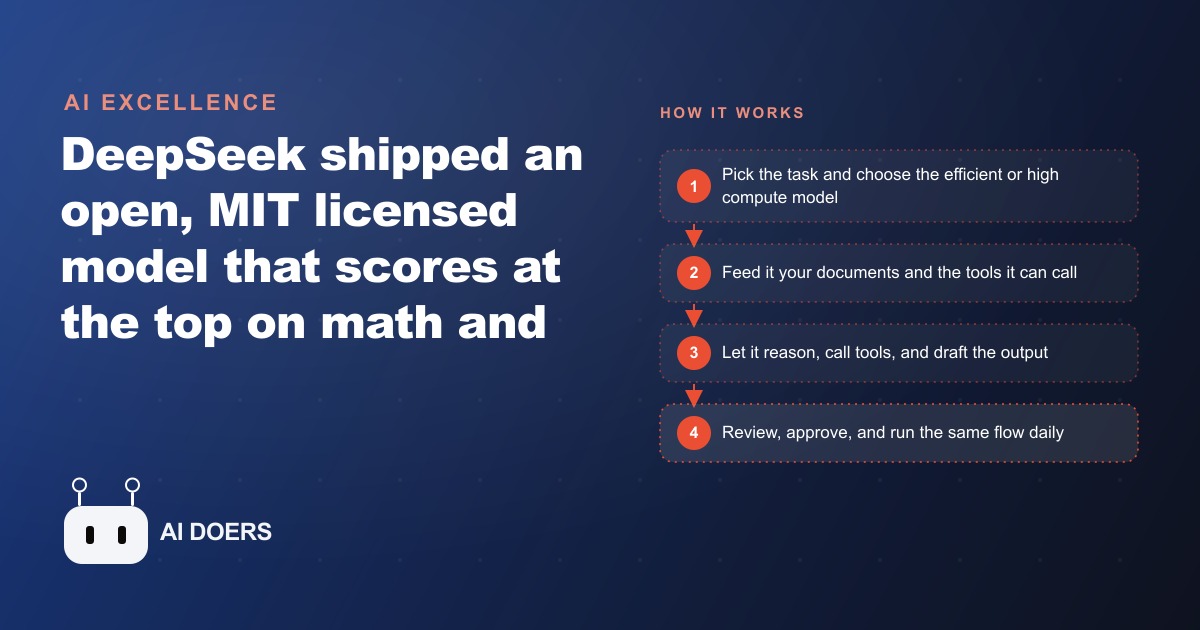
DeepSeek 3.2 reaching gold-medal level on the International Math Olympiad is not a benchmark headline. It is a business decision: the era when paying a closed-model premium for serious reasoning tasks was the only rational choice is over.
DeepSeek 3.2 is the first open-source model to achieve gold-medal performance on one of the hardest structured reasoning benchmarks in existence. On agentic tool-calling evaluations, it scores at or near the top of all models, open and closed. The weights are MIT licensed, meaning any business can run them on its own hardware without sending a single document to an outside server. And the cost to operate it is one order of magnitude lower than the equivalent closed-model API at the same document volume. The case for the closed-model premium rested on a quality gap that justified the dependency and the cost. That gap is now too narrow to justify either for the majority of real business workloads.
The quality gap between open and closed models is now too small to justify the dependency
For most of the past several years, the closed-model premium was clearly rational. The strongest reasoning capability, the most reliable instruction-following on complex multi-step tasks, and the most consistent behavior across varying input types all lived in the closed models. The open alternatives were capable for their cost but not genuinely competitive at the capability ceiling. Paying the premium made economic and operational sense if your business needed what only the closed models could reliably provide.
That calculation has changed for most practical business tasks. Document summarization, structured data extraction from long files, customer communication drafting, question answering over proprietary knowledge bases, code assistance, policy interpretation, and the dozens of similar text-based tasks that represent the overwhelming majority of AI usage in real organizations do not require the very highest level of the closed-model capability range. A well-instructed open model performing at gold-medal math reasoning and scoring at the top of tool-calling benchmarks is more than capable for all of them, and it costs a fraction to operate.
The dependency argument is what the quality argument has been obscuring. A closed-model deployment means the business has no control over pricing changes when the provider decides to raise rates. No control over behavior changes when the provider updates the model without notice. No control over terms of service modifications that could affect permissible use cases. No control over what happens to the data being sent to an outside inference server. For a business using AI on sensitive documents, client information, internal processes, or proprietary data, those are real operational risks that compound over a multi-year horizon. The quality premium has been implicitly treated as compensation for accepting those risks. When the quality difference shrinks to where it does not affect outcomes on real tasks, the risk acceptance is no longer compensated.
The combination of capability parity on practical tasks and persistent dependency risk is what tips the decision now. The question for any new AI deployment in a serious business context is no longer whether open models are good enough. They are. The question is why a business would accept the data exposure and operational dependency of a closed model when the quality difference has shrunk to where it does not affect the outcomes that actually matter to the business.
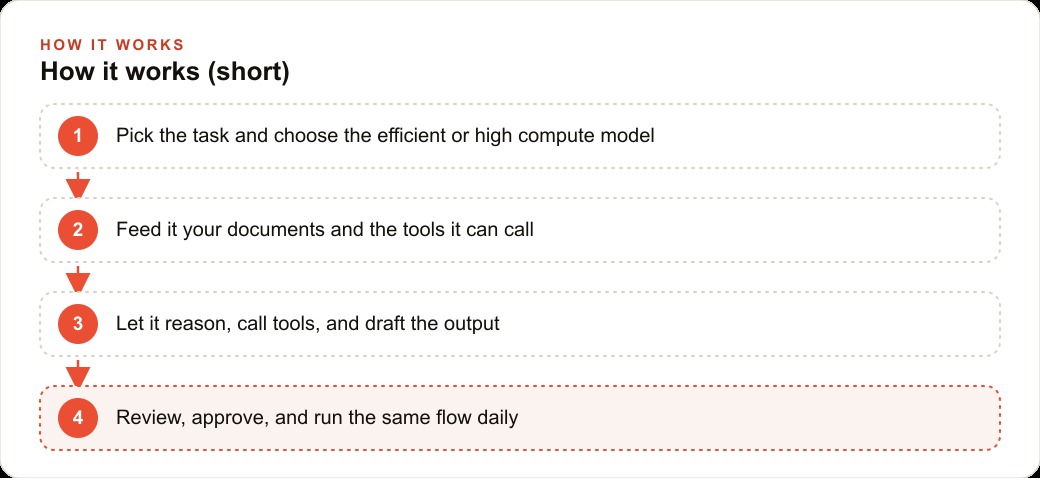
Sparse attention and gold-medal math tell you something specific about direction
The technical advance inside DeepSeek 3.2 is not a bigger model trained on a larger dataset. It is a specific algorithmic improvement in how the model processes long context, and that improvement points toward a direction that matters for practical business use.
The attention mechanism in most large language models scales quadratically with context length. Doubling the length of the document being processed more than doubles the compute cost, and in practice it often slows response time substantially. DeepSeek 3.2 introduced a sparse attention approach that scales closer to linear. For a business feeding the model long documents, contracts running to dozens of pages, discovery transcripts, policy manuals, extensive email threads, or accumulated customer correspondence, this is not a marginal efficiency gain. It is the difference between a workflow that stays fast and economical as document volume grows and one that hits cost and latency limits that make it impractical to run at real business scale.
The gold-medal math result tells you something different and equally important. The International Math Olympiad is not a task any business cares about directly. It is a proxy for a type of structured multi-step reasoning that does appear in business tasks constantly: following a complex process precisely from beginning to end, verifying each step against a defined constraint, maintaining logical consistency across many sequential decisions, and arriving at a correct conclusion without drifting or making the kind of casual error that would be immediately caught by a careful reviewer. A model capable of gold-medal math performance can correctly follow a multi-step document review checklist, accurately extract structured information from a complex contract, and maintain reasoning consistency across a long document analysis task in a way that weaker models fail to do reliably.
The combination of efficient long-context handling and demonstrated structured reasoning quality, both in the same open, MIT-licensed release, is exactly what a business needs from a model it plans to deploy on real operational tasks at meaningful volume.
The counter-argument about deployment difficulty is three years out of date
The standard objection to adopting open models in a business context is that they are harder to operate than closed APIs. You need hardware with sufficient memory to run the weights, technical expertise to manage the deployment and handle updates, and ongoing infrastructure maintenance that subscribing to a closed API completely eliminates. This objection was legitimate and practically meaningful when it was first widely stated. It is not an accurate description of the current deployment landscape.
Hosted versions of open models are available from multiple providers right now. A business that wants the cost advantage of running DeepSeek 3.2 without the complexity of managing the infrastructure can access the model through a hosted API at a cost that is still substantially lower than equivalent closed-model pricing. The full privacy advantage of self-hosting is not available through this route, but the cost advantage is, and for businesses whose primary motivation is economics rather than data sovereignty, the hosted open model option eliminates the deployment complexity objection while preserving the majority of the cost benefit.
For businesses where data sovereignty is the primary motivation, the infrastructure requirement for running a large open model has also dropped considerably. Specialized inference servers designed for open-model deployment have become more accessible and more documented. The technical expertise required to run a self-hosted deployment is more comparable to managing any other internal server application than it was when open models required deep machine learning engineering knowledge to run reliably.
The objection that open models are harder to run was a fair description of a real barrier at one point. It is now functioning more as a rhetorical defense of the closed-model ecosystem than as a practical description of the actual deployment friction a business would face in 2025. The barrier has dropped enough that it no longer outweighs the combined cost and dependency advantages for any serious evaluation of the options on a new deployment.
What this means for a business choosing a model stack today
The practical implication is not that every business should immediately migrate every closed-model deployment to an open alternative. It is that every business evaluating which model to use for a new workflow should now conduct that evaluation with open models as a first-tier option rather than a fallback for cost-constrained or experimental situations.
For workflows involving sensitive data, client documents under NDA, proprietary internal processes, or any category of information where data residency is a compliance concern or a competitive concern, the self-hosted open model is now the clearly better architectural choice. The data never leaves the building, the quality on the actual task is comparable to a closed API, and the cost is lower. The case for choosing a closed API instead needs to be affirmatively made, not assumed.
Here is a concrete example of where this changes the decision. A small law firm has attorneys and paralegals spending eight hours per week on document-intensive tasks during discovery phases: reading deposition transcripts, extracting key dates, identifying the named parties and their roles, summarizing arguments, and preparing first-draft briefing notes for the senior attorneys handling each matter. A self-hosted DeepSeek 3.2 deployment routes that document stack through the model. It extracts structured summaries, flags key dates and contested facts, identifies inconsistencies between witness accounts, and produces first-draft briefing notes organized the way the firm's attorneys actually use them. A human attorney reviews every output before it is used in any client communication, filing, or strategic decision, which is the correct workflow regardless of how the drafting step is done.
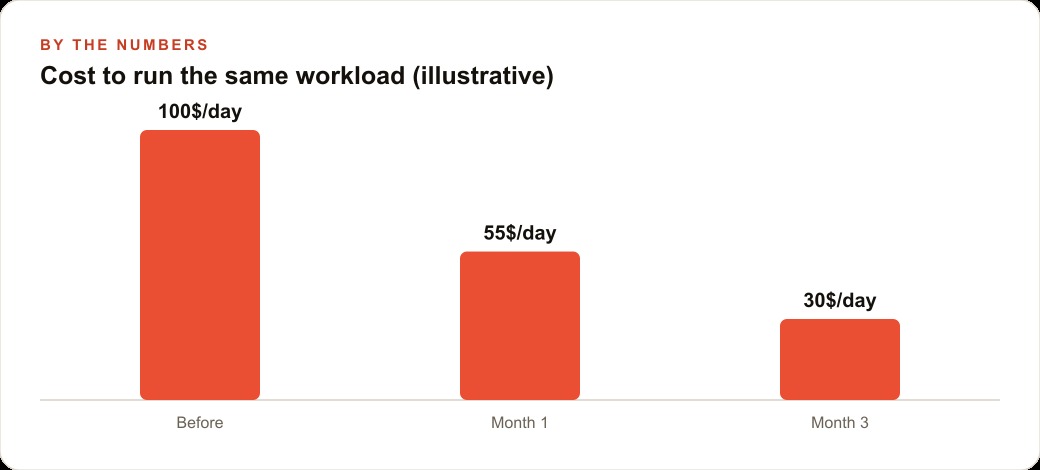
The compute cost for this workflow at that document volume: roughly three to ten dollars per day depending on document length and which model tier is used. The standard-efficiency model handles most summarization tasks at the lower end of that range. The high-compute special version is reserved for the complex multi-step reasoning tasks where the extra token spend produces a meaningfully better output. The equivalent cost of running the same workflow through a leading closed-model reasoning API at the same document volume: over one hundred dollars per day at current pricing. The quality difference between the two outputs on this specific task, document summarization and structured extraction with attorney review at the end: not material to the outcome.
Eight hours per week of document processing time reduced to the review step, which takes two hours. Privileged and confidential material never transmitted to an external server. Compute cost: three to ten dollars per day. Closed-model API cost for the same volume: over one hundred dollars per day. The premium that was once justified by a meaningful capability gap is now paying for a dependency and a cost that the open model has made unnecessary for this use case.
The businesses that recognize this first, rebuild the relevant workflows around open models, and develop the operational competence to run them reliably will carry a structural cost advantage over competitors that stay in the closed-model ecosystem by default. That advantage scales with document volume. It also scales with the number of workflows in which the same choice is made. Each open-model deployment compounds the advantage relative to the closed-model alternative, and as document processing volume grows with the business, the gap widens rather than narrowing over time.
The practical starting point for a business evaluating this shift is to identify one workflow where document volume is high, the task is repetitive and checkable, and the data sensitivity makes closed-model transmission a concern. Run the open model on that workflow for sixty days with a human review at the end of each output. Compare the quality, the cost, and the operational friction to the closed-model alternative at the same volume. The comparison usually resolves the decision on its own.
DeepSeek 3.2 is not the last open model that will close the gap with closed frontier performance. It is the model that demonstrated the gap is now small enough to matter for business decisions. The technical direction, more efficient attention for long context, training on complex synthetic agent environments, and architecture optimized for tool use and multi-step reasoning, is pointing toward open models that handle progressively more of the high-value business reasoning tasks that were previously the exclusive domain of the closed-model premium tier. The businesses that develop the capability to run and evaluate open models now will have a compounding advantage as that direction continues, while those that remain exclusively in the closed-model ecosystem will face rising costs and dependency risks that only grow with scale. That is the trajectory DeepSeek 3.2 represents: not a single model release, but a turning point in what businesses can expect from open-weight alternatives to the closed-model ecosystem.
That is exactly what we do at AI DOERS. Book a private 30-minute call with Madhuranjan Kumar and we will map the fastest path to it for your specific business.
Book your call →
Madhuranjan Kumar
Madhuranjan Kumar brings 20 years of performance-marketing experience and has managed over $200 million in Facebook ad spend for brands across the United States and beyond. His expertise spans the full modern marketing stack: Meta, Google Ads, TikTok, email automation, CRM, and the websites that hold it together. At AI DOERS he turns that track record into lead-generation systems for businesses across every industry.