
Controllable World Models Are Here: Walk a Client Through a Space Before You Build It
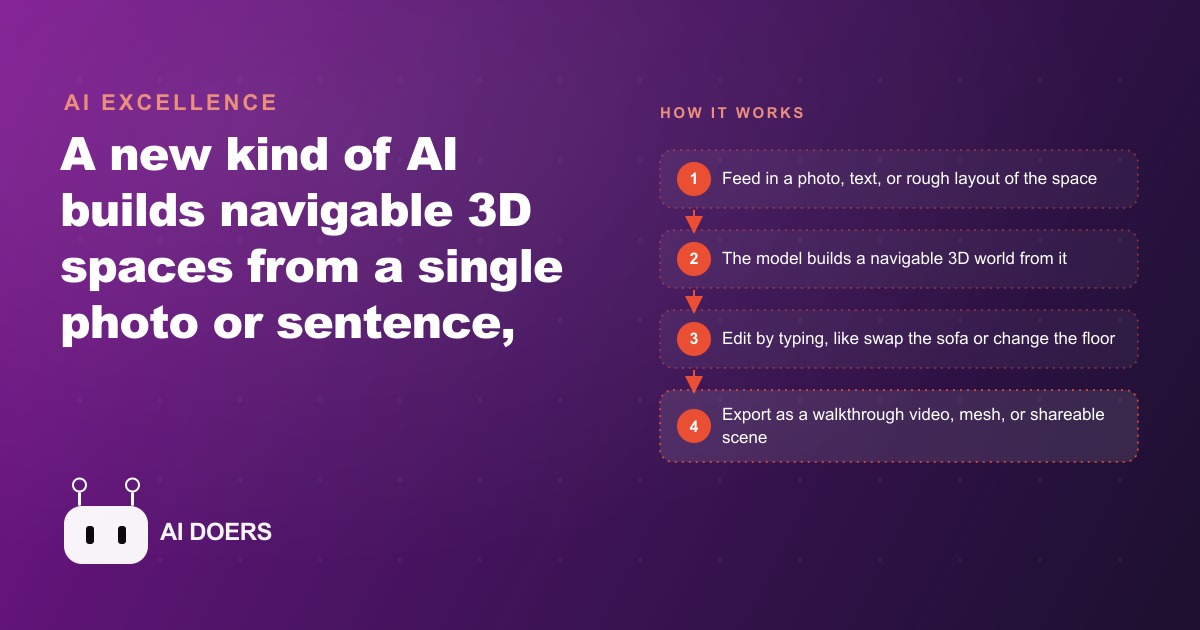
A new class of AI turns a photo or a sentence into a navigable 3D world you can move around in and edit by typing. Here is what it does and how I would put it to work selling design.

Showing a flat render of a space in 2026 is a credibility problem, not a budget problem
I am Madhuranjan Kumar, and I want to make a claim that some designers and architects will push back on: the era of flat renders as the primary tool for selling an unbuilt space is ending faster than the industry is acknowledging. Not because flat renders are wrong, but because a segment of the client population has already seen the alternative and now expects it. When a client has experienced walking through an AI-generated 3D preview of a renovation before committing budget, returning to a static image for the next project reads as a step backward, not as a stylistic choice.
The technology that makes this possible is not a better rendering engine. It is a fundamentally different kind of model: one that predicts and generates three-dimensional space rather than one that predicts the next word in a sequence. A language model builds a sentence by estimating what word comes next. A world model builds a navigable environment by predicting what space looks like from every angle, including angles the input image never showed. The difference is architectural, not just a matter of quality.
The practical result: upload one photograph of an existing room, and the model reconstructs a fully navigable 3D environment you can move through. Points of the reconstruction where the camera did not capture details are filled in with plausible inference. The result is not perfect and the edges become uncertain as you move further from the captured area. But for the core of the space, the quality is sufficient to walk a client through it in a meeting and have them understand what they are approving.
The expectation has shifted in one direction and will not reverse
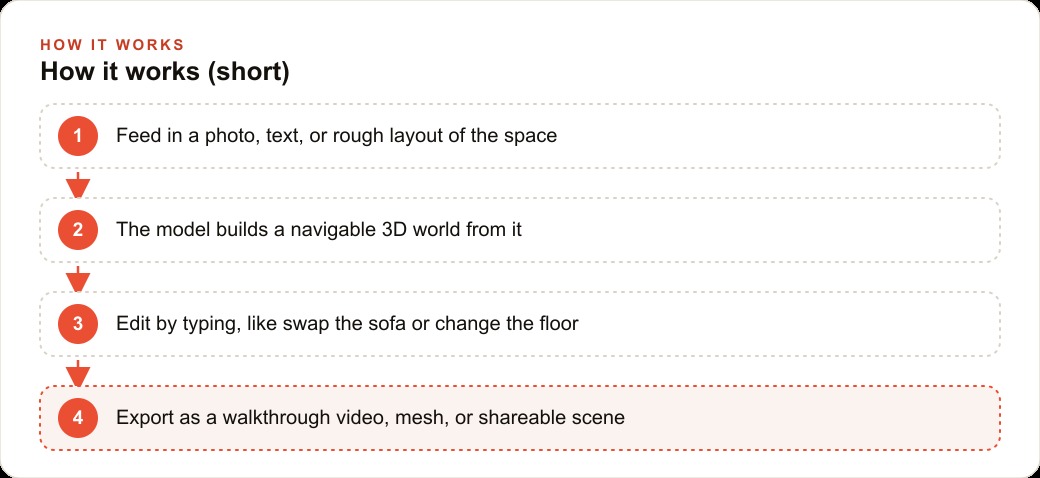
The design industry has historically moved slowly on client communication tools because the tools that required significant compute, specialist software, or substantial time to produce had a natural gate that kept widespread adoption slow. That gate has fallen. The current generation of world model tools accept a phone photo, a text description, a rough layout sketch, or a combination, and produce a navigable environment in a matter of minutes. The compute is in the cloud. The interface is a browser.
The implication is that client expectations are now set not by what the design industry chooses to offer but by what clients encounter elsewhere. A homeowner who researches renovation options online has already encountered AI-generated room previews in advertising, in kitchen design apps, in furniture retailer websites that let you visualize a sofa in your living room. That homeowner now arrives at the consultation with a baseline expectation about what preview technology looks like. A flat render does not match that baseline.
This is not a complaint about artistic quality. Skilled rendering is beautiful and tells a story that a generated preview cannot tell with the same polish. But a beautiful render that a client cannot interact with answers a different question than a navigable preview that lets them walk through the space and say that doorway feels too narrow, or that window placement is exactly right. The flat render tells them what it might look like. The navigable preview lets them experience what it might feel like.
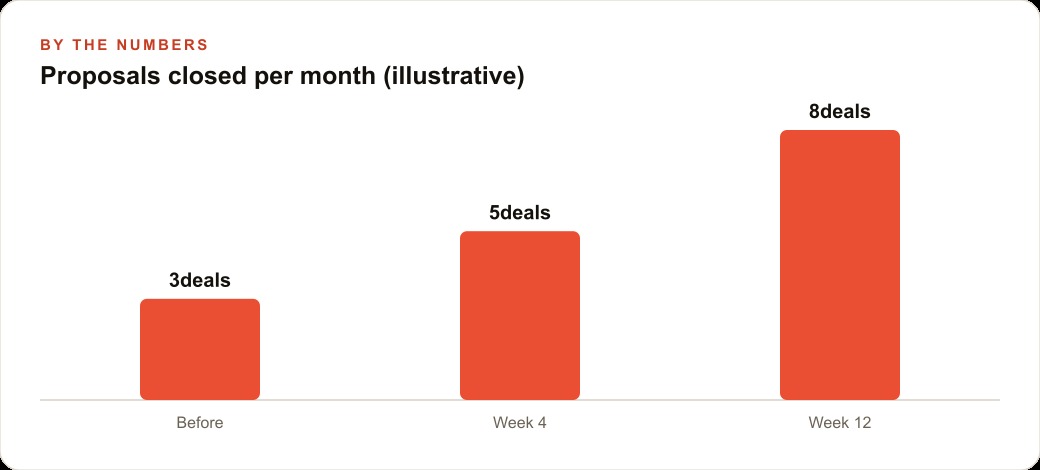
The studios that adopted early are already seeing the effect in their close rates. A proposal that includes a live walkthrough of the proposed space, editable in real time by typing instructions like swap the countertops to dark stone or open the south wall for more light, produces a different conversation than one that presents three static options and asks the client to choose. The decision-making shifts from evaluating what someone else designed to participating in refining something that already feels partially real.
The objection that the technology is not professional enough yet
The most common objection from designers who have looked at world model tools is that the visual quality does not meet the standard of professional architectural rendering. This is true and is not the point. The world model is not replacing the final rendering. It is replacing the pre-approval conversation that happens before the final rendering is ever commissioned.
The sequence in a traditional proposal process: concept discussion, rough sketches, preliminary renders that cost money and time to produce, client review, revisions, more renders, final approval, detailed documentation. The world model enters between the concept discussion and the preliminary renders. A designer who can generate a navigable preview from a rough concept in 20 minutes before spending any money on traditional renders is running a different and more efficient process. The client sees the space sooner, approves or redirects sooner, and the final render, when it is produced, reflects a concept that has already been validated in a walkthrough rather than a concept that is shown to the client for the first time in its high-quality form.
The professional rendering is still the deliverable. The world model is the conversation tool. Comparing their visual quality is the wrong frame for evaluating whether to use one.
Why early adopters are closing proposals competitors cannot even enter
The competitive effect of adopting navigable world models early is more pronounced than the technology itself might suggest. The first time a potential client experiences a design proposal that lets them walk through the space, they set a new expectation for every subsequent proposal they evaluate. A competitor who presents flat renders after that experience is not just presenting a lower-fidelity option. They are presenting evidence of a different process philosophy, one where the client participates less in pre-approval refinement and more in post-approval acceptance.
In a market where two studios are equally capable of producing beautiful final results, the one that offers the richer pre-approval experience has a structural advantage at the proposal stage. The client is not choosing between finished rooms. They are choosing between two experiences of becoming confident that they are making the right decision. The navigable preview accelerates and enriches that confidence-building process in ways that flat renders cannot.
The studios that have integrated world models into their proposal process are also reporting a secondary benefit: fewer revisions after approval. When a client walks through a space and has the opportunity to refine it before committing, the elements that would have produced dissatisfaction after build become visible and fixable in the preview stage. The client who said during the preview walkthrough that the kitchen feels closed off and approved the wall opening before construction does not request the wall opening as a costly change order after the fact. The pre-approval investment in exploration pays back in reduced post-approval rework.
The window for gaining the early-adopter advantage is still open, but narrowing
The world model tools are available now with free credit tiers that support real client demos. The export formats, navigable splats, standard meshes, images, and video, are compatible with existing presentation workflows. A designer who wants to integrate this into their next proposal can do so this week using a phone photo of an existing space as the input.
The argument for waiting for the technology to mature is also the argument for letting competitors who do not wait build the expectation advantage first. The appropriate bar for adoption is not whether the tool can replace every capability in the current workflow. It is whether it can improve the client experience in the pre-approval stage at acceptable effort and cost. The current tools clear that bar clearly.
The clients who have seen a world model walkthrough will look for it in future proposals. The studios that provide it early build the association between their practice and a more client-participatory design process. That association compounds into a reputation that becomes a sourcing advantage. Clients who want the interactive process refer other clients who want the same. The early adoption is not just a capability upgrade for current proposals. It is an investment in a positioning that will draw a self-selecting segment of clients who value collaborative pre-approval more than traditional sequential presentation.
The time to make that investment is when the tool is still novel enough that offering it signals something meaningful about how a studio works. That window is open. It will close as the tool becomes standard. Building the reputation while the tool still differentiates is the strategy that produces a durable advantage rather than a brief first-mover moment.
What the adoption data says about where the market actually is right now
The adoption curve for AI-generated 3D visualization in client-facing design work is earlier than the technology press suggests and later than the technology vendors claim. The vendors have a commercial interest in presenting the technology as mainstream. The technology press has an interest in finding the stories of dramatic adoption. Neither is the right data source for a practitioner decision about when to invest.
The right data source is the client side of the transaction: when do clients, specifically the clients who are buying design and staging services today, begin to treat 3D visualization as a baseline expectation rather than a premium differentiator?
The pattern in other technology transitions in professional services suggests this threshold arrives when the clients of the early adopters begin expecting the same experience from the competitors of those early adopters. A client who walked through a 3D-rendered renovation preview with one architect begins asking the next architect they consider whether they offer the same experience. The practice that does not offer it must either explain why or discount to compete.
That propagation process has started in some segments of design and staging, particularly high-end residential architecture in urban markets. It has not yet fully propagated to mid-market interior design and property staging in most regions. The window between where it has started and where it becomes universal is exactly the window for early adopter advantage to be established at minimal risk and maximum return.
The specific use cases where 3D beats photorealistic rendering every time
The distinction between 3D visualization and photorealistic rendering matters for specific use cases in ways that are not always clear from technology comparisons. Photorealistic rendering produces an image that looks like a photograph of a finished space. 3D visualization produces an interactive or navigable representation of a space that the client can explore.
For certain client decisions, the photorealistic image is sufficient: the decision about whether a color palette works, whether a furniture arrangement feels right, whether a material choice is consistent with the overall design. These are single-point decisions that a high-quality still image can support.
For other client decisions, the static photorealistic image is insufficient: the decision about whether the space feels right to move through, whether the flow from the entrance to the main living area is comfortable, whether the proposed changes to a commercial space will work for the employees who will use it daily. These decisions require the client to experience the space rather than view an image of it.
AI-assisted 3D visualization tools now support the second category of decision at a cost point that was previously only available to practices with dedicated visualization staff and high-end rendering software. The practice that identifies which of its client decisions fall into the second category and deploys 3D tools specifically for those decisions is making the highest-value use of the technology.
The window is narrower than it looks from the outside
The practices that establish early-mover advantage in AI-assisted 3D visualization over the next 18 months will be the ones that competitors spend the following 3 years trying to catch. This is the standard pattern in professional service technology transitions: the advantage is established during the adoption window, and the practitioners who move after the window closes face established reputations, refined workflows, and client expectations they did not help shape. The cost of entry after the window closes is higher and the advantage is smaller. The practices that move now, when the tools are capable and the competition has not yet standardized on the approach, are paying the lower price for the larger advantage.
That is exactly what we do at AI DOERS. Book a private 30-minute call with Madhuranjan Kumar and we will map the fastest path to it for your specific business.
Book your call →
Madhuranjan Kumar
Madhuranjan Kumar brings 20 years of performance-marketing experience and has managed over $200 million in Facebook ad spend for brands across the United States and beyond. His expertise spans the full modern marketing stack: Meta, Google Ads, TikTok, email automation, CRM, and the websites that hold it together. At AI DOERS he turns that track record into lead-generation systems for businesses across every industry.