
Context Engineering, Clearly Explained: The Skill Behind Real AI Agents
Context engineering is designing systems that give a language model the right information, in the right format, at the right time. It becomes essential the moment you stop chatting with an AI and start building agents, because one prompt must encode every action the agent will face.

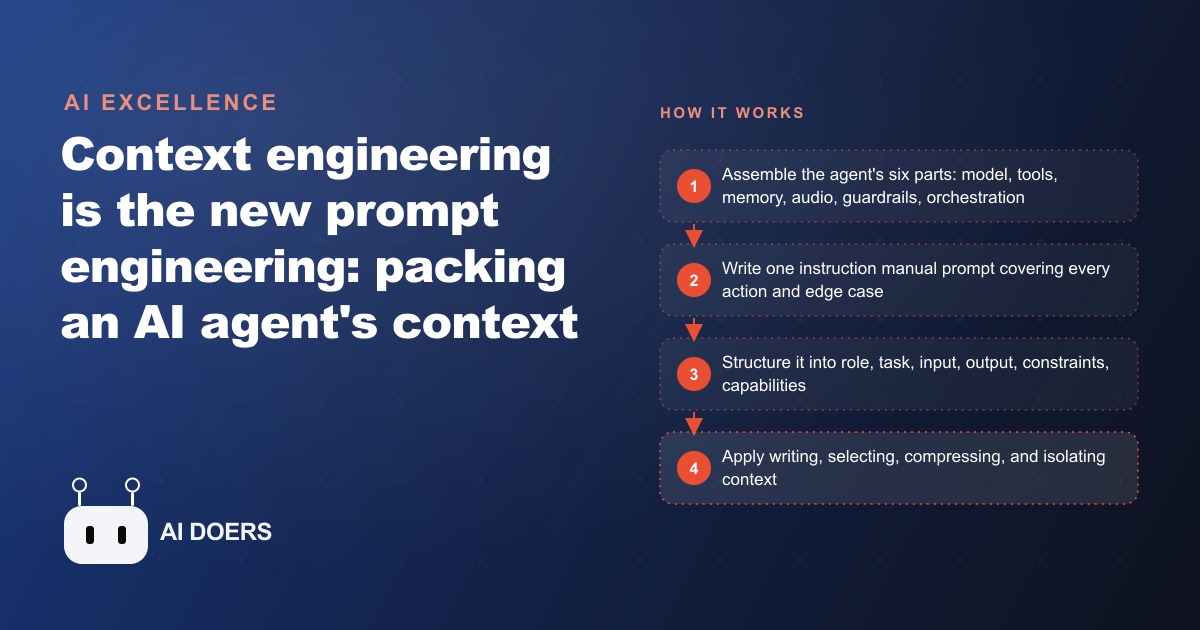
A term that barely existed two years ago is now one of the most searched phrases among developers building AI products: context engineering. The reason it spread is not hype. It spread because teams shipping real agents kept running into the same wall. The model was capable. The idea was solid. And the agent still failed in unpredictable ways the moment it touched real, unscripted data. Almost every time, the problem was not the model. The problem was that the model had no idea what was actually in front of it.
I, Madhuranjan Kumar, have been watching this pattern repeat across industries. The businesses closing that gap fast are the ones treating context engineering as a first-class design skill, not an afterthought bolted on after the agent is already coded. Here is the practical playbook.
Map the six building blocks before writing a single word of the prompt
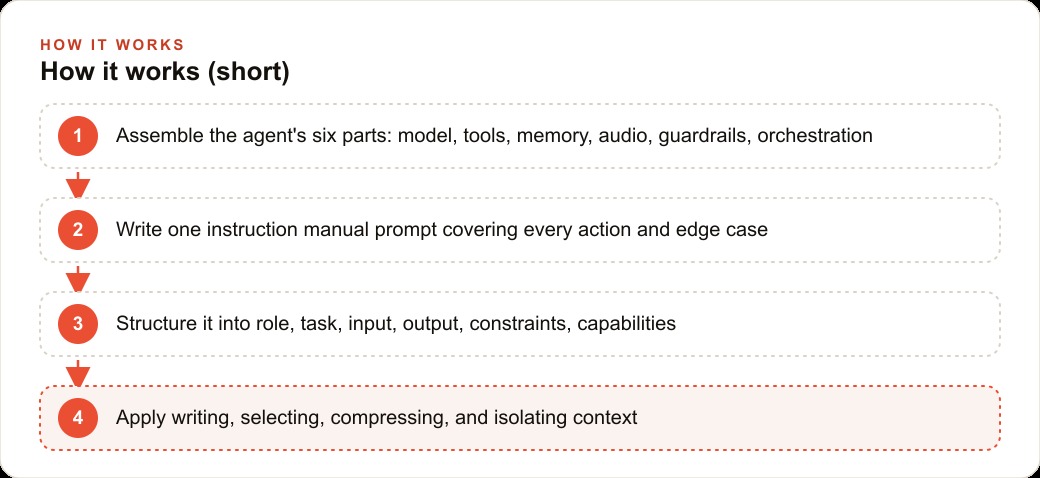
Before you write a single word of a prompt, you need to know what the agent is actually made of. Every AI agent is built from six components: the model, the tools, knowledge and memory, audio and speech, guardrails, and orchestration. Think of it like a burger. A burger needs a bun, a patty, sauce, lettuce, cheese, and pickles. Pull out any component and you no longer have a complete burger. You have something that looks like one but will fall apart on contact. An AI agent is the same. Build it without guardrails and you have an agent that will eventually go off-policy in a way that damages your brand. Build it without orchestration and you have an agent that runs once and cannot be monitored, improved, or trusted at scale.
Here is what each of the six parts means in practice.
The model is the brain: GPT, Claude, Gemini, Mistral, or any open-source option. Your choice here affects capability, cost, and speed, but it does not determine whether the agent succeeds. The engineering around it does.
Tools are how the agent reaches outside itself. A calendar tool lets it book meetings. A CRM tool lets it read and write contact records. A web-search tool lets it pull live data. Without tools, an agent can only work with what is already in its prompt. With tools, it can act on the world.
Knowledge and memory separate stateless agents from ones that actually learn. A legal intake agent that forgets what the prospect said last session is useless. A therapy support bot that cannot recall prior disclosures is worse than useless. Memory, whether short-term session state or long-term retrieval, is what makes an agent feel like a real participant in a workflow rather than a vending machine that resets after every interaction.
Audio and speech open the door to phone-based agents and voice-first interfaces. If your agent is answering calls or joining meetings, this component is load-bearing from day one.
Guardrails are the rules that keep the agent safe and on-policy. A customer-support agent without guardrails will eventually produce a response that goes viral for the wrong reason. Guardrails are not optional. They are part of what makes a system you can trust.
Orchestration is how the agent gets deployed, monitored, and improved over time. It covers logging, escalation triggers, and the iteration process. An agent without orchestration is a demo, not a product.
The reason you map these six before writing the prompt is that the prompt must reference all of them. You cannot write a good instruction manual for a machine if you do not know what the machine has. When you know the tools, you can tell the agent which ones to use and when. When you know the memory architecture, you can tell the agent how to retrieve and store context. When you know the guardrails, you can encode the constraints without ambiguity. This mapping step, even at only 20 minutes, changes the quality of everything that follows.
Write the instruction manual, not the chat message
Here is an analogy that makes the shift concrete. Imagine an alien lands on Earth and is handed a bag of burger ingredients. The alien has no cultural knowledge, no common sense about food assembly, and no intuition about sequencing. If you want a burger, you need to give it a manual. You cannot just say "make a burger." You need to explain what the bun is, what order things go in, what done looks like, and what to do if something goes wrong.
That is what a context-engineered prompt is. It is not a chat message. It is not a clever sentence. It is an instruction manual for an agent that will use its tools, consult its memory, observe its constraints, and produce consistent output across hundreds or thousands of situations where no human is watching.
This is where the CPU and RAM analogy becomes concrete. The language model is the CPU: it processes instructions. The context window is the RAM: it holds the working state. Context engineering is the act of loading that RAM with exactly what the task requires and nothing that will confuse it. A CPU running the right program on corrupted RAM produces garbage. An excellent model with a poorly engineered context window does the same.
When you are casually chatting with an AI about running shoes or planning a vacation, you are doing prompt engineering. You ask, the model responds, and if the answer is wrong you correct it in the next turn. That back-and-forth is perfectly valid for personal use. But the moment you start building an agent, that correction loop is gone. The agent runs unattended. One set of instructions must cover every situation it will encounter: every edge case, every ambiguity, every escalation scenario. Prompts built for this purpose start to look less like sentences and more like structured code, with XML tags for input parsing, markdown sections for different responsibilities, and numbered rules for priority ordering. That is not a coincidence. The prompt has become a program.
The practical implication is this: the time you spend writing and refining the prompt is not overhead. It is the actual work. A team that treats the prompt as a quick starting point and plans to fix things in production will spend most of its time fixing things in production. A team that treats the prompt as the instruction manual, written with the same rigor as a design spec, will spend most of its time shipping.
Structure the prompt into six labeled sections
The single most useful structural improvement you can make to an agent prompt is splitting it into six clearly labeled sections: role, task, input, output, constraints, and capabilities. Each section governs a distinct part of the agent's behavior. When sections are labeled, the model can locate the rules that apply to whatever it is currently doing rather than trying to infer them from a wall of undifferentiated text.
Role defines who the agent is, not in a creative sense but in an operational one. "You are a polite, brief first responder for inbound leads at a real estate brokerage. Your purpose is to qualify the lead and book a showing within one conversation." That single sentence tells the model its voice, its function, and its objective before it reads another instruction.
Task breaks down the specific work: what the agent must do, in what order, and under what conditions. If there are decision branches, they belong here. If there is a workflow with steps, number them explicitly.
Input describes what the agent will receive and how it is formatted. If inputs arrive as XML tags, say so here and give examples. This is where context engineers often find the most leverage. When inputs are structured and labeled, models parse them reliably. When inputs are free-form, the model guesses at structure and guesses wrong often enough to matter at scale.
Output specifies exactly what the agent should return: format, length, tone, structure, and handling for edge cases. If you need JSON, say so. If you need a specific field schema, define it. If you need a 300-word summary rather than a 50-word one, state that constraint explicitly.
Constraints are the guardrails. What the agent must never do. Topics it cannot touch. Claims it cannot make. Actions it cannot take without escalation. Writing constraints before capabilities is a non-negotiable discipline. It is far harder to add guardrails after you have discovered what an unconstrained agent will say in production.
Capabilities list the tools the agent may use, in what order, and under what conditions. If the agent can read from the CRM but not write without confirmation, say so here. If it can book a calendar slot but only after completing the qualifying-question sequence, put that logic in this section.
A concrete example: a real research-agent prompt using this structure might tell the model to extract up to 10 subtasks from the user's query, rank each by audience engagement and source authority, return results as strict JSON with fixed field names, correct any UTC date format errors automatically, and write a 300-word trend summary that leads with the most actionable finding. That prompt, split cleanly into the six sections and fed inputs inside XML tags, produces consistent research outputs that a single-sentence instruction never could. The structure is not bureaucracy. It is the reason the agent knows what to do when the input is messy or unexpected.
Apply the four context strategies: writing, selecting, compressing, isolating
Once the prompt structure is solid, there are four core strategies for managing the context that flows through it. The LangChain framework names them directly: writing, selecting, compressing, and isolating.
Writing context means being intentional about what gets added to the context window and how. Information that is ambiguous, redundant, or tangential inflates the context and reduces the model's ability to follow the relevant instructions. Write context the way a good editor writes copy: cut everything that does not earn its place.
Selecting context means choosing, at runtime, which pieces of information the current task actually requires. An agent handling customer inquiries does not need the full history of every prior conversation. It needs the relevant ones. A retrieval step that selects the three most relevant prior interactions before each response produces better outputs than one that passes the last 50 messages raw. The model performs better when the RAM is loaded with what matters, not with everything that exists.
Compressing context means converting long histories or large documents into summaries before passing them into the context window. A customer interaction history spanning 20 conversations can be compressed into a structured summary: what the customer has asked about, what was resolved, what is still open, and any preferences noted. That summary is more useful to the model than the raw transcript, and it uses a fraction of the tokens.
Isolating context means keeping sensitive, confusing, or task-specific information separate from the parts of the prompt where it could interfere. If you have PII in the inputs, isolate it from the reasoning chain. If one part of the prompt handles tool calls and another handles response generation, keep their contexts distinct so they do not bleed into each other and produce unexpected behavior.
Applying these four strategies systematically is what separates context engineering from prompt writing. Prompt writing asks what to tell the model. Context engineering asks what the model needs to see at each step, in what form, and how to ensure nothing irrelevant contaminates it.
Build multi-agent rather than one agent that does everything
The most common structural mistake in early agent builds is trying to make one agent do everything. One agent that gathers information, reasons about it, selects an action, executes the action, handles error cases, formats the output, and logs the result will eventually contradict its own instructions. The context grows too large and too complex for the model to hold consistently across all of those responsibilities at once.
The better design is a multi-agent system. One agent gathers. Another summarizes. Another decides. Another acts. This mirrors how competent human teams work: no one person does every step of a complex operation. Roles are separated, handoffs are clean, and each specialist works within a well-defined scope.
The key to making multi-agent work is sharing context cleanly between agents. When the gathering agent finishes, the summary it hands off to the deciding agent must contain everything that agent needs and nothing it does not. That handoff is itself a context-engineering problem: you are designing what goes into the deciding agent's RAM and ensuring it is complete, structured, and unambiguous.
For a business using a CRM and website stack to manage customer relationships, the multi-agent pattern becomes concrete quickly. The CRM is not just storage. It is shared memory for the entire agent system. What the lead-response agent learns gets written to the CRM. The showing-coordinator agent reads it. The booking-confirmation agent reads the result of the booking and updates the same record. The architecture of the tooling shapes the architecture of the agents, and the context engineering holds it all together.
For a real estate brokerage handling 40 inbound leads a day, the multi-agent design might split the work like this: one agent handles the initial conversation and qualification, a second reads the CRM and calendar to find available showing slots, and a third confirms the booking and sends the follow-up. Each agent is scoped tightly. Each has its own six-section prompt. The context flowing between them is structured so each agent picks up exactly where the last one left off, with no information lost and no ambiguity about the current state of the lead.
Treat every agent action as an implicit decision that needs a rule
The last principle is the one most often skipped, and it is the one that causes the most production incidents. Every action an agent takes is an implicit decision. When the agent sends a message, it decided that now was the right time to send it. When it books a meeting, it decided the lead was qualified enough to warrant a slot. When it writes to the CRM, it decided what data was worth saving. None of those decisions are neutral. Each one has a right answer and a wrong answer, and without an explicit rule, the agent will make its own call.
The practical test is to walk through the agent's possible action sequence, step by step, and ask at each one: if the agent does this, under what conditions should it do it, and under what conditions should it stop and ask a human? Every time you cannot answer that question from the current prompt, you have found a rule that needs to be written.
For an agent that follows up on Facebook and Instagram ads leads, the implicit decisions multiply quickly. Does it follow up once or twice before marking the lead cold? How long does it wait between touches? What does it say if the lead has already spoken with a human? What happens if the lead's number is invalid? Each of those scenarios needs an explicit rule in the constraints or task section, or the agent will invent its own behavior in production and that invented behavior will eventually be wrong in a visible way.
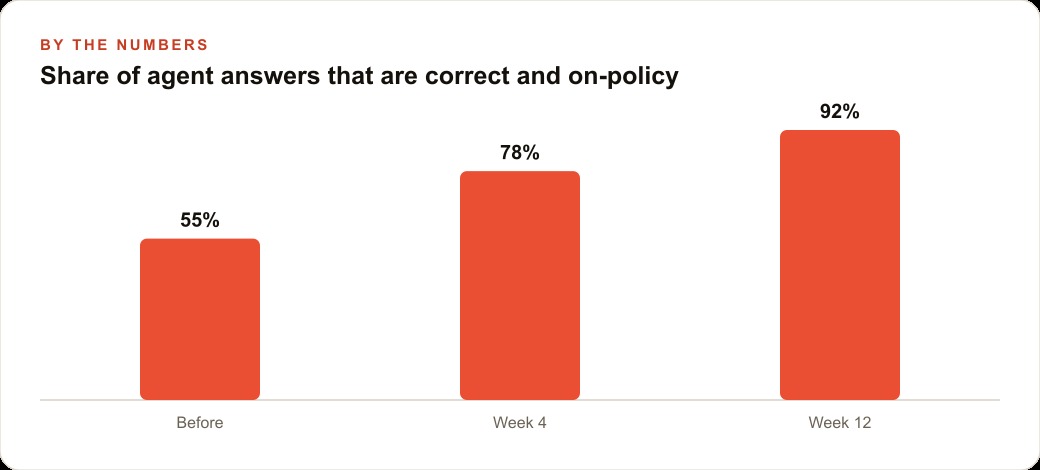
The real estate brokerage example brings all six steps together. Before context engineering, the brokerage was contacting roughly 30 percent of its 40 daily inbound leads, about 12 per day. The gap was not strategy. The gap was response time. Leads went cold in the hours between inquiry and first reply. A well-engineered lead-response agent replies in seconds. Its prompt is structured into the six sections: the role defines it as a polite, brief first responder; the task instructs it to ask two or three qualifying questions and then book a showing; the constraints lock it out of price guarantees and any statement that could create fair-housing risk; the capabilities list the CRM read and calendar-booking tools it may use and the conditions for using each; inputs arrive in XML tags so the lead's name, property interest, and budget range are parsed cleanly without guesswork.
With that context-engineered prompt running, the contact rate moves from 30 percent to 70 to 80 percent, which is 28 to 32 leads contacted per day compared to 12 before. That result is not primarily a function of which model powers the agent. It is a function of how clearly the context was engineered: the right tools mapped before the first word of the prompt was written, the instruction manual structured into six labeled sections, the four context strategies applied to keep the RAM loaded with only what the task needs, and an explicit rule written for every decision the agent makes along the way.
Context engineering is not a framework you adopt once and forget. It is a design discipline you apply every time you build an agent. The businesses that internalize it now will build systems that hold up when the situation gets complicated, because they took the time to load the RAM with exactly what the task needs, and nothing more.
That is exactly what we do at AI DOERS. Book a private 30-minute call with Madhuranjan Kumar and we will map the fastest path to it for your specific business.
Book your call →
Madhuranjan Kumar
Madhuranjan Kumar brings 20 years of performance-marketing experience and has managed over $200 million in Facebook ad spend for brands across the United States and beyond. His expertise spans the full modern marketing stack: Meta, Google Ads, TikTok, email automation, CRM, and the websites that hold it together. At AI DOERS he turns that track record into lead-generation systems for businesses across every industry.