
How Specializing Hard and Owning Your Data Builds a Compounding Edge
A coding app became a real AI lab by starting from a strong base, focusing on one job, and feeding its own usage data into better models, and the same flywheel works for a local trade business.

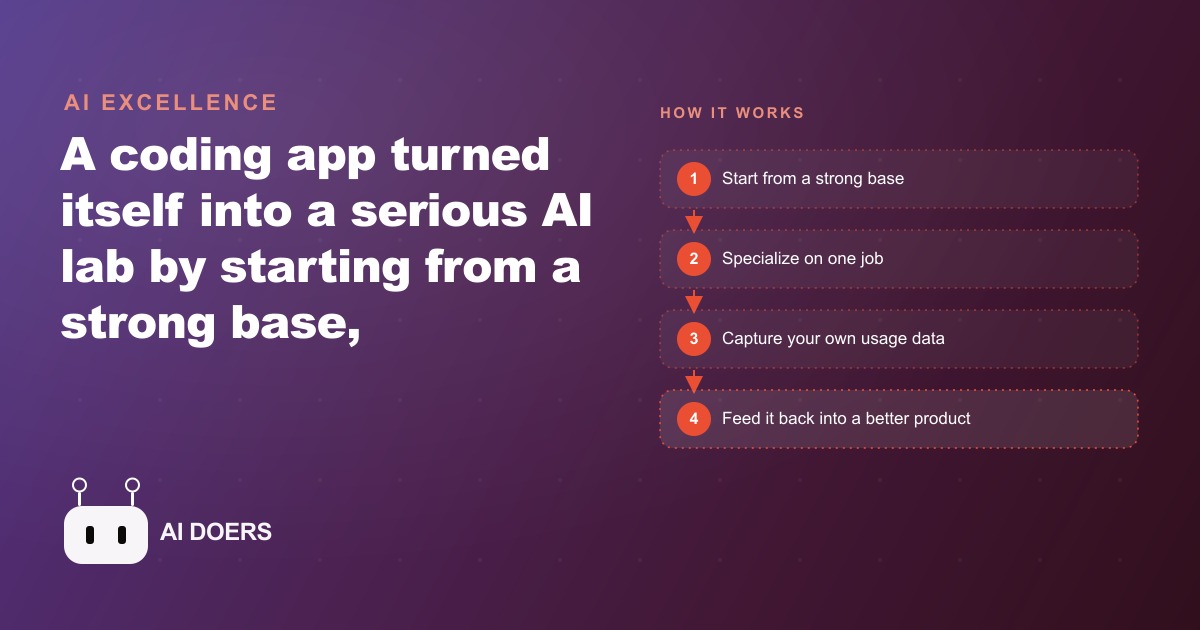
Cursor released Composer 2 this week, a coding model that sits close to frontier quality but costs significantly less to run because it was built in house and trained on years of the company's own real usage data. The announcement is worth studying not because of what it means for coding tools specifically, but because of what it reveals about how a compounding competitive edge actually gets built. I am Madhuranjan Kumar, and the pattern at work here transfers directly to any business that does the same job repeatedly and accumulates information in the process, which describes most local and professional service businesses more accurately than it describes software companies.
A Coding Tool Just Became One of the Most Interesting AI Labs in the Industry
Cursor started as an IDE, a code editor with AI features, built on top of existing open-source foundations and early versions of frontier models. It was not a lab. It did not have a research team producing novel architectures. It had a focused product with a clear audience: developers who wanted AI assistance tightly integrated into their daily workflow.
What happened over the following period is the story worth paying attention to. The product got users because it did one job better than the alternatives, not because it did more things. Those users generated real behavioral data: exactly which suggestions were accepted, which were rejected, at what point in the code a model went wrong, and how developers actually worked when the AI was involved. That data is not available for purchase. It cannot be scraped from the internet. It exists only because real users worked inside the product and the company paid attention to what they did.
That data became the training signal for Composer 2, the company's own model, tuned specifically for the job of coding assistance rather than general capability. The result is a model that sits close to frontier quality on the task it was designed for, at a cost structure that does not depend on paying a larger outside provider a margin on every API call. A product that looked like a developer tool is now an AI lab with proprietary training data that no one else can replicate. That transition happened through specialization, not through spending.
The Lab With More Resources Kept Losing Ground Because the Data Gap Stayed Open
The striking part of this story is what the well-funded general-purpose competitors could not do. OpenAI, Anthropic, and Google all build frontier models with capabilities that in many respects exceed what Cursor's in-house model can do. But frontier general capability is not what wins in a specialized application. Relevance to the specific task wins, and relevance comes from training on data that mirrors the actual job.
A general model trained on internet text and code repositories has learned from thousands of different coding contexts and millions of different styles. A model trained on the real interactions of developers using a specific tool has learned from a much narrower but far more relevant set of behaviors: the exact kinds of mistakes people make in this workflow, the exact kinds of suggestions that get accepted versus rejected, and the exact patterns that characterize successful completion of the task at hand.
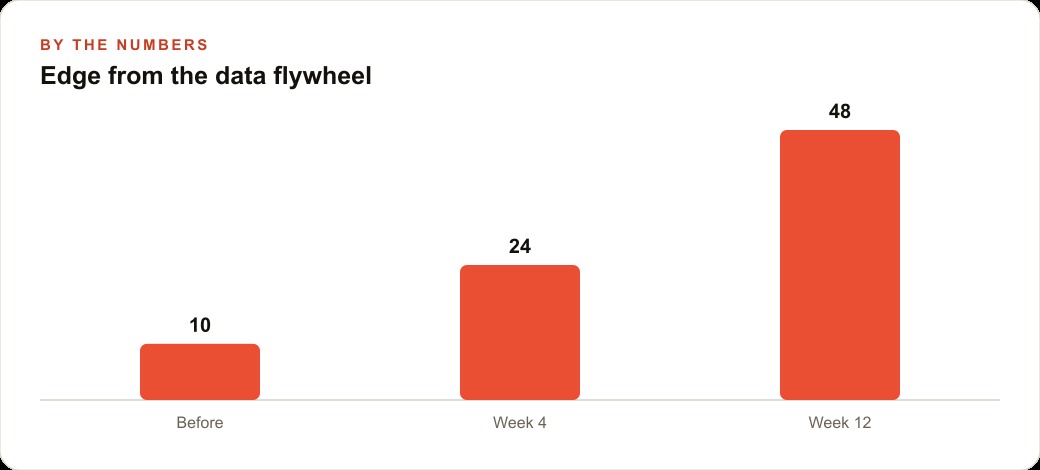
The larger competitors can allocate more compute. They can hire more researchers. They cannot buy the behavioral data that Cursor accumulated by being the product people actually used. That asymmetry is the core of the moat, and it holds in any industry where the data generated by doing the work is more relevant than the data generated by reading about the work.
This is the lesson that applies directly to a business with no AI ambitions at all. If you do the same category of job consistently and you record what happens, you accumulate a form of data that no outside competitor can purchase. The value of that accumulation is not always obvious when you are in the early stages of the logging habit. It becomes obvious when you compare your quoting accuracy, your scheduling efficiency, or your follow-up conversion rate to a competitor who is still working from memory.
Targeted Feedback Beats Vague Feedback by a Wide Margin
One of the specific techniques that made Cursor's improvement loop faster than it otherwise would have been was the way the company handled error signals. Most feedback systems collect a thumbs up or thumbs down at the end of an interaction, which tells the model that an answer was good or bad but gives it no information about which part of the reasoning chain went wrong. That is the equivalent of a customer leaving a one-star review without any comment. You know something went wrong. You do not know what to fix.
Cursor's system was designed to identify the specific moment in a coding session where the model's output diverged from what the developer actually needed. Instead of a signal that said the overall result was wrong, the system surfaced signals that said the reasoning went off track at step three of six, and here is what the developer did to correct it. That is targeted feedback, and it produces faster improvement because the learning is specific. The model does not have to infer from a global bad signal which of its dozens of intermediate steps caused the failure. It learns from the exact point of failure.
The translation to a service business is direct. Vague retrospectives, which are the business equivalent of a general thumbs down, do not improve future performance. A plumber who reviews which specific job estimate ran over time and by how much, then adjusts the next estimate for that job type, is running targeted feedback. The improvement is specific, measurable, and immediately applicable. A plumber who reviews the month and concludes that margins were lower than expected has a global signal with no actionable component. The distinction between specific and vague learning is one of the most compressible differences between businesses that improve quickly and businesses that plateau.
Owning the Model Solved Both the Cost Problem and the Control Problem
For a period before Cursor built its own model, the company depended on outside API providers for the core AI capability of the product. That dependency had two costs. The first was margin: every AI-assisted interaction had a direct cost paid to a third-party provider, and as usage scaled, that cost scaled proportionally, compressing the economics of the business. The second was control: the product's capability was bounded by what the outside provider chose to offer and how they chose to change it over time.
Building an in-house model trained on Cursor's own data addressed both problems simultaneously. The cost per interaction dropped because the company was no longer paying a provider's margin on every call. The capability became tunable: instead of accepting a general model's strengths and weaknesses, the team could direct training toward the specific areas that mattered most for coding assistance. And the improvement loop closed entirely within the company: data from users went into training, training produced a better model, the better model generated better user experiences and more data, and the cycle continued without any external dependency in the critical path.
This is an organizational design principle as much as a technology decision. Businesses that depend entirely on outside providers for core capabilities face the same two constraints: margin compression and control loss. The businesses that invest in building something proprietary, even something as modest as a structured internal knowledge base, a pricing algorithm based on their own job history, or a client communication playbook drawn from their own best outcomes, capture both the cost and control benefits that Cursor captured by owning its model. The specific mechanism is different. The structural advantage is identical.
The Same Flywheel Runs in a Trades Business Whether the Owner Knows It or Not
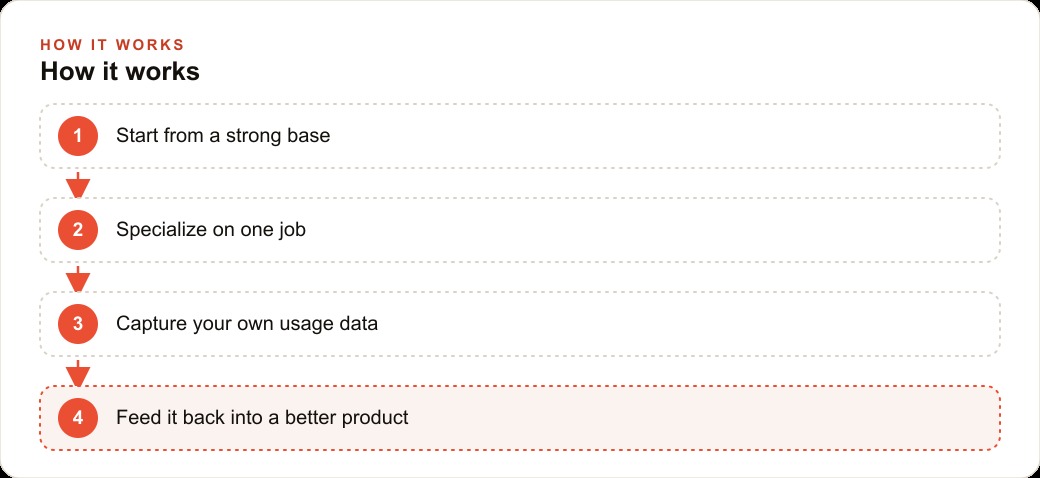
The four-move sequence that describes Cursor's trajectory, starting from a strong existing base, specializing on one job, capturing real usage data, and feeding it back into improvement, is not unique to AI companies. It is a general pattern for building compounding advantage in any field, and it runs in a trades business whether the owner has named it or not.
The owner who starts with an established trade skill rather than building from scratch is starting from a strong base. The one who narrows to a specific job type and serves it very well is specializing. The one who logs what happens on every job, what it actually took, what it cost, how the customer responded, and what they would do differently, is capturing usage data. The one who reviews those logs monthly and adjusts quoting, scheduling, and follow-up based on the patterns is feeding the data back. Each of those moves stacks on the others, and the compound effect over time is a business that is measurably more accurate, more efficient, and more reliable than one that relies on memory and intuition alone.
The flywheel does not require technology to run. It requires discipline. The tool that accelerates it is not an AI model or a specialized platform. It is a consistent habit of recording what happens and asking what the pattern means. Technology makes the data easier to collect and the patterns easier to spot, but the underlying logic works with a spreadsheet and a recurring calendar reminder.
The Electrician Running Fifteen Jobs a Week and What the Loop Looks Like in Practice
Let me make this concrete. Consider an electrician running roughly fifteen service and installation jobs per week across a two-person operation. The business is doing well enough, but the owner has noticed that some job types are reliably more profitable than others, and some estimates consistently run over. The margin feels unpredictable from month to month even when volume is stable.
The strong base is the trade skill and the existing customer relationships. The specialization move is to focus on the two or three job types that produce the best margin and the best referrals: in this hypothetical, panel upgrades and EV charger installations in newer residential construction. The data capture move is to log every job with a consistent short set of fields: job type, location, quoted hours, actual hours, materials cost, quoted price, outcome, and whether the customer rebooked or referred.
After three months of consistent logging, illustrative patterns emerge. Panel upgrades in older homes run twenty-five to thirty percent over the estimated time on average because the existing wiring requires more remediation than the initial assessment captures. The quote template has been systematically underpricing that category. EV charger installations in homes with modern panels run close to estimate. Referral rate is highest from customers who also received a follow-up inspection call six weeks after job completion.
Each of those patterns is an improvement the owner can make immediately and specifically. The panel upgrade quote gets adjusted to reflect the real average time. The follow-up call gets scheduled automatically for every completed job. The targeted feedback is: panel upgrades in older homes, adjust for remediation at the estimate stage. Not a vague sense that margins are off, but a specific step to fix.
If the business runs twenty panel upgrade quotes per quarter and half of them historically ran over by thirty percent, and the average job is priced at eight hundred dollars, the systematic underpricing represents roughly six thousand dollars per quarter in margin lost to a pattern that the data surfaces immediately. Fixing the quote template based on the logged actuals is worth that six thousand dollars per quarter, and it took one month of logging and one afternoon of review to find it. That is the flywheel delivering a specific, measurable return.
From there, the same customer records become a follow-up engine for Facebook and Instagram ad campaigns targeting homeowners with aging panels, or for remarketing through Google Ads to the same neighborhoods where the conversion rate on EV installations has been highest. The data that improved the quoting accuracy is the same data that sharpens the targeting. Each loop through the cycle makes the next loop more valuable, and the competitor working from memory cannot replicate the two years of structured data that underlies both improvements.
Starting Late Is Not the Problem. Stalling the Loop Is.
Cursor did not build the first AI coding tool, and it did not have the largest initial user base. What it did was spin the improvement flywheel consistently once it had started, and the compounding effect of consistent loops over time produced an advantage that more richly resourced competitors could not close because the relevant data was not for sale.
The same principle applies to the trades business that starts logging jobs today even though a competitor started two years ago. The late starter cannot buy the earlier start, but they can spin faster: more consistent logging, more focused review, more specific adjustments per cycle. The moat is not the head start. The moat is the depth of the data accumulated over the time the loop has been running, and every month of consistent operation adds to it.
The businesses that stall are the ones that start the logging habit, review it once or twice, and then let it drift because the near-term returns are not dramatic. The improvement in any single cycle is modest. The improvement across twelve cycles, applied to quoting accuracy, scheduling, follow-up conversion, and referral generation simultaneously, is the difference between a business that is compounding and one that is flat. That is the lesson from Cursor, and it does not require training an AI model to apply it.
If you are building the systematic capture-and-review habit for your own operation, the foundation is a consistent short set of fields logged on every job and a monthly appointment to sit with the patterns. For businesses that want the data architecture set up correctly from the start, with the review process automated and the patterns surfaced without manual analysis, that is the kind of system I build for clients, and you can bring that infrastructure in rather than assembling it from scratch.
That is exactly what we do at AI DOERS. Book a private 30-minute call with Madhuranjan Kumar and we will map the fastest path to it for your specific business.
Book your call →
Madhuranjan Kumar
Madhuranjan Kumar brings 20 years of performance-marketing experience and has managed over $200 million in Facebook ad spend for brands across the United States and beyond. His expertise spans the full modern marketing stack: Meta, Google Ads, TikTok, email automation, CRM, and the websites that hold it together. At AI DOERS he turns that track record into lead-generation systems for businesses across every industry.