
The 3-AI Creative Stack: How to Use ChatGPT, Udio, and Midjourney Together
Using one AI tool for everything produces average results. Here is how to combine ChatGPT for ideation, Udio for music, and Midjourney for visuals into a workflow that produces content any of them would struggle to make alone.

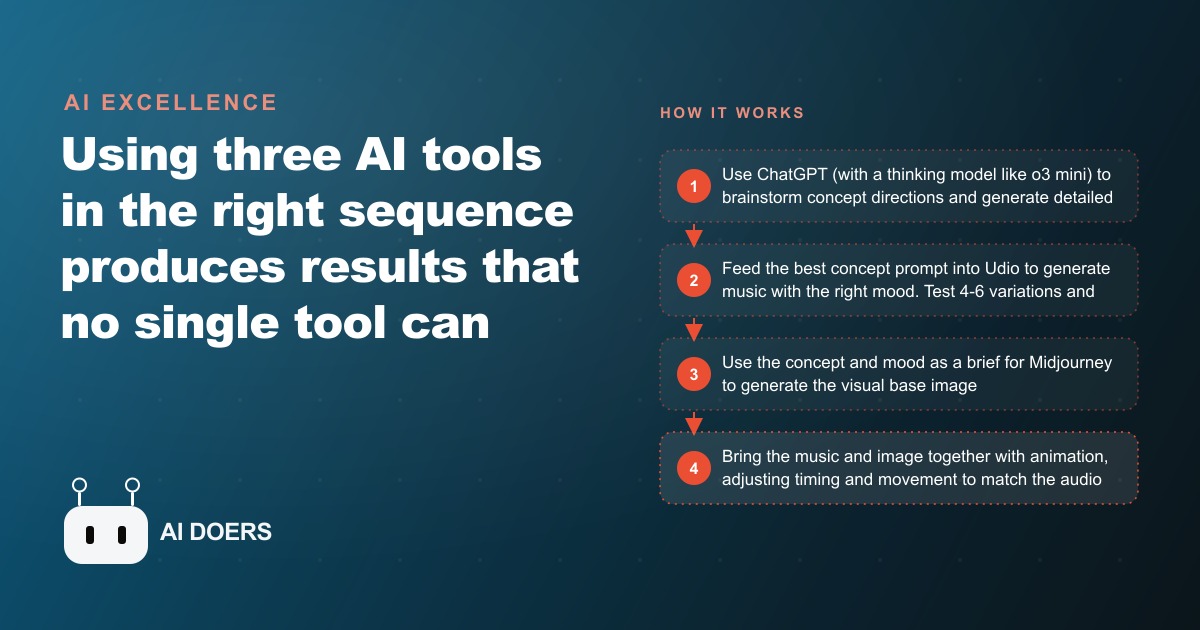
Use one AI tool for everything and you get average content, the kind that is technically fine and instantly forgettable. Chain three tools together in the right order and you get output none of them could produce alone: music that sounds like it belongs with the visual, a visual that fits the concept, and a concept refined enough to actually inform both. The trick is not any single tool. It is knowing which tool owns which stage and refusing to let one of them do a job it is bad at.
The stack is ChatGPT for ideation and prompt writing, Udio for music, and Midjourney for visuals, with a human tying the pieces together at the end. Written by Madhuranjan Kumar, this piece lays out the seven principles that make the combination work, built while producing an intro animation for a live stream and adaptable to any branded content, marketing asset, or brand element you need. Each one is a rule you can apply the next time you sit down to make something.
1. Treat ChatGPT as the creative director, not the production line
The most common mistake is asking ChatGPT to produce the finished thing. Its real strength is language, context, and following creative direction in natural conversation, which makes it a superb director and a mediocre factory. Use it to define the brief, name the concepts, and write the prompts that the specialized tools will execute. When you keep it in the director's chair, thinking, planning, and shaping the brief, the specialized tools downstream have something coherent to work from. When you push it to also generate the music description and the visual prompt and then take those outputs without evaluating them, you get low-coherence results that feel assembled rather than designed.
2. Switch to a thinking model for the brainstorm
Not all of ChatGPT is equal for this job. A thinking model like o3 mini, one that reasons through ideas before presenting them, produces noticeably more varied and genuinely creative brainstorming than a standard model. The difference is real enough that it is worth the deliberate switch for ideation specifically. For production tasks like formatting or editing, a standard model is perfectly fine. But when you are trying to generate concept directions that are not obvious, the thinking model earns its place by exploring more of the space before it answers. Reach for it at the start of a project, then drop back to the standard model once you are past the creative part.
3. Describe the feeling, not the specs
Across every tool in this stack, shorter prompts built around mood beat longer prompts stuffed with technical detail. For music, describing an upbeat, forward-looking feeling that makes someone nod along while driving produces better results than specifying a 120 BPM track with a particular instrument list. These models understand emotional registers better than they parse technical requirements. The same holds for visuals: tell the tool the emotional experience you want the audience to have, and it fills in the craft. This is counterintuitive if you come from a technical background, where precision usually helps, but here the emotional brief is the precise instruction. Save the specs for the human editing stage.
4. Let Udio carry the music, and never take the first take
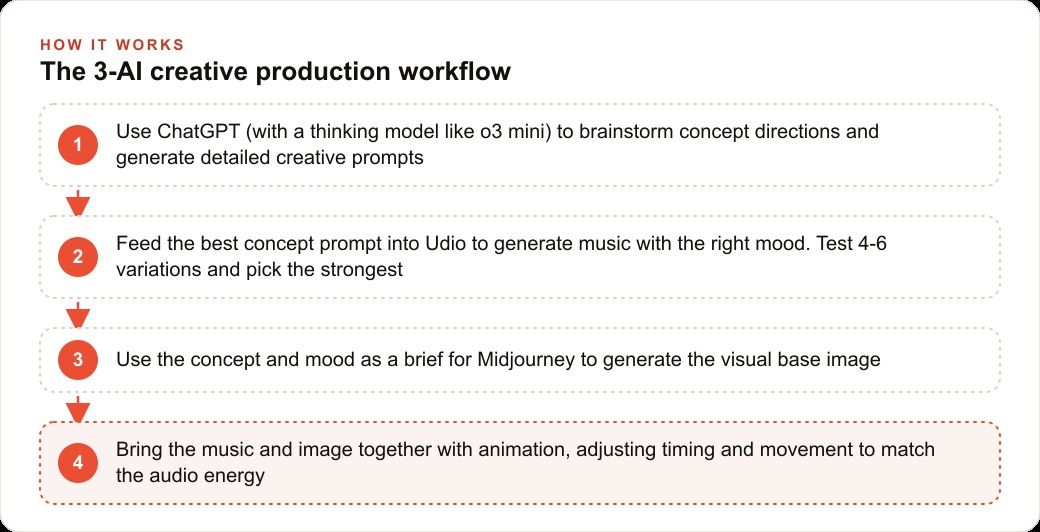
Once you have a concept and prompt from ChatGPT, Udio generates the music, and the discipline here is to generate several variations rather than committing to the first one. Produce four to six versions and listen to each critically, because the differences between them are often significant. One might have the right energy but the wrong instrumentation. Another might nail the mood in the first thirty seconds and lose it in the middle. The first output is a starting point, not a conclusion. The version you actually want is usually the third or fourth one you audition, the one that holds its energy all the way through and, ideally, has a build you can use as a transition.
5. Use Udio's style reference when a feeling is easier to show than describe
Udio also has a style reference feature: upload an existing track and have the tool generate a new piece inspired by it. This is the answer for when you know the exact feeling you want but find it easier to demonstrate than to put into words. A similarity slider controls how closely the output tracks the reference. Set it high and you get something that feels like a new version of the original. Set it lower and the tool uses the reference more loosely, borrowing the vibe without copying the shape. This turns a vague creative instinct into a usable input, which is exactly the kind of bottleneck that stops most people from finishing.
6. Pass the mood into Midjourney, not just the subject
Midjourney handles the visual, and the key is that the creative concept from ChatGPT serves as the brief for the image, not just a description of what should appear on screen. If you only tell it what objects to draw, you get a generic picture. If you pass the mood and concept language into the prompt, you get a visual that feels emotionally aligned with the music, which is the whole point of coordinating the tools. Look specifically for compositions with empty space where text can go, an upper third left open for a title, for instance, because a beautiful image with nowhere to place your brand name is not usable. Like the music, treat the first generation as a draft and re-roll until the mood and the layout both land.
7. The human assembly step is where coherence is born
The final principle is the one people skip most, and it is the most important. Generating music and image separately and laying one on top of the other, without thinking about how the timing, pacing, and energy of the audio relate to the movement in the visual, produces something that feels unfinished. A human deciding when the visual moves and how fast, matching a slow zoom to the music's build, timing a transition to a beat, is where the final coherence actually comes from. The best output in this whole workflow came from exactly this combination: AI-generated music, an AI-generated base image, and a person's judgment about how to bring them together. The tools produce the parts. The human makes them one thing.
A worked example: a professional intro for a gym's live stream
Consider a mid-size independent gym with about four hundred active members. It runs a Saturday morning bootcamp that it live streams on Instagram for members who cannot attend, and after two years the stream still opens with a phone propped against a weight rack showing Madhuranjan Kumar walking into frame. The owner wants it to feel professional without hiring a production agency.
Here is the seven-principle stack applied. In ChatGPT on a thinking model, the owner writes a brief for a thirty-second intro, describing the mood as energetic and motivating but not aggressive, more like the first mile of a run that goes better than expected than a heavy competition, and asks for three concept names plus a music prompt for each. In Udio, the owner takes the strongest music prompt and generates five variations; two fade early, one is too aggressive, and of the two strong ones, one has a build that would work perfectly as the stream transitions from the intro screen to Madhuranjan Kumar. In Midjourney, the owner uses the concept's mood description to generate a visual emphasizing early-morning energy and warmth, and picks one with enough empty space in the upper third to overlay the gym's name and schedule. Finally, a family member who does basic editing brings the image into a simple tool, adds a slow zoom matched to the music's build, and exports a thirty-second clip. The whole production, from first brainstorm to final export, takes about three hours.
Put illustrative numbers on the payoff. ChatGPT Plus runs around twenty dollars a month, Udio around twelve to fifteen, and Midjourney's basic plan around ten, so the full stack sits near forty-five to fifty-five dollars a month against several hundred dollars for a freelance composer plus a design agency for branded assets. The gym starts using the intro the next Saturday, and its average concurrent viewer count climbs over the following month, partly because the professional open signals that the stream is worth watching. That momentum is worth feeding: the same branded intro can front the gym's Facebook and Instagram ad campaigns, and the polished assets give the CRM and website stack something on-brand to send new members in their welcome sequence.
Why coherence is the whole game
Step back from the seven principles and one idea connects all of them: internal coherence. Coherence means the music, the visual, and the concept feel like they were designed for each other, because they were, each built from the same brief and refined through the same creative thinking. It is invisible when it is present and glaring when it is missing. An audience that could never explain why will simply feel that a piece of content is off, that the music does not fit the image or the tone does not match the message, and that vague wrongness quietly erodes trust in the brand.
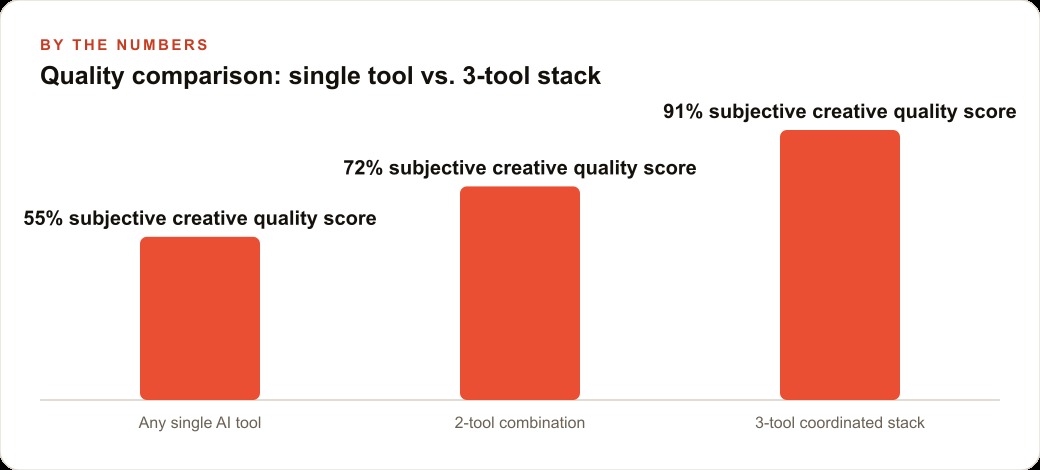
This is why using one tool for everything falls short even when each individual output is decent. The easiest path, one tool, one prompt, first result, produces parts that were never designed to work together, so they never quite do. The three-tool stack is really a coherence machine: it lets each tool do what it is best at, then relies on a human to align the pieces so the seams disappear. The extra thirty to sixty minutes the workflow costs over a single-tool shortcut is almost entirely spent buying that coherence, and for anything that represents the brand in public, it is the best time you will spend.
The human stays in the director's chair
It is worth naming what does not change in all of this: judgment. The AI tools generate an abundance of raw material, more music variations and image options than you could use, but they cannot tell you which one is right for your brand or your moment. That decision, which take holds its energy, which image leaves room for the title, when the visual should move and how fast, is human work, and it is the work that actually determines quality.
That is a reassuring conclusion rather than a limiting one. It means the person using this stack is not being replaced by it, they are being amplified by it. The tools remove the parts that used to require a composer, an illustrator, and a budget, and they leave the part that requires taste. A business owner with a clear sense of their brand and a willingness to audition options can now produce work that used to require a whole team, precisely because the judgment that ties it together was never the part a tool could do.
Where to start today
Open ChatGPT, switch to a thinking model, and write a brainstorming prompt for one piece of branded content you actually need, including the mood, an output format asking for concept names and prompts, and any constraints like duration or platform. Take the strongest concept into Udio, generate a first set of variations, and audition them on headphones before choosing. Bring the concept's mood into Midjourney and generate visual options, looking for space for text and a mood that matches the music. Then assemble the pieces in a basic editor like CapCut, iMovie, or Canva, and judge the result against the brief you wrote in step one.
The stack adds maybe thirty to sixty minutes over generating everything in one tool and taking the first output, and for anything that represents your brand publicly, that time buys the internal coherence that makes content look deliberately produced rather than improvised. If you would rather have the whole creative pipeline set up and a batch of branded assets produced for you, that is the kind of work I take on for businesses that want the polish without learning three tools at once.
That is exactly what we do at AI DOERS. Book a private 30-minute call with Madhuranjan Kumar and we will map the fastest path to it for your specific business.
Book your call →
Madhuranjan Kumar
Madhuranjan Kumar brings 20 years of performance-marketing experience and has managed over $200 million in Facebook ad spend for brands across the United States and beyond. His expertise spans the full modern marketing stack: Meta, Google Ads, TikTok, email automation, CRM, and the websites that hold it together. At AI DOERS he turns that track record into lead-generation systems for businesses across every industry.