
The Cold Email Framework That Books Meetings Without Any Track Record
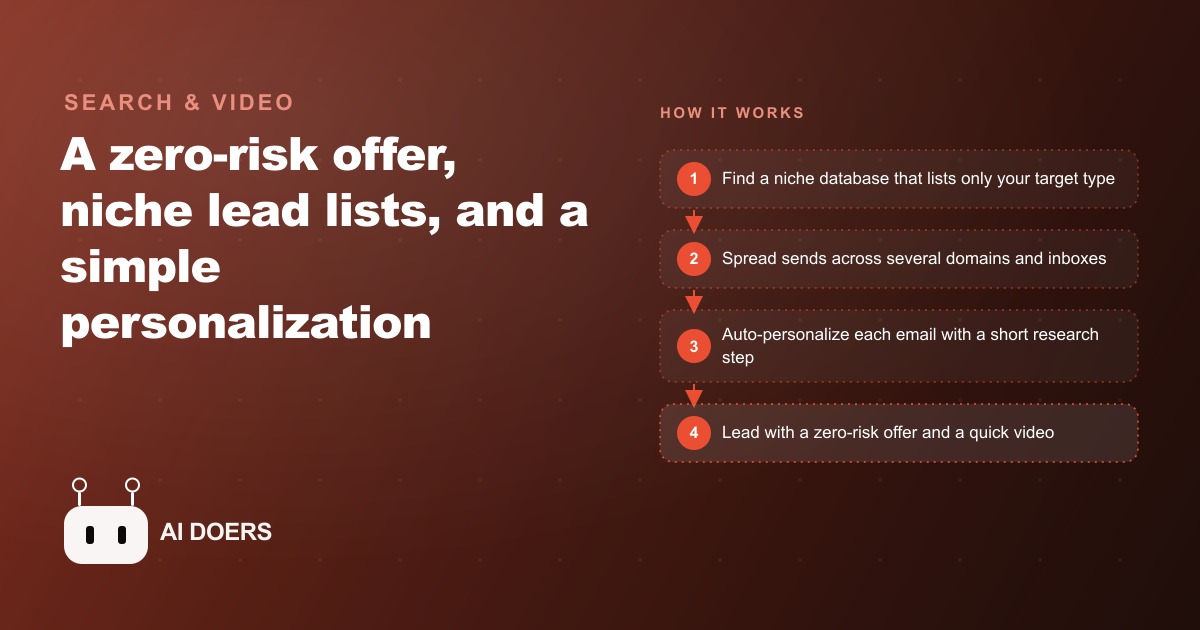
A zero-risk offer, niche lead lists, and a tiny personalization automation can fill your calendar with qualified meetings even before you have a single case study. Here is the whole system and how a local service business can run it.

Six months. Zero cases studies. Half a million dollars in identified sales pipeline. The person who built that result was still in school when it happened. I am Madhuranjan Kumar, and the reason this is worth breaking down in detail is that the method is entirely reproducible and none of it depends on a track record you do not yet have.
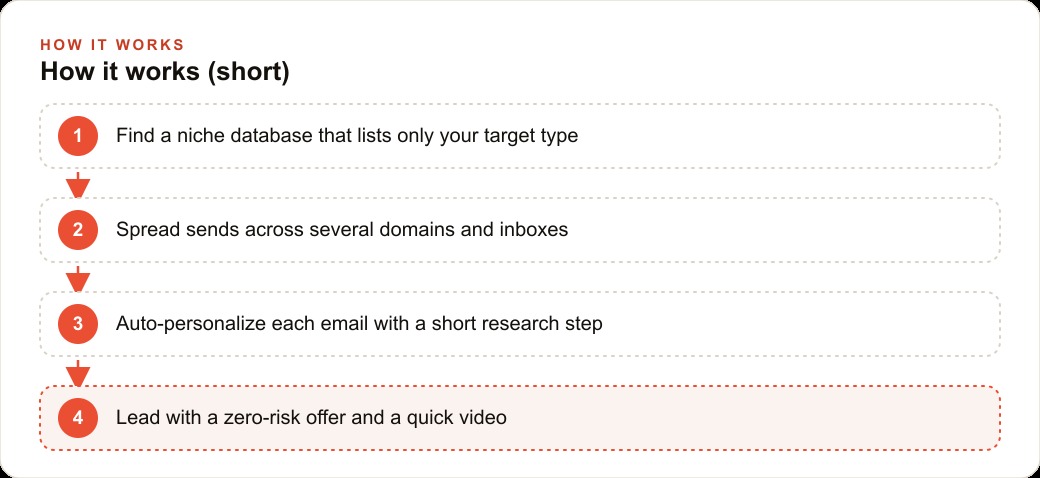
Find the niche list that does your filtering before you write a single word
Most cold email campaigns fail before the first message is sent because the list is wrong. Pulling ten thousand leads from a broad database with generic filters like "small business" or "marketing services" produces a list where the majority of names are irrelevant. The response rate to a well-written email sent to a bad list is still near zero. The list quality determines the ceiling of the campaign more than any other factor.
The correct approach is to work backward from where your ideal customer already identifies themselves. Almost every industry has a niche directory, a trade association list, a certification database, or a platform-specific marketplace where only the right type of business appears. A commercial pest control company looking for restaurant clients does not pull from a generic "food service" filter on a leads platform. It finds the restaurant association directory for the target region and pulls from that. Every name on that list is pre-qualified by their own industry membership.
Ask an AI research tool to identify where your specific target type of business publishes itself online. The question "where do independent dental practices in the Southeast list themselves publicly" returns a set of directories, associations, and platforms that general Google searches would not surface efficiently. Those directories are the starting point for a clean list. Clean means every company on it is the right type, which is the only quality check that matters before the enrichment step.
From the directory, enrich for decision-maker contact information using a tool with a verified email database. The verification step is not optional. Emails that bounce hurt deliverability, and deliverability is the constraint that determines whether any email from your domain reaches an inbox at all. Verify everything before the first send.
Set up the infrastructure before the first send, not after the first bounce
Infrastructure is the least exciting part of cold email and the one most beginners skip. A bounce rate above two percent from an email domain triggers spam detection systems and begins damaging that domain's reputation with every subsequent send. Recovery from a damaged domain reputation takes weeks, and there is no shortcut.
The standard for infrastructure that delivers at scale is simple: multiple domains, multiple inboxes per domain, and a low daily send volume from each inbox. Five domains with three inboxes each gives fifteen sending addresses. Sending thirty emails per day from each address gives a daily volume of four hundred and fifty, which reaches meaningful scale over a two-week campaign without triggering any single inbox's volume thresholds.
The domains should be variations of your main brand: your-name-media.com, yournameconsults.com, yourbrandagency.com. They should look legitimate because they are legitimate. Each domain needs a complete email setup including SPF, DKIM, and DMARC records for authentication, and each inbox should go through a warm-up period of two to three weeks sending low volumes before it is included in a live campaign.
This setup requires a half-day investment and a few dollars per domain per year. It is the infrastructure decision that most beginning cold emailers make incorrectly by sending everything from one address, then wonder why a technically excellent campaign produces near-zero response.
Build the four-step personalization flow in one afternoon
The personalization step is what separates a cold email that feels personal from a template where someone filled in the city name. In 2026, AI-personalized first lines are widespread enough that "I noticed your company serves businesses in [City]" reads like the template it is. The bar for genuine-feeling personalization has risen because everyone has access to the same tools.
The four-step flow that produces lines that actually feel personal is simple to build and requires no manual research per contact. A spreadsheet holds each lead. An automation reads each lead's company name and website, passes them to a research step that produces a brief profile, then passes that profile to a writing step that produces a single-sentence icebreaker grounded in something specific and recent: a new location, a hiring announcement, a product launch, an award received. That icebreaker is returned to the spreadsheet in a new column. The whole flow processes a list of several hundred contacts in an hour without touching any of them manually.
The output is a first line that references something real about the company, not something every company on the list has in common. That specificity is the signal that the email was written by someone who looked. The research step that enables it takes one afternoon to set up and then runs automatically for every subsequent campaign.
Write the offer with a number, a timeline, and a catch
The email itself follows a short, specific structure. Subject line: sounds like a note from a neighbor or a colleague, not a marketing email. The goal is an open, and the subject line competes with everything else in the recipient's inbox. A subject line that reads like an internal message or a personal note generates more opens than one that reads like an advertisement.
First line: the personalized icebreaker from the automation. Second paragraph: the offer in plain, specific terms. The offer must have three components to overcome the trust deficit of a cold message to a stranger.
First, a clear outcome: not "I will help improve your marketing" but "I will deliver eight qualified booked appointments for your commercial accounts department." Second, a specific timeline: thirty days, not "within a few weeks." Third, a catch that inverts the risk: if the outcome is not delivered, there is no payment, no contract, no further obligation. The prospect who reads that structure does not have to trust you. They only have to trust that they have nothing to lose by taking one conversation.
The final element is the ask: not a meeting request, because a meeting request from a stranger requires a commitment before any trust exists. The ask is a short video, two minutes, that explains exactly how the outcome will be delivered. This breakdown requires no further commitment to watch. It either convinces or it does not. The response rate for a video offer is measurably higher than a meeting request in cold email contexts because the trust threshold is lower.
Read reply rate as a compass that tells you exactly what to fix
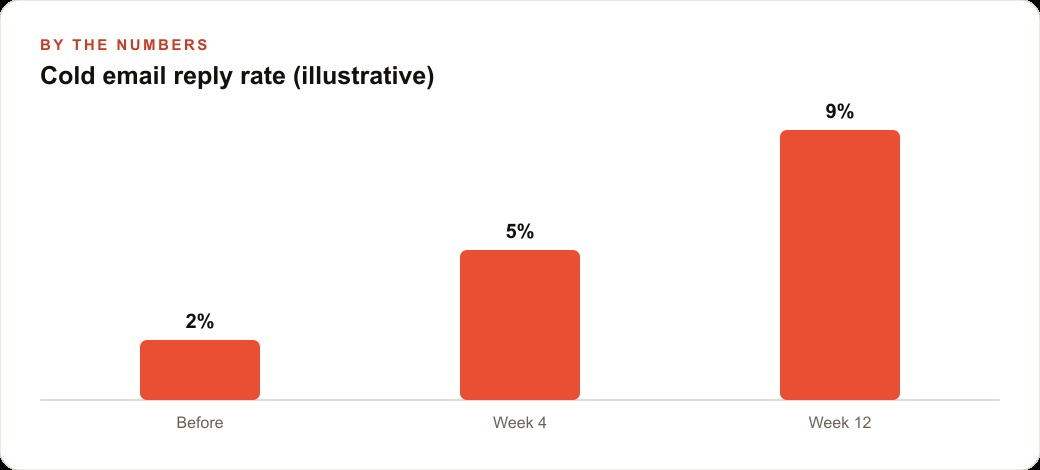
Under two percent reply rate means the problem is the list or the deliverability. The email may be excellent but it is reaching the wrong people or landing in spam. Check the list quality first: are these actually the right type of business, the right decision-maker level, in an industry that would plausibly benefit from the offer? Then check deliverability: run the sending domain through a deliverability checker and confirm emails are landing in the primary inbox rather than spam or promotions.
Two to five percent reply rate means the list and deliverability are solid but the email itself is not converting. The offer may be unclear, the subject line may not be generating opens, or the personalization may not feel genuinely personal. Test one variable at a time: subject line first, then offer framing, then the first line quality.
Five to ten percent reply rate means the system is working. At this range the math on pipeline is compelling for almost any service business. A campaign reaching three thousand well-chosen leads at a seven percent reply rate produces two hundred and ten replies. Half genuinely interested produces one hundred and five conversations. A third of those converting to booked calls produces thirty-five qualified meetings from one campaign.
The pest control company seeking commercial accounts, the marketing consultant seeking agency retainers, and the HVAC service company seeking facility management contracts all run the same math. The inputs are the list, the infrastructure, the offer, and the personalization. The output is meetings. For businesses also investing in Google Ads to drive inbound inquiries, cold email reaches the decision-makers who never search, which makes it a complementary acquisition channel rather than a competing one.
Turn the first case study into the engine for the second campaign
The first delivery from a zero-risk offer should be treated as a case study investment, not a free service. Every detail of the engagement is documented: the client type, the starting situation, the actions taken, the results achieved, the timeline. That documentation becomes the most powerful asset in the next campaign's email.
A first line that references a case study from a relevant and recent engagement converts at roughly twice the rate of a first line that references generic company research. The prospect's internal monologue shifts from "this is a cold email template" to "this person has done this for someone like me." That shift in perception is worth far more than any improvement in subject line or offer structure, which is why the first win, delivered at zero cost to establish the case study, pays for itself many times over in the campaigns that follow.
The businesses that run cold email as a quarterly activity rather than a one-time experiment are the ones that build compounding lead engines. Each campaign improves on the previous one because the case study library grows, the list quality improves with each iteration, and the offer sharpens based on what the replies reveal about what the audience actually wants. For businesses that also use SEO and organic search as an inbound channel, cold email is the outbound counterpart that reaches the buyers who are not yet looking. Running both together creates a lead environment where inbound and outbound reinforce each other across the same audience.
The measurement framework that proves content investment value
Measuring the business value of content produced with AI assistance requires the same measurement framework as any content investment: connecting content consumption to business outcomes. The challenge with content measurement is that the connection is often indirect, with content informing a purchase decision that happens through a separate channel days or weeks after the content was consumed.
The measurement approach that captures this indirect value is multi-touch attribution combined with content-specific engagement metrics. Multi-touch attribution tracks whether a customer who converted had previously consumed content from the business. The content engagement metrics, time on page, return visits to the content, content-assisted conversions in the attribution model, indicate which content pieces are actually influencing purchase decisions rather than generating views that do not convert.
For a business investing in both content marketing and paid advertising, the multi-touch model reveals how these channels interact. Content that appears in the customer journey before a paid ad click indicates that the ad converted a customer who had already been educated by the content. Content that appears after an ad click indicates that the ad brought a prospect who then needed more information before converting. Each pattern has different implications for budget allocation and content prioritization.
The content format decisions that AI assistance changes
AI assistance changes the economics of content format in a specific direction: it makes text-based content production significantly faster and cheaper, it makes image and graphic creation accessible without graphic design skills, and it does not change the production cost of video at meaningful quality. The format decisions a business makes in a content program should reflect these different economics.
A business that produces twenty text articles per quarter with AI assistance and three videos per quarter with production investment is allocating its content resources correctly given the current tool economics. A business that tries to use AI to accelerate video production to the same degree as text production will encounter the gap between what text-to-video tools currently produce and the quality bar that professional video requires.
The practical guidance is to use AI assistance where it produces genuinely usable outputs at current quality levels, which for most businesses means text content, static graphics, and structured data analysis. Reserve production-intensive formats for the content pieces where the investment is justified by the expected audience and conversion impact, rather than trying to use AI tools to match quality levels they have not yet reached.
For web presence and search visibility specifically, high-quality text content with genuine insights and clear structure continues to be the format that delivers reliable search traffic and compounding authority over time. The AI tools that make this format cheaper and faster to produce have not changed the fundamentals of what makes it effective.
That is exactly what we do at AI DOERS. Book a private 30-minute call with Madhuranjan Kumar and we will map the fastest path to it for your specific business.
Book your call →
Madhuranjan Kumar
Madhuranjan Kumar brings 20 years of performance-marketing experience and has managed over $200 million in Facebook ad spend for brands across the United States and beyond. His expertise spans the full modern marketing stack: Meta, Google Ads, TikTok, email automation, CRM, and the websites that hold it together. At AI DOERS he turns that track record into lead-generation systems for businesses across every industry.