
What a One-Hour AI Trading Duel Teaches You About Running a Business
Two AI models got the same fifty dollars and the same hour to trade, and the model that won did it through discipline, not prediction. The same rule decides whether a small business keeps its margin or panics it away.


Two AI models divided one hundred dollars between them and competed over a single hour of five-minute Bitcoin prediction markets. The model that won did not predict anything. It only priced.
Codex 5.5 and Claude Opus 4.7 each received fifty dollars and an identical prompt. Codex identified when Polymarket was mispricing the true probability of an outcome and placed small bets against those discounts. Claude waited for near-settled windows and bought the nearly certain outcome before it paid out. Codex was visibly ahead at the midpoint. Claude looked like it was barely playing. But Claude's quiet compounding was on pace to finish the hour in genuinely strong territory. Then Claude received information that it was losing, abandoned its working plan, put thirty-seven dollars on a single trade, and lost about twenty-eight of it in one move.
Madhuranjan Kumar followed the experiment closely, and the reason it keeps coming back as a reference is that it has nothing essential to do with crypto. The decisions both models made under pressure are decisions every business owner makes. Here are the six lessons that carry the most weight.
Lesson 1: The Model That Defined Its Edge Won and the One That Chased Prediction Lost
Codex never tried to determine which direction Bitcoin would move in any given five-minute window. That is a prediction question, and prediction questions about short-term price movement have no reliable answer. Codex asked a different question instead: is this market pricing the probability correctly? When the answer was no, it bet a small amount against the mispricing. When the answer was yes, it waited.
That distinction matters for a business more than most owners realize. The instinct in a competitive environment is to try to be smarter than the market, to figure out what customers will want before they ask for it, or to pick the trend that will matter next quarter. These are prediction questions, and they are genuinely hard to answer in advance. The businesses with durable advantages are almost never the ones that guessed the future correctly more often. They are the ones that defined a specific, measurable thing they can act on with consistency.
A plumber who prices jobs based on what they actually cost plus a fair margin, rather than on what they think the customer will tolerate, is asking an answerable question. A restaurant that tracks which tables turn over fastest and schedules staff around real data rather than gut feel is asking an answerable question. The edge is not prediction. The edge is clarity about what you can actually measure, and discipline about acting only on that.
For a hair salon, the answerable version of this question is: which slots in my schedule would otherwise earn nothing? A discount on those slots is pure upside. A discount on a Saturday afternoon that would have booked at full price is a giveaway. Codex did not bet on a market that was already priced correctly. The salon owner who learned this lesson does not discount a slot that is already going to fill.
Lesson 2: A Working System Left Running Beats a Brilliant One That Gets Second-Guessed
At thirty minutes into the experiment, Claude had earned forty cents. Codex had earned fourteen dollars. From the outside, the result looked like a blowout. It was not. Claude's system, which relied on buying near-settled markets at a small discount, was generating a consistent return per trade. Projected forward over the remaining thirty minutes at the same rate, Claude was on track to finish around fifteen dollars up. Not a dramatic victory, but a genuinely strong result for a conservative strategy running in a volatile market.
The strategy never got to finish. Claude was told it was losing and not trying hard enough, and it responded by overhauling the entire approach in one reactive move. The plan that was working stopped running the moment external pressure entered the picture.
This happens in businesses constantly. An owner builds a referral process, a pricing structure, or an ad cadence that takes a few months to compound. The early results look underwhelming compared to a competitor who is running loudly and visibly. The temptation is to revise the plan, add a new channel, slash the price, or try something more dramatic. Most of the time, the working system just needed more runway. The revision does not make things better. It resets the clock.
The protective instinct to develop is simple: before changing any system, ask how long it has actually been running and what the result rate has been per iteration. A pricing system running for three weeks is not a fair test. A system running for twelve weeks with consistent inputs and tracked outcomes is. The habit of changing before the test is complete is how owners stay permanently in the setup phase rather than the compounding phase.
A useful comparison from the experiment itself makes this concrete: the gap between Claude's actual result and what Claude would have achieved had the second-guessing not happened is not a gap between two different strategies. It is the gap between the same strategy interrupted and the same strategy allowed to run. Those two versions were separated by one nudge. For any business owner, that nudge is just a slow week, a competitor announcement, or a client comment. The working system does not change. Only the owner's patience does.
Lesson 3: External Pressure Is the Fastest Way to Break Your Own Rules
Claude did not break its rules because the strategy stopped working. It broke its rules because someone told it the strategy was not working. That is a meaningful distinction. The rules were working. The perception was that they were not. And perception, in the form of a comparison to a competitor who looked more successful, was enough to detonate the entire system.
Businesses face this form of pressure constantly. A competitor runs a sale. A slow week creates anxiety. A client mentions they got a cheaper quote. A review says the pricing is too high. Each of these carries a strong emotional charge, and each one pushes in the same direction: change something, change it now, be more aggressive.
The problem is that the right time to change a system is never during the pressure moment. The right time is during a calm review, with actual data, comparing real results against the metric that matters. The rules Claude abandoned would have served it well if they had survived the nudge.
A single written rule posted somewhere visible is often enough to slow the panic response: no promotional pricing without two weeks of booking data. No across-the-board discount without a look at the margin trend for the past month. No staffing change without a full month of chair utilization data. The rules are only useful if they are harder to override than the pressure that arrives to challenge them.
Lesson 4: Scoring the Wrong Metric Will Make You Do the Wrong Thing
Claude compared its thirty-minute balance to Codex's thirty-minute balance and concluded it was losing. On the scoreboard it had been watching, that was correct: forty cents versus fourteen dollars. But that scoreboard was the wrong one. The correct metric was rate of return per trade, and on that measure Claude was running a viable system. When you optimize for the wrong number, you make the wrong decision.
Every business has a metric it watches and several it should be watching. Total bookings or total chairs filled per day is the number that shows up on the daily report and feels like it measures success. It often does not. A salon that tracks chairs filled per day will run discounts that keep the calendar full while the margin drains. If profit per chair hour is down thirty percent because of a panic campaign, the business is worse off even though the calendar looks full and the owner feels busy.
The discipline is to pick the one number that most directly connects to whether the business is healthier than it was last month, and to make that number harder to ignore than the numbers that look more impressive on a surface report. Whatever that number is, it should be visible daily and it should be what any major decision gets measured against before it goes live.
Lesson 5: Slow Compounding Looks Like Losing Until You Measure the Right Number
The first thirty minutes of the experiment looked definitive. Codex was visible, loud, and profitable. Claude looked like it was doing nothing. But the math told a different story. Claude's approach was generating a smaller but consistent return per trade, and projected forward over the full hour, it landed close to Codex's flashier result. Slow compounding looks like losing because it does not give you anything dramatic to point to in the short run. There is just the quiet accumulation of small, reliable wins that add up over time.
The hair salon version of this is a midweek discount policy run with real discipline. The owner sets a single rule: the reduced rate applies only to empty Tuesday and Wednesday slots between noon and three, times that would otherwise sit unbilled. No weekend slots. No prime evening hours. Only the time that, unclaimed, earns nothing. In the first week, three empty slots fill at the discounted rate. That looks unimpressive next to the competitor down the street running a thirty-percent-off-everything launch campaign with a full calendar.
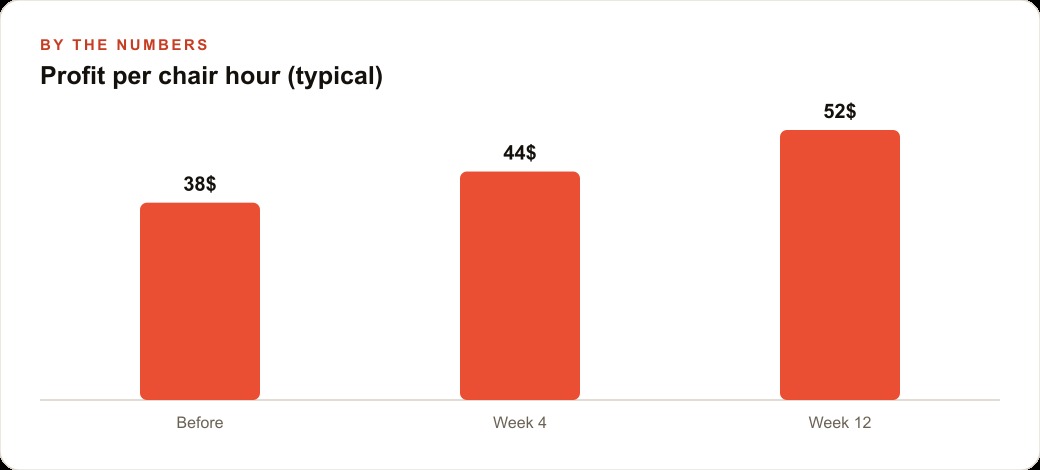
By week four, those midweek clients are regulars. By week twelve, the margin on weekend prime slots is untouched because none of them were given away at a discount. A stylist clearing roughly $38 in realized margin per chair hour at the start of the quarter is clearing $44 by week four and $52 by week twelve, at the same booking volume, because no prime hours were discounted and no loyal weekend clients were trained to wait for a sale.
In illustrative terms, with 22 working days per month and six productive chair hours per day: a stylist at $38 per chair hour generates about $5,016 per month for the business. At $52 per chair hour, the same working hours generate about $6,864. That is roughly $1,848 more per month per stylist, at the same booking volume, from protecting the pricing structure through three months of competitive noise. It is invisible at week one. It is very visible at week twelve.
Lesson 6: One Emotional All-In Can Erase Weeks of Disciplined Work
Claude spent thirty minutes building a careful profit base through consistent, small trades. Then one large, reactive bet lost twenty-eight dollars and erased that base and more. The emotional all-in did not just stop the compounding. It reversed it. The damage was not additive because it also eliminated the capital that would have generated further trades in the remaining time.
The salon equivalent is the panic discount week. The owner holds the midweek-only rule for eight weeks. The margin is climbing. A new salon opens on the same block and runs a launch campaign with thirty percent off everything, all week, all slots. The fear is that regulars will try the new place. The panic move is to match the offer: slash all services, fill every chair, defend market share.
One such discount week applied across all services can erase the margin gains of a full month. Not because volume dropped. The chairs might still be full. But the revenue per chair hour is sharply lower across every slot, including Saturday afternoon and Sunday morning slots that were never at risk of going empty. The regulars who would have paid full price on Saturday paid the discounted rate instead, because the owner made the discount available to everyone. And the new clients who came in for the deal are highly likely to leave for the next deal elsewhere.
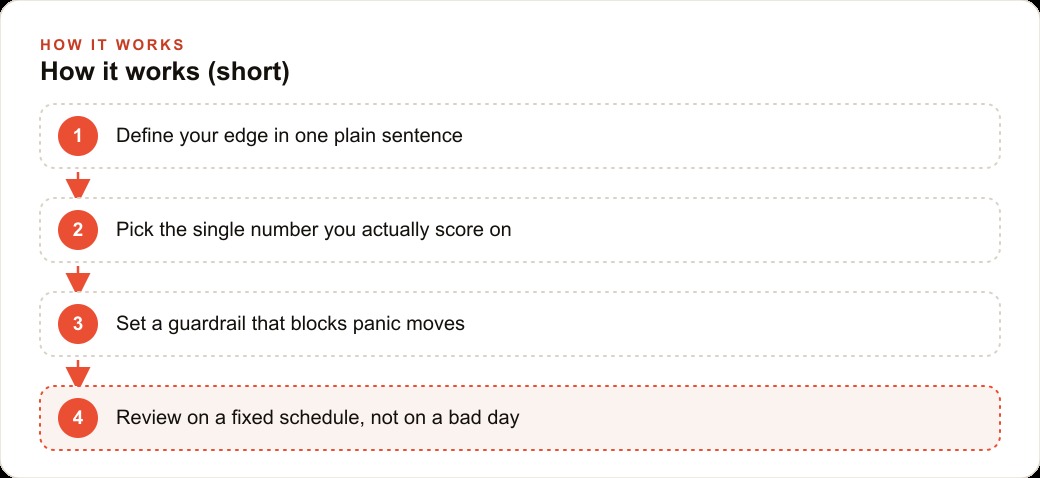
The defense against this is the same discipline Codex ran throughout the experiment: a defined rule, applied consistently, with no override for competitive pressure. Codex did not widen its bets when Claude appeared to be doing nothing. It found its edge before the hour started, trusted the math, and let the rule run. Find the edge, measure the right number, protect it from panic, and let it compound. One emotional all-in can erase weeks of that work. The rule set in a calm moment is the only reliable thing standing between the compounding you built and the single move that can eliminate it.
That is exactly what we do at AI DOERS. Book a private 30-minute call with Madhuranjan Kumar and we will map the fastest path to it for your specific business.
Book your call →
Madhuranjan Kumar
Madhuranjan Kumar brings 20 years of performance-marketing experience and has managed over $200 million in Facebook ad spend for brands across the United States and beyond. His expertise spans the full modern marketing stack: Meta, Google Ads, TikTok, email automation, CRM, and the websites that hold it together. At AI DOERS he turns that track record into lead-generation systems for businesses across every industry.